
Peptides
October 16, 2026
Gonadorelin versus hCG: two different places in the hormone pathway
On this page
Gonadorelin and human chorionic gonadotropin, or hCG, can both appear in discussions about testosterone and fertility. That shared context can make them sound like alternatives with the same action. They act at different points in the reproductive pathway, however, and evidence for one cannot automatically establish what the other will do.
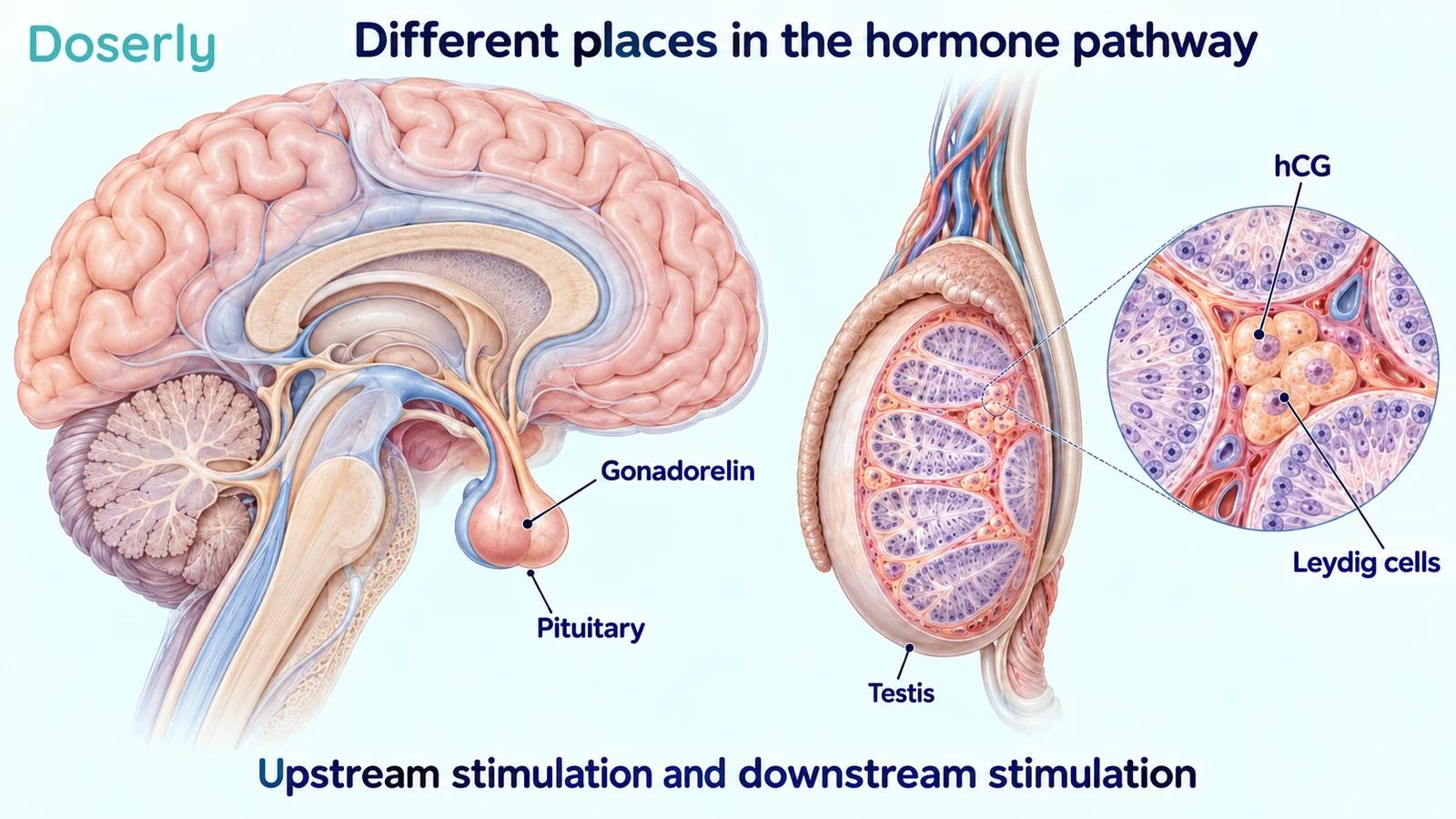
Gonadorelin stimulates the pituitary, which can release luteinizing hormone (LH) and follicle-stimulating hormone (FSH). hCG acts mainly as an LH-like signal at the gonads. In men, that includes stimulating Leydig cells in the testes to produce testosterone. These are different routes to a potentially overlapping downstream hormone result.
The distinction matters when a treatment is described as “keeping the testes working,” “preserving fertility” or replacing another prescription. Each phrase needs a specific endpoint and evidence from a relevant population. This comparison focuses on male reproductive physiology and fertility research, with a brief explanation of why the same substitution logic also fails in female fertility care. The Doserly gonadorelin guide provides additional background.
Where each treatment acts
The hypothalamus normally releases gonadotropin-releasing hormone, or GnRH, in pulses. GnRH reaches the pituitary and stimulates gonadotropin release. LH and FSH then carry different signals to the testes. Gonadorelin is a manufactured form of GnRH, so its immediate target is the pituitary rather than the testis itself. Gonadorelin product information.
The PREGNYL label describes hCG's activity as similar to pituitary LH and identifies the testicular Leydig cells as a target. Its clinical effect therefore does not require hCG to first make the pituitary release LH. The same label includes selected cases of male hypogonadotropic hypogonadism among its indications. That is a diagnosis-specific use, not a promise of fertility benefit in every man with low testosterone. PREGNYL prescribing information.
One way to keep the distinction clear is to ask what remains between the treatment and the desired organ response. Gonadorelin still requires the pituitary to produce a useful pattern of gonadotropin output. hCG bypasses that step for LH-like stimulation, but still requires responsive gonadal tissue. Neither mechanism removes every possible cause of infertility.
Why LH-like activity is not the whole fertility pathway
A testosterone increase can be an important response, but sperm production is a more complex endpoint. FSH signaling and the condition of the sperm-producing tissue also matter. Male infertility guidance therefore discusses hCG and FSH-containing treatment together in appropriate hypogonadotropic disorders, with the regimen depending on the clinical situation and response. EAU male infertility guideline.
This prevents two opposite mistakes. It would be wrong to assume that hCG can never support fertility because it is mainly LH-like. It would also be wrong to assume that a rise in testosterone proves that hCG alone has supplied everything needed for sperm production.
Likewise, gonadorelin's ability to stimulate both LH and FSH does not prove that a proposed schedule will produce adequate long-term stimulation. The intact pathway is a biological possibility, not an outcome guarantee. The relevant questions include the diagnosis, prior pubertal development, delivery pattern and actual semen response.
For someone comparing prescriptions, the useful unit of comparison is the whole treatment program. A drug name by itself leaves out whether another gonadotropin is being given, how response is assessed and whether the goal is hormone replacement, sperm production or pregnancy.
Timing is part of gonadorelin treatment
Pulsatile GnRH therapy aims to replace a missing signal repeatedly through a pump. It is not equivalent to an isolated stimulation test or an occasional injection. Gonadorelin has a short circulating half-life, approximately four minutes in the UK product information, although downstream hormone responses can last longer. Gonadorelin product information.
An older comparison in 30 men with idiopathic hypogonadotropic hypogonadism found better endocrine and fertility responses with pulsatile pump delivery than with twice-daily injections. The study is historical and involved a selected patient group, but it directly demonstrates why the delivery schedule cannot be omitted when citing gonadorelin fertility evidence. Shargil, 1987.
hCG is a different molecule with a different clinical administration pattern. Matching the number of injections, the volume in a syringe or the frequency of appointments does not create pharmacological equivalence. A dose-conversion table would require evidence of comparable effects for a specified goal; mechanism alone cannot supply it.
What an actual comparison found
A small study compared a pulsatile gonadorelin pump with cyclical hCG plus human menopausal gonadotropin in 28 men with congenital hypogonadotropic hypogonadism. Ten received the pump and 18 received the combination regimen. The median time until sperm first appeared was six months with the pump and 14 months with the comparison treatment. Zhang and colleagues, 2019.
Several qualifications change how that finding should be used. The study was nonrandomized, so treatment selection could have influenced group differences. The comparator included both hCG and another gonadotropin preparation; it was not hCG alone. And first sperm appearance was not the same endpoint as live birth.
The proportions reaching spermatogenesis were 90% and 83.3%, without a statistically significant difference. That does not establish equivalence: a small study can fail to detect a real difference. Nor does the shorter median time establish universal pump superiority. The broader EAU guideline does not identify a general advantage of pulsatile GnRH over gonadotropin therapy and notes its practical burden. EAU male infertility guideline.
The fair conclusion is narrower and more useful: both approaches have been studied in selected hormone-deficient men, and one small comparison favored the pump for speed under its particular conditions. That does not justify switching an unrelated patient between products without evaluating the treatment goal.
Blood testosterone and testicular testosterone are different measurements
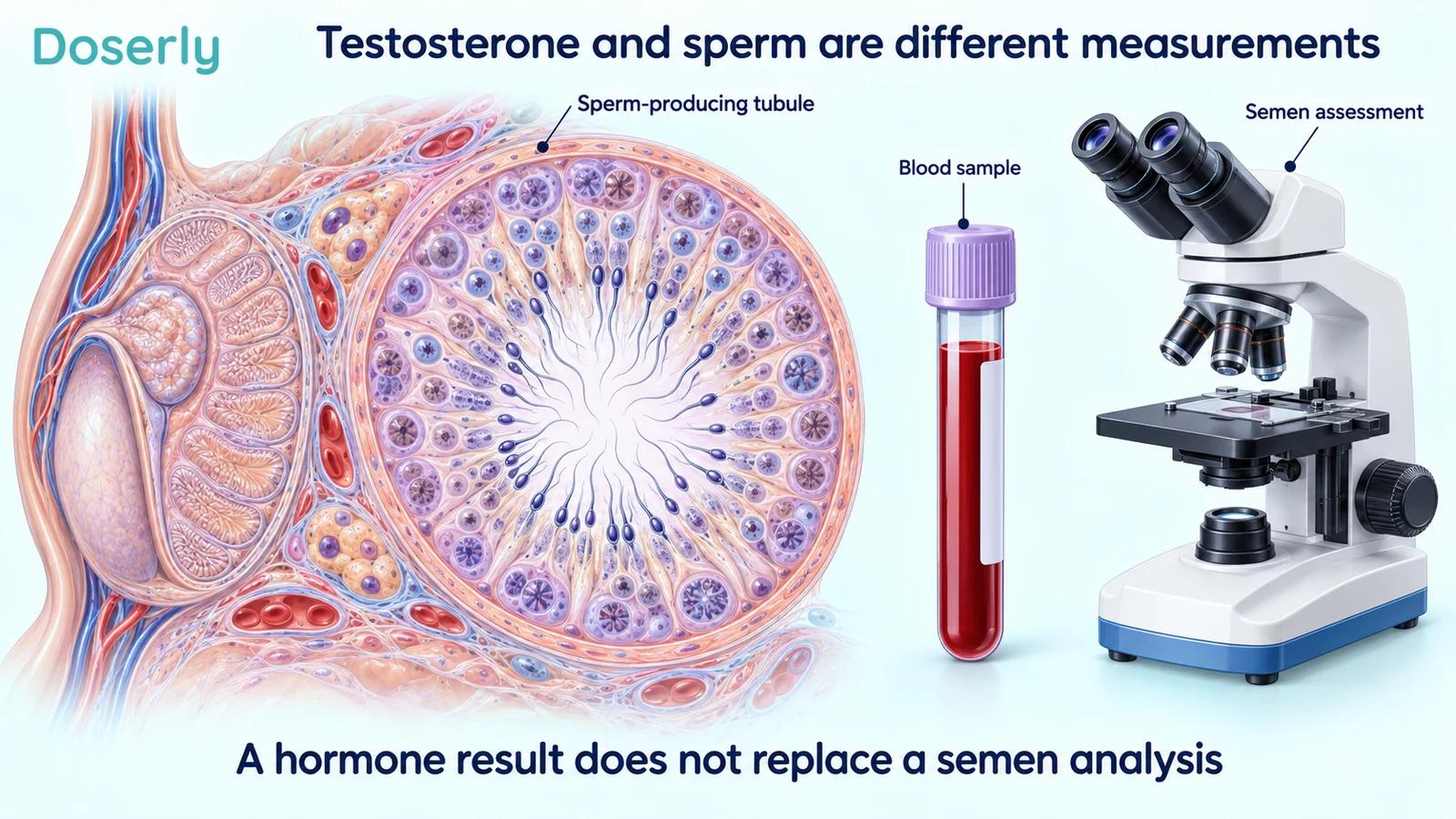
Much of the interest in hCG during testosterone treatment comes from work on intratesticular testosterone: the testosterone concentration inside the testes. A blood testosterone result does not directly measure that local environment.
In a randomized physiological study, 29 men with normal reproductive function received testosterone together with placebo or one of several hCG doses for three weeks. Investigators measured intratesticular testosterone using testicular-fluid aspiration. Testosterone without hCG markedly suppressed that local concentration; hCG supported it in a dose-dependent manner. Coviello and colleagues, 2005.
The experiment is important evidence about hCG's downstream action under gonadotropin suppression. It was not a long-term fertility trial, and it did not test gonadorelin. Maintaining a local hormonal measurement for three weeks cannot establish preserved sperm production or future pregnancy. It also cannot establish that an upstream peptide would produce the same effect during ongoing testosterone exposure.
Semen evidence is closer to the goal, but still has limits
A retrospective report followed 26 hypogonadal men receiving testosterone plus hCG. No participant became azoospermic during the reported follow-up, and nine contributed to a pregnancy with a partner. These observations are relevant because they assessed semen and pregnancy rather than only a hormonal surrogate. Hsieh and colleagues, 2013.
However, there was no randomized comparison group. The cohort was small, follow-up varied and the findings do not guarantee protection for every patient. Most importantly for this comparison, the additional treatment was hCG. Replacing that name with gonadorelin changes the intervention without supplying new evidence.
Fertility preservation during ongoing testosterone exposure is also different from treating congenital GnRH deficiency, or restoring sperm production after testosterone has been stopped. These settings involve different starting physiology and different clinical decisions. A study from one should not be presented as if it directly answers the others.
The female pathway makes substitution even less straightforward
hCG can substitute for an LH surge in appropriate ovulation-induction treatment, as described in its prescribing information. Pulsatile GnRH instead provides upstream signaling in selected hypothalamic disorders. Triggering a mature follicle to ovulate and supporting the hormonal pattern that permits follicle development are different treatment tasks. PREGNYL prescribing information.
The Endocrine Society recommends considering pulsatile GnRH for fertility treatment in women with functional hypothalamic amenorrhea after a complete fertility workup, where the treatment is available. That recommendation does not make gonadorelin a general substitute for an hCG trigger in other fertility protocols. Endocrine Society FHA guideline.
This example reinforces the central comparison: a shared connection to reproduction does not establish a shared clinical role. The same hormone pathway can be entered at different points for different reasons.
Practical differences belong in the decision
Pump treatment requires a suitable delivery system and ongoing support. A treatment based on gonadotropin injections has its own administration and monitoring requirements. Convenience matters, but it should be assessed alongside whether the treatment matches the diagnosis and whether the clinic can monitor the intended outcome.
Adverse effects also cannot be assumed identical. In the small male comparison, local skin reactions were more prominent with pump treatment, while acne and breast tenderness were more common with the gonadotropin regimen. Those observations come from a limited study, not a complete ranking of every possible risk. Zhang and colleagues, 2019.
A product label, a physiology experiment and a fertility cohort each provide different information. The label establishes product-specific uses and precautions. A physiology experiment can clarify mechanism. A fertility cohort can show what happened during a treatment program. None should be used to silently fill gaps left by the others.
How to evaluate a proposed substitution
A useful discussion should identify the reason for the proposed change before comparing brands or injection schedules. Ask what diagnosis is being treated, which part of the pathway needs support and what outcome will determine whether the new plan is working.
For a fertility goal, that often means discussing semen assessment or ovulation-related monitoring rather than relying on testosterone or LH alone. For a testosterone-related goal, the clinician still needs to consider whether fertility is currently important or may become important later. The goals can overlap without being identical.
It is also reasonable to ask whether the supporting study tested the actual proposed product, schedule and combination of treatments. Evidence for pulsatile gonadorelin in congenital hormone deficiency does not establish occasional gonadorelin injections as an hCG replacement during testosterone therapy. Evidence for hCG does not prove gonadorelin ineffective; it simply belongs to hCG until a relevant comparison is performed.
The gonadorelin evidence overview can help distinguish these research settings. The treatment decision rests on the diagnosis, the complete regimen and the outcome being followed, rather than the fact that both molecules influence reproductive hormones.
Explore the research
- Gonadorelin product information
- PREGNYL prescribing information
- EAU male infertility guideline
- Pump versus injections, 1987
- Pump versus cyclical gonadotropins, 2019
- hCG and intratesticular testosterone, 2005
- Testosterone plus hCG semen cohort, 2013
- Endocrine Society FHA guideline