
Peptides
October 16, 2026
Gonadorelin pumps and real-world access: why delivery is part of the evidence
On this page
A study may show good fertility outcomes with pulsatile gonadorelin, yet the treatment can still be difficult to obtain. The missing piece may be the pump, replacement pods, a compatible medicine supply or a clinic able to supervise the complete program. Finding a vial with the right ingredient does not necessarily solve those problems.
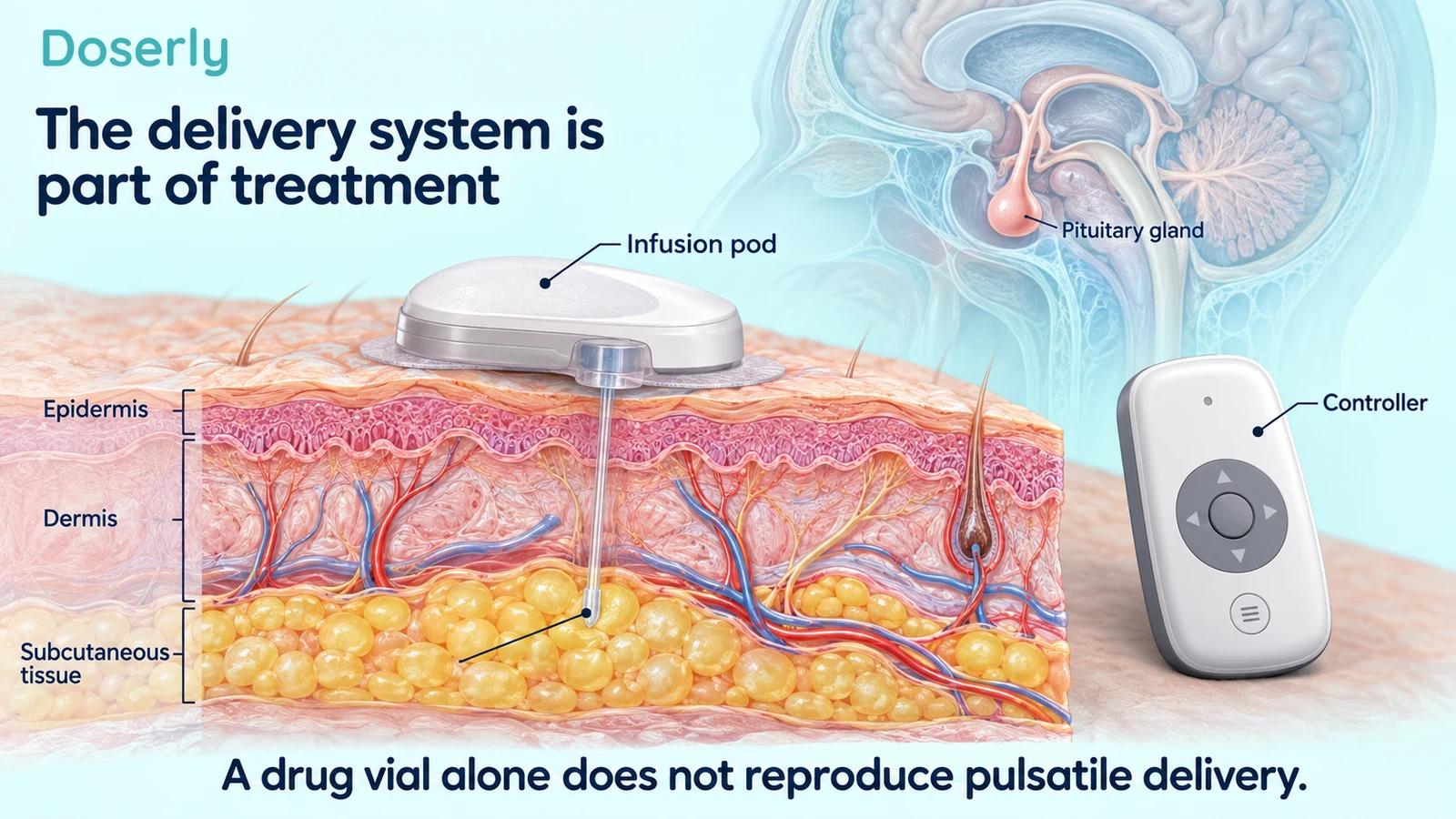
This is unusually important for gonadorelin because the delivery pattern is part of the intervention. Pulsatile therapy repeatedly replaces a GnRH signal in selected hypothalamic disorders. A single diagnostic injection, an occasional injection schedule and a specialist pump program are not the same treatment.
The practical question is therefore broader than “Is gonadorelin available?” It is whether the appropriate medicine, delivery system, consumables and clinical support are available together for the intended use. This article connects the treatment evidence with that access question. The Doserly gonadorelin guide provides the underlying physiology and clinical context.
Why the pump belongs in the evidence description
Gonadorelin is a manufactured version of gonadotropin-releasing hormone, or GnRH. It stimulates the pituitary to release reproductive hormones. In pulsatile replacement therapy, repeated brief signals aim to substitute for deficient hypothalamic signaling.
An older study in 30 men with idiopathic hypogonadotropic hypogonadism compared twice-daily injections with pulsatile pump delivery. Endocrine and fertility responses favored the pump under the study conditions. The study was small and historical, but it directly shows why a description of the molecule without its delivery method is incomplete. Shargil, 1987.
A pump is not simply a convenience that saves a few injections. It enables the exposure pattern used in the research. Replacing that pattern with a more accessible schedule creates a different intervention, even if the total amount of drug sounds similar. Evidence of success with one cannot silently validate the other.
This does not mean every patient with a reproductive hormone problem needs a pump. The diagnosis still determines whether pulsatile GnRH is appropriate. It means that when pump evidence is cited, the proposed treatment should be compared with the program actually studied.
What a specialist treatment program includes
A portable system may combine an infusion device with a controller and replaceable components. The exact arrangement varies by product. The patient and clinical team must learn the applicable instructions and know how treatment will be monitored.
In a 25-year retrospective cohort of women with functional hypothalamic amenorrhea, investigators described the move from older bulky pumps to a smaller pod-and-controller system. They emphasized the costs of medicine, materials and monitoring, as well as the technical skills required. The cohort reported favorable reproductive outcomes in a specialist setting. Quaas and colleagues, 2022.
That setting is part of what the results represent. The outcomes did not come from handing someone an unspecified vial and asking them to improvise a delivery method. Treatment selection, equipment and follow-up accompanied the drug.
For someone evaluating access, this means asking who will provide training, who handles device questions and what happens if a component fails or cannot be replaced. These are practical questions about implementing the studied approach. They do not require a patient to become their own device engineer or reproduce a published protocol without supervision.
A real example: the medicine and device can separate
A manufacturer letter dated December 13, 2024, hosted by France's medicines regulator ANSM, described a long-term shortage of the LUTREPULSE administration system used with LUTRELEF. Ferring reported that the supplier had permanently stopped manufacturing the system and that only limited kit stocks remained. The letter projected exhaustion in the second quarter of 2025, with remaining kits expiring at the end of February 2026. It advised against initiating new treatment with that combination. Ferring information letter hosted by ANSM.
The same letter gave September 2028 as the estimated availability date for a replacement delivery system. That was a development estimate in a dated notice, not a guarantee of a future launch. It should not be treated as a confirmed date for an individual patient's care.
Meanwhile, the French public medicines database continued to list LUTRELEF in a record updated September 29, 2026. A medicine listing and a functioning treatment supply chain are therefore different forms of information. French public LUTRELEF record.
These sources illustrate the access problem; they do not establish live inventory in every country or clinic. Current arrangements need confirmation through the treating service and its authorized suppliers. The date, jurisdiction and specific device matter whenever an availability statement is repeated.
Approval history is not a stock check
The FDA's orphan-drug database records a US marketing approval for Lutrepulse in October 1989. That is useful regulatory history. It is not evidence that a clinic can obtain a complete working system today. FDA orphan designation and approval record.
An approval record answers a question about a regulatory decision. A current label describes a particular product. A shortage notice describes a supply issue. A pharmacy or clinic inventory answers a local operational question. Confusing these categories can create false reassurance or an exaggerated claim of universal unavailability.
The same caution applies to manufacturer websites. A product can remain described on an informational page without that page confirming regional stock, reimbursement or access to the required device. A treatment brochure may explain how a system works while saying little about whether new patients can start it this month.
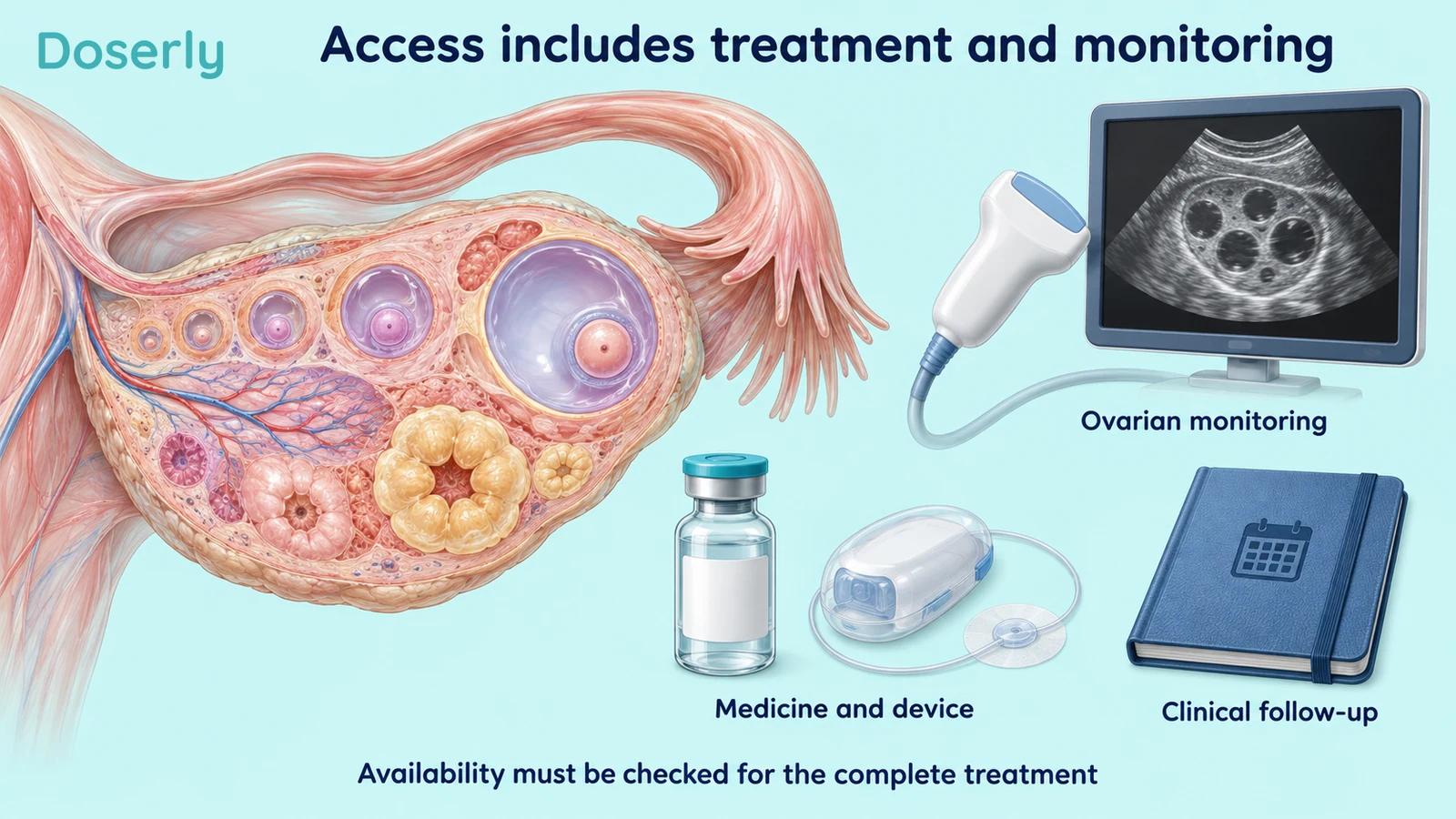
For readers, the most reliable approach is to ask for confirmation of the complete treatment, not just confirmation that an ingredient or brand appears in a database. The answer should identify the actual product and delivery system the clinical team intends to use.
Why a diagnostic vial does not solve a pump shortage
The UK gonadorelin product information describes a single-injection diagnostic test of pituitary gonadotrope function. That use is different from an extended pulsatile fertility program. Its existence does not establish that the product is suitable for an alternative pump arrangement or that an occasional injection will reproduce pump outcomes. UK gonadorelin product information.
The distinction includes more than dose. Product formulation, preparation, storage, device compatibility and the clinical purpose all matter. A clinician and pharmacist need to establish those details for the actual product and authorized use. An online article cannot infer compatibility merely because two packages name the same active substance.
Nor should a different GnRH-related drug be assumed equivalent. The reproductive field includes longer-acting analogues and antagonists used for different purposes. Similar terminology can conceal different actions and exposure patterns. A search result containing “GnRH” does not identify a replacement for pulsatile gonadorelin.
The gonadorelin routes and delivery overview helps explain the research distinctions. Any practical substitution requires a separate clinical assessment rather than a conversion based on vial concentration or injection frequency.
What the female fertility evidence actually supports
The 25-year FHA cohort included 66 women, 82 treatment courses and 212 cycles. It reported ovulation in 96% of cycles and a live-birth rate of 65.9% per treatment course. These are encouraging outcomes, with different denominators that should be preserved when describing them. Quaas and colleagues, 2022.
The study was retrospective and single-center. It demonstrates outcomes within a particular specialist program, not the probability of success for every person with absent periods. It also does not establish that an improvised delivery method will produce the same results.
The Endocrine Society's FHA guideline suggests pulsatile GnRH for women seeking pregnancy after a complete fertility workup, where it is available, with gonadotropin treatment when it is unavailable. The availability qualification is clinically meaningful. It recognizes that a theoretically suitable treatment is not always deliverable in practice. Endocrine Society FHA guideline.
The guideline also addresses the underlying energy imbalance and broader care of FHA. Access to a pump does not remove the need to establish the diagnosis or address the health context in which menstruation stopped.
Male fertility involves a different time horizon
In congenital hypogonadotropic hypogonadism, treatment may be followed for many months before sperm production reaches the study endpoint. A nonrandomized comparison of 28 men reported a median of six months to sperm appearance with a pump, compared with 14 months using cyclical gonadotropins. The finding concerned a selected diagnosis and a particular comparison regimen. Zhang and colleagues, 2019.
That duration makes continuity of access important. A clinic needs to consider whether medicine and replacement components can be supplied across the anticipated course, not just at initiation. A patient also needs a plan for monitoring, interruptions and reassessment that fits the couple's fertility timeline.
The EAU male infertility guideline discusses gonadotropin therapy and notes the practical burden of pulsatile GnRH without assigning it a general advantage over gonadotropins. Choosing between approaches therefore involves diagnosis, evidence and feasibility together. EAU male infertility guideline.
A longer program is not necessarily a better program for every patient. The important question is whether the treatment can be delivered reliably and whether its progress is being assessed against the intended outcome.
Costs are more than the prescription price
A quoted medicine price may leave out the device, disposable components, laboratory work, ultrasound visits, travel and time away from work. Coverage may apply differently to each part. The FHA cohort explicitly identified medicine, materials and monitoring as contributors to the treatment's cost. Quaas and colleagues, 2022.
Before starting, it is reasonable to request an estimate for the whole planned course and to ask which costs are uncertain. The answer may change with treatment duration or local coverage. A published price from another country is not a useful estimate of an individual's total cost.
Practical burden also includes learning the device, arranging appointments and knowing whom to contact. A treatment that is manageable in a specialist study may require additional support in a different setting. These considerations do not weaken its biological rationale; they determine whether that rationale can be translated into an actual course of care.
Questions to resolve before treatment begins
A clear access discussion should cover the complete intervention:
- Which diagnosis makes pulsatile GnRH appropriate, and what outcome is being targeted?
- Which medicine and delivery system will be used, and are both currently obtainable locally?
- Are replacement components available for the anticipated duration?
- Who provides training, monitoring and help with interruptions?
- What are the alternatives if the system cannot be supplied, and how do they differ clinically?
- What costs are included in the estimate, and what is covered separately?
If a supply problem arises, the response should be a revised clinical plan, not an untested assumption that a more convenient injection schedule is equivalent. The purpose of checking access is to preserve the connection between the evidence and the treatment actually delivered.
Gonadorelin's delivery system is part of its clinical story. The useful evidence concerns a diagnosed population receiving a defined program with monitoring. Access is meaningful when that whole program can be supported, with current local information and realistic alternatives if it cannot.
Explore the research
- Pulsatile pump versus injections, 1987
- Pulsatile GnRH in FHA: 25-year cohort, 2022
- Ferring device-supply letter hosted by ANSM, December 2024
- French public LUTRELEF medicine record
- FDA Lutrepulse approval history
- UK diagnostic gonadorelin product information
- Endocrine Society FHA guideline
- Male congenital hypogonadism pump comparison, 2019
- EAU male infertility guideline