
Peptides
October 16, 2026
Gonadorelin and fertility: the diagnosis determines the role
On this page
Gonadorelin has a credible role in selected fertility disorders, but “fertility support” is too broad a description to tell someone whether it fits their situation. The important question is where the reproductive pathway is failing. Replacing a missing signal from the brain can help when the pituitary and reproductive organs can respond. It cannot be assumed to repair damaged testes, unblock a sperm duct or solve every cause of absent ovulation.
That distinction explains why impressive outcomes in one carefully diagnosed group may have little relevance to another person with the same symptom. Two men can both have no sperm in an ejaculate for entirely different reasons. Two women can both have absent periods without sharing the same hormonal disorder.
This article explains which diagnoses make the mechanism plausible, what human studies measured and what a fertility assessment needs to establish. The Doserly gonadorelin guide covers the molecule and its broader evidence base.
Start with the signal, not the symptom
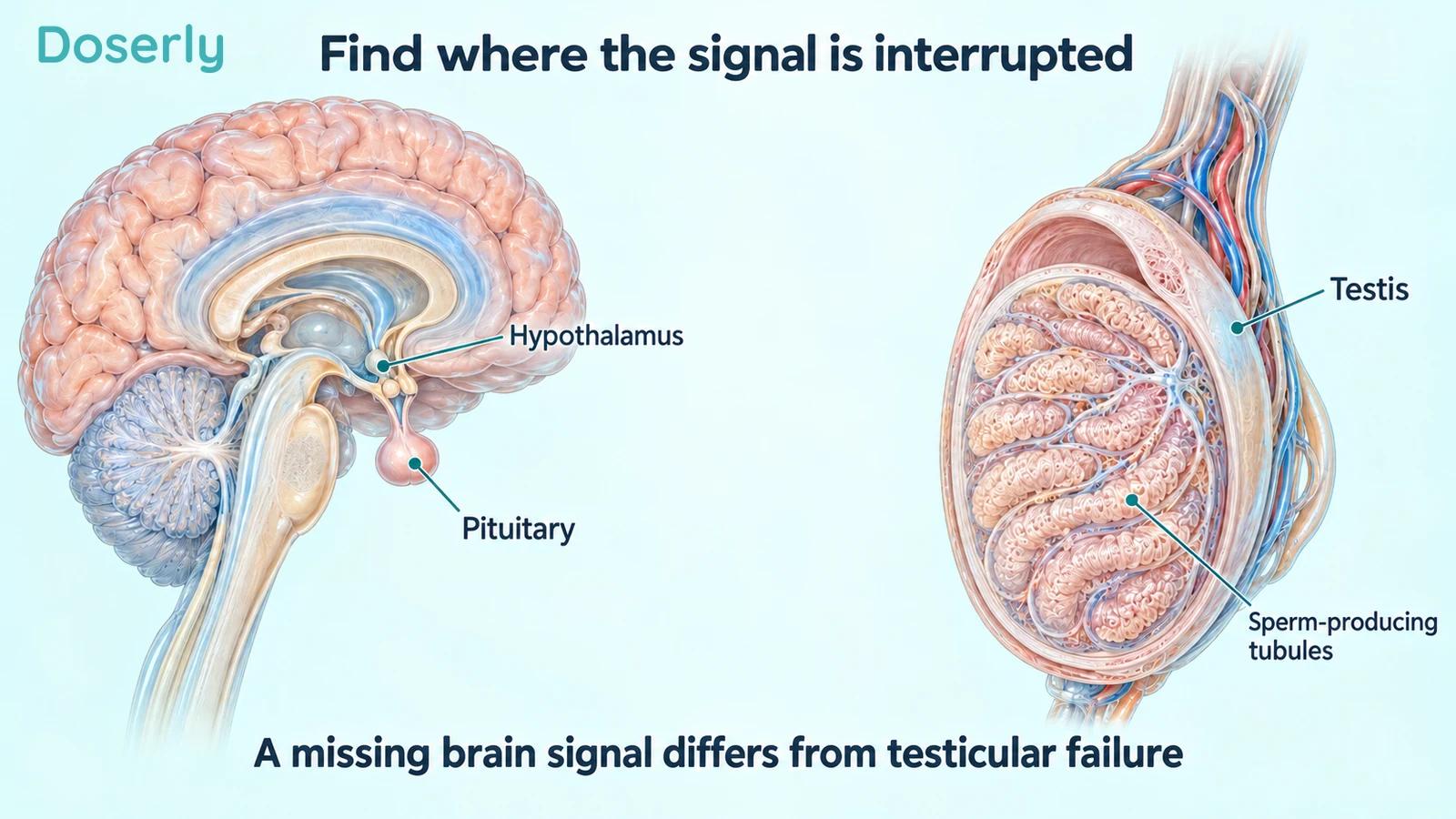
Gonadorelin is a manufactured version of gonadotropin-releasing hormone, or GnRH. Normally, the hypothalamus releases this hormone in pulses. It stimulates the pituitary to release luteinizing hormone (LH) and follicle-stimulating hormone (FSH). Those hormones act on the testes or ovaries.
In a man with deficient hypothalamic GnRH signaling, the testes may receive too little LH and FSH despite having some capacity to function. Repeated physiological-style GnRH pulses can replace an upstream signal. But that approach still depends on responsive pituitary cells and usable downstream tissue. A problem located primarily in the testes is a different biological problem.
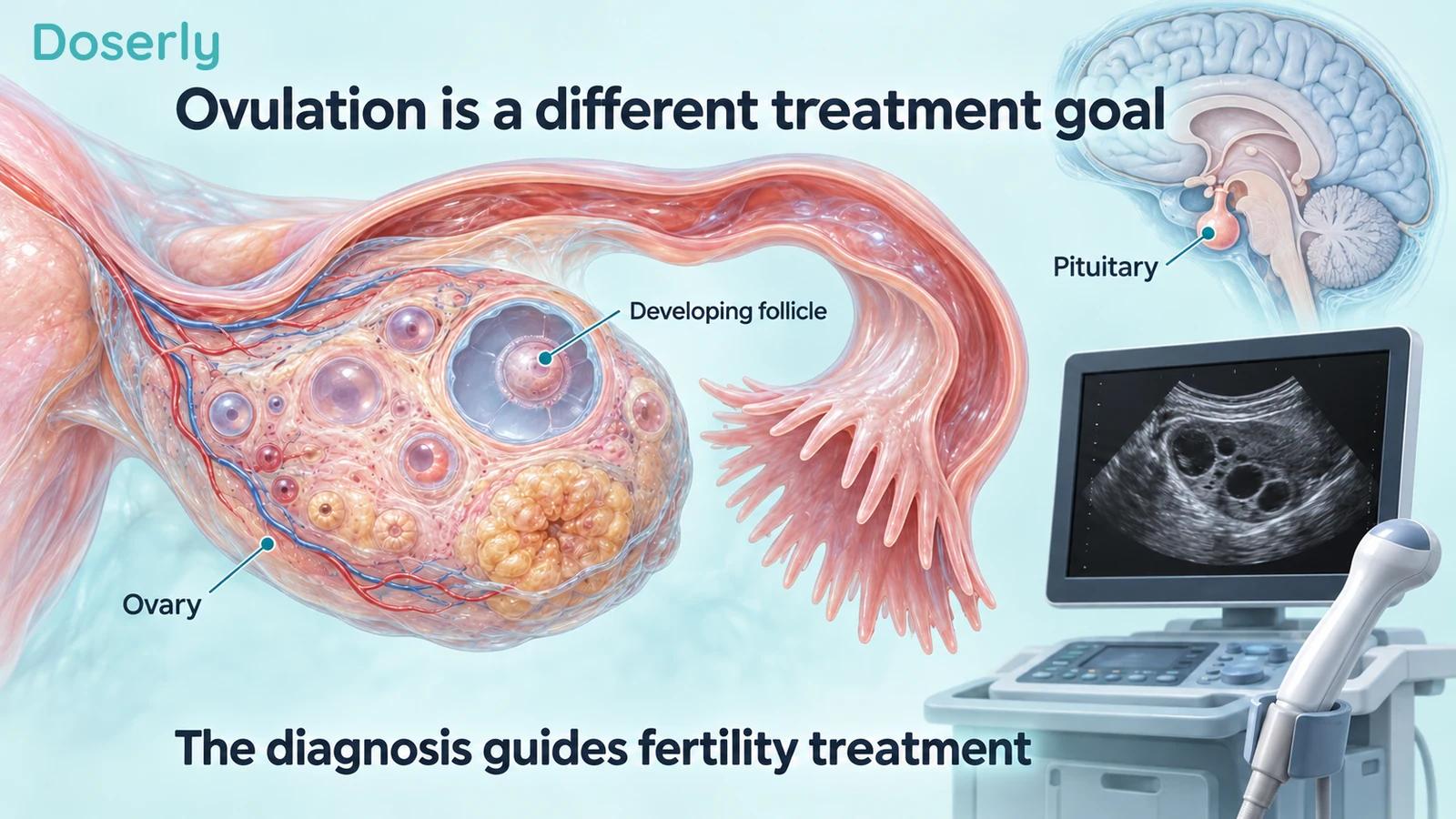
The same logic applies to ovarian function. A missing hypothalamic signal can prevent normal follicle development and ovulation. That is distinct from other ovarian, pituitary or reproductive-tract conditions. Identifying the level of the problem is therefore part of deciding what gonadorelin could reasonably accomplish. Gonadorelin product information, EAU male infertility guideline.
Men with hypogonadotropic hypogonadism
Hypogonadotropic hypogonadism describes inadequate reproductive hormone production associated with insufficient gonadotropin stimulation. The name does not identify every cause. Some patients have congenital deficiency, sometimes with absent or incomplete puberty. Others develop an acquired disorder after normal reproductive development.
This history matters because it says something about prior testicular development and function. In a cohort of 76 men receiving long-term GnRH therapy for idiopathic hypogonadotropic hypogonadism, investigators separated men with absent puberty, partial puberty and adult-onset disease after completed puberty. Treatment lasted 12–24 months. Prior pubertal development was associated with a better outcome, while a history of cryptorchidism and very low baseline inhibin B were adverse predictors. Pitteloud and colleagues, 2002.
The useful finding is not simply that “gonadorelin worked.” It is that response varied within an already selected diagnosis. A man with a history of undescended testes and absent puberty may have a different starting point from someone whose reproductive system developed normally before hormone signaling became deficient.
An early hormone improvement is not the final fertility answer. In that cohort, LH and testosterone normalized in most men, yet some remained azoospermic. The reported 18% figure applied specifically to the subgroup with absent puberty, not to all participants. Sperm production and a normal blood testosterone result were not interchangeable outcomes.
What the comparative treatment evidence adds
A small nonrandomized study compared pulsatile gonadorelin with cyclical gonadotropin treatment in 28 men with congenital hypogonadotropic hypogonadism and azoospermia. Ten received the pump and 18 received cyclical hCG and human menopausal gonadotropin. Median time to the first appearance of sperm was six months in the pump group and 14 months in the comparison group. Zhang and colleagues, 2019.
That result is clinically interesting because waiting time matters to couples. But treatment assignment was not randomized, the groups were small and the comparator was a particular combination schedule. The study does not establish that gonadorelin is superior to every gonadotropin regimen. Nor does first sperm detection establish a pregnancy or live birth.
The current EAU guideline describes gonadotropin treatment for hypogonadotropic hypogonadism and notes the practical burden of pulsatile GnRH. Its broader assessment does not give pulsatile treatment a general advantage over gonadotropins. A favorable small study and a cautious guideline can coexist: they answer different-sized questions with different amounts of evidence. EAU male infertility guideline.
Why a low sperm count is not enough
An abnormal semen analysis identifies a finding that needs explanation. It does not identify the correct hormone target. Evaluation may reveal impaired testicular production, an obstruction, a genetic condition, medication-related suppression or another cause. Some men have more than one contributing factor.
Obstructive azoospermia illustrates the distinction. Sperm can be produced but fail to reach the ejaculate because of a blockage. Increasing a brain signal would not remove that obstruction. In primary testicular failure, the problem is different again: adding stimulation cannot be assumed to restore the tissue's capacity to produce sperm. The EAU guideline finds no substantial evidence that hormonal stimulation improves spermatogenesis in that setting. EAU male infertility guideline.
An older study tested pulsatile LHRH, another name for GnRH, in four men with idiopathic oligozoospermia and normal gonadotropin levels. After three months, investigators found no improvement in semen concentration, motility or volume. Four patients cannot settle every question about unexplained infertility. They do show why evidence from deficient GnRH signaling should not simply be transferred to men who already have normal gonadotropin levels. 1985 oligozoospermia study.
The practical implication is to ask for the diagnosis behind a proposed prescription. “Low sperm count” describes what was measured. “Hypothalamic GnRH deficiency with responsive downstream function” explains why an upstream replacement might help.
Women with functional hypothalamic amenorrhea
Functional hypothalamic amenorrhea, often abbreviated FHA, involves disrupted hypothalamic signaling and absent menstrual periods in a relevant clinical context. It is a diagnosis of exclusion. Pregnancy and other hormonal or structural causes must be considered before that label is applied.
The Endocrine Society guideline recommends an assessment that includes eating patterns, exercise, stress, weight changes and relevant medical history, together with appropriate laboratory evaluation. Correcting an energy imbalance is central to care and may require changes in nutrition, exercise and weight. Psychological support can also be relevant. Fertility treatment does not make those underlying issues unimportant. Endocrine Society FHA guideline.
For women with FHA who wish to conceive, after a complete fertility workup, the guideline suggests pulsatile GnRH as a first-line approach where available, with gonadotropins when it is unavailable. The recommendation concerns a defined diagnosis and reproductive goal. It is not a recommendation to use gonadorelin for any irregular menstrual cycle.
The guideline also places conditions on proceeding with ovulation induction, including efforts to normalize energy balance. Producing an ovulation is only one part of preparing for a pregnancy. A clinician must evaluate the person's broader health and the reasons menstruation stopped.
Read female fertility outcomes with their denominators
A 25-year single-center retrospective cohort reported outcomes for 66 women with FHA treated using pulsatile GnRH. The dataset included 82 treatment courses and 212 cycles. Ovulation occurred in 96% of cycles, and 75% of cycles were monofollicular. The live-birth rate was 65.9% per treatment course. Quaas and colleagues, 2022.
Those are encouraging results, but the denominators matter. A treatment course could contain more than one cycle, and some women returned for another course. “65.9% per treatment” is therefore not the probability of a live birth from one injection, one cycle or every woman who might consider the treatment.
The study was not a randomized comparison of fertility treatments. Its newborn comparison group addressed birth-weight outcomes, not randomized treatment effectiveness. The findings support the feasibility and outcomes of a specialist program in selected women; they do not establish that the same results will occur in every clinic or every cause of amenorrhea.
Monofollicular ovulation is relevant because the number of developing follicles affects treatment decisions and multiple-pregnancy risk. It still does not mean the risk is zero. The cohort reported one dizygotic twin pregnancy. Favorable outcomes need to be read alongside the monitoring and selection that accompanied them.
A couple's evaluation is broader than a hormone pathway
Fertility belongs to the reproductive situation of the couple, not to one laboratory marker in isolation. Male infertility guidance recommends evaluating both partners concurrently. A treatment that improves sperm production may not resolve a separate problem affecting ovulation, tubal function or another aspect of conception. EAU male infertility guideline.
Timing matters as well. If a proposed treatment may require many months before sperm appears, that waiting period has consequences for the couple's overall plan. It is reasonable to discuss what will be monitored, when lack of progress will trigger reassessment and how alternatives fit the diagnosis. That is different from promising a fixed response date based on a study median.
Medication and treatment history also belong in the assessment. Exogenous hormones can alter the same axis clinicians are trying to interpret. A baseline result obtained during suppression may mean something different from the same result obtained without those exposures. The clinician needs the actual product, schedule and timing, rather than a vague description such as “hormone support.”
What a diagnostic response would leave unresolved
Gonadorelin can also be given as a diagnostic challenge. A rise in LH after that challenge shows a short-term pituitary response under the test conditions. It does not establish that months of treatment will produce sperm or lead to ovulation, much less a live birth. The product information explicitly limits what the diagnostic test can establish about a subnormal response and pituitary reserve. Gonadorelin product information.
This distinction becomes important when a treatment recommendation rests mainly on a before-and-after blood result. That result may be useful within an assessment, but a fertility plan needs a diagnosis and a downstream endpoint. It also needs a delivery method supported by the relevant evidence. A diagnostic injection and a sustained pulsatile fertility program are different interventions even when both use gonadorelin.
Questions that make a treatment discussion useful
Before choosing an approach, several questions clarify what the evidence means for an individual situation:
- What diagnosis explains the fertility problem, and what findings support it?
- Is the proposed target the hypothalamus, pituitary, testes or ovaries, or is the issue outside this pathway?
- Does the evidence involve the same diagnosis and a comparable delivery method?
- Is success a hormone change, sperm production, ovulation, pregnancy or live birth?
- What monitoring and practical support are needed, and when will the plan be reassessed?
These questions connect mechanism to an observable goal. Gonadorelin can replace a missing signal in an appropriate setting. Its role becomes much less clear when diagnosis, delivery or endpoint is left unspecified. The gonadorelin evidence overview can help organize the discussion, but the fertility workup determines which evidence applies.
Explore the research
- Gonadorelin product information
- EAU guideline: male infertility
- Predictors of long-term GnRH therapy outcomes, 2002
- Pulsatile gonadorelin versus cyclical gonadotropins, 2019
- Pulsatile LHRH in idiopathic oligozoospermia, 1985
- Endocrine Society FHA guideline
- Pulsatile GnRH in FHA: 25-year cohort, 2022