
Supplements
October 16, 2026
Glucosamine for knee pain: why the product matters, but does not settle the argument
On this page
Two people can read glucosamine research and come away with opposite impressions. One remembers a large trial that found no significant pain benefit. The other remembers a prescription preparation that improved an osteoarthritis symptom score. Both may be describing real studies.
The useful response is to compare what the trials actually tested. Glucosamine hydrochloride, prescription glucosamine sulfate, and a retail combination containing several ingredients are not automatically the same intervention. The participants, treatment schedules, outcomes, and trial methods can differ too.
However, this distinction needs a guardrail of its own: different formulations do not prove that formulation caused the different results. A favorable study of one preparation is evidence to consider, not a license to dismiss every unfavorable study as the wrong product. For someone with knee pain, the practical question is whether a sufficiently trustworthy body of evidence supports a meaningful benefit from the actual preparation being considered.
Why cartilage biology makes the idea plausible
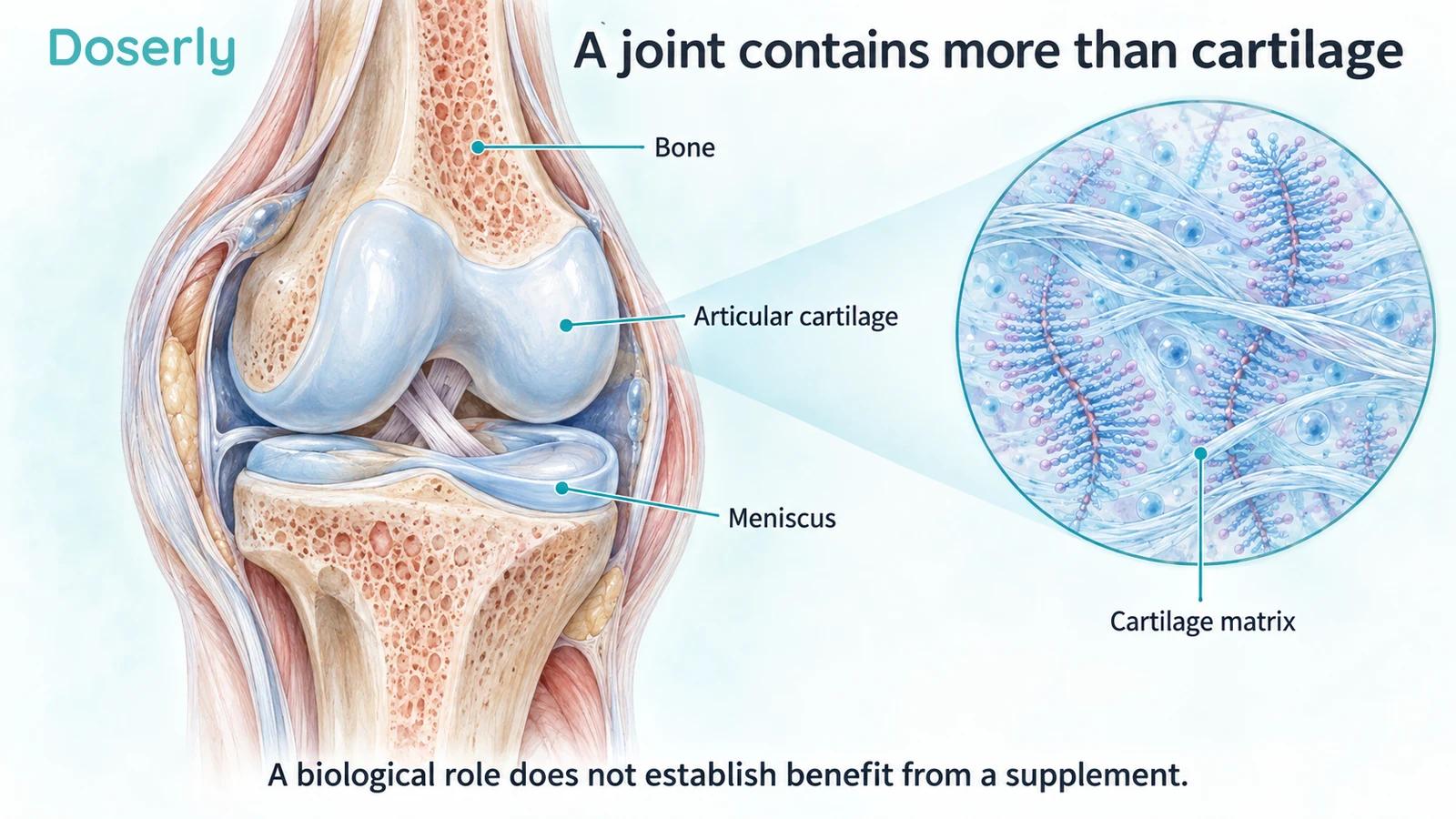
Glucosamine is an amino sugar involved in the biology of molecules found in cartilage and other connective tissues. That gives researchers a reason to investigate it. It does not establish that swallowing additional glucosamine repairs a damaged joint. The body’s use of a substance and the clinical effects of supplementing it are separate questions. NCCIH’s overview describes this biological background alongside the inconsistent clinical findings.
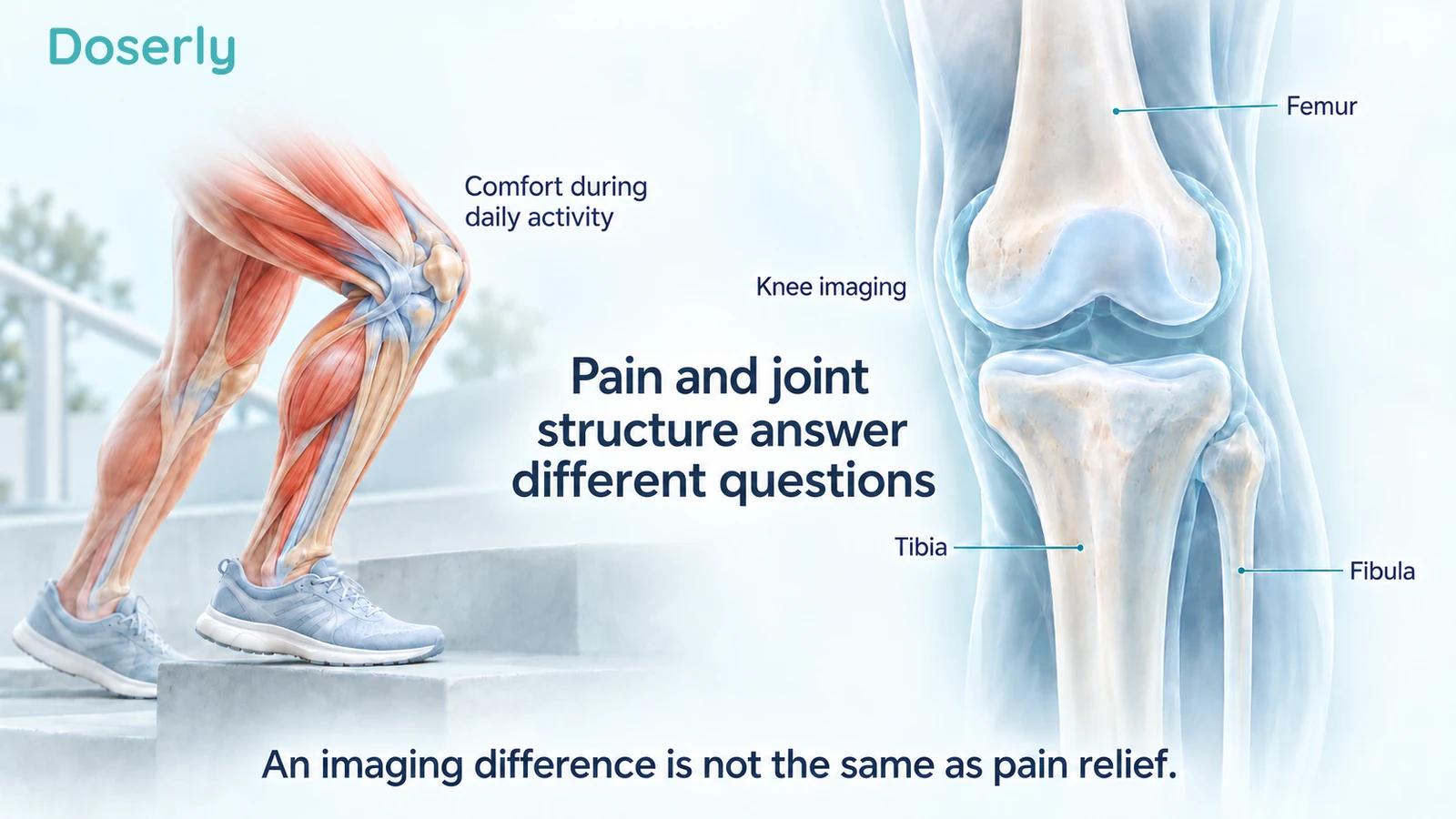
Knee osteoarthritis also presents more than one treatment target. Pain during walking, difficulty climbing stairs, and changes visible on joint imaging do not all measure the same thing. A person can reasonably care about each, but improvement in one cannot be assumed to establish improvement in the others.
This matters when a supplement is described as providing cartilage’s “building blocks.” The phrase skips the difficult part of the evidence: demonstrating a useful outcome in people. Trials must still show whether people feel or function better, and whether any structural change is reliable and clinically consequential.
What the large GAIT trial found
The 2006 Glucosamine/chondroitin Arthritis Intervention Trial, known as GAIT, randomized 1,583 people with symptomatic knee osteoarthritis. It compared glucosamine, chondroitin sulfate, their combination, celecoxib, and placebo over 24 weeks. Its principal pain outcome was the proportion achieving at least a 20% reduction from baseline. The glucosamine preparation used in GAIT was hydrochloride. GAIT primary report
The placebo response rate was 60.1%. Glucosamine’s response rate was only 3.9 percentage points higher, a difference that was not statistically significant. Chondroitin alone and the combination also failed to show a significant advantage on the overall primary comparison. Celecoxib did separate from placebo.
The combination produced a favorable result in an exploratory subgroup with moderate-to-severe pain at entry. That finding should not be rewritten as proof for glucosamine alone. It concerned two ingredients together, in a smaller subgroup, within a trial whose overall supplement comparisons were negative.
Notice how much information disappears in the phrase “patients improved.” Improvement occurred frequently with placebo too. The treatment question is whether assignment to the supplement improved outcomes beyond what happened in the comparison group, not whether some people taking it felt better.
A positive sulfate trial deserves a precise description
The 2007 GUIDE trial studied 318 people and compared a prescription glucosamine sulfate preparation, acetaminophen, and placebo for six months. The glucosamine regimen was 1,500 mg once daily; that is a description of the experiment, not a personalized dosing recommendation. GUIDE primary report
Its primary measure was the Lequesne index, an index of symptoms and functional limitation. The mean score decreased by 3.1 points with glucosamine sulfate and 1.9 points with placebo, a 1.2-point between-group advantage. That supports a benefit for the preparation on that outcome in that trial. It does not imply a 3.1-point treatment effect beyond placebo.
GUIDE and GAIT therefore differ in both preparation and primary outcome. One emphasized change in an index; the other emphasized reaching a specified pain-response threshold. Their populations and conduct also differed. Comparing their headlines cannot isolate which difference explains their results.
A useful way to read GUIDE is to retain the positive finding while keeping its boundaries visible: a particular prescription preparation, a defined population, six months, and a particular symptom index. It did not test every bottle labeled glucosamine sulfate, establish prevention in healthy knees, or demonstrate cartilage regeneration.
Why the formulation explanation remains a hypothesis
A decisive test of whether the salt or preparation explains conflicting results would compare the relevant products under otherwise similar conditions. Ideally, the same research program would use comparable participants, blinded allocation, consistent outcome definitions, and adequate follow-up. Simply placing two separate trials beside each other cannot accomplish that.
There are also reasons to examine bias alongside chemistry. The American College of Rheumatology and Arthritis Foundation’s guideline discusses discrepancies between industry-sponsored and publicly funded studies and concerns about publication bias. It judges that the studies at lowest risk of bias do not show important benefit and strongly recommends against glucosamine for knee, hip, or hand osteoarthritis. ACR/AF guideline
That judgment does not make a positive trial disappear. It explains why a guideline panel can read positive studies and still decline to recommend the intervention. Guidelines consider the reliability and consistency of the entire evidence base, rather than choosing the most encouraging individual result.
Conversely, a supplement should not be treated as biologically identical to every other product merely because they share a short ingredient name. The disciplined position holds both ideas together: product identity matters, and evidence quality still matters after product identity has been specified.
Longer studies asked about joint structure
Some glucosamine sulfate research extended beyond symptom relief. A three-year randomized trial published in 2001 enrolled 212 people and assessed joint-space width on weight-bearing knee radiographs. The placebo group lost an average of 0.31 mm of joint space, compared with 0.06 mm in the glucosamine sulfate group. Symptoms also favored the treatment group. Reginster and colleagues
A separate three-year trial published in 2002 randomized 202 participants. It likewise reported less radiographic narrowing with glucosamine sulfate and favorable symptom results. These were meaningful reasons to investigate a possible effect on progression. They were not direct observations of newly manufactured cartilage replacing a damaged joint surface. Pavelka and colleagues
Joint-space width is an imaging outcome. It must be interpreted in the context of how the radiographs were acquired and analyzed, the participants retained in follow-up, and the consistency of subsequent results. A favorable average imaging difference is not interchangeable with avoiding joint replacement, eliminating disability, or obtaining a meaningful improvement in everyday life.
This is why “slows narrowing” and “rebuilds cartilage” should never be casually exchanged. They describe different claims. The latter requires evidence that these radiographic studies were not designed to provide.
LEGS complicates a simple sulfate-versus-hydrochloride story
The LEGS trial randomized 605 people with chronic knee pain and radiographic changes to glucosamine sulfate, chondroitin sulfate, the combination, or placebo. Follow-up lasted two years. It is especially useful because it prevents the discussion from becoming “hydrochloride failed, therefore sulfate succeeds.” LEGS primary report
The combination showed a small reduction in joint-space narrowing relative to placebo in the adjusted analysis: 0.10 mm, with a confidence interval extending from 0.002 to 0.20 mm. Neither single ingredient showed a significant structural effect. All groups reported reduced knee pain during the first year, but there was no significant between-group symptom advantage.
Those findings create two important boundaries. First, a combination result cannot be credited to glucosamine alone. Second, a statistically significant imaging result does not automatically establish better pain control. Even within a single study, the structural and symptomatic answers can differ.
The uncertainty near the lower end of that confidence interval also matters. Reporting only “significantly slowed progression” makes the finding sound more decisive than reporting the actual small difference and its precision.
What a label can and cannot tell you
If a product is being compared with research, start with the full preparation name, chemical form, quantity per serving, and all co-ingredients. A label saying “joint support” is insufficient. So is a label listing several ingredients without clarifying the amount of each.
A combination raises an additional attribution problem. If a person starts glucosamine, chondroitin, an herbal extract, and a new exercise program together, subsequent improvement cannot identify which component helped. The same caution applies to trials: a combination trial estimates the effect of the combination it assigned.
Matching a study preparation improves the relevance of the comparison; it does not guarantee a response. Nor does a high manufacturing standard itself prove clinical efficacy. Product quality and treatment effectiveness are separate questions, and both deserve an answer before a product-specific promise becomes persuasive.
For the ingredient and formulation background, the Doserly glucosamine guide provides a useful companion. The chondroitin guide helps distinguish the second ingredient when a product or study combines them.
Keep the decision connected to daily function and safety
For someone already considering glucosamine with a clinician, the useful conversation begins with the diagnosis and the hoped-for improvement. “Walk to the shops with less discomfort” is more informative than “support my cartilage.” A consistent record of activity-related symptoms, function, rescue medication use, and changes in activity can help make the follow-up discussion concrete.
Such a record still cannot turn an uncontrolled personal trial into proof. Symptoms vary, expectations matter, and people often start a new treatment when symptoms are unusually troublesome. Record what happened honestly without assuming that sequence establishes cause.
Safety review also matters. NCCIH notes a potential interaction with warfarin that may increase bleeding risk, possible effects on blood glucose in some people, and limited information during pregnancy or breastfeeding. Discuss the actual product and medication list with a clinician or pharmacist rather than assuming a familiar supplement is interaction-free. NCCIH safety information
For osteoarthritis care, NICE recommends tailored therapeutic exercise and weight management when appropriate, and advises against offering glucosamine because strong evidence of benefit is lacking. These recommendations keep attention on a broader plan rather than making a supplement the entire strategy. NICE recommendations
The honest conclusion is narrower than either sales pitch or blanket dismissal: some glucosamine sulfate trials reported benefits, other substantial studies did not establish useful symptom advantages, and preparation differences have not resolved the disagreement. Identify the product carefully, read the comparison rather than the before-and-after change, and ask whether the outcome would matter in your own daily life.
Explore the research
- GAIT: glucosamine, chondroitin, combination and placebo comparisons
- GUIDE: prescription glucosamine sulfate and symptoms
- Three-year glucosamine sulfate study, 2001
- Three-year glucosamine sulfate study, 2002
- LEGS: single ingredients, combination and joint-space narrowing
- ACR/AF osteoarthritis guideline
- NCCIH: glucosamine and chondroitin
- NICE osteoarthritis recommendations