
Peptides
October 16, 2026
GLP-1 treatment for overweight cats: what an early exenatide trial found
On this page
Excess weight can make a cat's daily life harder and complicate its health. If you have watched human GLP-1 medicines change obesity treatment, it is understandable to wonder whether a similar approach could help your pet.
There is feline research, but the details matter. A 2016 study tested exenatide, not semaglutide, in obese client-owned cats. It did not establish a significant advantage over placebo for weight loss, and its main insulin-related outcome was negative. Primary study
The experiment is useful because it looked beyond the scale: researchers measured insulin responses, glucose handling and body composition. Those are exactly the distinctions an owner needs when considering what “successful weight treatment” should mean for a cat.
Why researchers considered a GLP-1 medicine
GLP-1 is a gut hormone involved in responses to eating. Medicines that activate its receptor can influence insulin secretion and appetite-related processes. Exenatide is one such medicine; semaglutide is another, with different molecular and formulation characteristics.
Early feline experiments showed that exenatide could increase insulin secretion under controlled conditions in healthy cats. That provided a biological reason to explore longer treatment in cats with obesity. It did not establish that the same response would persist or translate into useful fat loss. Healthy-cat physiology study
A short experiment and a sustained clinical programme ask different questions. An immediate hormone response shows that a pathway can respond. Months of treatment must also address adaptation, appetite, practical administration, body composition and adverse effects.
Our semaglutide guide explains the human medicine and its evidence. It is useful background for understanding the drug class, but human weight-loss percentages and doses are not evidence for treating a cat.
Which cats took part?
The trial recruited obese but otherwise healthy adult pet cats. Owners were asked to continue their cats' existing diets. The study compared twice-daily exenatide with placebo over a planned twelve weeks, with owners and investigators blinded.
Fourteen cats were initially enrolled; twelve entered the final analysis. Two cats stopped very early because of aggression around injections, and two more withdrew later for similar practical reasons. The later withdrawals contributed data under the study's analysis rules. Methods and participant flow
This is why “twelve cats studied for twelve weeks” needs qualification. It describes the analysed sample and planned treatment period, not twelve complete and identical experiences.
The cats were not being treated for active diabetes. Their obesity was the context in which researchers studied insulin secretion and metabolic responses. Results from this group cannot be assumed to apply to a thin diabetic cat losing weight from poor glucose control.
That distinction also prevents a common misunderstanding: less weight is not always the desired direction in a cat. The appropriate goal depends on whether the cat has excess fat, insufficient muscle, an untreated illness, or some combination.
What was the main result?
The primary outcome concerned insulin concentrations during an intravenous glucose-tolerance test. In that test, researchers gave a controlled glucose challenge and measured the response. Exenatide did not significantly improve the insulin outcome or the reported glucose-tolerance measures. Trial results
The test was designed to reveal aspects of metabolic function, not to reproduce an ordinary meal. It answers how the body responds under those experimental conditions. It does not directly tell an owner whether the cat is more comfortable, more active or likely to avoid diabetes years later.
A negative primary outcome also deserves to remain visible when an article discusses a more favourable secondary result. Weight was an important measurement, but it was not the only question the experiment was built to address.
This does not make the study a failure. Finding that a promising short-term physiological effect does not clearly persist in a different population is valuable information. It helps define what future research needs to test.
Did the cats lose weight?
The reported median relative weight loss was 5.1% with exenatide and 3.2% with placebo, with P=0.10 for the comparison. The study did not demonstrate a significant between-group advantage. Weight results
A percentage change is calculated relative to starting weight. It can make differently sized animals easier to compare, but the median is still a group summary. It does not mean every treated cat lost 5.1% or that the medicine reliably produces that result.
The distinction between change within a group and difference between groups is especially relevant here. Seeing weight fall during treatment does not establish that the drug caused the fall. The comparison with placebo is what helps separate a drug effect from changes occurring during study participation.
Both groups continued their usual feeding rather than receiving an identical standardized diet. Exact daily intake was not measured. Those details limit how confidently the mechanism of any weight change can be explained.
The result is therefore a preliminary signal, not a veterinary version of a large human obesity trial. It leaves open the possibility of an effect that this small study could not establish, while giving no basis to promise one.
Why body composition matters as much as the scale
Body weight includes fat, muscle, bone, organs and water. A scale records the total. It cannot determine which components changed.
The researchers used dual-energy X-ray absorptiometry, usually abbreviated DXA, to assess body composition. Exenatide did not significantly change the reported body-fat measures relative to placebo. Body-composition findings
This does not prove that no individual cat lost fat. It means the group comparison did not establish a clear treatment effect on those measurements. Describing the trial as demonstrating selective fat loss would therefore be inaccurate.
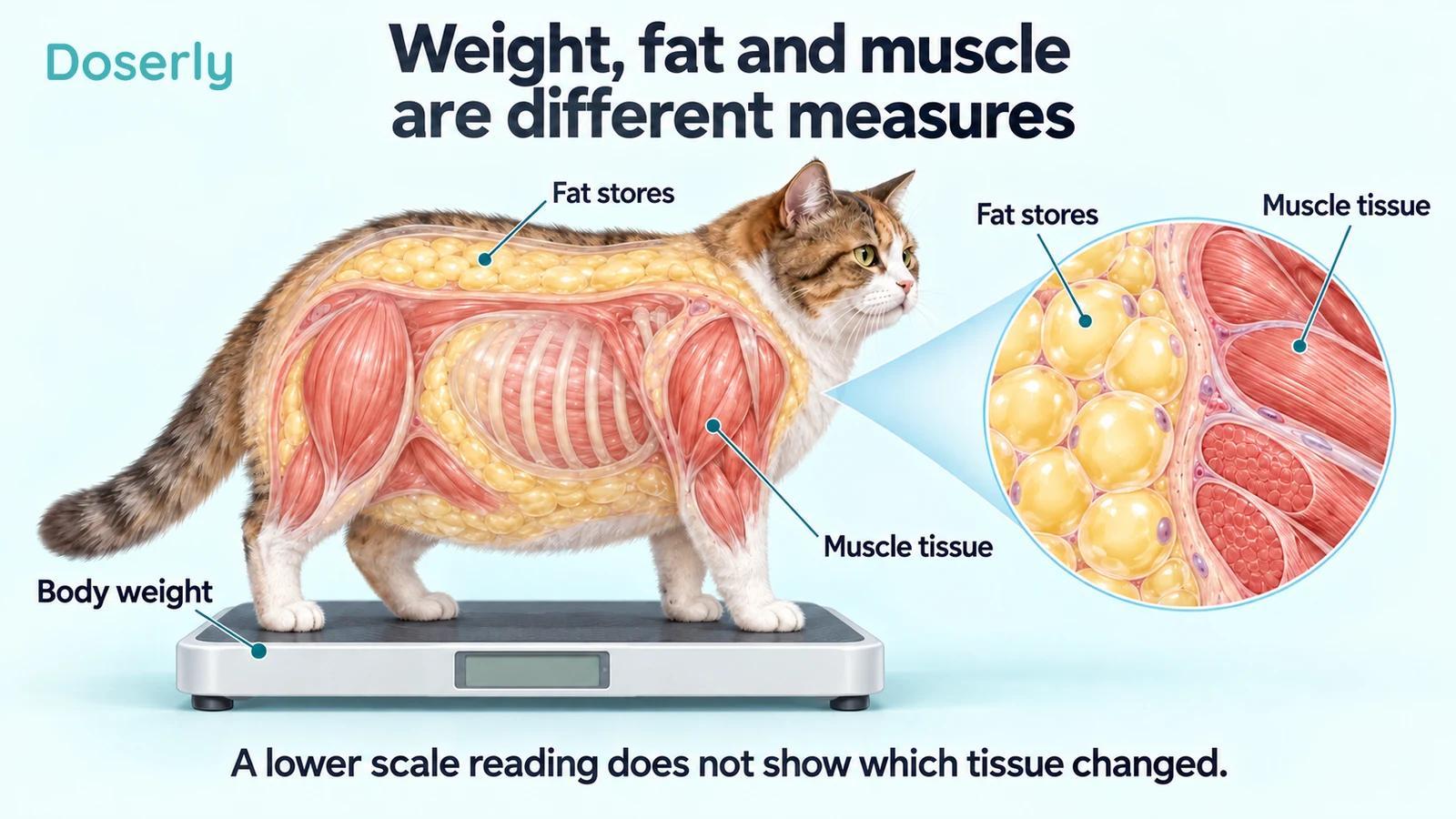
The scale measures total body weight. The tissue illustration explains why fat stores and muscle must be considered separately; it is not a before-and-after treatment result.
For everyday veterinary assessment, body condition score estimates fat stores, while muscle condition score evaluates muscle. An animal can have excess fat and still have clinically important muscle loss. WSAVA provides separate tools for these assessments. WSAVA nutrition guidance
That is why “the number went down” is not a sufficient treatment goal. Owners and veterinarians want an appropriate direction of change, adequate nutrition and preserved function. A slower, sustainable improvement may be more valuable than a rapid fall that reflects poor intake or illness.
Tolerability includes whether treatment can be given
The study reported a small number of gastrointestinal events and a suspected low-glucose episode. Its size was insufficient to define uncommon risks. The withdrawals related to injection behaviour also reveal a practical issue that a laboratory result cannot capture. Safety and adherence results
A medicine can have promising pharmacology and still be difficult to administer consistently. The relationship between a cat and its caregiver matters: repeated restraint, distress or avoidance can undermine a treatment plan.
This is not an argument that every injection is unacceptable. Many cats tolerate prescribed injections well. It is an argument for measuring the real burden of a proposed regimen and considering whether its demonstrated benefit justifies that burden.
It also highlights a distinction between this formulation and other drugs under investigation. A different duration of action might change convenience, but convenience alone would not establish effectiveness or safety. Each formulation still needs its own evidence.
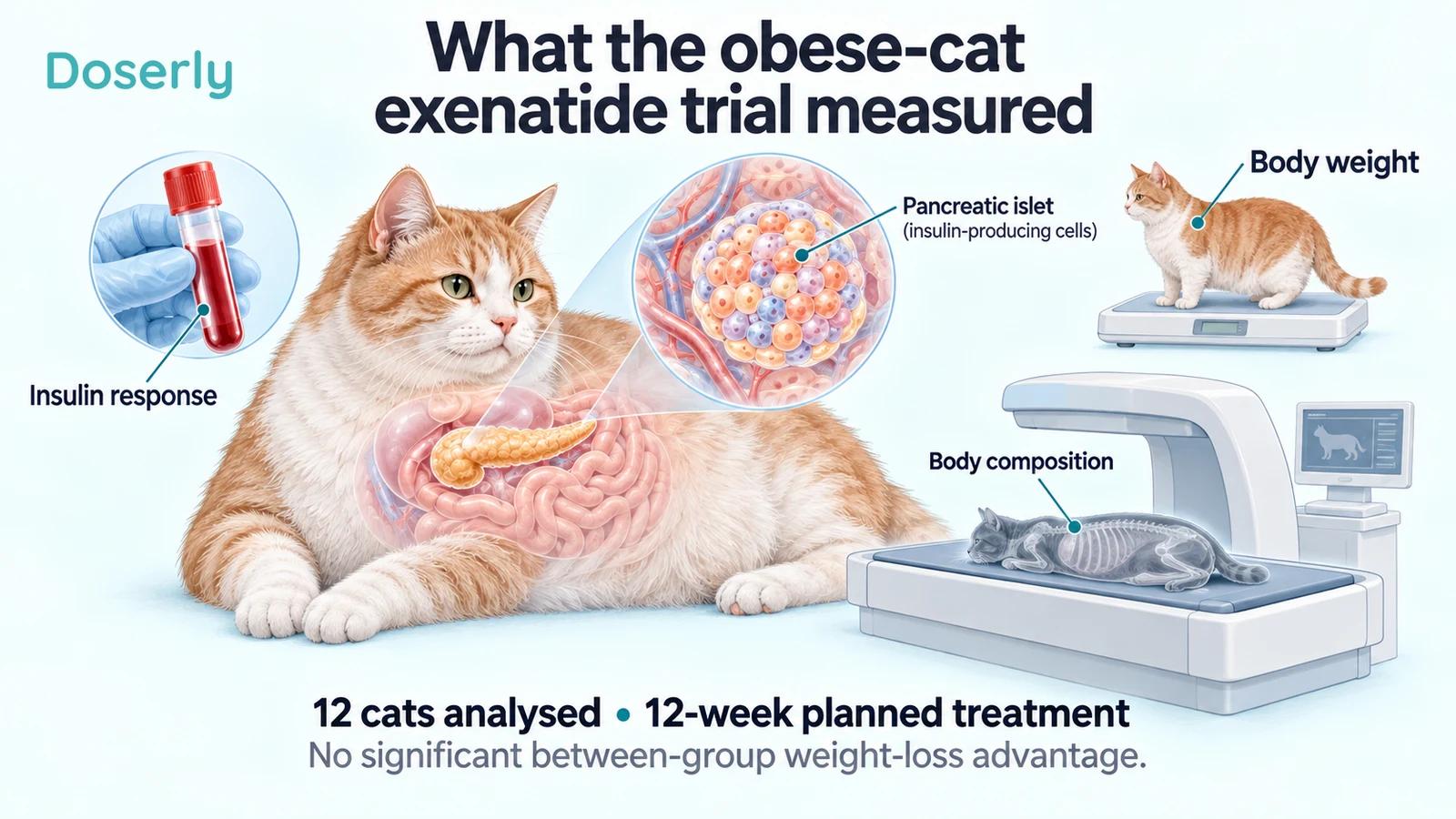
The trial assessed insulin response, weight and body composition. Twelve cats were analysed, but not all completed the full planned treatment period. The scanner and anatomy are explanatory illustrations.
Appetite reduction is not always reassuring in a cat
For an overweight pet, eating less can sound like progress. But a cat that is unwilling to eat, vomiting or becoming lethargic needs assessment rather than congratulations for reducing calories.
Cats can develop hepatic lipidosis, a serious accumulation of fat in liver cells, in association with inadequate intake and underlying illness. Cornell's clinical guidance explains why loss of appetite warrants attention, particularly in an overweight cat. Cornell on hepatic lipidosis
This does not mean that planned veterinary weight loss causes liver disease. It means deliberate, nutritionally supported weight management is different from a cat unexpectedly stopping food.
A useful plan should tell an owner how to respond to reduced appetite and whom to contact. It should not depend on guessing whether a change is the intended effect of a drug or a sign of illness.
What can owners do with the evidence now?
Start with an assessment of the cat rather than a drug name. Ask the veterinary team to explain body condition, muscle condition, other health problems and a realistic goal. The plan should include the food actually eaten, not just what is offered.
A diet history can reveal practical obstacles: treats from several family members, access to another pet's bowl, inconsistent portion measurement or difficulty separating animals at mealtimes. These details are not moral failings. They are information that makes a plan workable.
AAHA's nutrition guidance emphasizes individualized assessment and follow-up rather than a single calorie recommendation for every animal. AAHA nutrition and weight-management guidelines
Track progress with the measurements your veterinarian recommends. Weight, appetite, ease of movement and tolerance of the routine can each add useful context. A written record helps identify whether a change followed a food adjustment, illness or new treatment.
If a GLP-1 treatment is proposed, ask which feline study supports that exact product, which outcome improved and how the cat will be monitored. A credible answer should distinguish established findings from a hypothesis or an investigational programme.
What would stronger feline obesity evidence look like?
A useful next study would follow enough cats to estimate a treatment effect precisely, account transparently for withdrawals and compare treatment alongside a clearly described nutritional plan.
It would measure fat and lean tissue rather than relying only on total weight. It would also assess appetite, wellbeing, practical administration and what happens after treatment stops. Those outcomes determine whether a result is useful to a household caring for a cat over years.
The 2016 experiment contributes an early answer: the tested exenatide regimen did not establish superior weight loss or improved insulin response in this small obese-cat population. That is a reason to keep the scientific question specific. It is not evidence that a human GLP-1 medicine should be repurposed at home, nor a reason to postpone the veterinary nutritional care that an overweight cat can receive now.
Sources
- Obese-cat exenatide trial, 2016.
- Gilor and colleagues, exenatide physiology in healthy cats, 2011.
- WSAVA Global Nutrition Guidelines and toolkit.
- AAHA Nutrition and Weight Management Guidelines, 2021.
- Cornell Feline Health Center, hepatic lipidosis.