
Peptides
October 16, 2026
GHRP-6 versus GHRP-2: appetite, hormones and clinical evidence
On this page
GHRP-6 and GHRP-2 belong to the same broad family of growth hormone secretagogues: substances that stimulate growth-hormone release. Both interact with the ghrelin signaling system, which also has a role in appetite. That makes comparisons understandable, especially if you're interested in eating more, changing body composition or recovering from an injury.
But “which is stronger?” is incomplete. Stronger at producing a brief hormone peak, stimulating a meal, changing IGF-1 or improving daily function? Those outcomes need different measurements. The available studies do not establish a single clinical winner across them. GHRP-6 human endocrine study, GHRP-2 food-intake study.
Start with the full substance name
The numbers in GHRP-6 and GHRP-2 distinguish different compounds. They are not interchangeable product strengths or instructions to take six versus two units. GHRP-2 is also known as pralmorelin; the Japanese prescription diagnostic product contains pralmorelin hydrochloride. GHRP-6 is the synthetic hexapeptide studied in the early human GH experiments. PMDA product information, GHRP-6 identity in the original study.
The distinction becomes especially important in a research summary. A paper may discuss “GHRPs” as a class while actually administering just one molecule. A shared receptor gives a reason to compare the compounds, but it doesn't permit transferring a numerical result from one to the other.
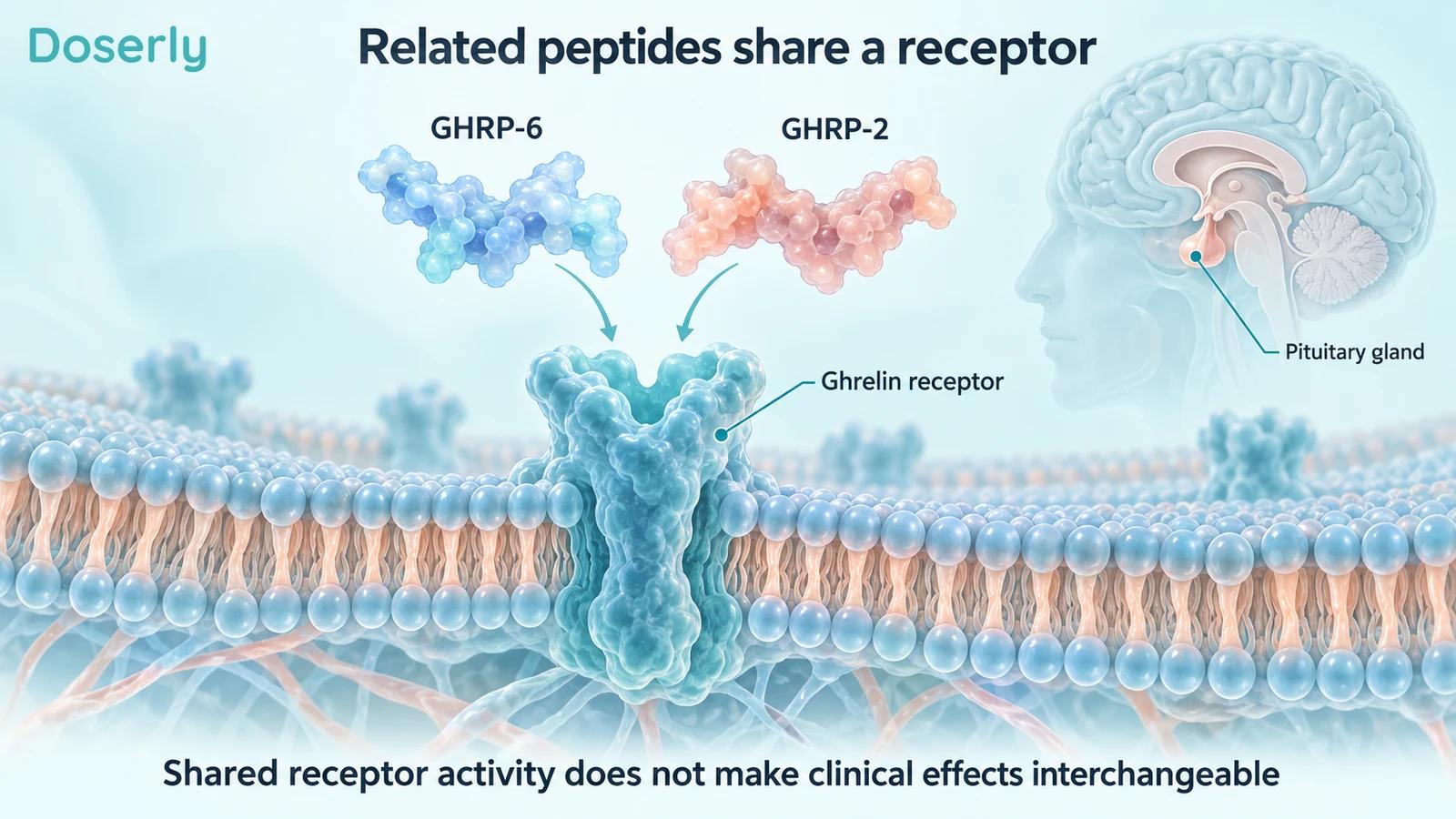
Our GHRP-6 guide provides a fuller account of that compound. For the comparison here, keep three questions separate: what happens to hormone measurements, what happens to eating, and what has actually been established for clinical use.
Both can stimulate growth hormone, but study conditions matter
In an early GHRP-6 experiment, 18 healthy men received intravenous exposures at different levels, with placebo and GHRH comparisons. GH rose in a dose-dependent fashion. Lower GHRP-6 exposures combined with GHRH produced a synergistic hormone response. Cortisol and prolactin also rose at the highest tested GHRP-6 exposure. Bowers and colleagues, 1990.
This establishes endocrine activity under the tested conditions. It doesn't provide a head-to-head comparison with GHRP-2, and it doesn't show that the highest GH response is the best choice for a person's health goal.
A related human comparison sometimes adds confusion. A 1997 study compared GHRP-2 with hexarelin, another secretagogue, and with other hormonal stimuli. It examined GH, prolactin, ACTH and cortisol in small groups of young and older adults. GHRP-6 was not the direct comparator in that experiment. GHRP-2 and hexarelin study.
That paper is relevant to the broader family, including the fact that effects can extend beyond GH. It cannot settle a GHRP-2-versus-GHRP-6 ranking by changing “hexarelin” to “GHRP-6” in a retelling. Our hexarelin guide gives context for that distinct molecule.
Comparing peaks from separate papers is also unreliable. The populations, administration route, sampling schedule and laboratory assay may differ. A higher average number in one experiment isn't equivalent to randomizing similar people to the two drugs in the same experiment.
Human appetite findings belong to GHRP-2
A controlled 2005 experiment infused seven healthy lean men with GHRP-2 or saline for 270 minutes and measured intake from a buffet meal. On average, participants ate approximately 36% more in the GHRP-2 condition. Laferrère and colleagues.
A subsequent study investigated GHRP-2 food-intake responses in participants with obesity as well as lean participants, including dose dependence. These studies are direct human evidence for an acute eating effect of GHRP-2. They do not establish long-term muscle gain, treatment of malnutrition or the same effect from GHRP-6. Later GHRP-2 appetite study.
The GHRP-6 appetite evidence discussed in this comparison comes from animals. For example, direct administration into brain fluid increased eating in adult male rats without a matching dose-related GH response. That supports investigating appetite biology, but differs substantially from a human injection study. Rat GHRP-6 feeding experiment.
It is therefore reasonable to say that the cited human food-intake experiments provide more direct evidence for GHRP-2's acute appetite effect. It is not reasonable to conclude that GHRP-2 must feel more hunger-inducing than GHRP-6 in everyday use, or that either is the better treatment for unexplained weight loss. Those claims require different comparisons and clinically relevant follow-up.
Repeated exposure complicates a simple potency ranking
An initial hormone response may change when exposure is repeated. In a five-day study, nine healthy participants received daily subcutaneous GHRP-2. Mean peak GH declined from 83 micrograms per litre on day one to 59 on day three and 51 on day five. GH release persisted, but the response attenuated significantly; average IGF-1 did not increase. Nijland and colleagues, 1998.
This means “still produces GH” and “produces the same response as initially” are different statements. It also demonstrates why a large early peak doesn't necessarily predict a sustained IGF-1 change.
For GHRP-6, a small intranasal experiment in six men found maintained GH responsiveness over seven administrations and an IGF-1 increase. Hayashi and colleagues, 1991. That is not a matched comparison proving that GHRP-6 causes less tolerance: the routes, exposure patterns and observation periods differed.
Nor do these experiments establish a break or cycling schedule. To compare repeated-use strategies, researchers would need comparable formulations and exposures, a prespecified endpoint and sufficient follow-up. A fading sensation of hunger is not the same measurement as an attenuated GH response.
What does Japanese pralmorelin approval actually mean?
PMDA lists a pralmorelin hydrochloride product, GHRP Kaken 100, for diagnosing growth-hormone secretion deficiency. Its label describes a supervised intravenous stimulation test and serial blood sampling. The purpose is to observe the GH response and contribute to diagnosis, not to provide months of treatment for recovery or appetite. Current PMDA label.
A diagnostic drug can be useful because it creates a measurable response. That doesn't require the response itself to deliver a lasting health benefit. The test helps answer whether an endocrine system responds in an expected way; the clinician then interprets the findings in context.
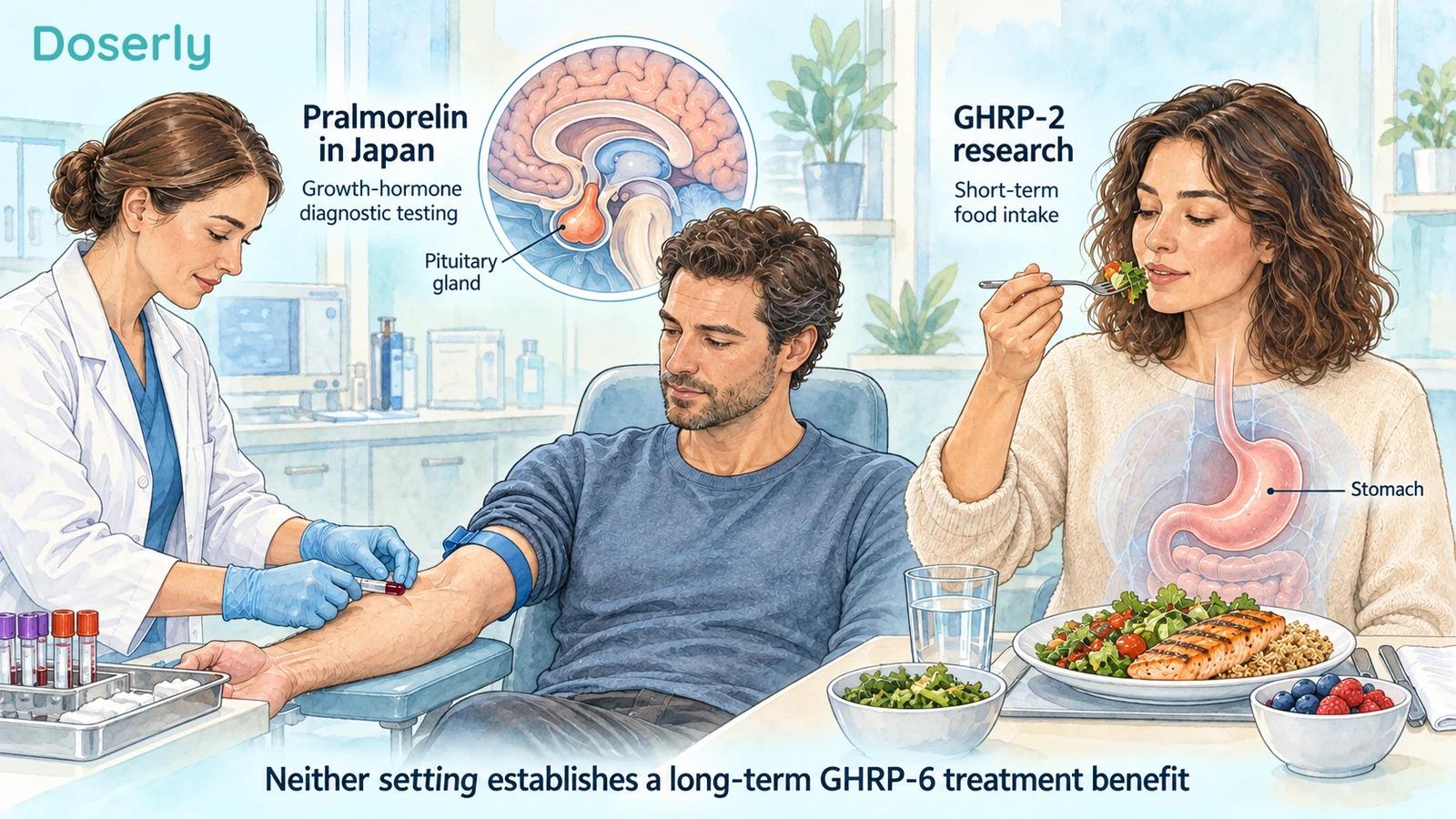
The label includes adverse effects and precautions. Its existence doesn't mean a different supplier's GHRP-2 product is the same medicine, or that a different route and duration have equivalent safety. It also doesn't authorize GHRP-6 by association. Regulatory decisions attach to a specified product and use, not every molecule sharing part of its name.
Can one be described as the safer or cleaner option?
The studies here do not establish a reliable long-term safety ranking. “Cleaner” is often used without specifying whether it means fewer non-GH hormone changes, fewer symptoms, better glucose handling or more reliable manufacturing. Those are distinct issues.
FDA lists safety concerns for compounded GHRP-6, including potential cortisol effects, reduced insulin sensitivity, increased blood glucose and possible immunogenicity associated with aggregation or impurities. Its GHRP-2 entry also describes immunogenicity concerns and serious adverse-event reports, while explicitly noting that causality has not been established. FDA compounding safety information.
Those entries cannot be used as a scorecard: more listed reports do not necessarily mean one substance has a higher event rate. Exposure populations, reporting patterns and study settings may differ. Likewise, a small study with few adverse events cannot rule out uncommon or delayed harms.
A comparison should therefore state what is known and leave the missing comparison visible. Neither an appealing mechanism nor a smaller hormone change in a separate experiment establishes overall safety for chronic unsupervised use.
Match the comparison to the problem you want solved
For a diagnostic question, the relevant evidence concerns test performance and clinical interpretation. For appetite loss, it concerns eating, nutritional outcomes and the cause of the problem. For rehabilitation, it concerns pain, movement and function. A study that answers one of these questions may contribute little to another.
Before treating the names as competing options, describe your goal precisely. “My appetite has fallen and I'm losing weight” calls for a different assessment from “I want a larger GH peak” or “my injury hasn't recovered.” The latter laboratory goal may not be the clinical outcome you actually want.
If a comparison is offered, ask whether it comes from a direct trial of the two substances, a comparison across separate studies or experience with mixed products. Also ask which molecule, route and formulation were studied. That makes it possible to discuss the actual evidence without dismissing the biological similarities.
The clearest conclusion is a differentiated one: both compounds have endocrine activity; GHRP-2 has specific acute human food-intake data and a defined Japanese diagnostic use; the cited GHRP-6 appetite findings are animal experiments. None of those facts establishes a universal winner for body composition, recovery or long-term health. Human GHRP-2 meal experiment, GHRP-6 rat experiment, diagnostic product label.
Explore the research
- GHRP-6 endocrine study, 1990.
- GHRP-2 versus hexarelin, 1997: a different head-to-head comparison.
- GHRP-2 meal study, 2005.
- GHRP-2 appetite study including obesity, 2006.
- GHRP-6 rat feeding study, 1995.
- Repeated GHRP-2, 1998.
- Repeated intranasal GHRP-6, 1991.
- PMDA pralmorelin label, revised July 2025.
- FDA compounding safety information.