
Peptides
October 16, 2026
GHRP-6 in stroke trials: what the hospital combination showed
On this page
An ischemic stroke interrupts blood flow to part of the brain. Treatment aims to limit injury quickly, then support recovery and prevent another stroke. Researchers have explored whether drugs that affect cellular survival signals could add protection beyond existing care. GHRP-6 has reached human research in that setting, together with epidermal growth factor, usually abbreviated EGF.
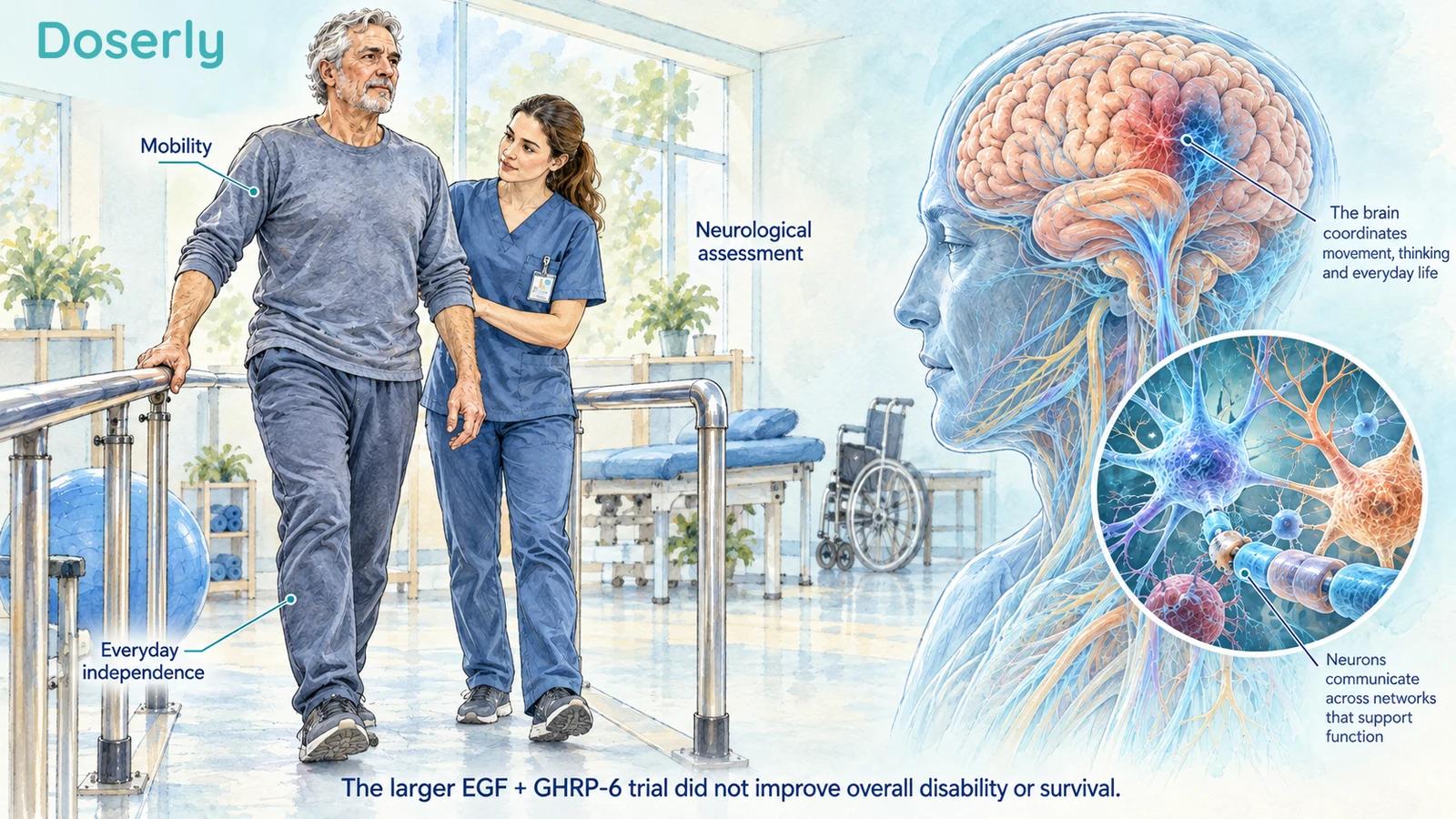
The most important result is straightforward: the larger combination trial missed its primary endpoint and found no overall improvement in disability or survival. Some subgroup and imaging findings were encouraging, but they do not overturn that main result. And because participants received both substances, the trial doesn't tell us what GHRP-6 would accomplish on its own. COURAGE-2 primary report.
This article explains why the combination was studied, how the early and later trials differ, and what those findings mean for someone looking for help after a stroke. New facial weakness, arm weakness or speech difficulty requires emergency assessment; an experimental peptide is not a reason to delay established stroke care. American Stroke Association.
What kind of stroke was studied?
An ischemic stroke is caused by an obstruction in a vessel supplying the brain. A hemorrhagic stroke involves bleeding. The distinction matters because a treatment suitable for one situation may be inappropriate for the other, and imaging helps clinicians distinguish them.
For eligible patients, urgent ischemic-stroke care can include a medicine that dissolves a clot or a procedure called mechanical thrombectomy, which removes it. Eligibility depends on timing, imaging and other clinical factors. Hospital care also addresses complications, the stroke's cause and prevention of further events. American Stroke Association's ischemic-stroke explanation.
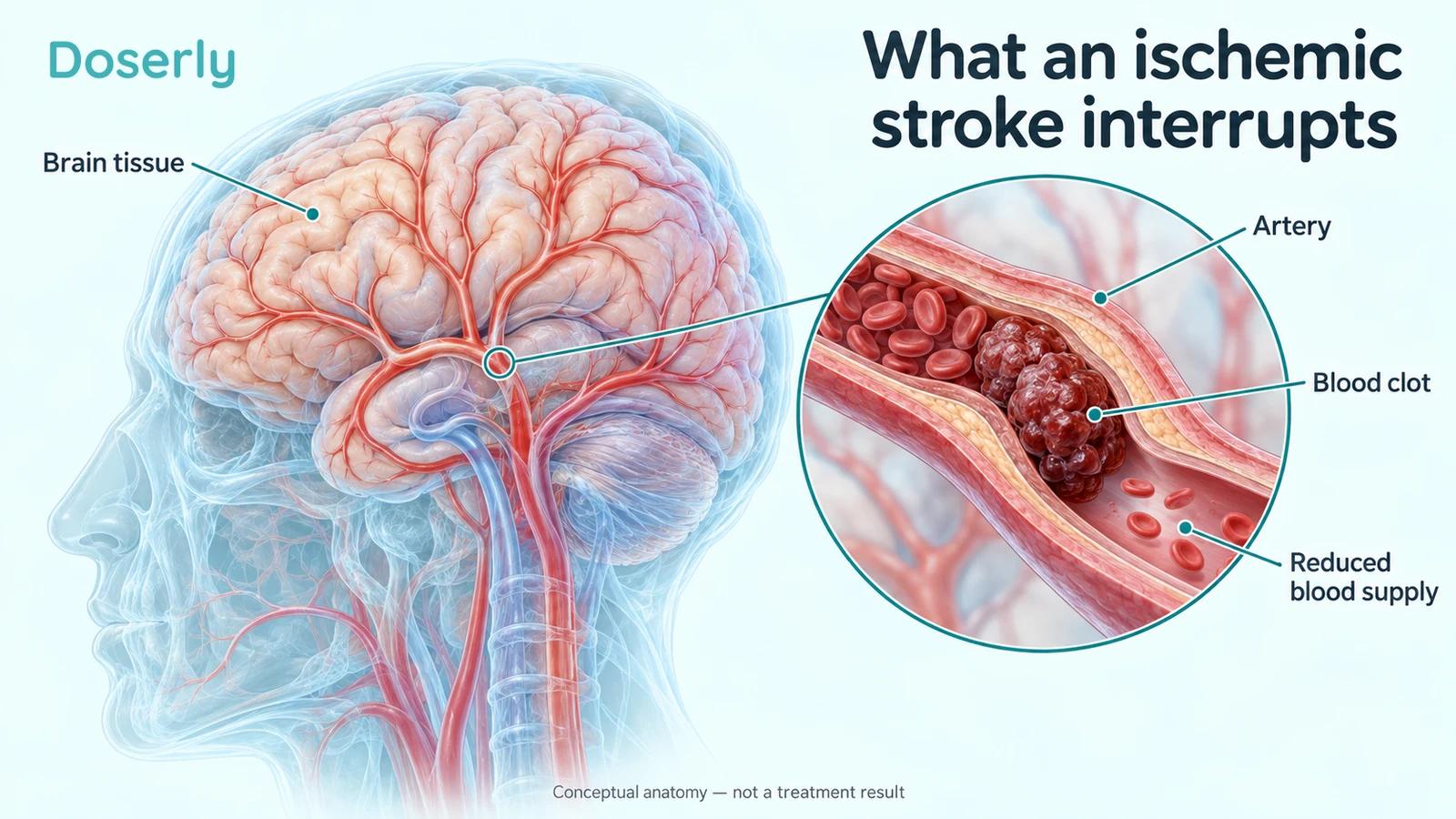
The EGF–GHRP-6 program investigated an additional biological idea: whether influencing the injured tissue's response could improve outcomes. That is a different task from mechanically reopening a blocked artery. A potential effect on cell signaling must ultimately translate into something clinically useful, such as less disability, rather than only an interesting laboratory result.
Why combine EGF with GHRP-6?
EGF is a signaling protein studied for effects on cells, while GHRP-6 is a synthetic growth hormone secretagogue, meaning that it can stimulate growth-hormone release. The proposed stroke application concerns broader tissue-protection mechanisms, not simply making a growth-hormone blood test higher. The Doserly GHRP-6 guide introduces its endocrine biology and other research.
One preclinical study used Mongolian gerbils with experimentally induced global brain ischemia. Researchers administered EGF, GHRP-6 or the combination after restoring blood flow. The combination improved reported clinical manifestations and tissue findings, including infarct volume and neuronal density. Infarct volume is the amount of tissue affected by the interruption of blood supply; neuronal density concerns the number of nerve cells in a sampled area. García Del Barco-Herrera and colleagues, 2013.
These were gerbils in an experimental model, not patients with naturally occurring stroke. Controlled injury timing and treatment in animals make mechanisms easier to investigate, but human strokes vary in location, cause, severity and accompanying illness. The animal work provided a reason for clinical testing, rather than an estimate of the benefit patients could expect.
It also explains why this program cannot be reduced to a generic claim that “peptides heal the brain.” The researchers tested particular molecules together, in a defined setting, with outcomes that could later be challenged in people.
What did the first human study contribute?
The early phase I/II study, published in 2024, involved 36 adults treated in Cuban stroke units. Two groups of ten received intravenous EGF plus different GHRP-6 amounts, and 16 received standard care. Combination treatment lasted seven days, with follow-up over six months. Safety was the main objective; neurological and functional outcomes were secondary. Phase I/II report.
There were important design limitations. Treatment was open-label, meaning that the allocation was known. The full report describes six early patients being placed in the control group after delays made them miss the intended treatment window. That departure from the planned allocation weakens confidence that the groups were comparable. Recanalization interventions were not used, which also limits comparisons with settings where eligible patients receive contemporary clot-directed treatment.
The early study reported encouraging functional findings and supported proceeding to a larger trial. Its small size and safety-centered design made it unsuitable for establishing routine clinical benefit. The correct next question was whether a more substantial comparison would reproduce an improvement in outcomes important to patients.
For readers, this is why publication dates alone don't settle a treatment claim. An older encouraging pilot and a later unsuccessful trial can both be accurately reported. Their roles differ: the pilot creates a reason to test further; the larger trial is a more demanding test of that reason.
What did COURAGE-2 test?
The multicenter phase III COURAGE-2 trial enrolled 188 people within 12 hours of ischemic-stroke symptom onset. Ninety-five received intravenous EGF plus GHRP-6 twice daily for seven days, and 93 received standard care. Eligibility included a National Institutes of Health Stroke Scale, or NIHSS, score of 5–20. The trial was randomized and open-label. COURAGE-2.
Its main clinical assessments used the modified Rankin Scale, usually shortened to mRS, at three and six months. The report found no overall differences in mRS, the Barthel Index or survival in the intention-to-treat population. That population is the main randomized comparison, rather than a selected set of participants who seemed most responsive.
These scales address related but different aspects of recovery. NIHSS assesses neurological impairment through a structured clinical examination. The modified Rankin Scale summarizes disability and dependence. The Barthel Index concerns performance of daily activities. None is simply a measurement of how much injured tissue appears on a scan.
For someone recovering from stroke, that distinction is practical. Being able to transfer from a chair, communicate needs or manage personal care may matter more than a change in a scan alone. A trial needs clinical assessments to learn whether a biological effect makes a meaningful difference in life outside the imaging suite.
How should we understand the favorable subgroup?
The larger study reported a favorable signal in 27 participants with severe stroke, defined in that analysis by NIHSS of at least 15. It also reported an imaging signal and sensitivity analyses using another severity threshold. These findings justify asking whether a more specifically selected population might benefit. They don't establish that population's treatment benefit with the same confidence as a successful primary comparison. COURAGE-2 subgroup findings.
A subgroup is a smaller part of the original trial. Once the population is divided, estimates become less precise, and chance differences between groups can matter more. Examining several outcomes or cutoffs also creates more opportunities for a favorable result to appear. A statistically significant comparison within a subgroup doesn't, by itself, demonstrate that treatment works differently in that subgroup than in everyone else.
A useful follow-up would recruit the severity group of interest prospectively, specify the main outcome in advance and test the hypothesis directly. Ideally it would also address blinding and how the experimental treatment fits with the background stroke care patients now receive.
For a family, “possible benefit in more severe stroke” can sound like an exception that makes the treatment appropriate immediately. The more accurate interpretation is that severity may be a promising question for a new trial. The current evidence has not established a dependable exception to the unsuccessful overall result.
Did the studies show that the combination was safe?
Safety findings require the same care as benefit findings. A stroke itself can cause serious complications, so an event after treatment is not automatically caused by the treatment. Conversely, an investigator's judgment that an event was unrelated doesn't establish that a medicine has no important risks.
COURAGE-2 reported severe adverse events in both groups and did not attribute them to treatment. The treated group nevertheless had more such events numerically. The published uncertainty does not support turning that observation into a confident claim of treatment-caused harm, but it also makes “no serious side effects” an inaccurate summary. COURAGE-2 safety results.
For GHRP-6 more generally, FDA describes limited safety information and concerns involving cortisol, glucose and immune reactions associated with peptide aggregation or impurities. Those concerns are not a direct estimate of risk from the hospital combination, but they matter when people use the trial to reassure themselves about unrelated products. FDA safety information.
A characterized investigational product delivered in a monitored hospital trial and a product bought for unsupervised use are not equivalent exposures. The study's follow-up cannot verify another product's content, sterility or long-term safety.
Does this help someone months or years after stroke?
The trials began treatment during the acute period, within hours of symptom onset. They do not answer whether starting GHRP-6 later improves persistent weakness, fatigue, speech difficulty or cognition. A six-month follow-up means the investigators observed outcomes later; it doesn't mean treatment began six months after stroke or continued throughout that period.
That timing distinction often disappears when a study is summarized as “improved stroke recovery.” The condition of the tissue, treatment goals and practical care needs can differ greatly between the first hospital day and later rehabilitation. A therapy aimed at limiting early injury would need separate testing before being presented as a treatment for established chronic disability.
Rehabilitation addresses specific functions and everyday goals through an individualized team approach. Depending on needs, that can include physical, occupational and speech-language therapy, alongside nursing, nutritional and psychological support. American Stroke Association rehabilitation guidance.
When discussing a new treatment, name the problem you want to improve and how you would recognize improvement. That keeps the conversation grounded in the person's actual needs rather than an undifferentiated idea of brain recovery.
What can patients and families take from this research?
The human program is more substantial than an animal mechanism alone: an experimental combination was tested in real patients, and a larger trial reported its results. The main result was disappointing. Presenting that plainly respects both the research and the people who need reliable information.
The studies do not establish GHRP-6 alone, another peptide combination, a home injection schedule or treatment begun long after stroke. They identify a possible subgroup hypothesis that needs further testing. That leaves room for research without making a clinical promise.
If someone proposes the combination, ask which study population matches your situation, whether the overall outcome improved, and how the proposal fits with the stroke team's plan. Ask separately about rehabilitation goals, prevention of another stroke and management of ongoing symptoms. Those questions remain useful even when an experimental treatment's evidence is uncertain.
Explore the research
- COURAGE-2, 2026: randomized phase III combination trial; primary endpoint missed.
- Phase I/II report, 2024: safety-focused study, allocation deviation and background care.
- Gerbil ischemia experiment, 2013: preclinical combination rationale.
- American Stroke Association: ischemic stroke: anatomy and established acute care.
- American Stroke Association: recognizing stroke: emergency symptoms.
- American Stroke Association: rehabilitation: individualized functional recovery.
- FDA compounding safety information: GHRP-6 safety concerns beyond the stroke trial.