
Peptides
October 16, 2026
GHRP-6 and hunger: what the appetite research actually shows
On this page
GHRP-6 is a laboratory-made peptide that stimulates a receptor involved in growth-hormone release and appetite. That combination explains its appeal to people who struggle to eat enough: perhaps a stronger hunger signal could make gaining weight easier. But the question isn't simply whether the biology sounds plausible. It's whether GHRP-6 helps people eat adequately, gain the kind of weight they need and stay healthier over time.
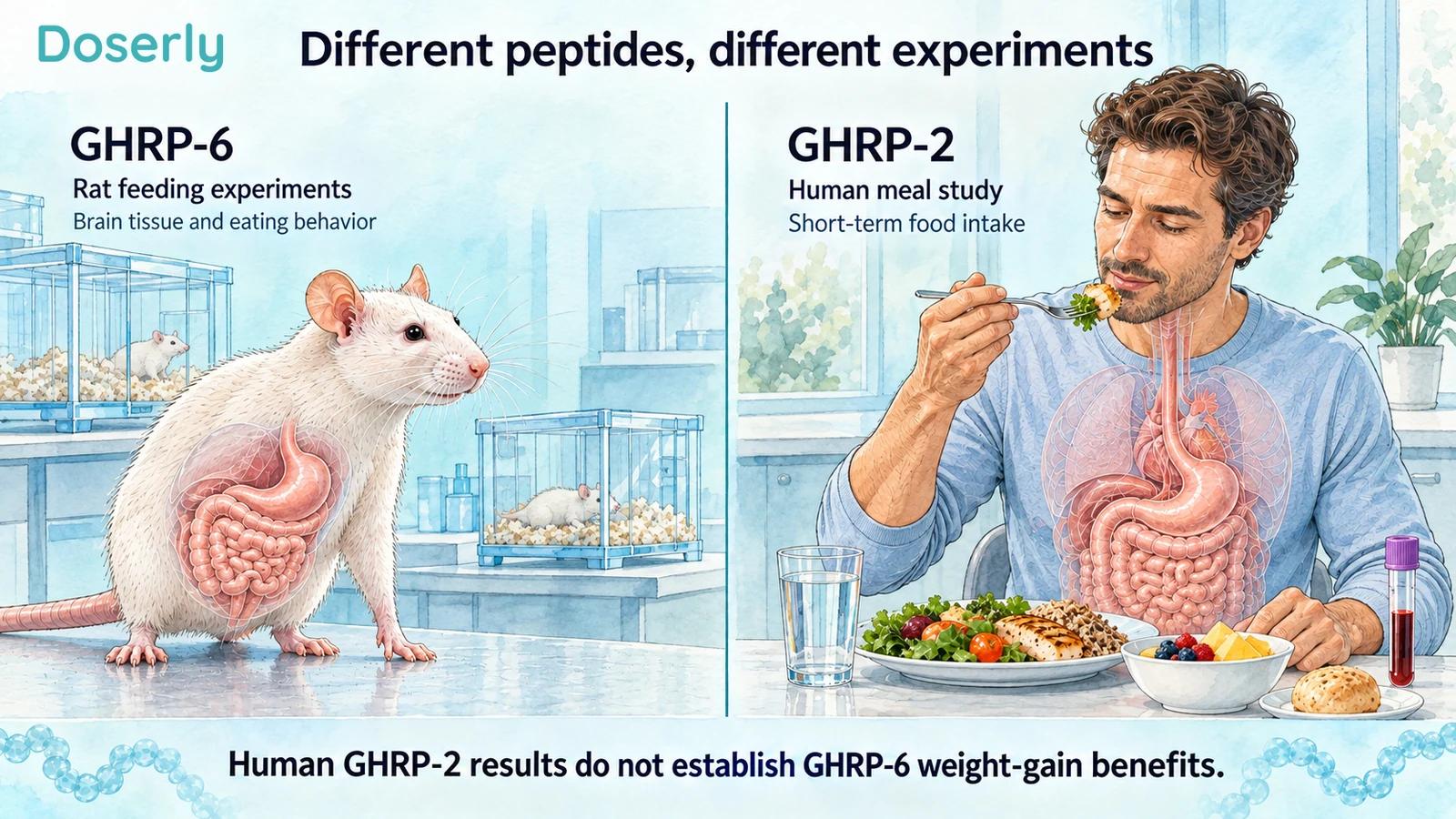
The direct appetite experiments discussed here used rats. The often-quoted controlled human meal studies used GHRP-2, a different peptide. Human research with other substances acting on the same signaling system adds useful context, but it cannot supply a missing GHRP-6 treatment trial. This distinction matters whether you're an otherwise healthy person trying to gain muscle or someone losing weight because of illness. GHRP-6 rat feeding experiment, GHRP-2 human experiment.
Why a growth-hormone peptide might affect hunger
The name GHRP-6 stands for growth hormone-releasing peptide 6. A secretagogue is something that stimulates secretion: in this case, release of growth hormone. That describes one action, rather than every possible effect of the compound.
Ghrelin, a hormone produced mainly in the stomach, acts through the growth hormone secretagogue receptor. GHRP-6 activates that receptor too. Appetite regulation involves the brain's hypothalamus, while growth hormone is released by the pituitary gland beneath it. These linked systems help explain why scientists studied both feeding behavior and hormone measurements. They don't require both responses to change by the same amount or on the same schedule. Human ghrelin administration study, GHRP-6 hypothalamic experiment.
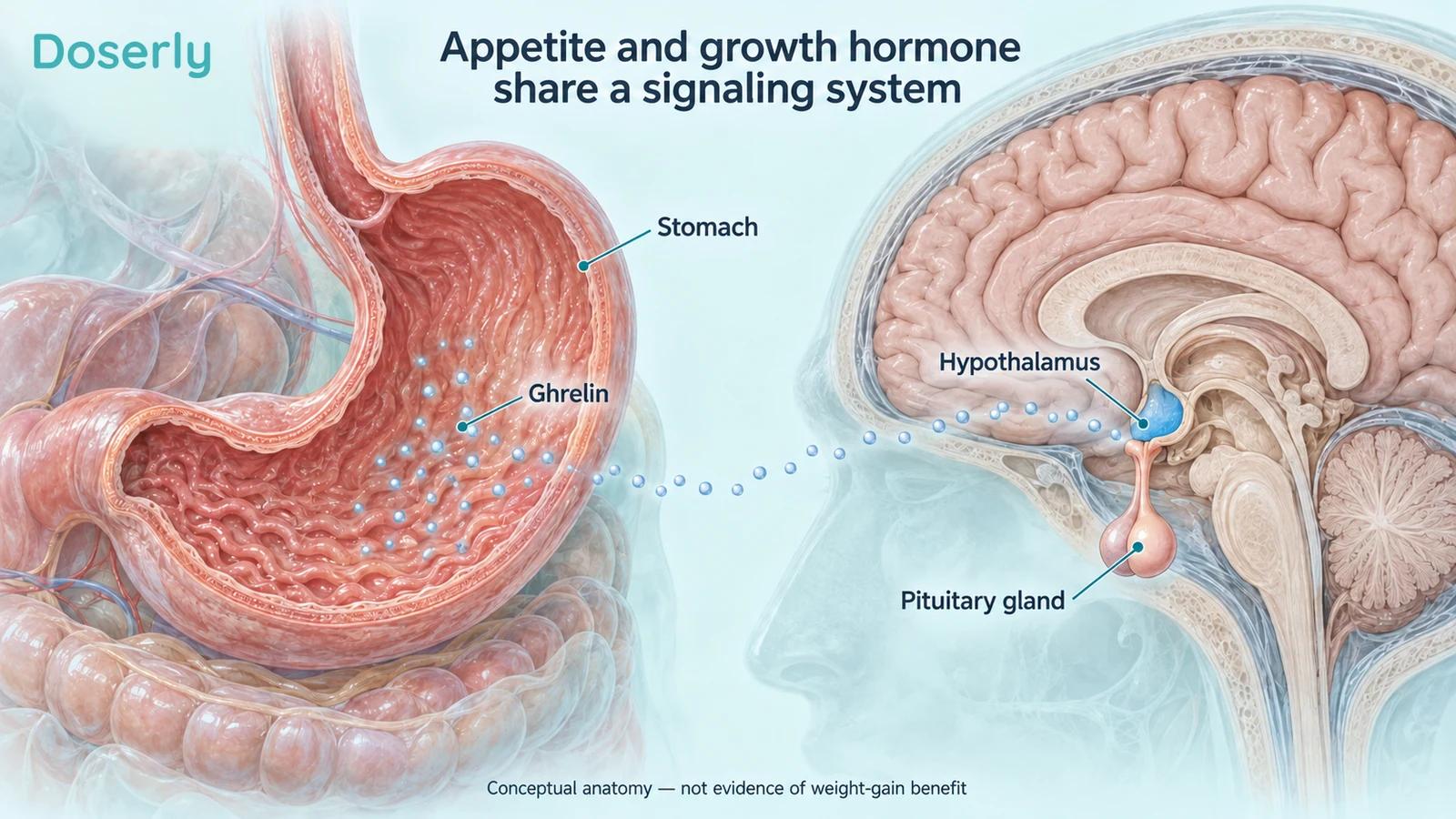
For a broader introduction to the compound, the Doserly GHRP-6 guide explains its identity and wider research. Here, the focus is narrower: what the feeding experiments establish, what the human comparisons actually tested, and what a useful appetite treatment would need to accomplish.
What happened in the rat experiments?
One 1995 experiment administered GHRP-6 into the fluid-filled spaces of the brains of adult male rats that had already eaten. Researchers observed eating during the following hour and sampled blood for growth hormone. The incidence of eating increased with the administered amount, but the growth-hormone changes did not follow the same dose-response relationship. The authors interpreted this as evidence that the feeding action could occur independently of the growth-hormone-releasing action. Locke and colleagues.
That is an informative result about a biological system. It is also a very particular experiment: direct administration into brain fluid, male rats and one hour of observation. It doesn't estimate how hungry a person would become after an injection under the skin, or how long that response would last. Importantly, a growth-hormone blood result cannot be substituted for the feeding behavior the researchers actually observed.
A second study examined brain tissue after intravenous GHRP-6 in rats. Researchers used c-fos messenger RNA, a marker of recent cellular activation, to identify responsive cells in the arcuate nucleus, a small hypothalamic region. Many of the activated cells also expressed neuropeptide Y, a signaling molecule associated with feeding, or growth hormone-releasing factor. This helped identify candidate neural pathways. It did not measure appetite in people or establish weight gain. Dickson and Luckman, 1997.
A six-day experiment added a longer perspective. Rats with free access to food received a continuous infusion into brain fluid; food intake and body weight increased. Yet the expression of neuropeptide Y messenger RNA at the end of the experiment wasn't higher than in controls. The investigators also studied food-restricted animals, whose responses differed. Johnstone and colleagues, 2005.
Together, these studies make the appetite hypothesis worth investigating. They also show why a simple account such as “it increases one hunger chemical, therefore it reliably builds weight” misses important details. A behavioral response, a gene-expression measurement and a weight measurement describe different aspects of the experiment. None provides a human treatment effect on its own.
The human food-intake studies used GHRP-2
In a 2005 experiment, seven healthy lean men received a subcutaneous infusion of GHRP-2 or saline for 270 minutes. Researchers then measured how much they ate from a freely available buffet meal. Participants ate about 36% more during the GHRP-2 condition, on average. The study supplied direct evidence that this related peptide could increase short-term food intake under laboratory conditions. Laferrère and colleagues, 2005.
The result answers a real question: did people eat more during the experiment? It doesn't show that they maintained a larger daily intake for months, gained muscle or recovered from malnutrition. A single buffet meal is easier to control and measure than life outside the laboratory, but it captures only part of a person's eating pattern.
A later GHRP-2 study examined adults with obesity as well as lean participants and investigated dose dependence. Its relevance is that appetite responses were investigated in more than one body-size group. It remains research on GHRP-2, not a head-to-head comparison demonstrating that GHRP-6 produces the same effect. Laferrère and colleagues, 2006.
The names are similar enough that this distinction can disappear in a short summary. When you see a precise claim about how many extra calories “GHRP” caused people to eat, check the full molecule name in the original report. A class label can be useful for discussing a shared receptor, but a numerical treatment result belongs to the substance tested.
What does research with ghrelin itself add?
Researchers have also administered ghrelin to people. A randomized, blinded study in 16 healthy lean volunteers compared a subcutaneous ghrelin injection with saline before a buffet breakfast. It found increased food intake and higher ratings of the food's palatability, meaning how pleasant participants found it. Druce and colleagues, 2006.
This provides another reason to take the receptor's appetite role seriously. It also separates two questions that can sound identical in everyday conversation: wanting food and enjoying the food available. A person might be interested in eating yet find meals unpleasant, or enjoy a meal while becoming full quickly. An appetite intervention needs to be studied in the problem it is meant to solve.
The volunteers were healthy and lean. Their response doesn't establish treatment for cancer-related weight loss, swallowing problems, gastrointestinal disease or an eating disorder. Nor does administering the body's hormone prove that a synthetic receptor agonist has identical distribution, duration or adverse effects. The experiment supports the pathway; it doesn't erase the need to test each treatment.
More hunger, more weight and more muscle are separate goals
Suppose someone feels hungrier after an intervention. That experience may be meaningful, particularly if eating has become difficult. But several additional questions determine whether it helped.
Did they actually eat more across the day, rather than moving food from dinner to lunch? Were they able to tolerate the additional food? Did their weight stabilize if it had been falling? If weight increased, did strength, activity or well-being improve too? These are examples of outcomes a trial could measure, not predictions about GHRP-6.
Body weight alone cannot identify the tissue involved. Fat, lean tissue and fluid contribute to the number on a scale. Even a more detailed measurement of fat-free mass doesn't directly measure how strong or capable a person feels. This is especially relevant when appetite claims are presented as muscle-building claims.
A longer randomized trial of MK-677, or ibutamoren, illustrates the distinction. This oral ghrelin mimetic is a different drug, not GHRP-6. In healthy older adults, it increased growth hormone and fat-free mass, but did not improve measured strength or function. Increased appetite was a reported adverse effect that often diminished over time; fasting glucose rose and insulin sensitivity decreased. Nass and colleagues, 2008.
Those findings cannot quantify GHRP-6's benefits or risks. They show why an appetite or body-composition signal is insufficient to promise better function. A treatment may change an intermediate measurement while leaving the outcome someone cares about unchanged.
When increasing appetite may be the wrong first question
If you're losing weight unintentionally, the reason matters. A desire to eat more is different from trouble swallowing, inability to afford or prepare meals, persistent nausea, or weight loss despite an apparently adequate intake. Describing the difficulty precisely helps a clinician decide what to assess.
NICE nutrition guidance recommends considering body mass index, unintentional weight loss and the duration of reduced intake when screening for malnutrition. It also directs people with signs of swallowing difficulty toward appropriate assessment. These are useful starting points because an appetite signal alone cannot solve every barrier to nutrition. NICE nutrition-support recommendations.
For someone trying to gain weight for training, the goals are different again. A sensible discussion would distinguish a stable, naturally smaller body size from an unexplained downward weight trend, and a wish to gain muscle from a medical inability to maintain nutrition. The experiments above did not recruit healthy lifters to test long-term muscle gain with GHRP-6.
If low intake has been prolonged or weight loss substantial, seek professional assessment before making large changes. NICE identifies circumstances in which reintroducing nutrition requires skilled supervision because of refeeding problems. That concern belongs to the person's nutritional condition, regardless of which appetite product prompted the conversation.
Safety is part of the appetite question
An effect can be desirable for one person and unhelpful for another. More hunger might conflict with a weight-management goal; it also doesn't tell us whether glucose handling or other endocrine effects remain acceptable.
FDA's compounding safety information specifically lists GHRP-6 concerns involving potential effects on cortisol, reduced insulin sensitivity and increased blood glucose. It also identifies possible immune reactions related to aggregation and peptide impurities, while emphasizing the limited safety information. These are concerns to take seriously, not a reliable estimate of how often a particular person would experience harm. FDA GHRP-6 safety entry.
Feeling hungry after a product therefore doesn't verify that product's identity, establish a safe amount or demonstrate that its overall effects are beneficial. The GHRP-6 guide's risk section gives additional context for discussing these uncertainties.
What would a convincing appetite trial measure?
A useful GHRP-6 trial would recruit a clearly defined population with a specific nutritional problem, compare a characterized formulation with an appropriate control, and follow participants long enough to see whether any early appetite effect persists. It would measure intake and tolerability alongside the outcomes that matter for that group.
For illness-related weight loss, that might include weight stabilization, nutritional status, daily function and quality of life. For another population, the most relevant outcomes could differ. Recording adverse events, treatment discontinuations and glucose changes would help determine whether an apparent appetite benefit is worth its costs.
Until that evidence exists, the practical conclusion is limited but useful: GHRP-6 has animal findings consistent with an appetite effect, and related human research supports the biological plausibility of the pathway. The missing step is demonstrating a worthwhile, sustained human benefit from GHRP-6 itself. Bring the nutritional problem you want solved to a clinician, along with a dated account of weight changes, eating difficulties and relevant medicines; that is more informative than treating hunger as a stand-alone measure of success.
Explore the research
- Locke et al., 1995: feeding after GHRP-6 delivered into rat brain fluid.
- Dickson and Luckman, 1997: activation markers in rat hypothalamic cells.
- Johnstone et al., 2005: six-day central infusion and feeding conditions in rats.
- Laferrère et al., 2005: acute GHRP-2 and food intake in seven men.
- Laferrère et al., 2006: GHRP-2 appetite research including adults with obesity.
- Druce et al., 2006: ghrelin injection and a buffet breakfast in healthy volunteers.
- Nass et al., 2008: MK-677, body composition and clinical outcomes in older adults.
- NICE CG32: assessment and nutrition support.
- FDA compounding safety information: GHRP-6-specific safety concerns.