
Peptides
October 16, 2026
GHRP-6 and blood sugar: what the human evidence can tell us
On this page
GHRP-6 stimulates growth-hormone release, but glucose control involves more than one hormone. If you're considering a peptide because of recovery, appetite or body composition, an increase in growth hormone doesn't tell you whether blood sugar will remain stable. The metabolic question needs its own measurements.
FDA lists GHRP-6 safety concerns involving reduced insulin sensitivity and increased blood glucose, alongside potential cortisol effects and limited safety information. At the same time, a frequently cited human experiment found a glucose rise under a very particular condition: participants also received a drug blocking the growth-hormone receptor. Understanding that condition prevents both exaggerated warnings and false reassurance. FDA safety entry, human mechanistic study.
Why growth hormone and glucose belong in the same discussion
Glucose is a fuel carried in the blood. Insulin helps coordinate its use and storage, and the liver, muscle and fat tissue contribute in different ways. Insulin sensitivity describes how responsive tissues are to insulin's actions. Reduced sensitivity can require more insulin to manage the same metabolic task.
Growth hormone participates in metabolism as well as growth-related signaling. Its effects interact with insulin and other hormones, rather than operating in isolation. The body's GH system is regulated through the hypothalamus, pituitary and feedback involving IGF-1, a signaling protein influenced by GH. Endotext physiology.
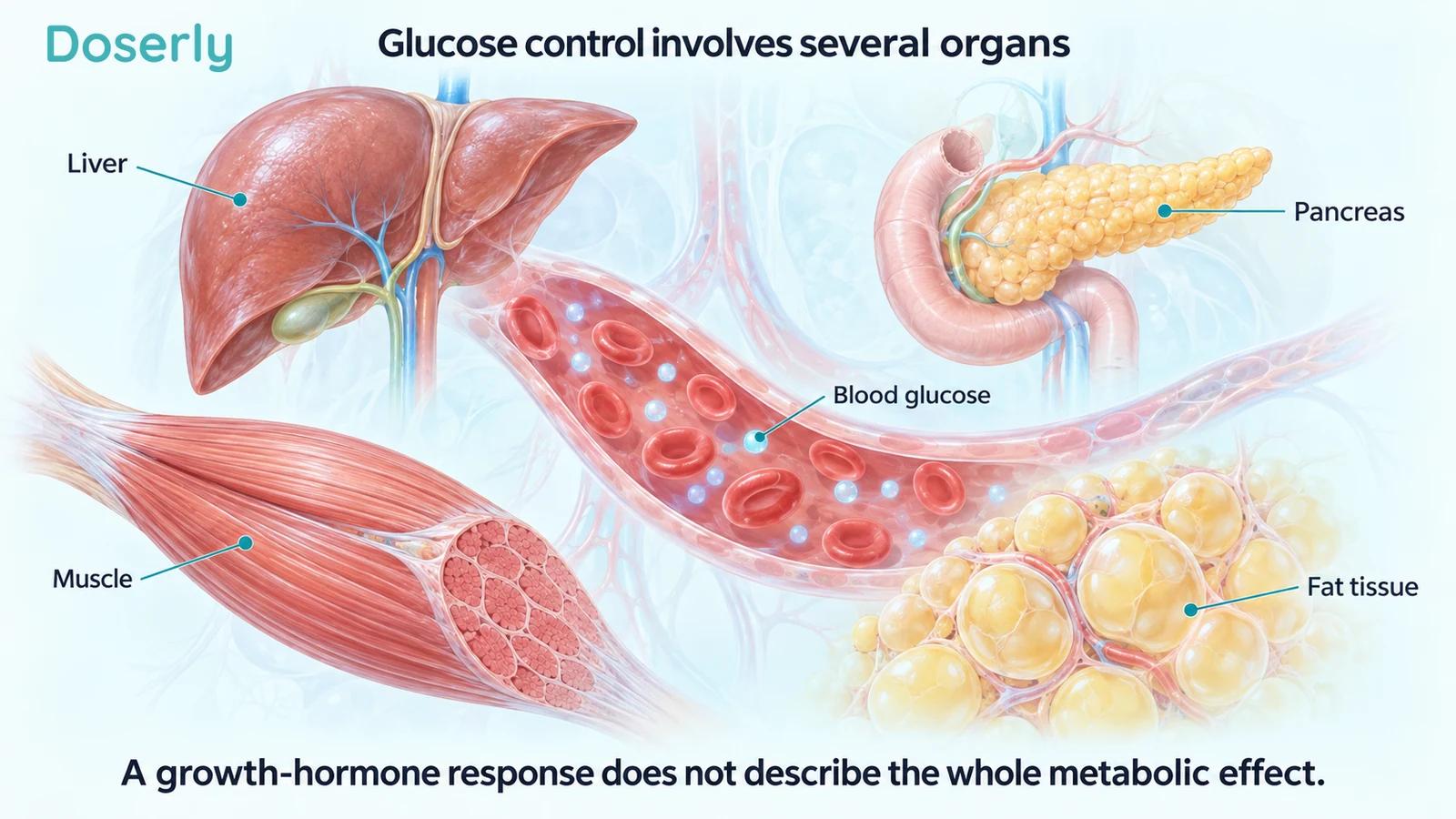
This is why a phrase such as “it only releases your own GH” doesn't settle the safety question. The source of the hormone and the consequences of changing its activity are different issues. The Doserly GHRP-6 guide explains the compound's wider endocrine effects; here, we will focus on what the glucose findings actually support.
What did the receptor-blockade experiment do?
A 2001 study enrolled ten healthy, nonobese men to examine GH-related metabolic regulation. Researchers used pegvisomant, a drug that blocks the GH receptor, and studied fasting and nonfasting conditions. The nonfasting condition involved five participants. Muller and colleagues.
With GH-receptor blockade in the nonfasting state, GHRP-6 was associated with an insulin rise from 10.3 to 81.3 mU/L and a glucose rise from 4.2 to 6.0 mmol/L. These changes were not observed during fasting with blockade or without pegvisomant. The study was acute, and its authors cautioned that longer exposure might produce different results.
The combination of higher insulin and higher glucose was interpreted as evidence of tissue-specific changes in insulin sensitivity. The accompanying fall in free fatty acids suggested that not every tissue's response was impaired in the same way. That is the reason the paper's title specifies tissue-specific insulin resistance.
The experiment is informative because the researchers deliberately altered one part of the hormonal system. It is not a trial of ordinary long-term GHRP-6 use, and it does not establish a typical glucose rise for everyone receiving GHRP-6. Leaving pegvisomant out of the summary changes the meaning of the result.
What can—and can't—be concluded from that result?
The study shows that GHRP-6-related metabolic responses can depend on the state of GH signaling and whether participants are fasting. It is evidence against assuming that every effect can be understood from the GH concentration alone.
It does not establish the probability of diabetes after GHRP-6, the average A1C change during months of use, or a safe exposure for people with prediabetes. None of those questions was the experiment's design. A brief laboratory glucose rise and a chronic disease diagnosis are different outcomes.
The opposite overinterpretation would be to say that glucose cannot be affected unless pegvisomant is present. The experiment's failure to detect the same change under other tested conditions doesn't exclude all effects under different exposures, populations or durations. Five nonfasting participants cannot describe every person's metabolic response.
This leaves an honest middle position: the experiment identifies a context-dependent physiological effect, while the broader long-term clinical risk remains insufficiently characterized. FDA's assessment should be read alongside that limitation, not used to transform the small experiment into a precise risk calculator.
Why a normal result in another short study is not a guarantee
In a 1991 study of six healthy men, researchers examined intravenous and intranasal GHRP-6 and measured several hormones, insulin and blood glucose. The report described GH responses and an IGF-1 increase after repeated nasal administrations, without a detected effect on blood sugar in the measurements reported. Hayashi and colleagues.
That finding is relevant: not every small human experiment showed an acute glucose increase. It also has a limited scope. Six healthy participants and brief exposure cannot establish metabolic safety during a much longer course or in people who already have diabetes.
The studies are not necessarily contradictory. Their designs differed in the presence of a receptor-blocking drug, route, timing and metabolic conditions. Reporting those differences gives a clearer account than choosing whichever result supports a preferred conclusion.
It also shows why “no statistically significant change” should not be translated into “no possible effect.” A small study may be able to identify a large acute response while remaining poorly suited to detect smaller, variable or delayed changes.
What does longer research with MK-677 contribute?
A randomized trial in healthy older adults tested MK-677, or ibutamoren, an oral ghrelin mimetic. It is a different compound from GHRP-6. The trial found increased GH and fat-free mass, but no improvement in measured strength or function; fasting glucose increased and insulin sensitivity decreased. Nass and colleagues.
This is useful context for the idea that stimulating the GH system can have metabolic tradeoffs. It is not a basis for assigning MK-677's glucose change or adverse-event frequency to GHRP-6. Different molecules and exposure patterns require their own evaluation.
The practical lesson is that a desired body-composition measurement and an undesired metabolic change can coexist. A favorable result on one endpoint does not cancel an unfavorable result on another. Any worthwhile treatment assessment has to consider both.
For someone whose main goal is muscle or recovery, this also raises a more basic question: was the hoped-for functional benefit actually demonstrated? Taking metabolic uncertainty in exchange for a proven clinical benefit is a different decision from accepting it for a benefit inferred only from hormone measurements.
Glucose, insulin and A1C answer different questions
A plasma glucose result describes blood glucose at a particular time. Its interpretation depends on whether the person was fasting, had recently eaten or was being tested under a specific challenge. Insulin is another measurement; its concentration does not simply mirror glucose in a way that can be interpreted without context.
A1C, also written HbA1c, reflects glucose attachment to hemoglobin in red blood cells and provides information about average glucose over roughly three months. It does not describe every short-lived rise or fall. Certain blood conditions and hemoglobin variants can make its interpretation unreliable. NIDDK A1C explanation.
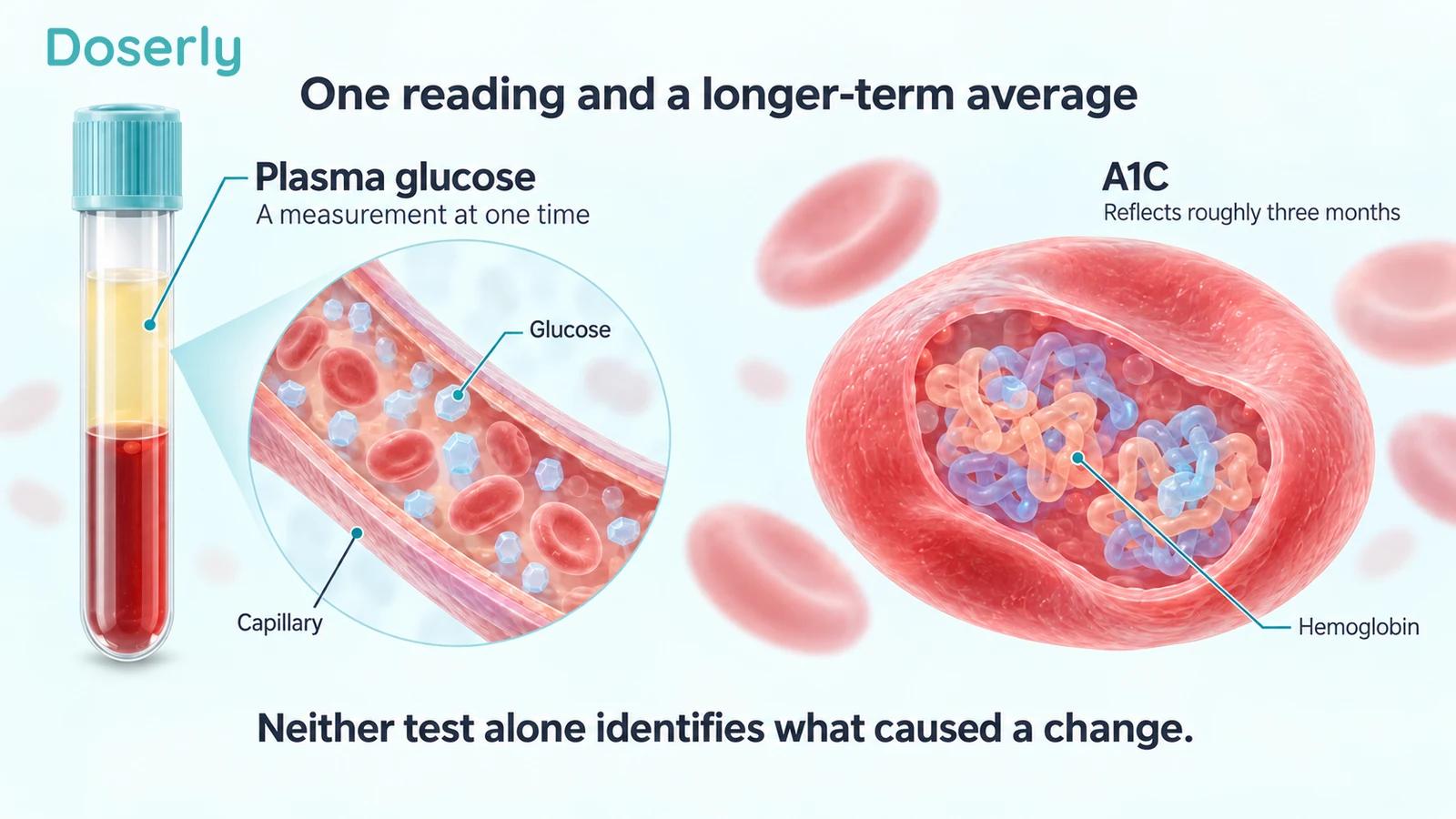
For example, a normal A1C shortly after a new exposure cannot exclude a recent glucose change that has not contributed much to the longer-term average. Conversely, one higher reading does not establish that a peptide caused a sustained problem. The timing of the measurement relative to the question matters.
NIDDK's professional testing guidance distinguishes laboratory diagnostic testing from home-meter readings and explains the need for confirmation when diagnosing diabetes in relevant circumstances. A clinician can interpret the pattern rather than treating an isolated number as either a diagnosis or an all-clear. NIDDK diabetes testing guidance.
Why baseline health changes the relevance of a study
The receptor-blockade participants were healthy, nonobese men. That selection helped investigate physiology, but it limits how directly the findings apply to someone with diabetes, substantial insulin resistance, multiple medicines or an acute illness. Study population.
A person who already needs treatment to control glucose may have less room for an additional metabolic disturbance. That doesn't allow us to predict the exact response to GHRP-6; it explains why background health belongs in the discussion. The absence of a precise risk estimate is not evidence that the baseline condition is irrelevant.
Studies also need to distinguish the drug's direct effects from changes in eating, weight, activity or other treatment. If someone becomes hungrier and changes their diet at the same time as starting a compound, a later glucose change could reflect several pathways. Without a controlled comparison, the contribution of each remains uncertain.
This is one reason to avoid claims that a particular meal schedule or supplement reliably prevents GHRP-6-related glucose problems. The studies reviewed here do not establish such a protective strategy. Adding another intervention can create additional uncertainty rather than resolving the first one.
Where does cortisol fit?
Cortisol is another hormone involved in metabolism, and GHRP-6's effects are not confined to GH. The early intravenous study in 18 healthy men found that cortisol and prolactin rose at its highest tested exposure. That is an acute endocrine observation, not a diagnosis of chronic cortisol excess. Bowers and colleagues.
It adds a reason to evaluate the whole response rather than treating GH as the only relevant measurement. It does not establish that cortisol caused the glucose changes in the pegvisomant experiment: those were different experiments, and demonstrating a causal pathway would require its own analysis. A clinician interpreting symptoms and laboratory results needs to consider the actual exposure and context, rather than assuming that every metabolic change has the same explanation.
What should a useful clinical discussion include?
Start with the reason for considering GHRP-6 and whether a relevant clinical benefit has been demonstrated. Then discuss your existing glucose history, medicines and any recent changes in symptoms, diet or activity. A clinician can decide which measurements are appropriate and when they would be informative.
If results have already changed, bring the original values with dates, units and testing conditions. A fasting laboratory result, a reading after a meal and an A1C percentage should not be placed in one undifferentiated list. The context makes them useful. NIDDK testing distinctions.
A record can establish that two events occurred near each other; it cannot by itself prove that one caused the other. At the same time, uncertainty about cause is not a reason to ignore a clinically important abnormal result. The immediate need may be to assess and manage the abnormality while its cause is investigated.
Do not adjust prescribed diabetes medicines or add insulin simply to accommodate an experimental peptide without medical direction. The evidence here supplies neither a validated GHRP-6 monitoring protocol nor a reliable medication-adjustment rule. If you already have diabetes, follow your established care plan and discuss new exposures with the treating team.
What evidence would reduce the uncertainty?
A useful longer-term GHRP-6 study would specify the formulation and route, include an appropriate comparator, and measure glucose outcomes prospectively. It would report participants' baseline metabolic health, changes in other medicines, discontinuations and adverse events.
For chronic exposure, repeated fasting measurements and longer-term markers could answer questions that a brief challenge cannot. Where relevant, carefully designed tests of insulin sensitivity could help distinguish mechanisms. Those measurements should accompany the clinical benefit being sought, rather than functioning as an isolated laboratory project.
The current evidence supports caution about sweeping claims in either direction. GHRP-6 cannot be called metabolically safe because it releases endogenous GH, and the receptor-blockade experiment cannot be presented as the inevitable glucose response of every user. The useful conclusion is that metabolism must be assessed directly and that long-term, population-specific information is still missing. The GHRP-6 risk section covers the broader safety picture.
Explore the research
- Muller et al., 2001: acute GHRP-6 under GH-receptor blockade.
- Hayashi et al., 1991: small intravenous/intranasal hormone study.
- Nass et al., 2008: the distinct oral drug MK-677.
- Endotext physiology: GH and metabolic regulation.
- NIDDK: A1C.
- NIDDK: diabetes and prediabetes tests.
- FDA GHRP-6 safety information.