
Supplements
October 16, 2026
Garlic and blood pressure: why the preparation matters
On this page
Garlic is familiar food, but a garlic supplement is not simply a measured serving of the garlic in dinner. Crushing, drying and aging change the compounds it contains. That matters when researchers test whether a preparation lowers blood pressure: a positive result for a defined aged extract doesn't automatically apply to powder, oil or raw cloves. Research on trial-product composition.
Some human trials have found lower blood pressure with aged garlic extract, particularly in people whose pressure remained high despite treatment. The evidence supports interest in the tested preparations as possible additions to care. It does not establish a reason to replace prescribed medication, and it does not promise the same response for everyone. NCCIH garlic overview.
What researchers are trying to change
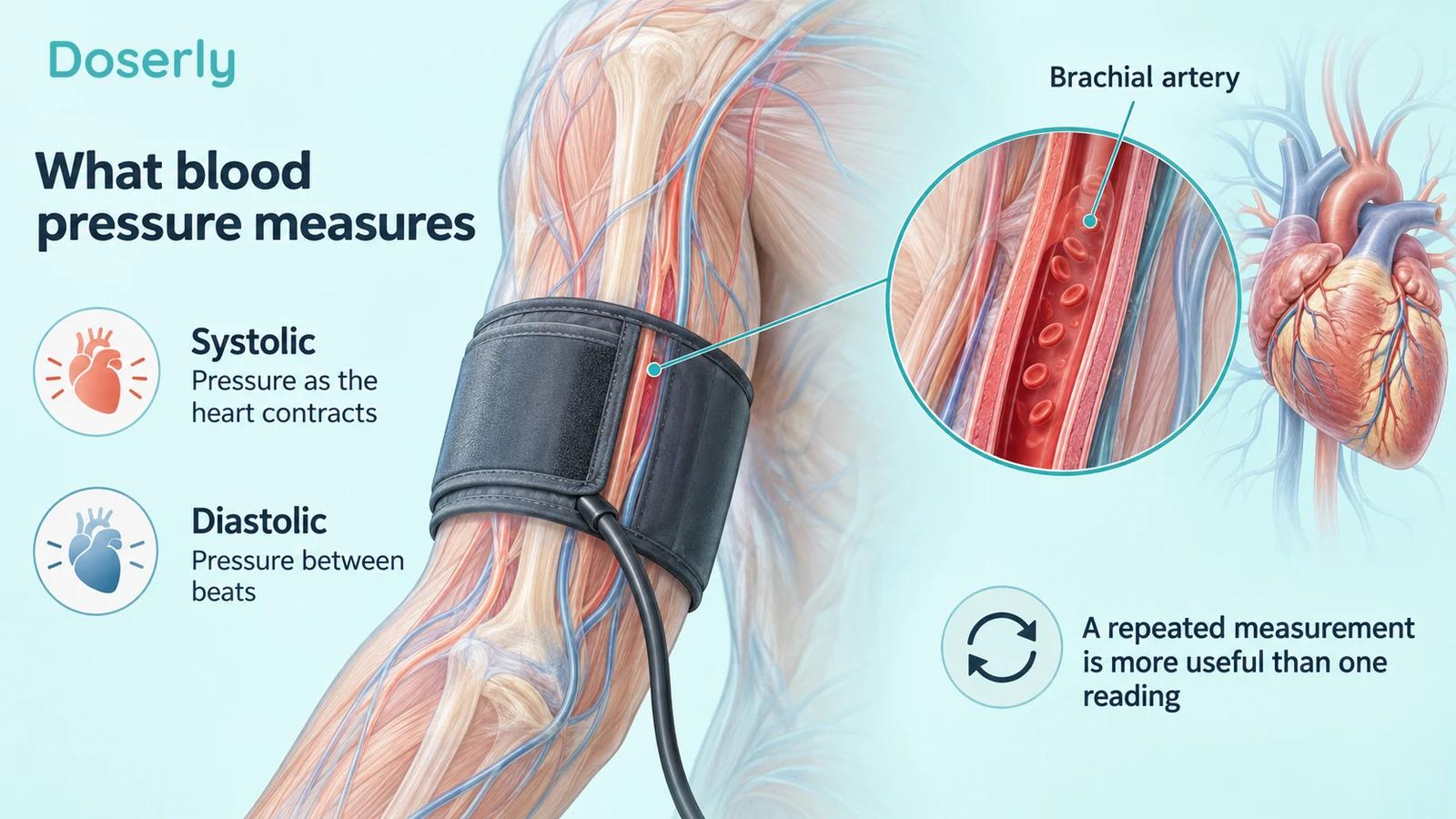
A blood-pressure reading contains two numbers. Systolic pressure, the top number, reflects pressure while the heart contracts. Diastolic pressure, the lower number, reflects pressure between beats. A trial can improve one without demonstrating a clear improvement in the other. A report of a “ten-point reduction” needs to identify which pressure, which participants and which comparison produced that number.
Blood pressure also varies between measurements. The American Heart Association recommends repeated home measurements with appropriate equipment and technique to help assess treatment. A single reassuring result after starting a supplement doesn't establish a sustained effect. Conversely, one high reading doesn't tell the whole story of someone's usual pressure. AHA home-monitoring guidance.
For garlic research, this means repeated measurements and a comparison group are especially useful. If participants enter a study after unusually high readings, some improvement may occur on later measurements even without an effective new treatment. Comparing the change with placebo helps account for that possibility.
Fresh garlic, powder and aged extract have different chemistry
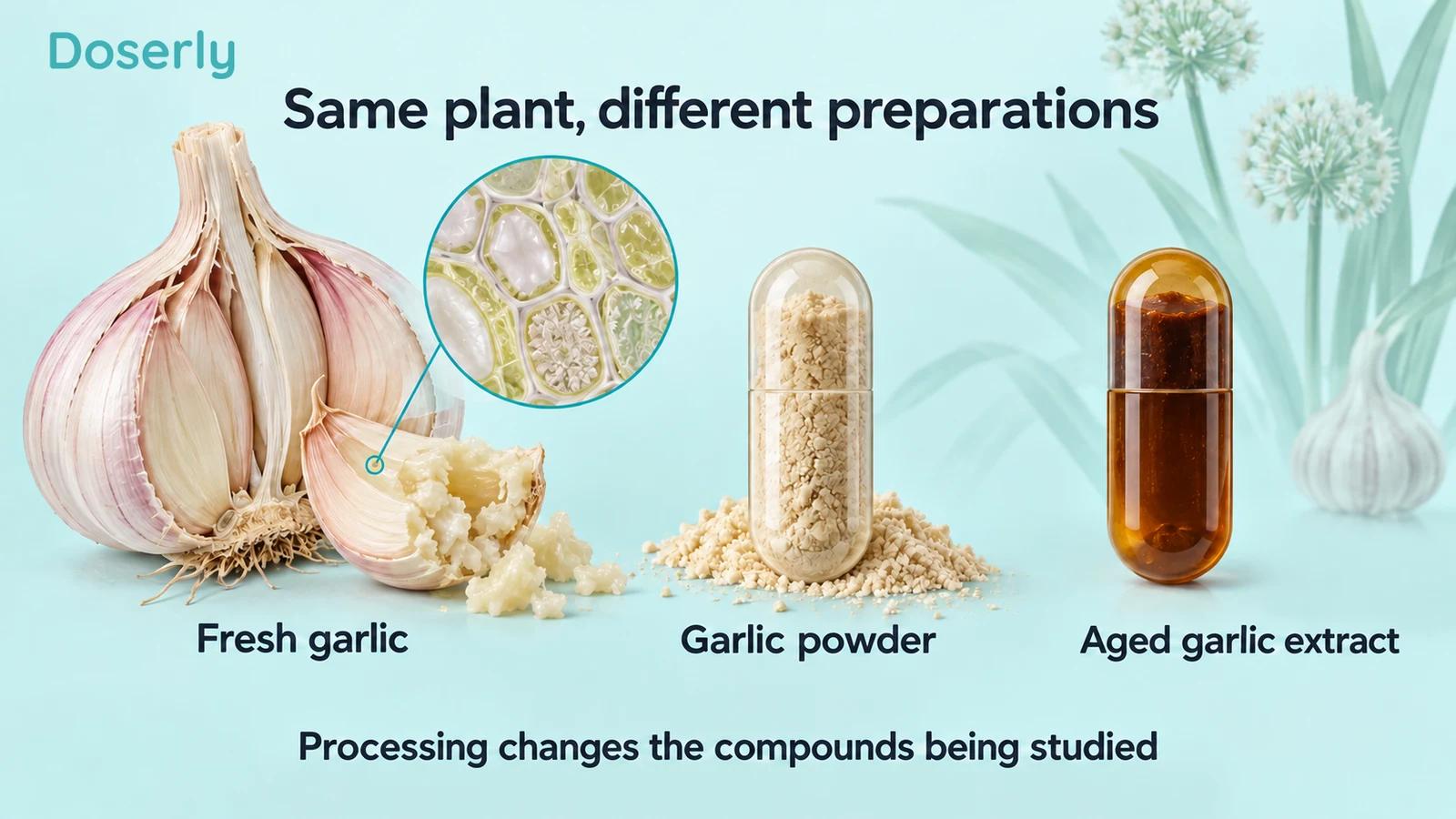
In fresh garlic, crushing brings together substances involved in forming allicin, one of garlic's sulfur-containing compounds. Whether a powder supplement releases comparable compounds depends on its processing and what happens during digestion. A product's potential to form allicin in a laboratory is not automatically its delivered exposure in a person.
Aged garlic extract has a different chemical profile and is often characterized by S-allylcysteine, abbreviated SAC. Clinical researchers can use the amount of this constituent to describe an extract more precisely. SAC content and total extract mass are separate measurements, just as the mass of a tea bag and the caffeine it supplies are separate measurements. Primary product-characterization study.
That does not establish SAC as the sole explanation for any blood-pressure change. Standardization helps identify the intervention; proving the contribution of an individual compound would require additional experiments. It also doesn't mean that eating garlic is useless. Culinary use and treating hypertension are simply different questions with different standards of evidence.
The early add-on trial: promising, but small
A 2010 randomized, double-blind trial enrolled 50 patients whose clinical records showed treated but uncontrolled hypertension. They received aged garlic extract or matching placebo for 12 weeks while the study assessed its role alongside existing antihypertensive treatment. The preparation supplied 960 mg of extract containing 2.4 mg of SAC daily. Original trial.
Among those whose systolic pressure was at least 140 mmHg at baseline, systolic pressure averaged 10.2 mmHg lower with garlic than control over treatment. Participants whose baseline systolic pressure was below 140 did not show a significant between-group change. The baseline distinction is important: the larger finding wasn't a universal effect across every person enrolled.
The trial was encouraging for an add-on question in a selected group. With only 50 participants and three months of observation, however, it couldn't establish rare adverse effects or prevention of strokes and heart attacks. It also didn't compare garlic directly against a first-line blood-pressure medicine, even though its authors discussed the magnitude alongside medication effects.
A comparison across separate studies can provide context, but it doesn't establish equal effectiveness. A fair head-to-head test would need comparable participants, treatment management, follow-up and outcome definitions.
Did more extract produce a larger response?
A subsequent dose-response trial enrolled 79 people with uncontrolled systolic hypertension for 12 weeks. It compared placebo with three amounts of aged garlic extract: 240, 480 or 960 mg daily, supplying 0.6, 1.2 or 2.4 mg SAC. Dose-response trial.
The middle-dose group had a significant systolic reduction of 11.8 mmHg compared with placebo over the trial. The highest-dose group did not show a clear, consistently stronger response; its eight-week comparison was not conventionally statistically significant. The lowest-dose group and diastolic comparisons did not show significant benefits.
This is not a neat “more is better” pattern. Small groups, variation in individual responses and tolerability can complicate dose comparisons. The study is a reason to investigate formulation and response carefully, not a basis for repeatedly increasing a retail supplement until the monitor shows a desired number.
The figures also illustrate why capsule counts don't transfer between products. Two capsules in one study supplied a defined amount of a particular extract and SAC. Two capsules from a different bottle may describe a different intervention entirely. Study doses here explain the experiment; they aren't personal dosing instructions.
The AGE at Heart trial: average response versus responders
The AGE at Heart trial, published in 2016, studied a daily aged extract providing 1.2 g of extract and 1.2 mg SAC for 12 weeks. Eighty-eight participants completed the randomized placebo-controlled study. The overall systolic reduction was 5.0 mmHg compared with placebo, with an uncertainty estimate reported as ±2.1 mmHg and P=0.016. Primary report.
The paper also reported larger reductions among responders: 11.5 mmHg systolic and 6.3 mmHg diastolic. Those numbers answer a different question. Selecting people who responded and then reporting their improvement produces a more favorable figure than averaging across the full study population. It doesn't tell a new user that they can expect that larger response.
The study explored central blood pressure, arterial stiffness and other cardiovascular markers too. Some findings were trends rather than statistically clear changes. A study that tests many outcomes can provide useful clues, but the existence of those measurements doesn't establish a benefit for every aspect of vascular health.
Notice another formulation detail: 1.2 g of extract supplied 1.2 mg SAC here, while a smaller extract mass supplied more SAC in the earlier trial. Extract weight alone cannot be used to rank those interventions. The composition reported by researchers is essential to understanding what was actually tested.
What does the broader review add?
A comprehensive review with a 2026 journal publication included 108 trials and 7,137 participants across cardiovascular risk factors. Its search covered literature through June 2024. Across the relevant blood-pressure analyses, average differences were about −3.71 mmHg systolic and −1.97 mmHg diastolic. The corresponding 95% confidence intervals were −5.07 to −2.36 and −2.86 to −1.08 mmHg. Updated meta-analysis.
The 108 trials were not all blood-pressure trials, and the total participant count should not be presented as the sample size for every outcome. The review pooled different preparations, health states and study durations. Its modest average effects can coexist with larger changes in selected hypertensive participants in smaller trials.
The review also examined cholesterol, glucose and inflammatory measures. Some improved, others did not. Its conclusions called for larger studies, longer follow-up and stronger methods. This helps locate garlic research in the right place: a body of potentially useful risk-marker findings with remaining clinical questions, rather than a universal cardiovascular treatment.
A cholesterol trial isn't a blood-pressure trial
A well-known 2007 study in 192 adults directly compared raw garlic, powdered garlic, aged garlic extract and placebo over six months. It found no significant LDL-lowering effect for the garlic preparations in participants with moderately elevated cholesterol. Researchers carefully characterized the products and checked their stability. Gardner and colleagues.
That result is relevant to broad claims about garlic and “heart health,” but it doesn't negate a separate blood-pressure result. LDL and blood pressure are different outcomes, and the populations differ. Equally, a favorable blood-pressure trial doesn't prove that a preparation lowers cholesterol. Keeping the actual endpoint in view makes apparently conflicting headlines easier to understand.
What should someone already taking medication consider?
Garlic supplements can cause abdominal discomfort, nausea, flatulence and odor, and may increase bleeding risk. NCCIH advises discussing their use with a healthcare provider, particularly when taking medicines such as anticoagulants or aspirin or when surgery is planned. Amounts above food use also raise additional questions during pregnancy and breastfeeding. NCCIH safety information.
Some small trials reported reassuring tolerability, including among participants using other medicines. That is useful but doesn't rule out uncommon interactions. A study with a limited number of exposed people cannot guarantee safety for every anticoagulant, procedure or combination.
The practical issue is the full regimen. Bring the exact supplement label and all medicines to a pharmacist or clinician. If blood pressure improves, medication decisions should be made with the treating professional, rather than using one lower reading as a reason to skip a prescribed dose. If symptoms occur after a change, note the timing and seek advice.
Making a follow-up result interpretable
AHA guidance recommends a validated automatic upper-arm device with a correctly sized cuff. Sit quietly before measuring, support the arm at heart level, and take repeated readings according to the plan agreed with your healthcare professional. Record the results rather than choosing only the best number. AHA home monitoring.
Include dates for starting or stopping a supplement, changes in prescribed treatment and symptoms. This record won't prove that garlic caused a change, but it can show whether the proposed plan is producing a consistent pattern and whether tolerability deserves attention.
Our garlic guide offers more background on preparations. The human evidence is most useful when it remains specific: a defined extract, a person with a defined blood-pressure problem, and a measured response over time. Familiarity with garlic as food doesn't remove the need for those details when using it as a supplement.
Sources
- Trial-product composition, stability and bioavailability.
- 2010 aged-extract add-on trial.
- Dose-response randomized trial.
- AGE at Heart randomized trial.
- Updated cardiovascular-risk-factor meta-analysis.
- Gardner et al., comparative garlic lipid trial.
- NCCIH garlic evidence and safety.
- AHA home blood-pressure monitoring.