
TRT
October 16, 2026
Free testosterone calculators: why two websites give different answers
On this page
Free testosterone is the portion of testosterone in blood that is not attached to a carrier protein. A calculator estimates that portion from other laboratory measurements. It can be useful when the total testosterone result does not tell the whole story, particularly when sex hormone-binding globulin, usually shortened to SHBG, is unusually high or low.
But a calculator does not measure another substance in your blood. It applies a mathematical model to information already collected. Two websites can therefore produce different answers without either receiving a different blood sample. They may use different equations, assume different albumin concentrations or display different units. Sometimes the results are not even describing the same fraction.
The useful response is to identify what changed between the calculations. Choosing the lowest result because it seems to explain symptoms, or the highest because it feels reassuring, leaves the original uncertainty unresolved. Here is how to make the comparison understandable.
What is being calculated?
Most circulating testosterone is attached to proteins. SHBG binds testosterone strongly; albumin binds it more loosely. Total testosterone includes the bound and unbound hormone. Free testosterone refers only to the unbound portion. Bioavailable testosterone conventionally combines free and loosely albumin-bound testosterone. Those labels should not be exchanged. Vermeulen and colleagues
Imagine opening two reports and seeing a larger number on one. Before asking which is right, check whether one says “bioavailable” and the other says “free.” A larger bioavailable concentration is expected because it includes an additional fraction. Comparing them as though both were free testosterone creates a disagreement that is really a labeling problem.
The free androgen index is another potential source of confusion. It is a ratio involving total testosterone and SHBG, not a measured free testosterone concentration. A percentage, an index and a concentration may all appear on a calculator page, but they answer different mathematical questions. The original method-comparison work examined these approaches separately rather than treating the index as interchangeable with free testosterone. Original validation study

Total testosterone includes protein-bound and free hormone. The protein shapes, hormone spheres and their relative sizes are conceptual; this is not a measured distribution in an individual blood sample.
Why the equation matters
A calculation needs a model of how testosterone binds to its carrier proteins. Some equations begin with chemical binding relationships. Others are empirical: researchers fit a relationship to measured results in a particular dataset. Even approaches based on binding chemistry can use different assumptions about how the binding sites behave.
The commonly used Vermeulen equation is named after a 1999 validation study. You may also encounter Ly equations or a model associated with Zakharov. These names refer to different published approaches, not different units for an identical calculation. A website that omits its equation leaves out information needed to interpret its result.
Binding research has also examined whether the two sites in an SHBG protein complex influence one another. This is called allostery: binding at one site changes the behavior of another. A 2015 primary study proposed a multistep model based on experiments investigating those interactions. It helps explain why researchers continue refining the mathematics. It does not mean that every implementation of a newer model is automatically the best clinical test. Zakharov and colleagues
For a reader comparing websites, the practical question is simple: “Which published equation does each tool implement?” If the answer is different, identical inputs need not produce identical outputs. If the answer is the same, units, albumin assumptions and software implementation become the next things to check.
How large can the differences be?
A 2018 study by Fiers and colleagues analyzed serum from 183 women and 146 men, measuring free testosterone with equilibrium dialysis followed by liquid chromatography–tandem mass spectrometry. The investigators compared the measurements with three calculation approaches.
In male samples from the European Male Ageing Study, the median ratio of calculated to measured free testosterone was 1.19 for Vermeulen, 1.00 for Ly and 2.05 for Zakharov. Individual agreement varied, and the relationship with SHBG differed across equations. The authors considered Vermeulen the most robust approximation in their comparison despite its tendency to overestimate. Fiers and colleagues
These ratios illustrate a method difference; they are not correction factors for your personal result. Dividing every Vermeulen estimate by 1.19 would assume that each sample behaves like the study's median. A median describes the center of a distribution, not an error that is identical in every person.
Earlier research reached a related conclusion using a larger collection of samples. A 2010 analysis compared five formulas against dialysis in 2,159 male serum samples from one research laboratory and found systematic discrepancies. Correcting albumin did not eliminate them. Ly and colleagues
Together, these studies explain why agreement needs to be demonstrated rather than presumed. They compare analytical methods, however; neither tells a clinician that using a particular website to select a testosterone dose improves symptoms or safety.
“Measured free testosterone” still needs a method name
Equilibrium dialysis separates free hormone from protein-bound hormone using a membrane. The small unbound molecules can cross; the larger proteins remain on the sample side. The hormone in the dialysate is then measured. The procedure requires controlled laboratory conditions.
A calculation takes another route: it combines total testosterone, SHBG and albumin using an equation. The Endocrine Society recommends an appropriate free testosterone assessment when total testosterone is borderline or SHBG is altered, using equilibrium dialysis or an accurate calculation. It specifically advises against direct analog free testosterone immunoassays because of their inaccuracy. Endocrine Society guideline
“Direct” on a laboratory menu can sound more authoritative than “calculated,” but that word alone is insufficient. Ask the laboratory or clinician for the actual method. A result from an analog assay should not be assumed equivalent to a properly performed dialysis measurement simply because both are labeled free testosterone.
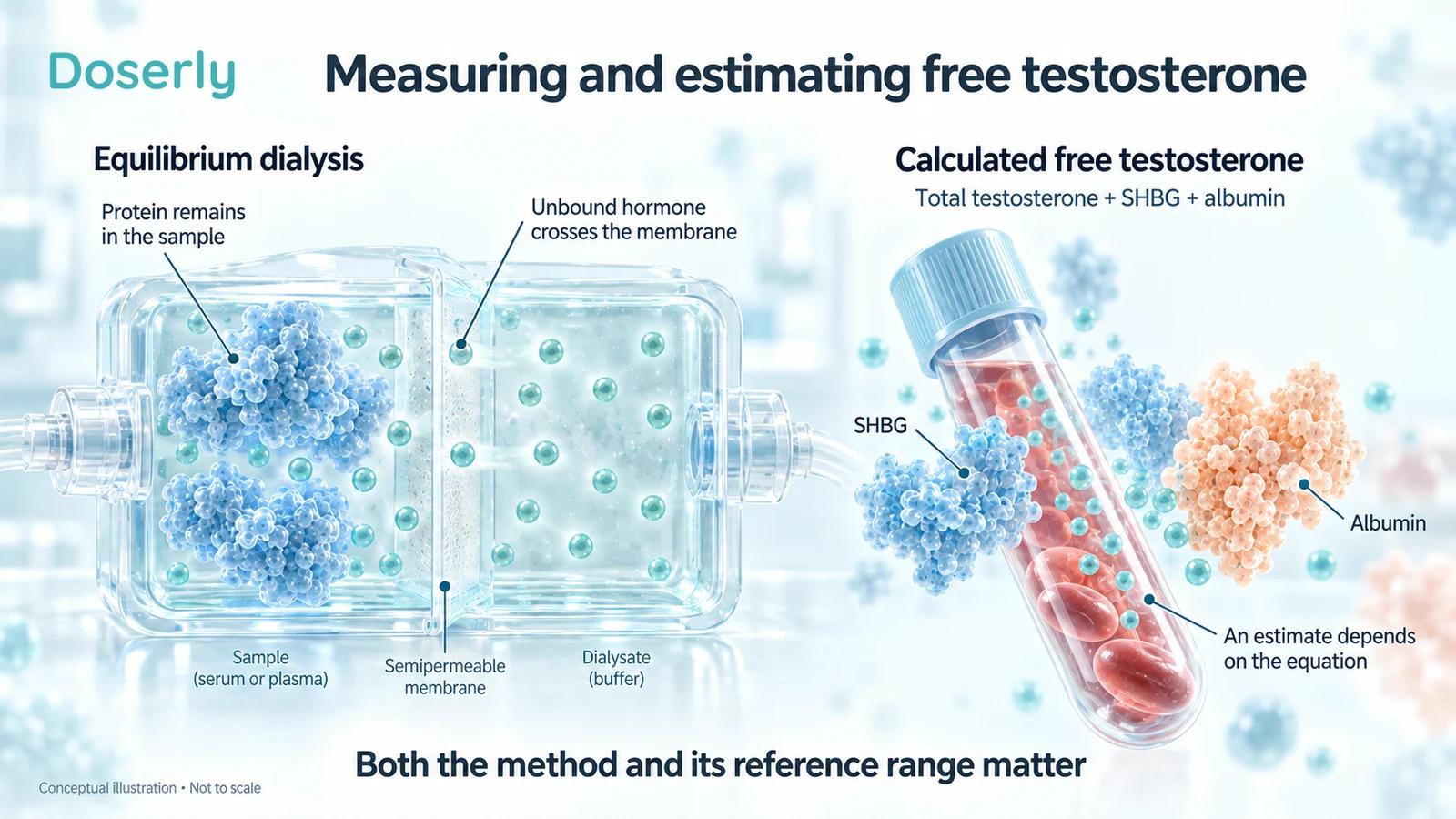
The left scene explains physical separation during equilibrium dialysis; the right represents calculation from other laboratory results. The equipment and molecules are conceptual, not an operating protocol or molecular-scale drawing.
Check units before looking for a biological explanation
Units are often the easiest discrepancy to resolve. A concentration is a quantity divided by a volume. Changing either part changes the displayed number without changing the sample.
For example, 10 ng/dL equals 100 pg/mL. There are 1,000 picograms in a nanogram and 100 milliliters in a deciliter, so the numerical multiplier is ten. These are illustrative values, not suggested treatment targets. If one tool displays 10 and the other 100 in those respective units, the results agree.
Albumin creates another common trap: 4.3 g/dL equals 43 g/L. Entering 43 into a field expecting g/dL is a tenfold input error. A well-designed form should reject implausible entries, but do not assume every calculator will.
Total testosterone may be entered in ng/dL or nmol/L, while free testosterone may be reported in pg/mL, ng/dL or pmol/L. Mass-to-molar conversion also involves the molecule's molecular weight; moving the decimal point by intuition is unreliable. Use the unit printed on the original report and the unit explicitly requested by the tool.
Keep the original laboratory document available. Copying just three numbers into a note can lose the units and specimen date, which are essential parts of what those numbers mean.
Was albumin measured or assumed?
Some calculators supply an albumin default so users can proceed when their report lacks that measurement. Others require an entered result. An assumed value is an estimate inside the larger estimate.
That does not mean a default always makes the calculation useless. It means two tools can be using different inputs even when you typed the same total testosterone and SHBG. Open any advanced settings and check whether albumin is fixed, optional or measured.
The 2010 formula comparison is useful here: albumin correction did not remove the underlying disagreement between methods. Measuring albumin therefore cannot be expected to make all equations converge. Ly method comparison
A useful record distinguishes “albumin measured on this sample” from “calculator default.” If albumin is substantially abnormal, explain that to the clinician interpreting the result rather than replacing it with an assumed normal value to produce a more familiar answer.
A precise calculation cannot repair an inaccurate input
A website may display several decimal places. That is computational precision, not proof that the biological estimate is accurate to that many digits.
If total testosterone is measured differently at two laboratories, calculated free testosterone can change even when the equation stays the same. The CDC's reference laboratory uses highly specific measurement procedures and reference materials to help laboratories check calibration. This process, called traceability, connects routine results with a common measurement reference. CDC Hormones Reference Laboratory
For tracking, save the laboratory and assay information alongside the value. If a noticeable change coincides with moving laboratories, ask whether the methods changed before concluding that hormone production changed by the entire reported amount.
The same reasoning applies to online tools. A redesigned calculator may have switched equations or defaults. Saving the method name is more useful than saving only a screenshot of its colored result indicator.
Why the reference interval belongs with the method
A reference interval describes results obtained in a reference population using a particular method. It is not a universal ruler that can be detached from that method and applied to any free testosterone number.
The Endocrine Society notes that free testosterone methods and calculations lack a harmonized reference range. Its diagnostic approach also requires compatible symptoms and consistently low values, generally confirmed with separate fasting morning measurements in an untreated man. Clinical guideline
Suppose one website calls a result low and another calls it normal. First compare the numbers in matching units, then compare the equations and the ranges. A different color may reflect a different cutoff rather than a different estimate. Neither color establishes the cause of fatigue, erectile difficulties or reduced sexual desire.
There is a reason free testosterone can still add useful information. In an observational study of 3,334 men aged 40–79, low calculated free testosterone despite normal total testosterone was associated with more androgen-related symptoms. The group with low total but normal free testosterone had a different pattern, including lower SHBG. This was an association study, not a trial proving who would benefit from treatment. Antonio and colleagues
A practical way to reconcile two results
Start with one original blood report and work through a single comparison:
- Confirm that both outputs are free testosterone concentrations.
- Match the total testosterone and SHBG values, including units and sample date.
- Check whether albumin was measured, entered or assumed.
- Identify each equation and convert the output to the same unit.
- Keep each result with its own method-appropriate reference interval.
If the discrepancy persists, bring both outputs and the laboratory report to the clinician. Ask whether it changes the clinical interpretation and whether laboratory clarification or another measurement would resolve it. Averaging the two estimates does not create a better validated result; it creates a new calculation with no established reference interval.
For people whose low total testosterone occurs alongside obesity or low SHBG, our guide to diagnosing obesity-related hypogonadism explains why the binding proteins matter. The goal is a coherent explanation of symptoms and laboratory findings, with a measurement method that can be followed consistently—not a search for the website that returns the preferred number.
Sources
- Vermeulen and colleagues, original method comparison, 1999
- Fiers and colleagues, calculation versus direct equilibrium dialysis, 2018
- Ly and colleagues, five formulas in 2,159 male serum samples, 2010
- Zakharov and colleagues, experimental SHBG binding model, 2015
- Endocrine Society diagnostic and treatment guideline, 2018
- CDC Hormones Reference Laboratory
- Antonio and colleagues, free testosterone and symptoms, 2016