
Supplements
October 16, 2026
Fenugreek and testosterone: the extract and the outcome both matter
On this page
Fenugreek has a familiar place in food and a much less settled place in testosterone marketing. Those two uses can look deceptively similar on a label. A seed used as a spice, a concentrated extract and a multi-ingredient “male vitality” tablet may all carry the same plant name while representing different exposures.
Human trials exist, including studies that reported favorable hormone or symptom findings. The overall picture is more mixed than a simple “boosts testosterone” claim suggests. A 2026 review found a small pooled signal for total testosterone, uncertain free-testosterone findings and very low certainty in both.
The practical task is to connect each claim to the preparation, population and outcome actually studied. A positive result in one category should not silently become a promise about the others.
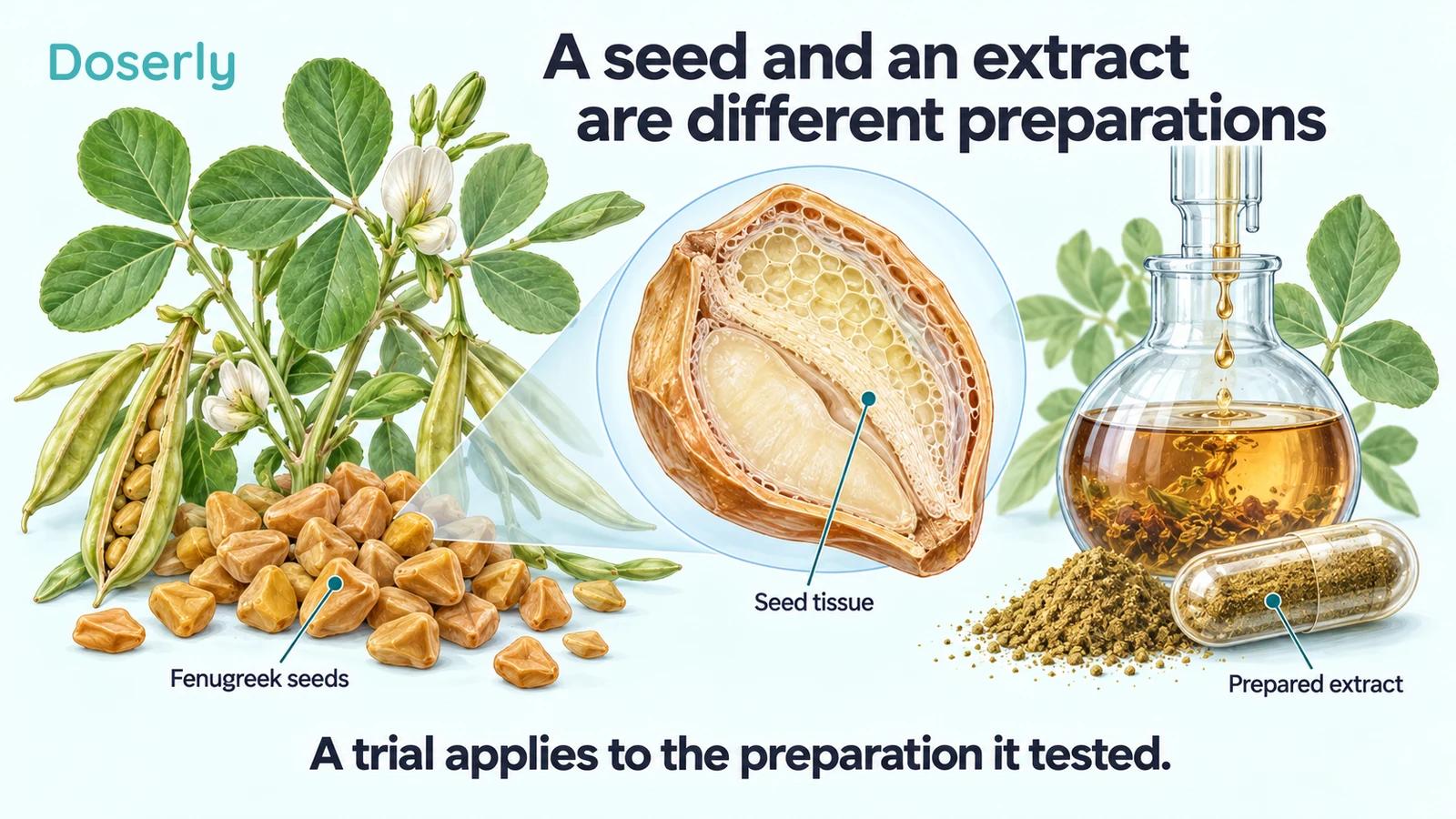
The plant name does not identify the intervention
Fenugreek is Trigonella foenum-graecum. Its seeds are used as food and as the starting material for various extracts. Trials have tested named proprietary preparations, different daily amounts and formulations containing additional nutrients. NCCIH overview.
An extract’s weight is not the same as an equivalent weight of whole seed. Extraction changes the mixture being delivered. Standardization can make a specified constituent more consistent, but it does not prove that the constituent causes a clinical benefit or that differently standardized products are interchangeable.
For example, a study of a seed extract plus minerals answers a question about that formulation. A separate trial in which every group receives the same nutrients can better isolate the added extract. The methods—not the front-label word “fenugreek”—tell you which comparison was made.
The Doserly fenugreek guide covers broader ingredient context. Here, the focus is whether the testosterone and male-health claims survive a closer look at the trials.
A positive study in older men is one part of the evidence
A 2016 randomized, double-blind trial enrolled 120 healthy men aged 43–70. Participants received a specialized seed extract at 600 mg daily or placebo for 12 weeks. Its primary outcome was an aging-male symptom questionnaire; sexual function and serum testosterone were secondary outcomes. Primary trial.
The investigators reported improvement in symptom scores, aspects of sexual function, and total and free testosterone compared with placebo. Those findings are relevant and should not be dismissed merely because the intervention is a supplement.
They are also bounded. The trial did not establish that any fenugreek preparation treats diagnosed hypogonadism, and healthy middle-aged or older volunteers are not interchangeable with every person concerned about testosterone. A 12-week observation cannot establish years of benefit or safety.
The hierarchy of outcomes helps interpret the paper. Its main question concerned symptoms, with hormone measures providing additional information. Marketing that presents the study solely as a testosterone experiment can miss both what was measured first and whether the symptom change would matter to a particular patient.
The earlier libido trial used a formulation
A 2011 randomized trial involved 60 healthy men aged 25–52 without erectile dysfunction. It compared a standardized fenugreek extract and mineral formulation with placebo over six weeks. The investigators assessed sexual-function questionnaire domains and quality-of-life measures. Primary trial.
They reported positive findings in aspects of libido, including arousal and orgasm. Participants also reported greater satisfaction with some measures of strength, energy and well-being, while mood and sleep did not improve. Testosterone and prolactin remained within reference ranges.
This is useful sexual-well-being evidence for a particular formulation. It is not equivalent to demonstrating that raising testosterone caused the reported benefit. A hormone remaining in the normal range is not a finding of treatment for hormone deficiency.
Self-reported satisfaction with muscle strength also differs from a measured strength test. Both can be worth studying, but the wording should preserve the distinction. A person saying they feel stronger is not the same endpoint as lifting more weight under a standardized protocol.
The 2024 trial separates baseline change from placebo comparison
A more recent randomized study tested a different fenugreek preparation in men recruited between ages 40 and 80. Ninety-five participants completed 12 weeks. Groups received no extract or one of three extract amounts, with the same accompanying vitamins and minerals across groups. Primary trial and full methods.
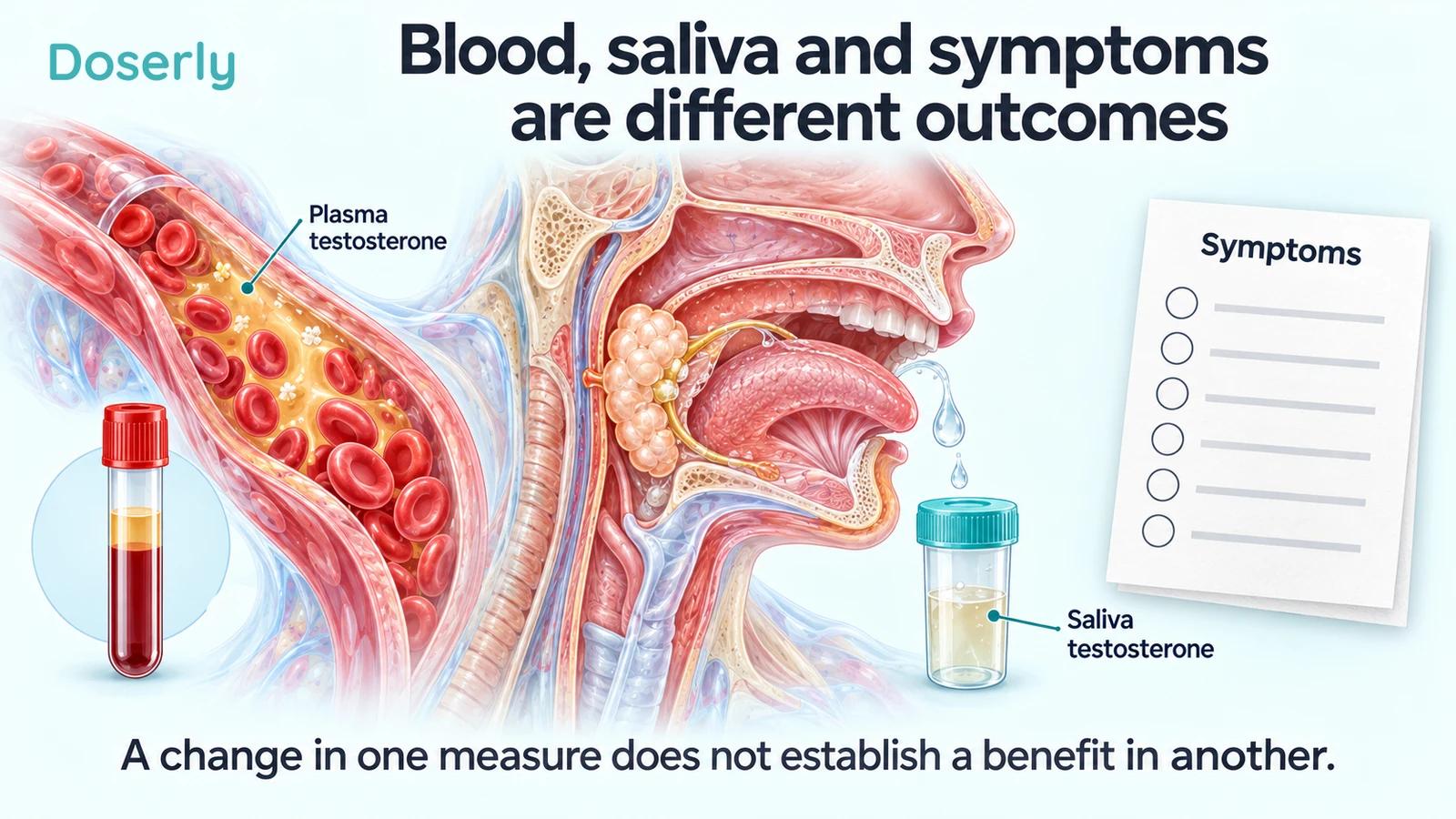
Across extract recipients, plasma total testosterone and a calculated free-testosterone index increased relative to baseline, but the corresponding overall comparisons with placebo were not statistically significant. Saliva testosterone did show a significant overall difference versus placebo. The investigators found no significant subjective benefit.
The study therefore does not support saying that every testosterone measurement improved over placebo, or that participants experienced better libido because a laboratory result changed. It also distinguishes a calculated index from a direct free-testosterone measurement.
The added nutrients are not an automatic explanation for an extract-versus-control difference because the control received them too. They remain part of the tested setting, however, so the study does not directly reproduce taking a standalone retail powder without those nutrients.
Why “up from baseline” is an incomplete claim
Imagine a study in which testosterone rises in both the extract group and the control group. Reporting only the extract group’s before-and-after change makes the intervention look more persuasive than the comparative result.
Participants can change for reasons unrelated to the study treatment. Measurement variability, ordinary biological variation and other changes over time all matter. Randomization and a concurrent control group are intended to help distinguish those influences from an intervention effect.
A nonsignificant difference does not prove that the true effect is exactly zero. It means the study did not establish the claimed difference under its analysis. The appropriate response is to describe the uncertainty, not switch to a more favorable within-group comparison and present it as the answer.
This is particularly important when many doses, timepoints and endpoints are measured. A positive finding at one timepoint does not automatically describe the whole trial. The question remains which comparison was planned and how consistently the result supports the clinical claim. The 2024 trial illustrates why baseline and placebo comparisons need separate reporting.
The 2026 review makes the uncertainty explicit
A systematic review published in 2026 included 13 randomized placebo-controlled studies, but only six contributed to the total-testosterone analysis and five to the free-testosterone analysis. The rest supplied other hormone or contextual male-health information. Systematic review.
The pooled total-testosterone estimate was small: a standardized mean difference of 0.25, with a 95% confidence interval from 0.02 to 0.48. The free-testosterone estimate was imprecise, crossed no effect and varied substantially between studies. The reviewers rated certainty for both outcomes as very low; none of the 13 studies received an overall low-risk-of-bias judgment.
A standardized mean difference is not a 25% testosterone increase. It expresses a difference relative to variability in the measurements so that studies can be combined. It does not tell an individual how many ng/dL their result will change.
The review’s conclusion was correspondingly restrained: the evidence does not support clinical or commercial testosterone-boosting claims. That assessment incorporates positive trials while judging their reliability and consistency.
Strength findings need their own interpretation
A 2010 trial studied 49 resistance-trained men during an eight-week supervised training program. It compared a proprietary fenugreek extract with placebo and reported advantages in bench-press and leg-press strength and body-fat changes. It did not find advantages in every performance measure; muscular endurance and Wingate power outcomes were among the negative comparisons. Primary training trial.
This is evidence about an extract used alongside a specific training program. It does not establish that a sedentary person taking a capsule will obtain the same changes, or that a hormonal mechanism caused the strength result.
A separate 2020 trial in 57 healthy, generally young men reported improvements in grip strength, anxiety, aging-male symptoms and some quality-of-life indicators with two extract amounts over 60 days. Its outcomes are relevant to function and experience, but they do not establish treatment of diagnosed testosterone deficiency. Primary trial.
These studies help explain why the literature cannot be summarized with one universal verdict about every possible benefit. There are positive signals worth testing more rigorously. There are also different preparations, short durations and different outcomes, which limit the confidence of a broad commercial promise.
Symptoms should lead the clinical question
A person seeking more energy may care little about the hormone concentration itself. Someone seeking help for erectile dysfunction has a different goal from someone trying to improve training performance. Someone with repeatedly low testosterone and compatible symptoms needs a clinical evaluation.
The Endocrine Society recommends diagnosing hypogonadism only when symptoms or signs accompany unequivocally and consistently low testosterone, confirmed with repeat morning fasting measurement. Appropriate free-testosterone assessment is used in selected circumstances. Clinical guideline.
A saliva finding in a supplement trial does not replace that diagnostic process. Nor does a broad aging-male symptom score prove that every participant has an androgen deficiency. Questionnaires can capture real distress without identifying its cause.
Before attributing a personal change to fenugreek, consider what else changed: exercise, sleep, medicines, illness or expectations. A brief record can clarify the chronology for a clinician, but it cannot recreate the protection against bias offered by a controlled trial.
Food familiarity is not a complete safety assessment
Fenugreek is generally considered safe in the amounts normally found in food. Concentrated supplemental use raises additional questions. NCCIH lists digestive symptoms, potentially harmful blood-sugar reductions at large amounts, and allergic reactions, including serious reactions. NCCIH safety information.
That makes medication review relevant, particularly for someone taking treatment that lowers blood glucose. A supplement marketed for testosterone still has other biological effects; the marketing category does not limit its interactions.
NCCIH also advises against amounts greater than those found in food during pregnancy and notes limited safety information during breastfeeding. Findings in male volunteers cannot establish safety for these populations.
A short trial reporting no adverse events provides limited reassurance for its participants and duration. It cannot exclude uncommon reactions or establish long-term safety for every extract. Describing fenugreek as a familiar spice should not erase the distinction between culinary exposure and a concentrated daily product.
A useful way to examine a product claim
Start with the study the seller actually cites. Identify the named extract, the daily amount, the participant group and whether other ingredients were included. Then locate the comparison: against baseline, against placebo or between doses.
Next, name the outcome precisely. Total testosterone, calculated free-testosterone index, saliva testosterone, sexual desire, erection frequency and measured grip strength are not interchangeable. A claim becomes easier to assess when it says exactly what improved.
Finally, ask whether the result is large and reliable enough to matter. Statistical significance does not establish a noticeable benefit, and a laboratory change does not explain a symptom without additional evidence. Product testing may establish identity or selected quality measures, but it cannot supply a missing clinical result.
Fenugreek’s human research is worth reading closely because it contains more than a simple positive or negative headline. At present, it offers preparation-specific signals with substantial uncertainty. It does not justify treating an arbitrary fenugreek capsule as a dependable testosterone treatment. 2026 evidence review
Sources
- Testofen trial in older men, 2016
- Extract and mineral formulation libido trial, 2011
- Blood plasma and saliva trial, 2024
- Systematic review of testosterone-related outcomes, 2026
- Resistance-training trial, 2010
- Psychological and physical health trial, 2020
- NCCIH fenugreek overview and safety
- Endocrine Society testosterone guideline