
Supplements
October 16, 2026
Fadogia agrestis: what the animal studies do—and do not—show
On this page
Fadogia agrestis is often discussed as though the remaining question is how much to take. The research raises an earlier question: has a useful and acceptably safe intervention been demonstrated in people at all?
For this review, searches of the primary literature and ClinicalTrials.gov on October 15, 2026 did not identify a controlled human trial establishing a testosterone, libido or performance benefit. The evidence behind those claims is largely animal research. That research includes both effects that attracted interest and findings that raised concerns about testicular, liver and kidney function.
Neither half should disappear from the story. An animal experiment cannot establish that a retail capsule benefits humans. A toxicity signal in rats cannot quantify a person’s risk, either. Together, they make confident human dosing advice especially difficult to defend.
The early experiment measured rat behavior and testosterone
A frequently cited 2005 study tested an aqueous extract of Fadogia agrestis stem in male albino rats. Researchers administered the preparation daily and assessed sexual behavior and serum testosterone on days 1, 3 and 5. They reported increases in testosterone and changes in mating-related behavior. Primary animal study.
The preparation matters: it was a water-based stem extract, not an unspecified root powder or a combination supplement. The observation period matters, too. A five-day experiment does not establish what happens during months of use.
The investigators proposed that the testosterone change might help explain the behavior. That is a possible interpretation of the animal findings, not confirmation of a human hormonal mechanism. Claims that the plant reliably stimulates a particular reproductive hormone pathway in people go beyond what this experiment established.
Human sexual desire is also not measured by counting rat mating behaviors. Relationships, distress, medication effects and satisfaction matter to clinical outcomes. The animal observations can motivate research; they cannot substitute for asking people whether a treatment meaningfully improves their lives.
A later experiment used an induced disease model
A 2022 study examined 30 male rats divided into six groups of five. Most groups had erectile dysfunction induced with paroxetine. Researchers compared several extract amounts with control conditions and a sildenafil group, measuring biochemical processes in penile and testicular tissues. Primary animal study.
The authors reported changes involving nitric oxide, cyclic GMP, enzymes and oxidative-stress measures. These are biologically relevant signals in that experimental model. They do not demonstrate treatment of erectile dysfunction in men, or reversal of antidepressant-related sexual symptoms in humans.
The presence of sildenafil as a comparator also needs care. Finding that some laboratory measures move in similar directions does not establish that the plant is clinically equivalent to sildenafil. Equivalence would require an appropriately designed human comparison with meaningful outcomes and safety assessment.
The investigators themselves placed clinical trials after these findings. A retail product should not be treated as if that next stage has already succeeded. Anyone experiencing sexual effects while taking an antidepressant should discuss them with the prescriber rather than stopping treatment or adding an untested hormonal supplement.
The testicular findings deserve equal attention
In a 2008 experiment, rats received a stem extract for 28 days, followed by assessment of recovery over ten days. Researchers found changes in several biochemical indices of testicular function and interpreted the pattern as evidence of adverse effects. Some measures recovered, mainly at the lowest studied amount. Primary testicular study.
This result cannot be compressed into either “fadogia causes permanent infertility” or “the low dose is safe.” The experiment did not establish a human infertility rate. Recovery of some markers over a limited interval also does not validate a safe human exposure or prove that every relevant reproductive outcome recovered.
There is a reporting wrinkle in the accessible abstract: acid phosphatase appears in both the increased and decreased lists. That inconsistency is another reason to avoid constructing a detailed biochemical mechanism from the abstract alone. The broader adverse interpretation and limited recovery observation are clear enough to report without inventing a resolution.
A larger testis-to-body-weight ratio, also described in the study, should not be marketed as evidence of healthier testicles. Organ size and organ function are different measurements. A change can occur alongside biochemical findings the investigators considered unfavorable.
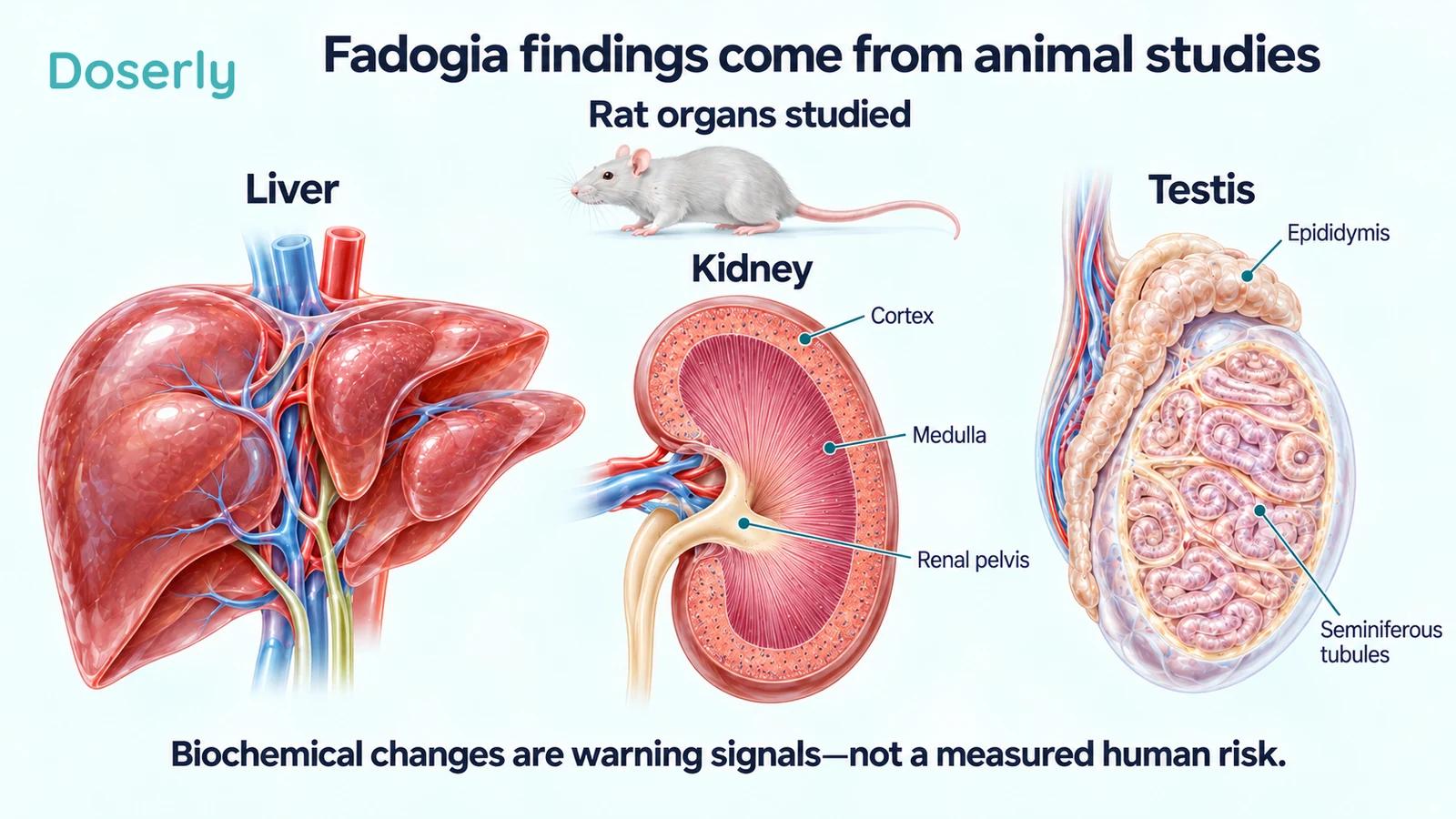
Liver and kidney markers changed without obvious illness
A 2009 study examined the same general type of aqueous stem extract in male rats over 28 days. It reported altered enzyme activities in liver and kidney tissue, corresponding increases in serum and increased serum malondialdehyde, a marker used in assessing lipid peroxidation. The authors interpreted the findings as consistent with compromised cell-membrane integrity. Primary toxicity study.
The study also reported no deaths and no observed overt toxicity symptoms during the experiment. Organ-weight ratios did not differ significantly from controls. Those observations belong beside the biochemical findings.
The combination illustrates why “the animals looked fine” is an incomplete safety argument. An experiment may detect a laboratory concern before obvious illness appears. Conversely, an abnormal experimental marker is not automatically the same as diagnosed clinical organ failure.
The cautious interpretation is that these findings create a safety question requiring better investigation. They do not provide a way to calculate an individual user’s chance of liver or kidney injury, and they do not identify a monitoring schedule that makes unsupervised use safe.
A human case report cannot isolate fadogia
A 2025 conference case report described a man with fatal multiorgan illness whose family reported testosterone injections and use of several other products, including fadogia, trimethylglycine and anastrozole. It is a serious clinical observation, but it involves multiple exposures and important medical context. Primary conference report.
It would be inaccurate to describe this as proof that fadogia alone caused the death. The report cannot separate the contributions of the different substances or establish an incidence rate. A case report also does not test whether a supplement provides any benefit.
Its practical value is narrower: clinicians need a complete account of medicines, injections and supplements when someone becomes unwell. A patient may think of a botanical capsule as unrelated to prescribed or nonprescribed hormones, but the full exposure history matters.
This example also shows why “no controlled human trials” does not mean “nothing has ever been reported in a person.” Evidence comes in different forms, and each form answers a different question.
There is no validated human conversion from the rat amounts
The animal papers used amounts expressed per kilogram of body weight. Multiplying that number by your own weight is not a validated way to choose a human supplement dose.
Even formal approaches to translating animal exposures do not establish a dose that is both effective and safe. They operate within a larger development process that considers the preparation, absorption, metabolism, toxicology and human observations. Here, the clinical benefit and safety evidence needed to complete that process is missing.
Differences in plant part and extraction add another uncertainty. The same weight of two powders can contain different mixtures of compounds. A retail label’s milligram amount therefore cannot establish that it matches either the exposure producing an interesting animal effect or an exposure evaluated for toxicity.
Cycling a product does not repair that gap. The rat recovery observations do not validate a schedule of weeks on and weeks off in people. Nor is there a demonstrated protective supplement that can be added to make fadogia use safe.
Product testing revealed another problem: composition varies
A 2018 analytical study developed a method to examine selected chemical constituents in Fadogia agrestis plant material and dietary supplements. Of 17 supplements tested, 12 contained the measured phenolic compounds, while those compounds were not detected in five. Primary analytical study.
That finding supports concern about chemical consistency. It should not be overstated as proof that every product without detectable markers was counterfeit. The test examined specified compounds under a particular analytical method; it was not a human efficacy trial or a universal authentication verdict.
It also cannot tell us the composition of every product on sale today. The tested sample is a snapshot. Nevertheless, it makes a concrete point: citing a plant study does not establish what is in a capsule bearing the plant’s name.
The Doserly fadogia agrestis guide provides broader ingredient context. For this decision, identity, clinical benefit and safety remain three separate questions.
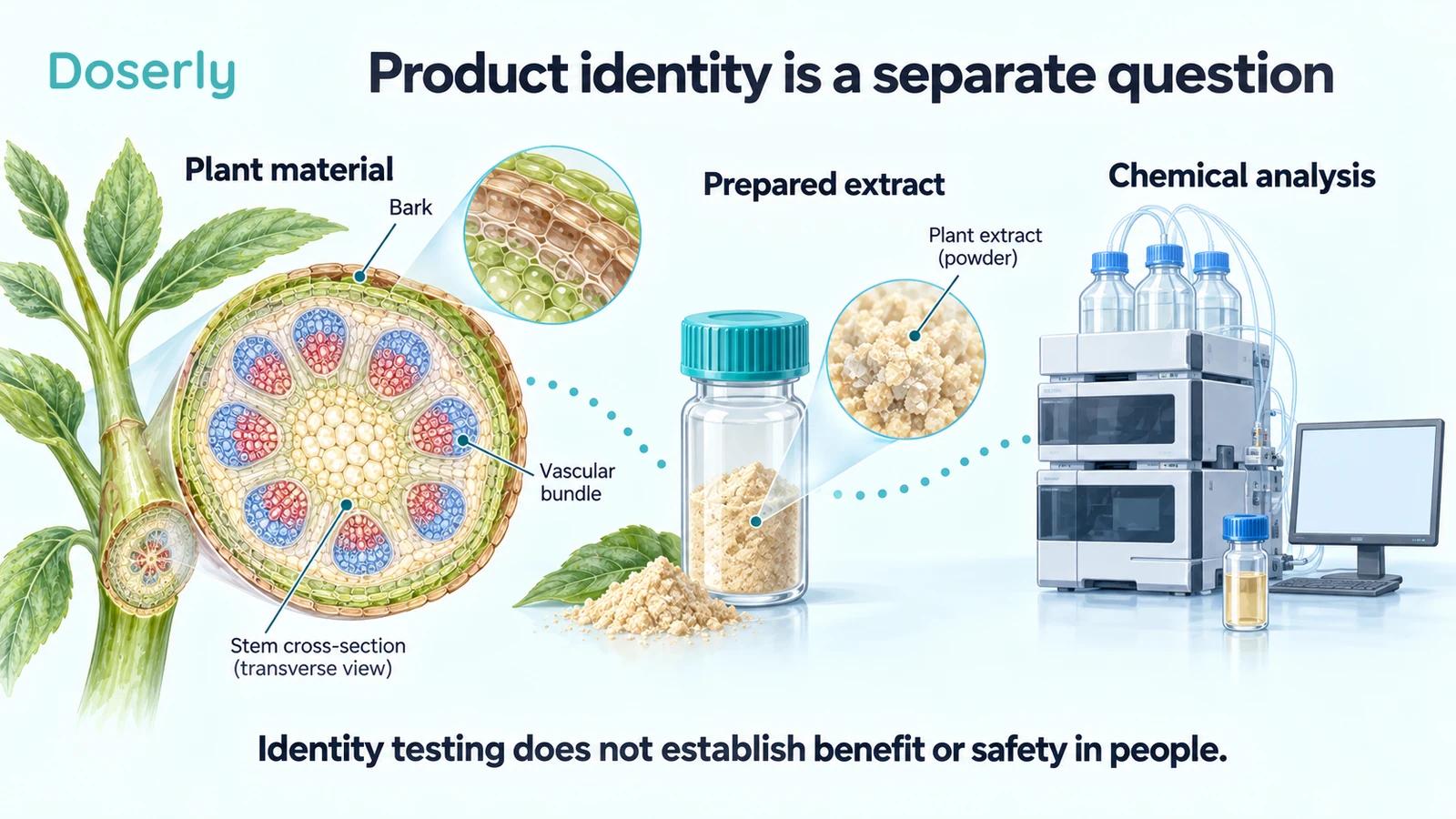
A certificate can answer only the questions it tested
If a seller supplies a certificate of analysis, useful details include the product and lot number, sample date, laboratory, method, analytes and actual results. A document without a clear link to the purchased batch offers less reassurance than its presentation may suggest.
An identity or contaminant test can still be valuable. It may reduce a specific uncertainty about substitution or an unwanted substance. It cannot establish that a correctly identified plant is effective, or that its own constituents are safe at a particular amount and duration.
The FDA explains that supplements are not approved for safety and effectiveness before marketing in the way drugs are. Manufacturing obligations and a product’s availability do not turn it into a clinically validated treatment. FDA supplement questions and answers.
That distinction is especially relevant when a product combines fadogia with other ingredients. A study of another botanical cannot be borrowed as evidence for fadogia, and a result from a mixture cannot identify which ingredient caused it.
Bring the underlying concern into focus
Persistent fatigue, low sexual desire and erectile difficulty deserve a clearer description than “low testosterone symptoms.” A clinician can use the pattern, duration, medicines and relevant testing to investigate possible causes.
For suspected hypogonadism, the Endocrine Society recommends compatible symptoms plus consistently low testosterone, with repeat morning fasting testing to confirm the result. A single result or an online symptom checklist is insufficient. Clinical guideline.
If you already use fadogia, include the exact product, amount, start date and other exposures in that discussion. Feeling normal does not prove long-term safety, while feeling unwell does not identify the ingredient responsible. Routine self-ordered blood tests cannot fill the absence of a validated human safety program.
For fertility concerns, a testosterone result is not a substitute for a reproductive assessment. The animal testicular findings make unsupported claims about fertility enhancement particularly inappropriate.
What would change the conclusion?
Useful progress would include a chemically characterized preparation, adequate toxicology and controlled human studies with a justified exposure. Trials would need outcomes that match the claim: meaningful sexual function, symptoms or performance, alongside appropriate safety observations.
Until then, fadogia is an example of a research signal reaching the market before its clinical meaning is established. The evidence supports investigating the plant. It does not support treating animal testosterone changes as a ready-made human treatment plan.
Sources
- Rat sexual behavior and testosterone study, 2005
- Rat testicular-function study, 2008
- Rat liver and kidney study, 2009
- Paroxetine-treated rat study, 2022
- Chemical analysis of plant material and supplements, 2018
- Confounded human conference case report, 2025
- ClinicalTrials.gov search checked October 15, 2026
- FDA dietary supplement questions and answers
- Endocrine Society testosterone guideline