
Peptides
October 16, 2026
Thymosin beta-4: why eye drops, wound gels and injections differ
On this page
Thymosin beta-4 is a small protein involved in the way cells organize actin, a structural protein that helps them move and change shape. That connection to cell movement has attracted interest in wound healing and tissue injury. Researchers have tested preparations containing thymosin beta-4 on the eye, on skin wounds and directly into the bloodstream.
If you're looking for help with an injury, that list can sound reassuring: several kinds of human studies exist. But each preparation reaches the body differently, and each study answers a different question. An eye-drop trial cannot establish that an injection treats a tendon injury. A short intravenous safety study cannot establish that a skin gel heals chronic wounds. The formulation, route, condition and outcome all belong in the description of the evidence.
The distinction is useful when someone offers you a paper as support for a treatment. Rather than simply asking whether thymosin beta-4 has been studied in humans, ask whether the study tested the particular treatment and benefit being proposed. Our thymosin beta-4 guide introduces the molecule and its wider research history.
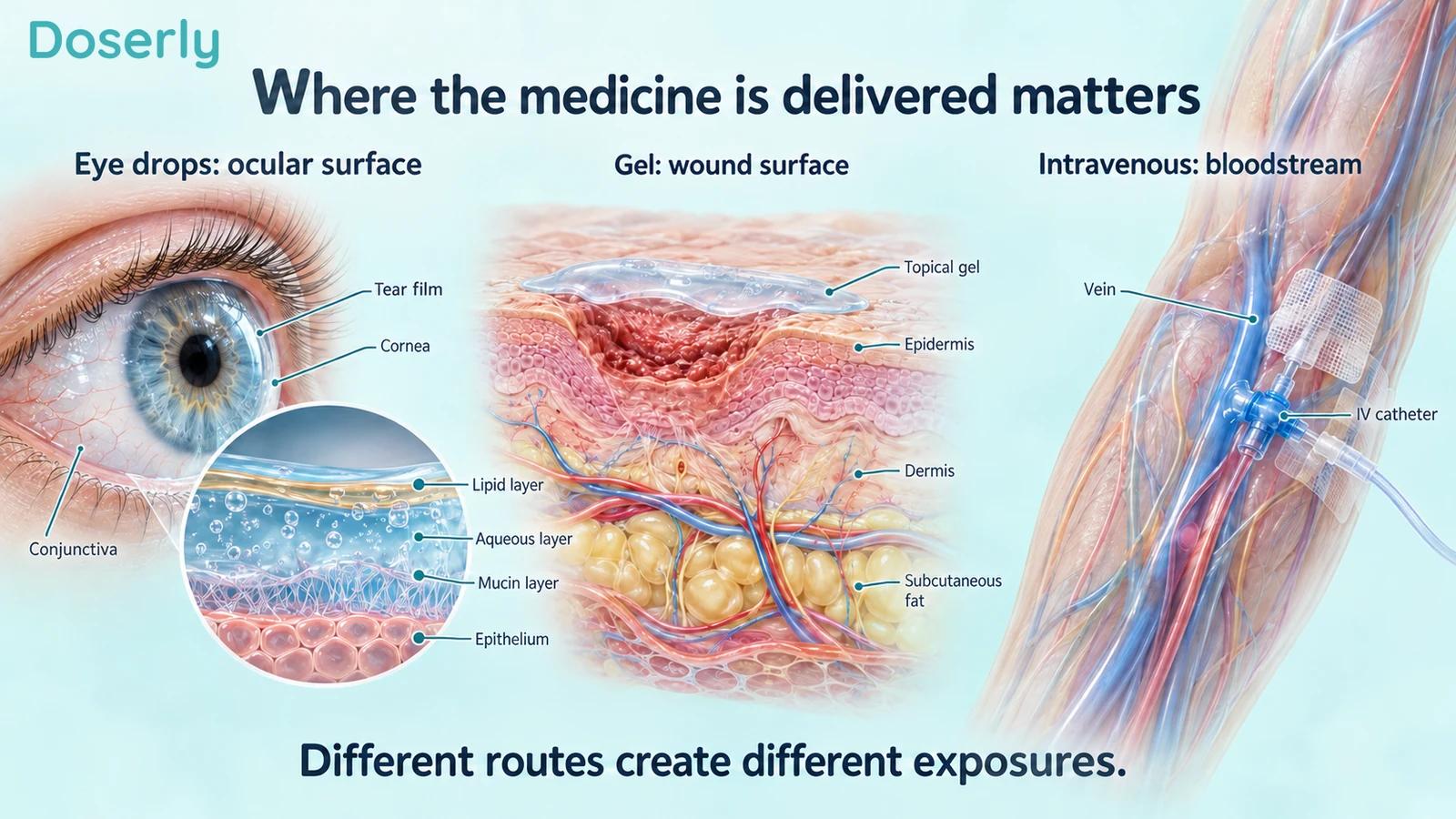
What changes when the route changes?
A medicine's route of administration is how it enters or contacts the body. Ophthalmic drops are applied to the eye. A topical gel is applied to a surface such as skin. An intravenous, or IV, preparation enters a vein. A subcutaneous injection goes into tissue beneath the skin and must be absorbed from there.
These are different exposure situations. Contact time, tissue barriers, formulation ingredients and absorption can influence how much intact peptide reaches a target. A number on a vial does not tell you how much reaches the cornea, tendon or heart. Nor does detecting a substance in blood prove that enough reaches a particular injured tissue to change its function.
Researchers describe these questions as pharmacokinetics: how a drug's concentration changes as the body absorbs, distributes and eliminates it. Pharmacodynamics concerns what the drug does at those exposures. A plausible mechanism connects the two, but clinical benefit still needs testing.
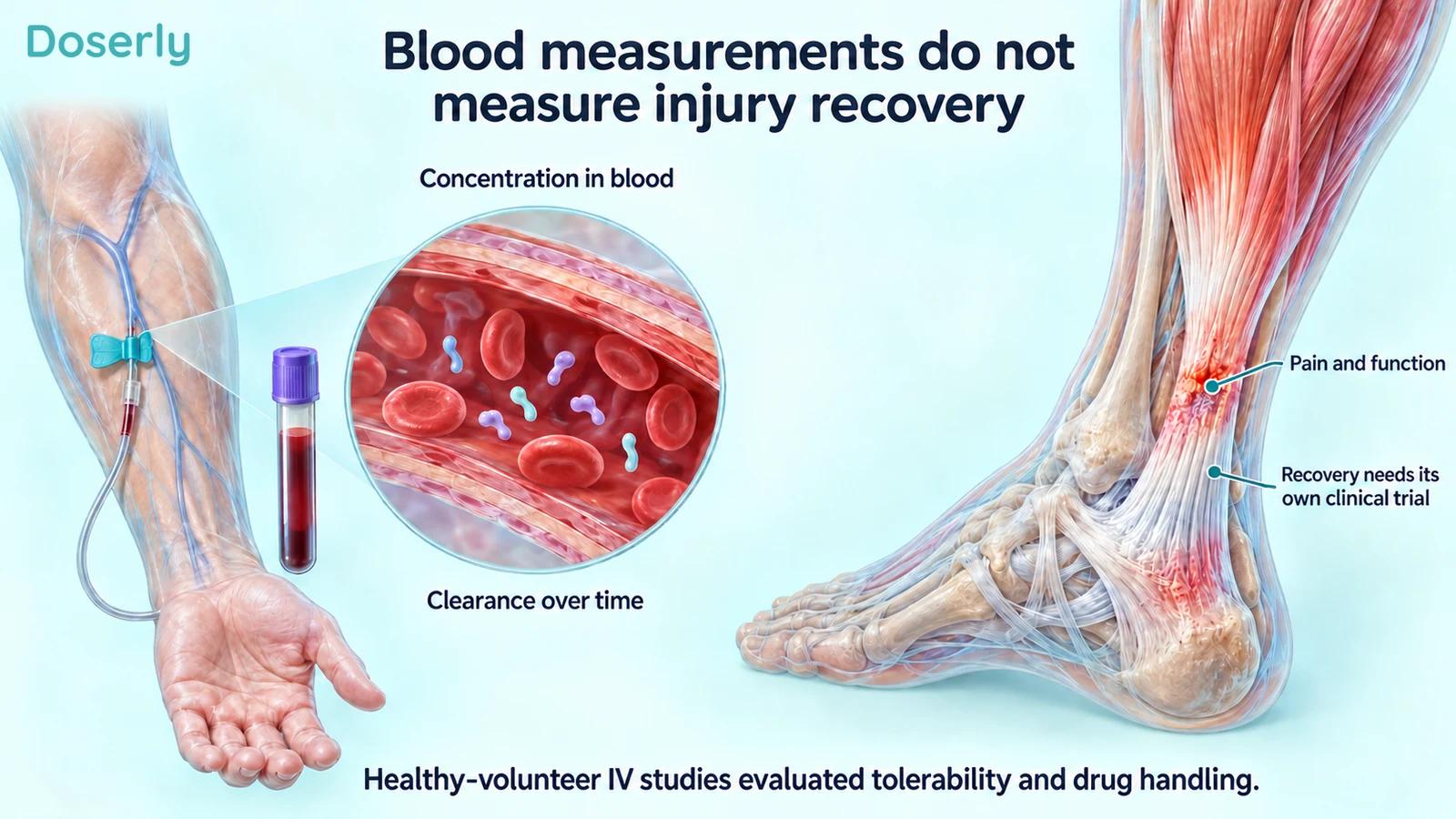
The human IV studies discussed below measured blood concentrations and short-term tolerability. The eye and skin studies assessed local clinical outcomes. Keeping those measurements separate helps explain why the same compound name does not make their results interchangeable. Recombinant thymosin beta-4 phase 1 study.
What the eye-drop studies actually investigated
A 2015 randomized study tested 0.1% thymosin beta-4 ophthalmic solution, RGN-259, against matching vehicle in 72 people with moderate to severe dry eye. Treatment lasted 28 days. The formulation was sterile and preservative-free, and the vehicle had the same other ingredients without the peptide.
The two primary outcomes, ocular discomfort and staining of the lower cornea at day 29, did not show a significant difference between groups. Other analyses suggested possible benefits in selected staining regions and discomfort during an environmental challenge. The full paper describes several of those analyses as ad hoc. That is a mixed local-eye result, not proof of a general wound-healing effect. Dry-eye trial.
A different randomized study examined persistent corneal epithelial defects in neurotrophic keratopathy, a disease involving impaired nerve support to the cornea. After four weeks, complete closure occurred in six of ten RGN-259 participants and one of eight placebo participants. The main comparison had P=0.0656, while later assessments were more favorable. This small study concerned a different disease and a different outcome from everyday dry-eye symptoms. Neurotrophic keratopathy study.
These studies explain why an ophthalmic formulation might interest eye specialists. They don't tell us how an injected preparation behaves in a muscle injury. They also don't validate applying a product prepared for injection to the eye. The studied formulation is part of the intervention, including its sterility, ingredients and handling conditions.
What topical wound-gel research adds
The skin-wound literature includes a randomized phase 2 study of 73 people with venous stasis ulcers at eight European sites. These are chronic wounds associated with venous disease, not simply cuts that have been slow to close. The trial compared topical thymosin beta-4 preparations with placebo and evaluated safety and healing.
The published abstract described an acceptable safety profile comparable with placebo. It reported that a 0.03% preparation might accelerate healing, with complete healing within three months in about a quarter of patients, especially those with smaller or less severe ulcers. The abstract does not provide the detailed arm-by-arm estimates needed to calculate a dependable treatment benefit from that percentage alone. Venous-ulcer report.
A related earlier report described the study while it was still underway, including debridement when needed and compression treatment. Debridement removes nonviable tissue; compression addresses the underlying venous problem. Those measures are part of the treatment setting, not irrelevant background. Earlier trial-design report.
A wound getting smaller during combined care does not reveal which component caused the change. The randomized comparison is what can estimate the added contribution of the gel. Even a convincing additional benefit in venous ulcers would not establish that the same gel treats pressure injuries, genetic skin fragility or a torn tendon.
There is also an anatomical difference. A surface wound exposes tissue directly to a topical preparation. An intact skin barrier over a deeper tendon is a different situation. Applying a gel over an injury and delivering a peptide to the injured structure are not automatically equivalent events. The venous-ulcer study does not resolve that delivery question.
What the earlier intravenous trial found
In 2010, researchers reported a placebo-controlled study of synthetic thymosin beta-4 in 40 healthy volunteers, organized into four cohorts. Participants received a single intravenous exposure, followed after safety review by repeated daily administration for 14 days. The study examined adverse events and pharmacokinetics.
The abstract reported infrequent mild or moderate adverse events, no serious adverse events and no dose-limiting toxicity. Blood exposure increased with dose, and the reported half-life increased across dose levels. Those observations supported further clinical development; participants were not being treated for tendon tears or other healing problems. Synthetic IV study.
A dose-limiting toxicity is a predefined adverse effect serious enough to limit dose escalation in a study. Its absence does not mean there were no adverse events or that every future exposure is safe. It means the trial did not encounter that particular stopping threshold under its conditions.
The distinction is particularly important for healthy volunteers. A safety study can help researchers decide whether to proceed to patients, but it does not demonstrate recovery in people who have an injury. Healthy participants also may differ from people taking multiple medicines or living with cardiovascular, kidney or immune conditions.
What the recombinant IV study measured
A later phase 1 study evaluated NL005, a recombinant human thymosin beta-4 product. “Recombinant” means it was produced using genetic technology rather than solely by chemical synthesis. Its investigators enrolled 54 healthy volunteers in the single-dose portion and 30 in the multiple-dose portion, which involved ten days of administration and follow-up to day 28.
The study examined tolerability, blood exposure and anti-drug antibodies. Antibody testing looks for an immune response directed against the administered product. No serious adverse events or dose-limiting toxicities were reported; adverse events were mild or moderate. The trial nonetheless recorded events and laboratory abnormalities, so “no serious events” should not be rewritten as “no side effects.” NL005 study.
The authors reported IV half-lives of approximately 0.5–2.08 hours across the single-dose groups and no obvious accumulation during the repeated-dose study. Half-life describes the time associated with a specified decline in blood concentration. It does not directly measure the duration of a biological response, and it does not set a clinically effective dosing interval.
Those numbers also belong to the product and route studied. Subcutaneous absorption can change the concentration curve, so an IV half-life is not a measured subcutaneous half-life. A schedule found online cannot be validated merely by attaching the IV number to it. The missing step is direct measurement and clinical testing of the proposed preparation and route.
Does “full-length thymosin beta-4” mean the same thing as TB-500?
Not reliably. Full-length thymosin beta-4 contains 43 amino acids. FDA's 2026 briefing describes the TB-500 substances it evaluated as a synthetic seven-amino-acid fragment corresponding to positions 17–23, with an acetyl group at one end. It also notes inconsistent commercial naming, including different substances sold under the same common name. FDA TB-500 briefing.
That introduces a second distinction before route is even considered: the actual molecule. Evidence for a full-length preparation is not automatically evidence for a fragment. Sharing a portion of a sequence does not establish identical stability, exposure or clinical effects. Similarly, a trade name cannot establish what a specific product contains.
For a useful discussion, the study and proposed product should match at the level of molecule and formulation. Our guide's TB4 and TB-500 comparison explains the naming problem in more detail. It is a practical issue because an impressive list of studies can become misleading if several investigate a different substance.
Why the studies cannot be combined into an injection protocol
Imagine someone cites an eye-drop study for tissue repair, a wound-gel study for healing speed and an IV volunteer study for safety. Each may be a real publication. The resulting injection claim still combines three separate experiments into a treatment that none of them tested.
A meaningful bridge would need to establish the intended molecule, its exposure after the proposed route, tolerability in the relevant patients and a clinical benefit for their condition. That might involve several development stages. It cannot be supplied by choosing a dose between numbers used in unrelated studies.
The same problem applies to oral products. The studies described here did not determine oral bioavailability, meaning how much intact peptide reaches circulation after swallowing it. They did not compare capsules with injections or eye drops. An oral product would need evidence appropriate to its own formulation and intended use.
Nor does a lack of visible reaction identify an effective dose. A preparation could produce no obvious symptoms because exposure is low, because adverse effects are subtle or because the person simply tolerates it. None of those possibilities demonstrates that it is helping an injury. Benefit and harm have to be evaluated separately.
A useful way to discuss a proposed treatment
Start with the problem you want to improve: a persistent eye-surface defect, a chronic leg ulcer, pain with movement or something else. Ask which clinical study involved people with that problem and used the same formulation and route. Then ask what improved and how that improvement was measured.
The answer might be that the treatment is being proposed on mechanistic grounds or clinical experience rather than a matching randomized trial. Knowing that helps you understand the uncertainty without pretending that all human research is irrelevant. It also makes it easier to discuss alternatives, expected monitoring and what would count as a worthwhile result.
If you keep a medication and symptom record, include the full product name and route alongside the timing. A note saying only “thymosin beta-4” loses information that matters when reviewing effects or possible reactions. Such a record supports a clearer conversation; it does not substitute for a controlled comparison.
The human literature on thymosin beta-4 contains useful findings, but its scope is specific. Eye-drop trials investigate ocular outcomes, gel trials investigate particular surface wounds, and IV volunteer studies investigate early tolerability and drug handling. Preserving those distinctions is the first step toward deciding whether any of that research answers your own treatment question.
Sources
- Sosne and Ousler, 2015: RGN-259 dry-eye trial.
- Sosne and colleagues, 2022: neurotrophic keratopathy trial.
- Guarnera and colleagues, 2010: venous-ulcer study.
- Guarnera and colleagues, 2007: ongoing venous-ulcer trial design.
- Ruff and colleagues, 2010: synthetic intravenous thymosin beta-4.
- Wang and colleagues, 2021: recombinant NL005 phase 1 study.
- FDA, 2026: TB-500 substance evaluation.