
Longevity
October 17, 2026
Exercise after cancer treatment: what the CHALLENGE trial changed
On this page
Finishing chemotherapy can feel like reaching the end of a very long assignment, only to discover that recovery has no clear timetable. Appointments become less frequent. Fatigue, altered bowel habits and uncertainty can remain. Advice to exercise may sound sensible, but it can also sound vague: what should movement accomplish, and who is supposed to help?
The CHALLENGE trial gave that conversation a stronger foundation. Published in 2025, it found that a supported exercise program after treatment for colon cancer improved disease-free survival. The findings also supported longer overall survival. This was a randomized trial with years of follow-up, rather than a comparison of people who happened to be more or less active. Courneya and colleagues, NEJM
That is meaningful news. It is also a specific result. Participants had undergone surgery and adjuvant chemotherapy for colon cancer. They received a sustained program with professional support. The study did not test exercise as a replacement for cancer treatment, and it did not establish the same survival benefit for every cancer.
Understanding those details makes the result more useful. It changes the question from whether survivors should simply try harder to move to how health systems can make appropriate rehabilitation part of cancer care.
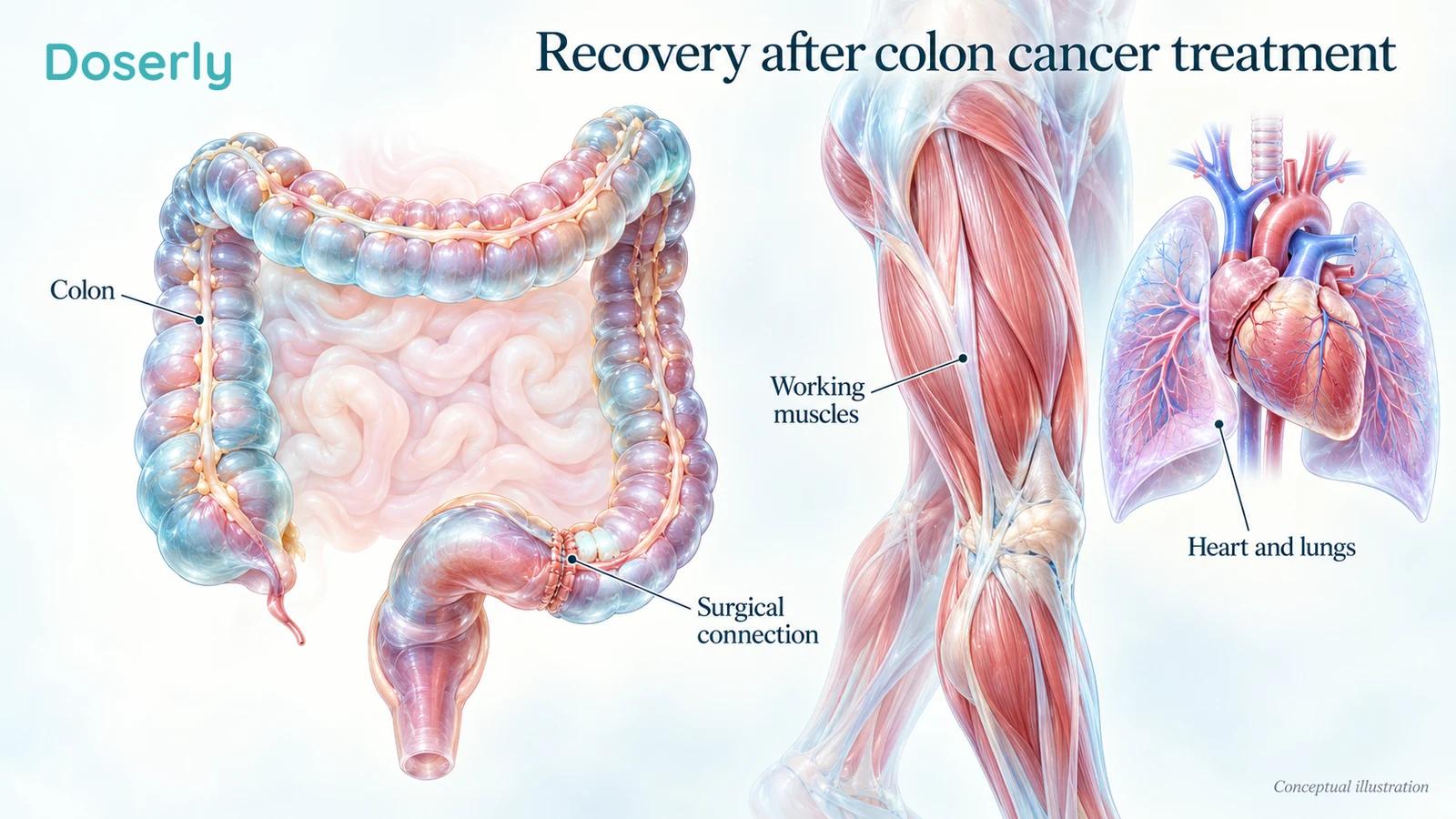
The uncertainty that the trial addressed
Before CHALLENGE, researchers had good reasons to investigate exercise. A 2006 prospective study followed 832 people with stage III colon cancer enrolled in a chemotherapy trial. Greater activity after diagnosis was associated with better disease-free survival. But activity itself was not randomly assigned. Meyerhardt and colleagues, CALGB 89803
That distinction matters even when researchers make careful statistical adjustments. People who remain active may have fewer complications, less aggressive disease, better access to care or more support at home. Someone may reduce activity because an undetected recurrence is already making them unwell. In that situation, reduced movement can be a consequence of illness as well as a possible contributor to future health.
A randomized exercise trial addresses much of that uncertainty by deciding the offer of an intervention independently of those characteristics. It asks a practical causal question: what happens when otherwise comparable groups are offered different care?
It does not require pretending that participants can be blinded to exercising. They know whether they are attending sessions. The important protection is that assignment occurs before the outcomes, rather than grouping people afterward according to how successfully they recovered. That gives a favorable result more weight than an association alone.
Who participated, and why that limits the headline
The trial enrolled 889 participants at 55 centers. The main comparison was a three-year structured exercise program against health-education materials. Median follow-up was 7.9 years. Primary trial report
The registered protocol specified high-risk stage II or stage III colon cancer after surgical removal and completion of adjuvant chemotherapy. Participants were medically fit enough for the program, had no evidence of recurrent or metastatic disease at entry, and were not already meeting the study's activity threshold. Registration occurred 60 to 180 days after the last chemotherapy dose. CHALLENGE protocol
Adjuvant treatment means treatment given after surgery to reduce the chance of cancer returning. This makes CHALLENGE a study of additional care after treatment with curative intent. It is a different clinical situation from trying to shrink a visible metastatic tumor.
The trial's conference report described a median age of 61 years; 51% of participants were women and about 90% had stage III disease. Those details help readers picture the actual study population. It was neither a study confined to very old adults nor a trial of elite athletes. ASCO primary trial abstract
For someone with rectal cancer, another cancer type, major frailty or ongoing chemotherapy, the question is not whether movement suddenly becomes irrelevant. It is whether this exact estimate of survival benefit applies. The trial cannot supply that answer. A rehabilitation plan can still be valuable for other reasons, while its expected benefits and necessary adaptations come from the evidence relevant to that person.
What the results actually mean
At five years, disease-free survival was 80.3% with structured exercise and 73.9% with education, an absolute difference of 6.4 percentage points. The hazard ratio was 0.72, with a 95% confidence interval of 0.55 to 0.94. At eight years, overall survival was 90.3% versus 83.2%, a 7.1-point difference; the hazard ratio for death was 0.63. NEJM results
Disease-free survival is a composite outcome. Here it counted recurrence, a new primary cancer or death. A headline saying exercise reduced recurrence by 28% is therefore less precise than saying it reduced the hazard of that composite event. The distinction does not make the result unimportant. It tells us what the trial actually counted.
The absolute difference answers a different question from the hazard ratio. Comparing the five-year estimates, about six more people per hundred were alive without a disease-free-survival event in the exercise group. That is a group comparison at a particular time, not a prediction that any named individual receives six extra healthy years.
A hazard ratio uses the timing of events across follow-up. It is not the percentage of participants who benefited, and a relative reduction cannot simply be added to a person's chances of survival. The published uncertainty also matters: an estimate has a range of plausible effect sizes, even when the statistical test is positive.
Overall survival is especially meaningful because it concerns whether people are alive, whatever the cause of death. It was a secondary outcome, however. The strongest wording follows the report: the trial established improved disease-free survival and produced findings consistent with longer overall survival. The cancer outcomes should not be collapsed into a promise that exercise prevents every recurrence.
The intervention was sustained help
The initial protocol combined professional behavior support with supervised activity, then continued contact over three years. Early meetings were more frequent; later support became monthly. Both groups received health-education materials. The comparison was therefore additional structured support versus information alone, not exercise versus a prohibition on movement. Public trial protocol
Participants chose the type, frequency, intensity and duration of aerobic activity. The study's goal was to increase recreational activity by at least 10 MET-hours per week during the first six months and maintain the increase. MET-hours combine estimated activity intensity and time; they are a research measure, not a personalized prescription. The trial also reported maintained improvements in activity, predicted aerobic fitness and six-minute walking distance. ASCO trial report
The flexibility matters. A program built around achievable activity and continuing problem-solving is different from handing someone an ambitious exercise target at their final chemotherapy appointment. Support can help a person negotiate symptoms, confidence, access and interruptions, rather than treating missed sessions as failure.
It also changes how to interpret the word exercise. Readers do not need to infer that a particular machine, wearable, high-intensity class or branded method produced the survival advantage. Those were not the randomized comparison. The evidence supports the care package that was tested; it does not identify a single indispensable workout.
Recovery benefits had an earlier evidence base
CHALLENGE's earlier feasibility analysis included 273 participants. The intervention achieved a larger increase in self-reported recreational activity than education alone and improved several objective functional measures, including walking and chair-stand performance. That report helped establish that the larger survival question was feasible to test. It did not, in 2016, prove a survival benefit. One-year feasibility results
A separate small randomized trial during chemotherapy illustrates another reason for rehabilitation. Thirty-three people with colon cancer received supervised exercise or usual care. The exercise group reported less physical fatigue after the intervention and better physical functioning, although the small sample required replication. Its purpose and endpoints differed from CHALLENGE's. Physical Activity During Cancer Treatment trial
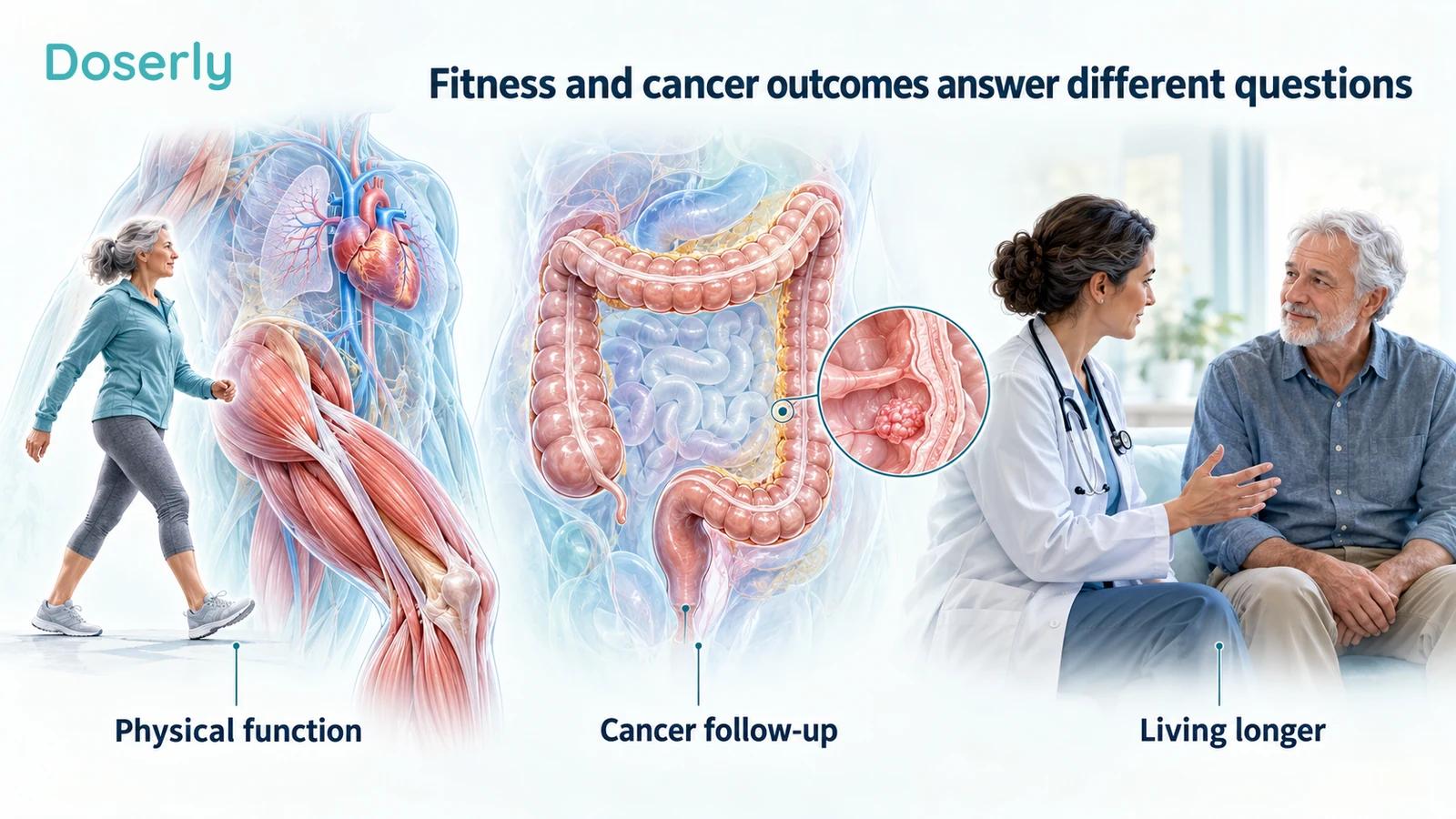
These studies help separate three questions that often get bundled together: can a person move more, can they function or feel better, and can an intervention change cancer outcomes? An intervention can succeed on one without yet having evidence for all three.
For a survivor, the first two are not consolation prizes. Walking to a nearby shop, returning to work or managing stairs can be central to independence. Those goals also provide something concrete to discuss during follow-up, while scans and clinical assessments answer different questions about the cancer.
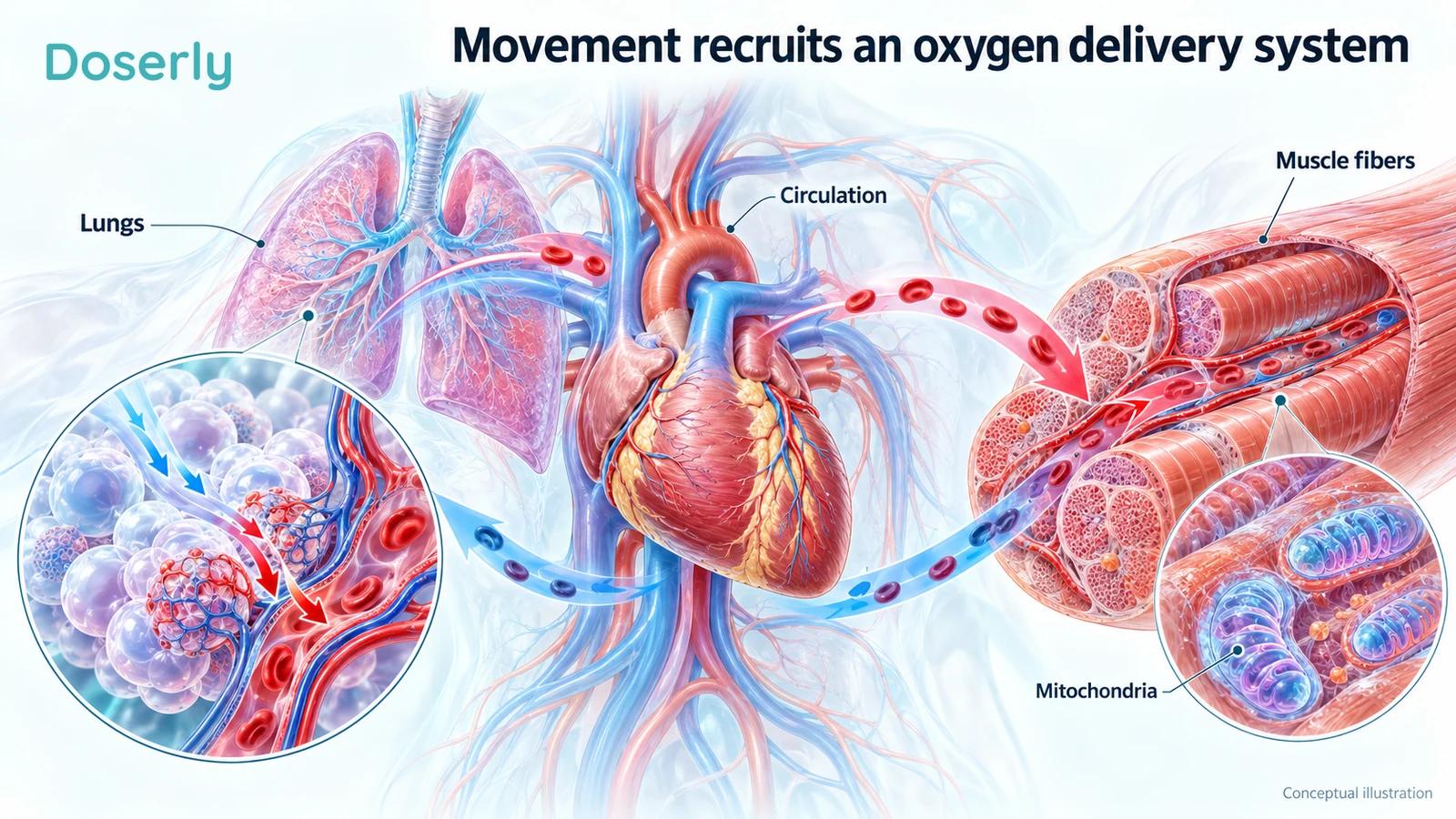
Why the mechanism remains an open question
It is tempting to explain the result with a single pathway: immune surveillance, insulin signaling, inflammation or the molecules released by working muscle. The trial protocol anticipated biological investigations, including insulin-related and inflammatory markers. Those were research questions alongside the clinical outcomes. Protocol objectives
The useful distinction is between establishing that a program changes an outcome and establishing exactly how it does so. A randomized clinical result can be convincing while the full biological explanation remains incomplete. Conversely, an elegant laboratory explanation can exist without a demonstrated clinical benefit.
That distinction prevents several misleading extensions. A supplement advertised as affecting one proposed exercise pathway cannot inherit the trial's survival result. Neither can a peptide promoted as improving recovery or cellular energy. Even if a product changes a relevant marker, it has not reproduced the intervention, the population or the follow-up.
Our review of ivermectin and fenbendazole cancer claims examines the same gap between an interesting mechanism and an outcome demonstrated in people. The question is always what evidence connects the proposed intervention to the result someone actually hopes to achieve.
Safety deserves specifics, not fear
Musculoskeletal adverse events occurred in 18.5% of participants assigned to exercise and 11.5% assigned to education. The program was beneficial overall, but it was not free of costs or physical problems. Trial safety results
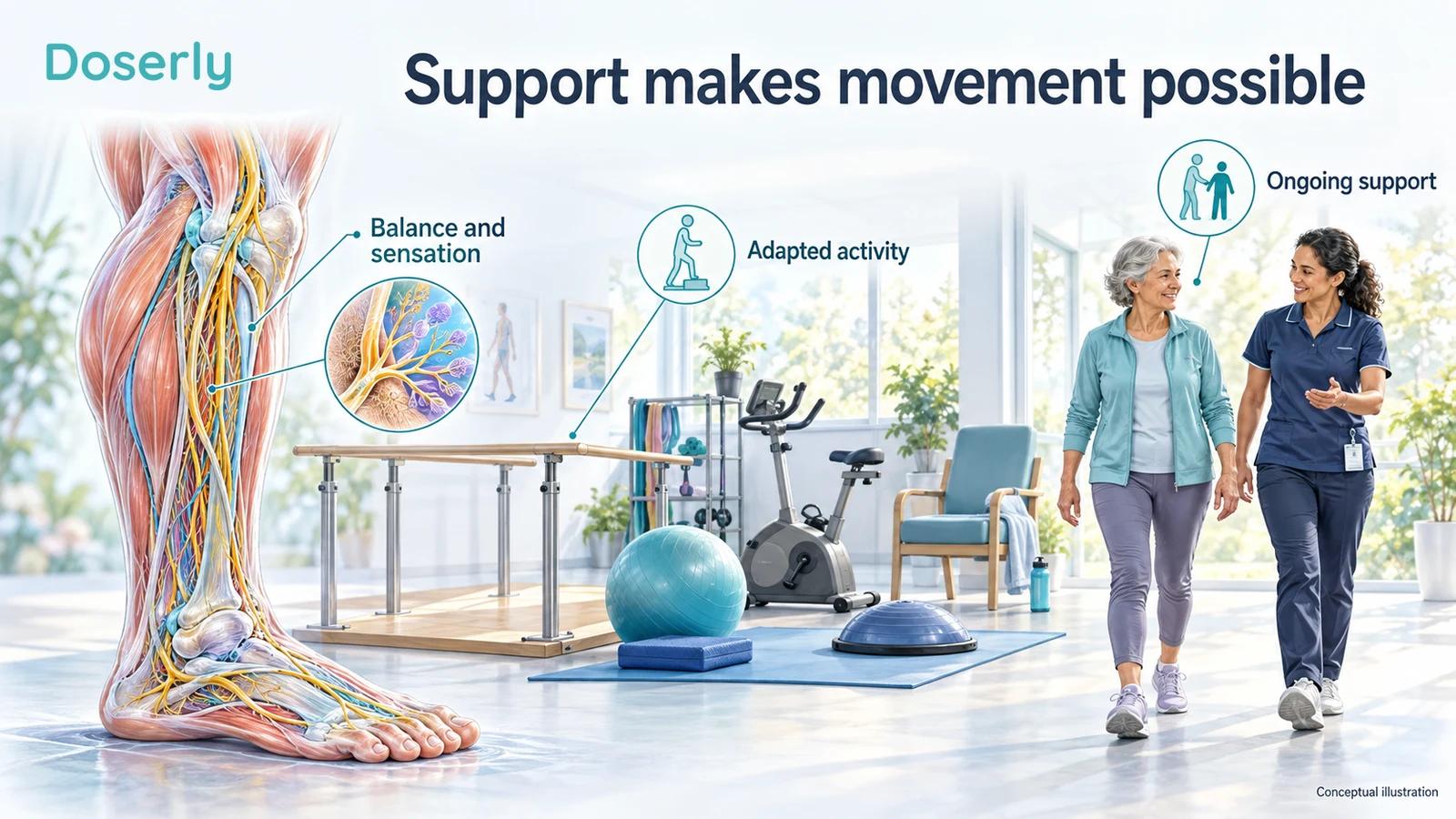
Cancer exercise guidance emphasizes that testing and activity should reflect treatment effects and individual limitations. Peripheral neuropathy can affect balance and sensation. An ostomy, persistent fatigue or musculoskeletal problems can require adaptations. The relevant question is what assessment and support make activity workable, rather than whether every survivor should follow the same routine. International exercise-oncology consensus
This is where a referral has more substance than a slogan. A professional can ask what feels unstable, what symptoms occur during activity, which environments are accessible and whether an existing medical problem needs attention first. The answer may change the activity, the setting, the pace of progression or the amount of supervision.
People with bone metastases require a separate assessment. An expert consensus recommends considering the location and characteristics of bone lesions, the person and the proposed activity together, with communication between the cancer team and exercise professionals. That is not the population in which CHALLENGE established its survival result. Bone-metastasis exercise consensus
The point is not to make movement feel medically forbidden. It is to make room for appropriate care when ordinary exercise advice overlooks a real limitation. Persistent or changing symptoms should not be dismissed as a motivation problem simply because exercise is beneficial on average.
What the 2026 follow-up adds
In 2026, the Canadian Cancer Trials Group reported an economic analysis of CHALLENGE. It evaluated the exercise program within the Canadian health system and found a favorable combination of health benefit and costs. The group's summary estimated the program itself at approximately CAD $3,000 per participant and attributed savings to reduced downstream cancer-care expenses. CCTG economic analysis announcement
That is an implementation finding, not another independent survival trial. It also does not mean that any gym membership saves a health system the same amount. Prices, staffing, reimbursement and subsequent cancer treatments vary across settings. The conference analysis asks whether delivering this program can represent good value under its stated assumptions. 2026 primary economic abstract
For patients, the immediate implication is organizational. If support is part of the effective intervention, access to support belongs in the conversation about care. Transport, disability access, work hours and insurance coverage are not peripheral details when they determine whether someone can participate.
A service can be cost-effective overall while remaining unaffordable to an individual. Those are different budgets. A practical survivorship discussion should therefore include who provides the service, what it costs the patient and what alternatives exist if the original model is unavailable.
Following a program is different from being assigned one
The primary comparison followed intention-to-treat principles: participants were analyzed in the group to which they were randomized. That approach preserves the value of the original assignment, even when real life makes participation imperfect. ASCO analysis description
Consider why this matters. If researchers kept only the people who attended every session, they might select those who were healthiest, least burdened by symptoms or most able to travel. Comparing that selected group with everyone else would partly recreate the problem that randomization was intended to solve. Attendance is informative, but it is not randomly assigned.
For a service planning to adopt the intervention, this makes the offer of care especially relevant. A clinic needs to know whether providing a program can improve outcomes across the people offered it, including people whose participation is interrupted. It also needs to learn why interruptions occur, so the service can respond without quietly excluding those with greater needs.
For a patient, the same principle offers a less punitive way to think about recovery. The published result came from a human program, with variation and obstacles. It should not be interpreted as a contract in which the benefit disappears after one missed appointment. The trial does not provide that kind of individual threshold, and inventing one would add anxiety without improving care.
What the study cannot tell an individual survivor
The trial cannot determine why a particular person's cancer returned. Recurrence reflects the biology of the disease and many factors outside personal control. A population-level reduction in risk should never become a retrospective accusation that someone failed to exercise enough.
It also cannot tell us the minimum amount of activity that guarantees benefit, whether exceeding the study goals adds further protection, or which participant needed which component of support. A successful program comparison is not automatically a dose-response map.
Some people will already be more active than the participants were at entry. Others will be far less able to exercise because of disability, comorbidity or treatment effects. Neither group can calculate its expected survival benefit by substituting personal activity minutes into the headline percentage.
These limits are reasons to individualize the discussion. They are not reasons to ignore a positive trial. A useful clinical decision often rests on evidence that fits imperfectly, provided the mismatch is recognized and the goal remains realistic. For some people that goal may center on endurance; for others, safe transfers, confidence outside the home or maintaining function.
A more useful conversation at follow-up
An exercise discussion can start with a daily task that has become difficult. That gives the cancer team and rehabilitation professional a shared target and makes it easier to identify what is getting in the way. A vague wish to become healthier can become a specific question about walking, fatigue, balance or returning to an activity that matters.
Useful questions include:
- Does my cancer and treatment history resemble the CHALLENGE population, or is the expected benefit based on different evidence?
- Is there an oncology rehabilitation or exercise referral, and what ongoing support does it provide?
- Which symptoms or treatment effects should shape the starting plan?
- How will we assess function and tolerability without confusing those measures with cancer surveillance?
- What support is available if cost, transport or caregiving makes attendance difficult?
A simple record of activity, symptoms and recovery may help that conversation. It does not need to become a competitive score. The record is useful when it helps identify patterns and communicate concerns; it is less useful when every difficult day becomes evidence of personal failure.
It may also help to distinguish the activity goal from the access problem. Someone who wants to walk farther but cannot reach an exercise service needs a different solution from someone who can attend but feels unsteady. Asking the clinic to name the next contact, explain the referral process and clarify who follows up can turn a general recommendation into an actual pathway. Family members can support that process by helping with transport or scheduling when invited, rather than becoming unofficial monitors of exercise performance. These are practical ways to discuss delivery of care, not additional components proven separately by the trial.
Follow-up for the cancer remains essential. Feeling fitter does not establish that microscopic disease is absent, and a difficult week does not establish recurrence. Keeping these questions separate allows both rehabilitation and medical surveillance to do their jobs.
CHALLENGE changed the evidence behind exercise after colon cancer treatment. It gives survivors and clinicians a stronger reason to discuss sustained, supported activity as part of care. Its most constructive message is that recovery deserves an organized service, with realistic goals and room for the person whose recovery does not follow a straight line.