
Peptides
October 16, 2026
Exenatide for feline diabetes: what 40% versus 20% really showed
On this page
A newly diagnosed diabetic cat may be drinking constantly, losing weight and needing an unfamiliar routine of insulin injections. When an additional medicine is said to improve the chance of remission, it is natural to want to know whether it could help your cat stop needing insulin.
Exenatide, a medicine that stimulates the GLP-1 receptor, has been investigated for that purpose. A small controlled study reported remission in 40% of cats receiving extended-release exenatide and 20% receiving placebo, alongside insulin and dietary care. That difference was not statistically significant. The findings offered a reason to investigate the treatment further, rather than establishing that it doubles a cat's chance of remission. 2016 study
There is more useful information here than a positive or negative headline. The study helps explain the proposed role of exenatide, how remission differs from good glucose control, and what an owner should ask before adding another treatment.
Why add something when the cat already receives insulin?
Insulin is a hormone made by pancreatic beta cells. It regulates how the body handles glucose, including how tissues take up and store fuel. Many diabetic cats have a combination of reduced tissue responsiveness to insulin and inadequate insulin production. Injected insulin supplies hormone the cat cannot provide in sufficient amounts. Cornell's explanation of feline diabetes
Exenatide has a different proposed role. It activates a receptor used by glucagon-like peptide-1, a gut hormone involved in metabolic responses to food. Among its actions is stimulation of glucose-dependent insulin secretion. That action requires functioning beta cells; it does not make exenatide interchangeable with insulin.
The idea behind combining them is understandable. Injected insulin can reduce excessive glucose exposure, while a GLP-1 medicine might support the cat's remaining insulin secretion or influence appetite. Whether those actions add a worthwhile clinical benefit has to be measured in cats receiving both treatments.
For human background, our semaglutide guide explains another GLP-1 receptor agonist. Semaglutide is a different molecule, and human treatment instructions are not feline treatment instructions. The study discussed here used extended-release exenatide.
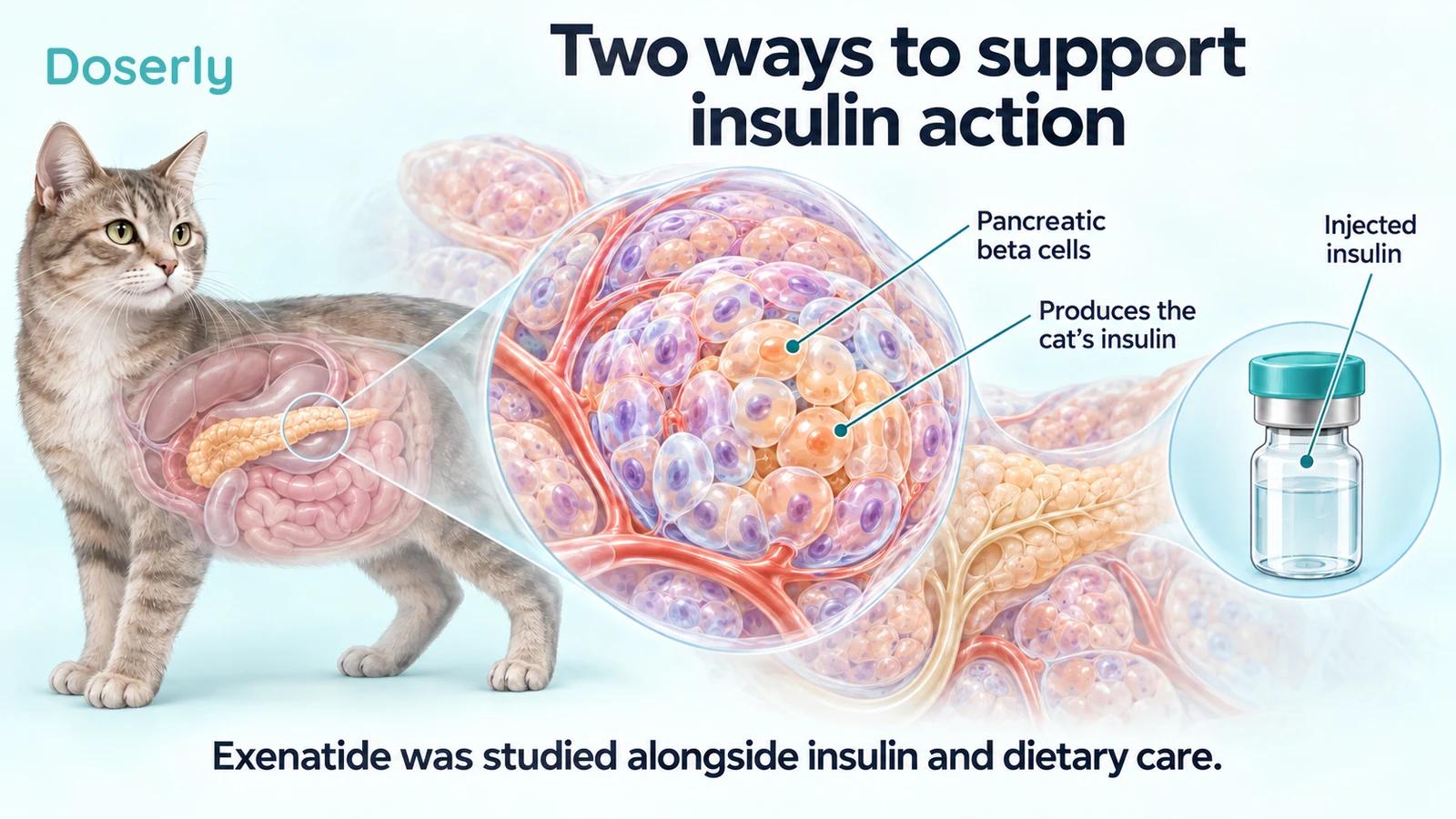
Beta cells produce the cat's own insulin; injected insulin supplies hormone from outside the body. The enlarged tissue and vial are conceptual illustrations, not a demonstration of exenatide repairing beta cells.
Who was actually studied?
Thirty client-owned cats with recently diagnosed diabetes received glargine insulin and a low-carbohydrate diet. Fifteen also received extended-release exenatide and fifteen received saline placebo. Follow-up lasted 16 weeks.
The methods describe alternating assignment, with the sequence known to the veterinarian. Owners were blinded, but veterinarians were not. This was therefore a controlled prospective pilot, rather than a trial with concealed random allocation. Study methods
That detail matters because predictable allocation can influence which animals end up in each group. It does not mean the investigators deliberately selected favourable cases. It means the design provides less protection against selection differences than a concealed random sequence would.
The cats were also screened for other illnesses and previous treatments. This makes the comparison more focused, but it means results cannot automatically be transferred to every older cat with several diseases. A cat with substantial kidney disease, for example, presents a different treatment decision from one meeting the study's eligibility criteria.
Six cats versus three cats
At the end of follow-up, six of fifteen exenatide-treated cats and three of fifteen placebo-treated cats met the remission definition. The comparison gave P=0.427. Primary results
The percentages are correct: six divided by fifteen is 40%, and three divided by fifteen is 20%. Their difference is 20 percentage points. Their ratio is two. None of those calculations removes the uncertainty created by small groups and few events.
In a group of fifteen, one cat changes the percentage by about 6.7 points. A small change in which animals recover therefore changes the headline noticeably. The observed difference is compatible with a useful effect, but the study did not establish that such an effect would persist in a larger, well-controlled comparison.
A p-value is not the probability that a medicine works. Here, it indicates that the observed difference was not sufficiently inconsistent with no group difference to meet the study's conventional statistical criterion. It does not prove the treatments are equivalent, and it does not justify ignoring the possibility of benefit.
The honest answer is narrower: this pilot did not demonstrate an additional remission benefit. That conclusion preserves both the encouraging direction of the result and the limits of what was measured.
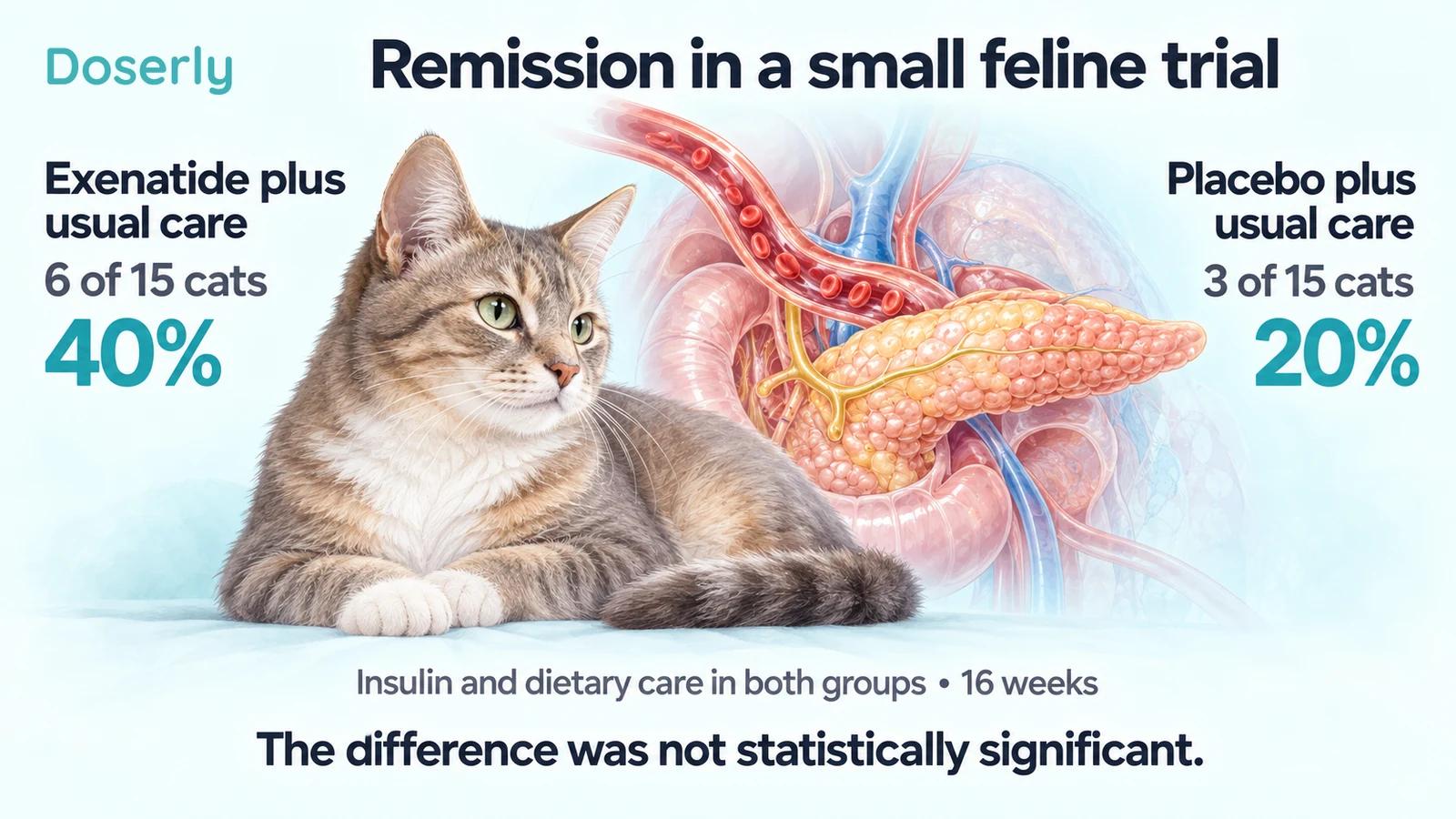
Both groups received insulin and dietary care. These are observed outcomes in small groups, not predictions for an individual cat or proof of a doubled treatment benefit.
Remission and good control use different denominators
The paper also reported good metabolic control in eight of nine exenatide-treated cats that had not entered remission, compared with seven of twelve remaining placebo-treated cats. Those percentages were approximately 89% and 58%; the difference was not significant. Results and outcome definitions
The denominators shrink because cats in remission are excluded from this particular comparison. It would be wrong to read the 89% as “89% of all cats stopped insulin.” Those cats were still receiving treatment.
Good control is nevertheless valuable. A cat that drinks normally, regains appropriate weight and feels comfortable can have a successful treatment outcome while continuing to need insulin. Remission is one desirable outcome, not the only measure of whether care is helping.
For an owner, this distinction can reduce unnecessary disappointment. If a cat is doing well on a manageable routine, failure to achieve remission does not mean the treatment failed. The goals should include comfort, safe glucose levels and a plan the household can sustain.
Why the definition of remission matters
The study required four weeks of acceptable glucose without insulin to count a cat as being in remission. A shorter period without injections would not meet that definition. This is broadly consistent with the four-week definition in the current iCatCare consensus. iCatCare guidelines
Suppose a cat stops insulin near the end of a trial. It may be doing well, but there may not yet be enough observation time to confirm the required duration. A study with longer follow-up could classify that cat differently without any change in its immediate health.
That is why comparing remission percentages from unrelated studies can be misleading. Studies may differ in how long they follow cats, how quickly treatment begins, which other diseases are excluded and how remission is defined. Differences between percentages cannot automatically be attributed to the insulin or added drug.
It is also why owners should not attempt to establish remission by simply withholding treatment. The veterinarian needs to guide any reduction and determine whether stable glucose persists safely.
What did the study say about tolerability?
Decreased appetite was reported in 60% of exenatide-treated cats and 20% of placebo-treated cats; vomiting occurred in 53% and 40%, respectively. These comparisons were not statistically significant, and many episodes were transient. Adverse-event results
A nonsignificant safety comparison does not establish absence of risk. With fifteen animals per group, uncommon problems can easily be missed. An owner also experiences an adverse effect as an individual event, regardless of whether a group comparison crosses a statistical threshold.
Appetite deserves particular attention in a diabetic cat. A treatment intended to influence food intake may complicate interpretation if the cat is also recovering from illness, receiving insulin or changing diet. Recording when appetite changes relative to medicines and meals gives the veterinarian more useful information than an undated impression.
Any proposal to add exenatide should therefore include an explanation of how tolerability would be assessed, which symptoms warrant contact and how the overall diabetes plan would be adjusted. The pilot is not a reason to self-administer research products or borrow a human prescription.
Does a second paper strengthen the result?
A 2020 publication examined glucose variability using curves from these same thirty cats. It provides another view of the response, but it does not add a second independent group of treated animals. Glucose-variability analysis
That distinction matters when a treatment is described as being supported by “multiple feline studies.” Different papers can answer different questions about one experiment. The later analysis may reveal patterns worth investigating, but it cannot independently reproduce the original remission comparison.
A separate 2025 study enrolled cats that had already entered remission and asked whether exenatide prolonged it. It did not demonstrate that benefit. Remission-maintenance trial
These are different clinical stages. Helping a newly diagnosed cat reach remission and helping an already remitted cat remain there are not interchangeable objectives. A treatment could theoretically affect one without affecting the other.
How should this affect a real treatment discussion?
Start with the reason for considering an extra medicine. Is the current problem persistent thirst, excessive glucose, difficulty managing weight, poor appetite, or a hope of reaching remission? Those goals lead to different assessments.
Ask how closely your cat resembles the study population. Duration of diabetes, other illness and prior treatment can matter. Also ask which outcome would be used to decide whether the added treatment is worthwhile. A modest change in a laboratory measure may not justify the same burden as a clear improvement in daily health.
The practical burden belongs in the discussion too. Extra injections, expense and follow-up can affect a household's ability to maintain the rest of the plan. A complicated regimen that is difficult to carry out may be less useful than one that reliably supports the cat's established needs.
Newer oral diabetes products should not be treated as interchangeable alternatives to either insulin or exenatide. FDA guidance restricts Bexacat and Senvelgo to selected cats and warns against their use in cats previously treated with insulin because of ketoacidosis risk. FDA guidance
What remains worth learning?
A more definitive study would need a larger sample, concealed random allocation, clear outcome definitions and enough follow-up to assess both remission and safety. It should also make the owners' practical experience visible: whether the extra treatment is tolerable and whether it improves a meaningful aspect of life with diabetes.
For now, the 40% versus 20% result should be discussed as an uncertain pilot finding. It is neither a proven doubling of benefit nor evidence that further research is pointless. The useful clinical foundation remains individualized insulin and nutritional care, monitoring, and a veterinarian who can explain how any proposed addition fits the cat in front of them.
Sources
- Riederer and colleagues, controlled exenatide pilot, 2016.
- Krämer and colleagues, analysis of glucose variability, 2020.
- Gilor and colleagues, remission maintenance, 2025.
- iCatCare diabetes consensus, 2025.
- Cornell, feline diabetes.
- FDA, oral feline diabetes medicines.