
Peptides
October 16, 2026
Epitalon versus epithalamin: why the name changes the evidence
On this page
Epitalon is a short synthetic peptide studied for effects on cell biology, including how cells maintain the ends of their chromosomes. Epithalamin is a preparation extracted from the pineal gland that contains a mixture of peptides. Their names sound similar because their research histories are connected. They are nevertheless different interventions.
That distinction becomes especially important when you encounter a claim that “Epitalon helped older people live longer.” Some of the human reports behind that claim actually studied epithalamin, sometimes alongside another extract called thymalin. A result for that preparation cannot simply become a result for a vial of synthetic Epitalon. FDA’s identity discussion, page 7.
This article explains what the names refer to, what the older human studies reported, and what would be needed to connect their findings to a different product. Our Epithalon guide provides the broader background on the peptide, including its cell research and safety uncertainties.
One defined peptide and one mixture
A peptide is a chain of amino acids, the chemical building blocks also used to make proteins. Epitalon, also spelled Epithalon, is a tetrapeptide: a chain containing four amino acids. Its sequence is alanine–glutamate–aspartate–glycine, commonly abbreviated Ala–Glu–Asp–Gly or AEDG.
Epithalamin is described in this literature as a pineal polypeptide extract. An extract contains multiple components rather than one specified four-amino-acid sequence. The pineal gland is a small structure in the brain associated with production of the hormone melatonin. That biological origin explains the historical interest in sleep rhythms and aging, but it does not tell us which constituent of an extract produces an observed effect.
FDA explicitly distinguishes epitalon from epithalamin in its 2026 compounding briefing. It also distinguishes Epitalon free base from Epitalon acetate when evaluating the proposed bulk substances. These naming issues concern chemical identity, not just spelling. FDA briefing, pages 7–8.
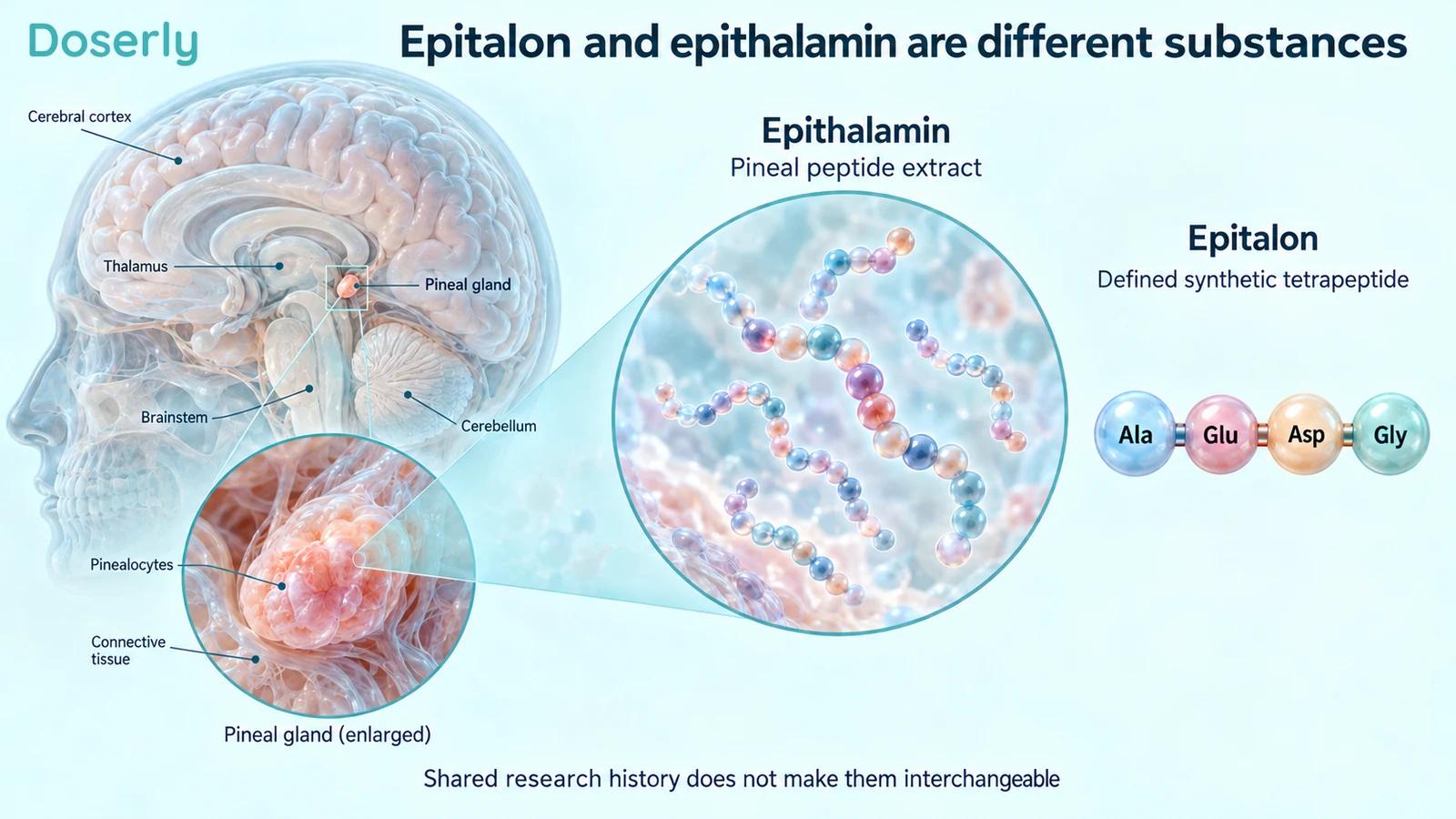
For a reader comparing research, the practical question is therefore more specific than “Was a pineal peptide studied?” It is “Which preparation was given?” An article that drops the final syllables of the name can accidentally replace the actual intervention with a different one.
What the best-known older human report studied
The 2003 paper “Peptides of pineal gland and thymus prolong human life” describes research involving 266 older people observed over six to eight years. The preparations were thymalin and epithalamin; the abstract describes treatment during the first two to three years, with a separate longer-treatment group. It reports lower mortality in treated groups, with the largest reported difference in a group receiving both preparations annually for six years. Original report abstract.
Those are clinically interesting observations because death and illness matter directly to patients. However, the headline is broader than “a trial of synthetic Epitalon.” Even the combination group cannot isolate the contribution of the pineal extract, because people received more than one preparation.
The abstract does not supply enough information to independently reconstruct all group-specific risks, participant flow, allocation procedures and adverse-event surveillance. Its favorable conclusion should not substitute for those details. We can accurately describe what the authors reported while recognizing that the accessible abstract leaves important methodological questions unanswered.
Notice that there are two separate issues here. One concerns how confidently the study establishes an effect of the intervention actually used. The other concerns whether that intervention is the same as the product being discussed today. Even a perfectly conducted trial of epithalamin would not, by itself, answer the second question.
What the longer follow-up adds
A 2006 report describes a 12-year randomized clinical study in older patients with coronary disease and accelerated cardiovascular aging. It identifies the intervention as epithalamine, a spelling variation used for the pineal preparation. The authors report fewer deaths and improvements in several cardiovascular measures. The abstract does not provide the complete event table or confidence intervals needed to evaluate the precision of those results. Twelve-year report.
A further report published in 2011 describes 39 coronary patients receiving epithalamin in addition to basic therapy and 40 receiving basic therapy alone. Treatment comprised six courses over three years; the title refers to 15-year follow-up. The authors report lower mortality in the treated group. Fifteen-year report.
The English title of that later paper refers to the pituitary gland, while its abstract identifies epithalamin and describes a pineal preparation. That inconsistency is another reason to preserve the intervention named in the methods description rather than infer identity from a title alone.
Long observation is valuable, but a longer calendar does not turn an extract study into a synthetic-peptide study. Nor should reports from a related research program automatically be counted as several independent replications. Determining whether participants overlap requires the full reports and cohort details. We have not assumed that every publication represents an entirely separate patient population.
Why shared origins do not establish equivalent effects
Suppose researchers discover that a mixture changes a laboratory measurement. They later develop one short peptide inspired by that mixture. There are several possible explanations for the original observation: one constituent may be active, multiple constituents may contribute, or the mixture may alter how a particular component is absorbed or broken down.
These are possibilities, not established explanations for epithalamin. They show why identifying a related peptide is the beginning of a development program rather than the end of the comparison.
A convincing connection would need chemical characterization of the preparations, evidence that the relevant biological activity is reproduced, and an understanding of exposure in people. Researchers would need to determine whether the synthetic peptide reaches the relevant tissue at an effective concentration and for an appropriate duration. If the desired claim concerns survival, clinical outcomes would still need testing.
This is also why equal milligram amounts cannot solve the problem. A milligram of a mixture does not specify how much of each constituent is present. A milligram of one defined molecule answers a different chemical question. Neither number establishes that two products have equivalent biological effects.
There is no basis in these older reports for translating an extract schedule into an Epitalon injection schedule. Repeating the historical frequency while changing the substance does not reproduce the historical intervention.
What the synthetic peptide has been shown to do in cells
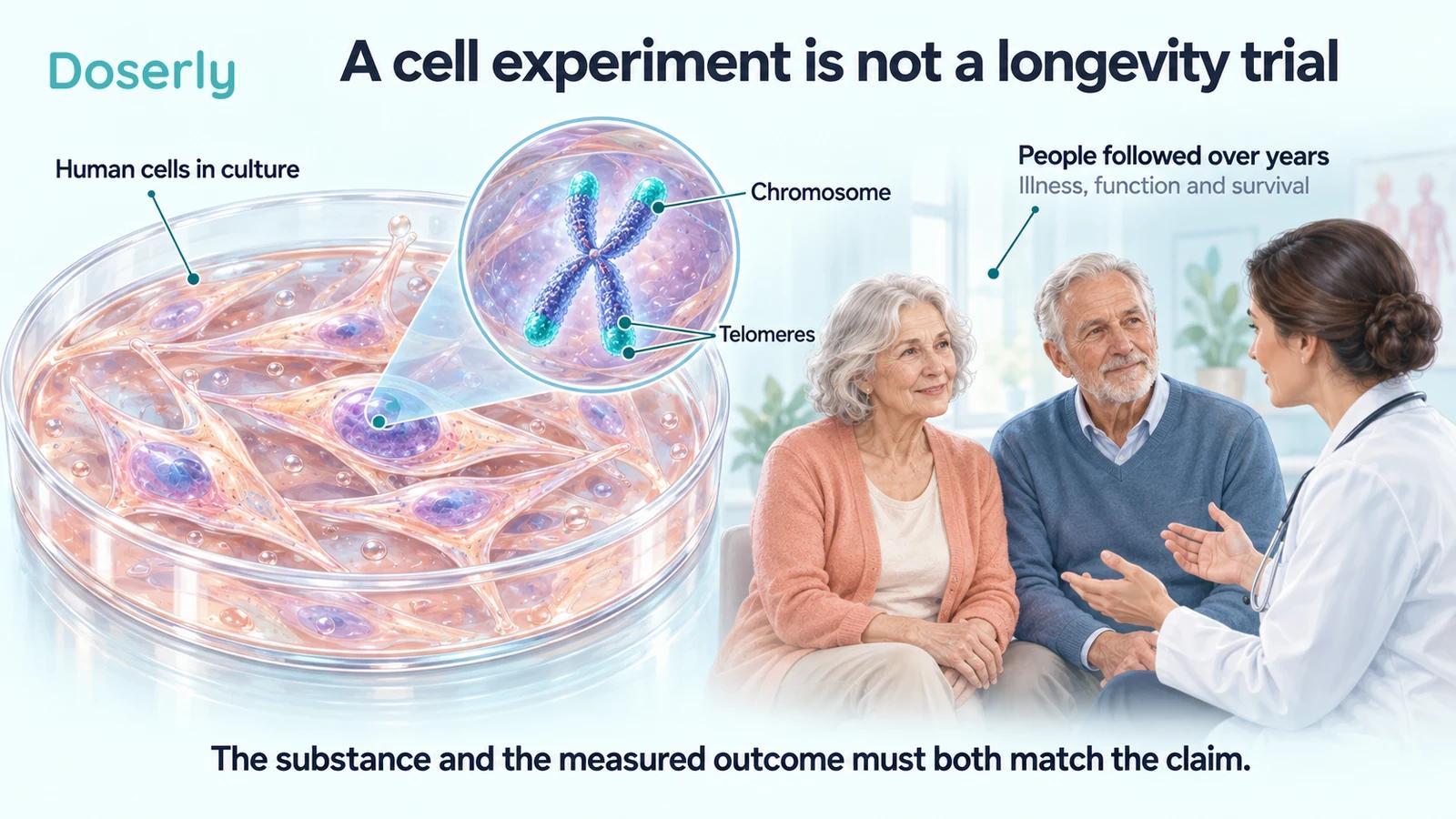
The frequently cited 2003 laboratory study exposed human fetal fibroblasts to Epithalon. Fibroblasts are cells involved in producing the supportive material around tissues. Researchers reported telomerase activity and telomere elongation in the treated cultures. Telomeres are protective structures at chromosome ends; telomerase is an enzyme that can add telomeric DNA. Original cell-study abstract.
These were human-origin cells grown outside the body. No older adults received the peptide in that experiment, and the study did not measure disability, cancer incidence or survival in people. “Human cells” is an accurate description of the material, but “human longevity trial” would describe a different experiment.
More recent research also examined Epitalon in normal and cancer cell lines. The 2025 paper reported different telomere-maintenance responses depending on cell type. Its correction should be read alongside the original publication. Cell study, correction.
These findings make the mechanism worth investigating. They do not supply the missing clinical connection between a synthetic molecule and an older extract trial. Combining two separate statements—an extract was associated with lower mortality, and a peptide affected cultured cells—does not establish that the peptide lowers mortality through that cellular mechanism.
Does the animal research settle the identity question?
Animal studies can test synthetic Epitalon directly, so they are relevant to that molecule. For example, a 2003 experiment followed female Swiss-derived SHR mice, with 54 animals per group, from three months of age until natural death. It found no change in mean lifespan, although measures involving the longest-lived animals increased. Original mouse-study abstract.
That distinction is useful even before considering translation to people. The average lifespan of the whole group and the survival of its longest-lived members describe different parts of the result. Saying simply that “lifespan increased” conceals the unchanged mean.
The experiment also cannot show that synthetic Epitalon and epithalamin are interchangeable in older patients. It involves a different species, a specified sex and strain, and a particular exposure pattern. It contributes an animal result for the synthetic peptide, not a comparison with the extract in humans.
You do not need to dismiss the animal work to maintain that distinction. A sensible research program can use it to choose future clinical questions while leaving the human treatment claim unresolved.
How to check a product discussion without becoming a chemist
Start with the exact intervention in the cited study. Look for its name in the methods or abstract, whether it was an extract or a defined molecule, and whether it was given alone. Then check the population and outcome. This small amount of reading often reveals whether the citation actually answers the question being asked.
For example, a page might cite the 266-person report beside a synthetic Epitalon product. The relevant follow-up is not whether the paper exists—it does—but whether its participants received that product. If the evidence is offered for an injection, a cell-culture concentration or topical preparation would raise another mismatch.
It is useful to keep three entries separate in your own notes: the name printed on the product, the substance named in the study, and the outcome measured. This can prevent an understandable spelling assumption from becoming an unsupported medical conclusion.
A clinician or pharmacist can help clarify a proposed product's identity, formulation and basis for use. A clear answer should be able to distinguish evidence for the specific preparation from evidence borrowed from related substances. A label, certificate or familiar name cannot itself establish a treatment benefit.
A useful correction keeps the original result available. Instead of deleting an extract study from a discussion entirely, label it as historical evidence for epithalamin and explain why it does not directly test the synthetic peptide. That preserves the research history while preventing a naming shortcut from changing the treatment claim.
What would make the clinical claim more persuasive?
The most direct evidence would be a well-described trial of a characterized synthetic Epitalon product in the population for whom the benefit is claimed. Researchers would need a suitable comparison group, outcomes chosen before the results are known, and follow-up long enough to examine both benefit and harm.
For healthy-aging claims, it matters whether the trial measures daily function, disease, hospitalization or survival. A laboratory marker may help explain a result but cannot replace all of those outcomes. Transparent reporting of adverse events and withdrawals would be essential, especially for repeated use over years.
The existing extract reports can motivate such research. They cannot remove the need for it. For someone deciding how much confidence to place in a longevity claim today, the most useful conclusion is specific: the older human epithalamin findings are not direct evidence that synthetic Epitalon extends human life.
Our complete Epithalon guide keeps the identity, cell experiments, animal findings and regulatory documents together while preserving those boundaries. Taking the exact study and product names into a clinical discussion is more informative than asking whether “pineal peptides” work as a single category.
Sources
- FDA, Epitalon-related bulk substances briefing, 2026: chemical identity and the distinction from epithalamin; a briefing document, not a drug approval.
- Khavinson and Morozov, 2003: older human thymalin/epithalamin report; abstract reviewed.
- Korkushko and colleagues, 2006: 12-year epithalamine report; abstract reviewed.
- Korkushko and colleagues, 2011: 15-year follow-up report; abstract reviewed.
- Khavinson and colleagues, 2003 cell experiment: fibroblast telomerase and telomere findings.
- Al-Dulaimi and colleagues, 2025 and correction: cell-type-dependent telomere findings.
- Anisimov and colleagues, 2003: synthetic Epitalon in female mice; mean and maximum lifespan differ.