
Peptides
October 16, 2026
Epitalon and telomerase: why the mechanism has more than one implication
On this page
Epitalon's best-known scientific story concerns telomerase, an enzyme that helps cells maintain the ends of their chromosomes. Laboratory findings suggest the peptide can influence this system in some cell models. That sounds relevant to aging because telomeres often shorten as cells divide.
But several steps separate a change in telomerase from a healthier person. A cell may express more of a gene, produce more enzyme activity, maintain longer telomeres or divide for longer in culture. Those are related findings, but they are not the same measurement, and none alone establishes longer human life.
There is also no universal rule that more cellular division is better. The value of maintaining a cell population depends on what those cells do, whether their DNA is otherwise intact, and whether their growth remains appropriately controlled. Understanding the mechanism therefore means considering more than its most appealing implication.
This article follows the experiments behind the telomerase story, including a small study in which cells from different donors responded differently. Our Epithalon guide covers the compound's broader identity, clinical research and safety context.
What telomerase does—and what it does not do
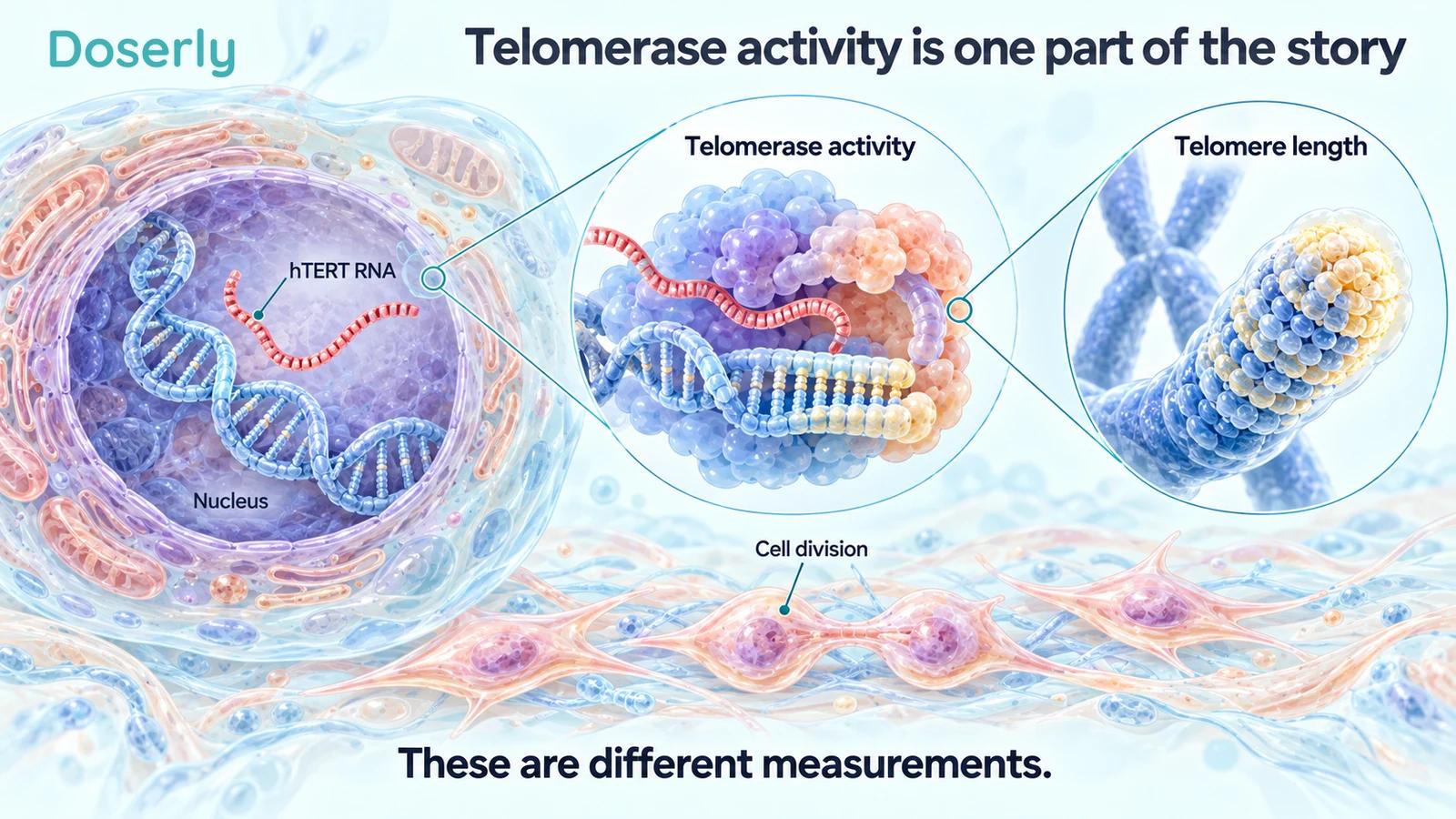
Telomeres are specialized structures at chromosome ends, made from repeated DNA and associated proteins. They help prevent natural chromosome ends from being treated like broken DNA. Telomerase can add telomeric DNA, helping certain cells maintain those ends through repeated division.
One component of the enzyme is encoded by hTERT, the human telomerase reverse transcriptase gene. Measuring hTERT RNA is one way to investigate the cell's production of that component. It is not the same as directly measuring the activity of the complete enzyme.
A classic 1998 experiment introduced the telomerase catalytic subunit into normal human cell types and showed that the cells could exceed their usual replicative lifespan in culture. That work helped establish a causal connection between telomere maintenance and cellular senescence under those experimental conditions. It did not involve Epitalon or treatment of aging people. Bodnar and colleagues.
This background explains why researchers would investigate a compound that appears to influence telomerase. It also establishes the correct scale of the initial question: cellular replicative behavior, rather than an immediate claim about whole-body aging.
The early Epithalon experiment was in fetal fibroblasts
The 2003 study frequently cited in this discussion added Epithalon to human fetal fibroblast cultures. The authors reported expression of the telomerase catalytic component, enzyme activity and telomere elongation in cells initially described as telomerase-negative. Original abstract.
A fibroblast is a cell involved in maintaining the supportive material around tissues. The word “human” identifies where the cells came from. It does not mean participants were given the peptide or that a clinical outcome was observed.
The fetal origin is also relevant. Cells obtained during development are not interchangeable with every cell population in an older adult. Culture conditions select and support particular cells, while a living person has many tissues with different turnover patterns and regulatory environments.
The experiment supports a mechanistic observation in that model. It does not establish the concentration that would be achieved in human tissue, the duration of an effect after administration, or whether repeated treatment improves a symptom or prevents disease.
What “overcoming the division limit” meant
A 2004 follow-up examined the proliferative potential of fetal lung fibroblasts. Its abstract describes untreated cultures losing proliferative potential around passage 34, while peptide-treated cultures reached passage 44 and continued dividing. Original follow-up abstract.
A passage is a laboratory step in maintaining a culture, generally involving transferring cells into fresh conditions. It is not a year of life. The result should not be translated into a percentage extension of a person's lifespan.
Nor does continued division establish that every aspect of cell function has become younger. Researchers would need to assess other characteristics directly. A culture can maintain one capability while changing in other ways.
The commonly used phrase Hayflick limit concerns the finite replicative capacity observed in many normal cell cultures. It is useful for discussing cellular senescence, but it is not a fixed countdown that determines the age at which every person dies. Many tissues contain cells that divide rarely or not at all, and the health of the body depends on much more than how many times one cultured cell population can divide.
A donor-cell experiment showed a mixed response
The 2019 AEDG study used blood lymphocytes from eleven men: five aged 18–22 and six aged 49–54. Lymphocytes are a type of white blood cell. Researchers stimulated the cells with phytohemagglutinin, or PHA, a laboratory agent used to encourage division, and exposed the cultures to AEDG outside the body. Original study.
Significant telomere-length changes were reported in seven donors' cell samples. Five showed an increase and two a decrease; the remaining four did not show a significant change. The authors also examined the mitotic index, the proportion of cells undergoing division, which did not show a simple universal increase.
This is a small exploratory experiment, but it is useful because it complicates a one-direction story. The result was not “all human telomeres lengthened.” The response depended on the donor sample and the outcome being measured.
The participants themselves were not treated. Their ages describe the donors, not the ages of people who experienced a proven anti-aging effect. This is the difference between ex vivo research—studying material removed from the body—and a treatment trial.
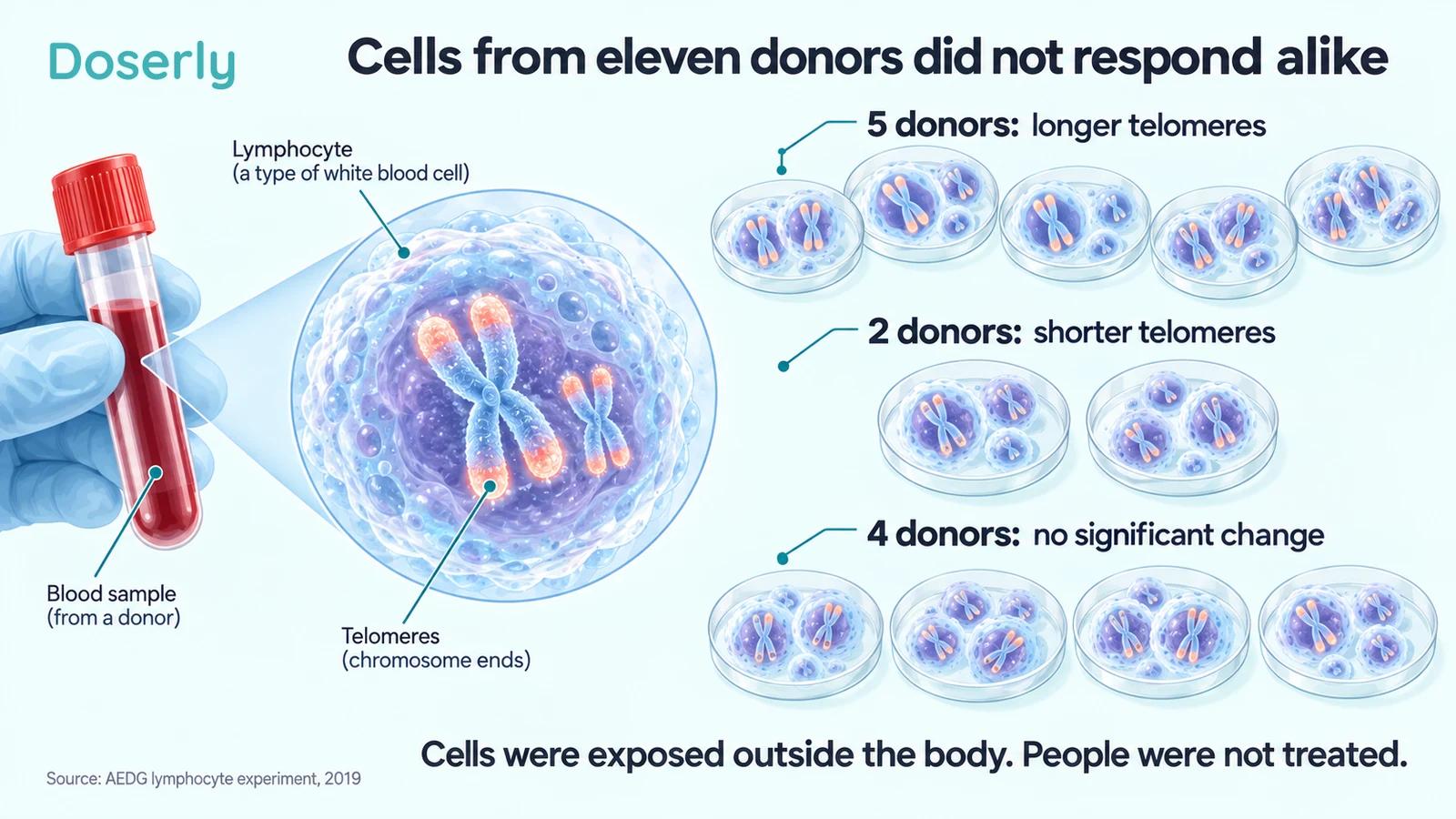
The study reported longer telomeres in five donor samples, shorter telomeres in two, and no significant change in four. The dishes are conceptual illustrations of sample groups, not images of the original cultures or predictions of individual benefit. Source.
“Normalization” needs a defined target
The 2019 authors described a tendency for shorter initial telomeres to lengthen and longer initial telomeres to shorten relative to their sample's average. That observation is interesting, but calling a pattern “normalization” raises an additional question: normal for what purpose?
A group average is a statistical description. It is not automatically the healthiest value for every individual, cell type or age. Demonstrating a clinical target would require evidence connecting that target to meaningful outcomes and showing that moving toward it improves those outcomes.
The experiment cannot establish that a person should use AEDG until a blood result reaches a particular percentile. It also cannot show that a decrease is necessarily beneficial simply because the starting value was relatively high.
The useful conclusion is narrower: donor samples did not respond identically, so a universal telomere-lengthening claim does not accurately describe this experiment. Larger and independently replicated studies would be needed to understand whether the pattern is robust and what explains it.
The newer study separated several parts of the mechanism
The 2025 Epitalon paper studied normal fibroblast and mammary epithelial cells alongside breast cancer cell lines. It measured telomere length, hTERT expression, telomerase activity and indicators of alternative lengthening of telomeres, or ALT, a distinct telomere-maintenance pathway. Original article.
The reported patterns differed between normal and cancer models. That is scientifically useful because a longer telomere does not identify the mechanism that produced it. Measuring enzyme activity and alternative-pathway indicators helps investigate the explanation rather than assuming one from the final length measurement.
The cancer and normal-cell experiments also used different exposure durations. Their results should not be simplified into a same-condition ranking of which cells respond more favorably.
A November 2025 correction replaced Figures 1–3, so the updated material should be consulted when interpreting quantitative claims. The correction belongs to the same experiment; it is not an additional independent study. Correction.
Why gene expression, enzyme activity and length must stay separate
An RNA measurement asks how much of a particular transcript is present. An enzyme assay asks whether a biological activity can be detected under the assay conditions. A telomere-length measurement asks about the chromosome ends after the processes acting on them have had their combined effect.
These measurements can support one another, but they do not remove the need for appropriate controls. For example, a change in RNA does not establish that the complete enzyme has become more active. A change in length does not prove telomerase caused it if another maintenance pathway is operating.
A further step is needed to connect those measurements with cell behavior. Do the cells divide more, survive better, retain their specialized functions or accumulate unwanted changes? Those questions require their own observations.
Finally, cell behavior must be connected to tissue and patient outcomes. A biochemical pathway may be real while its practical therapeutic value remains uncertain. This is why explaining the mechanism carefully can make the research more interesting without overstating what it has achieved.
The same mechanism can have different implications
Maintaining a useful cell population may be beneficial in some settings. Maintaining an abnormal population may be harmful. The biological process does not come with an automatic label saying which interpretation applies.
Research in families with inherited POT1 variants illustrates the point. The 2023 study linked a long-telomere syndrome with expansion of certain blood-cell populations and a range of tumors. It did not test Epitalon. It provides a human example of why extended cellular longevity can have consequences other than healthier aging. Primary family study.
This does not mean that activating telomerase in any context inevitably causes cancer. Cancer biology involves many changes, and a laboratory signal is not a clinical risk estimate. It means that benefit and safety both need investigation when altering a system involved in how long cells persist.
The relevant questions include which tissues are exposed, whether the effect is reversible, what happens to cells with pre-existing abnormalities, and whether the desired function improves. A simple slogan about “longer telomeres” leaves all of those questions unanswered.
What the mechanism does not tell us about a regimen
A cell-culture concentration does not identify a human dose. Cells in a dish are directly exposed under controlled conditions; a product administered to a person must be absorbed, distributed and cleared. The resulting tissue exposure cannot be assumed from the amount listed on a vial.
The laboratory studies also do not establish an ideal cycle length, a necessary washout period or a safe combination with other peptides. Those are clinical questions, not missing arithmetic that can be filled in from a molecular diagram.
If a proposed regimen is described as “telomerase-based,” ask which evidence connects the specific product and exposure to the intended benefit. A plausible mechanism can justify research. It cannot replace a trial demonstrating that the proposed use helps people enough to outweigh its risks.
What would move the story forward?
Useful follow-up work would reproduce the cell findings across independent laboratories, characterize the product and examine the conditions under which responses vary. Studies would need to distinguish changes in telomere maintenance from changes in other aspects of cell health.
Human development would then require suitable safety and exposure studies, followed by trials with a specific clinical goal. If the proposed benefit is improved function or reduced disease, those outcomes need to be measured rather than inferred from a telomere result.
Epitalon's telomerase story is therefore a mechanistic research story with several open directions. The most accurate reading preserves its interesting observations while leaving human benefit, long-term safety and dosing unresolved. The Epithalon guide provides the broader context for discussing those questions with a clinician.
Sources
- Bodnar and colleagues, 1998: experimental telomerase introduction into normal cells; not Epitalon research.
- Khavinson and colleagues, 2003: Epithalon fibroblast findings.
- Khavinson and colleagues, 2004: extended proliferative capacity in fetal fibroblast culture.
- AEDG lymphocyte study, 2019: heterogeneous responses across eleven donor samples.
- Al-Dulaimi and colleagues, 2025 and correction: multiple telomere-maintenance measurements in cell models.
- DeBoy and colleagues, 2023: human inherited long-telomere syndrome; not a peptide exposure study.