
Peptides
October 16, 2026
Eloralintide weight loss: who was studied changes what the result means
On this page
Eloralintide's weight-loss results are attracting attention because they suggest that an amylin-based medicine could become another option for treating obesity. Amylin is a hormone involved in appetite and the body's response to eating. Eloralintide is a longer-acting analogue being studied as a treatment.
A headline such as “about 20% weight loss” leaves out a crucial part of the result: who received the treatment, under which conditions, and how the average was estimated. That information determines how well the finding relates to someone with diabetes, someone already taking another weight-management medicine or someone much older than the typical participant.
The results deserve to be understood in their actual setting. This article explains the populations behind the early studies and the larger 48-week trial, without turning their group averages into personal forecasts. For background on the compound, see our eloralintide guide.
Which study produced the widely discussed result?
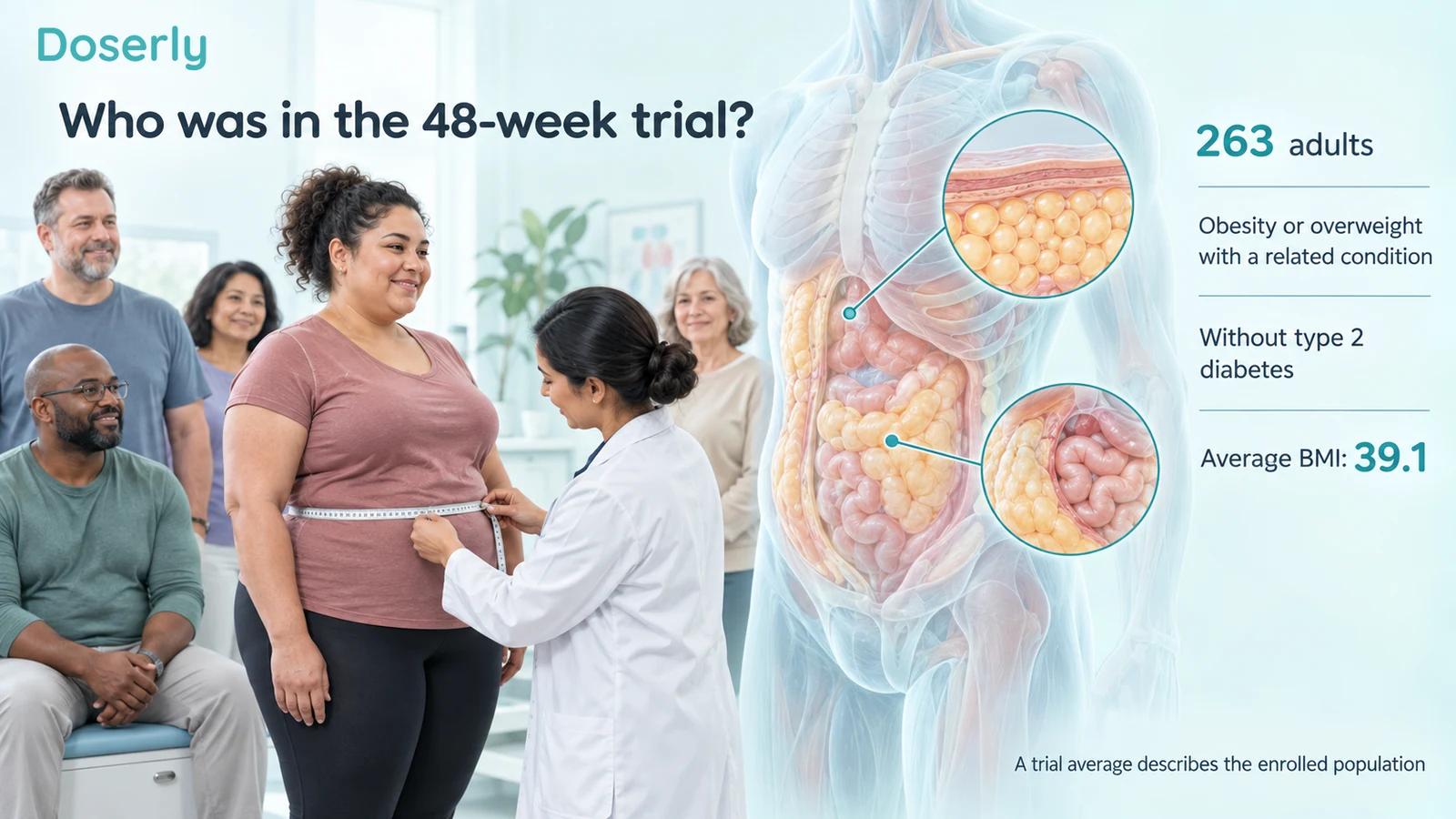
The 48-week phase 2 trial randomized 263 adults at 46 research centers in the United States. Participants were aged 18–75 and had either obesity, defined for entry as BMI at least 30, or overweight with BMI at least 27 plus a weight-related health condition. They didn't have type 2 diabetes.
The primary outcome was percentage change in body weight. The highest reported group averages were approximately 20% weight loss under the trial's efficacy estimand, compared with 0.4% with placebo. Other eloralintide groups had smaller average reductions. Phase 2 primary report
This wasn't a study of everyone who wanted to lose weight. It was a controlled experiment in adults meeting specified medical criteria. That doesn't make the results less valuable; it defines the question they answer.
The study also compared several schedules, rather than establishing one universal experience of “taking eloralintide.” The schedule attached to a result is part of the evidence, even when an article doesn't reproduce a dosing table.
What was the typical participant like?
The published report describes a mean age of 49 years, mean starting weight of 109.1 kg and mean BMI of 39.1. Approximately 78% of participants were female and 78% were White. These are group descriptions, not characteristics shared by every individual. Population in the primary report
A mean BMI near 39 indicates that the study's center of experience was well within the obesity range. It shouldn't be reframed as a trial of modest cosmetic weight loss in otherwise lean adults.
The age range also needs careful interpretation. Allowing enrollment through age 75 doesn't mean large numbers of people in their seventies were studied. The average age and overall sample size give more context than the maximum permitted age alone.
Representation matters without determining individual response. Being male or belonging to an underrepresented racial group doesn't establish that the medicine won't work. It means the study offers less precise information about some groups than the overall average might suggest. Adequately sized subgroup analyses and broader studies can help address that uncertainty.
Why does excluding diabetes matter?
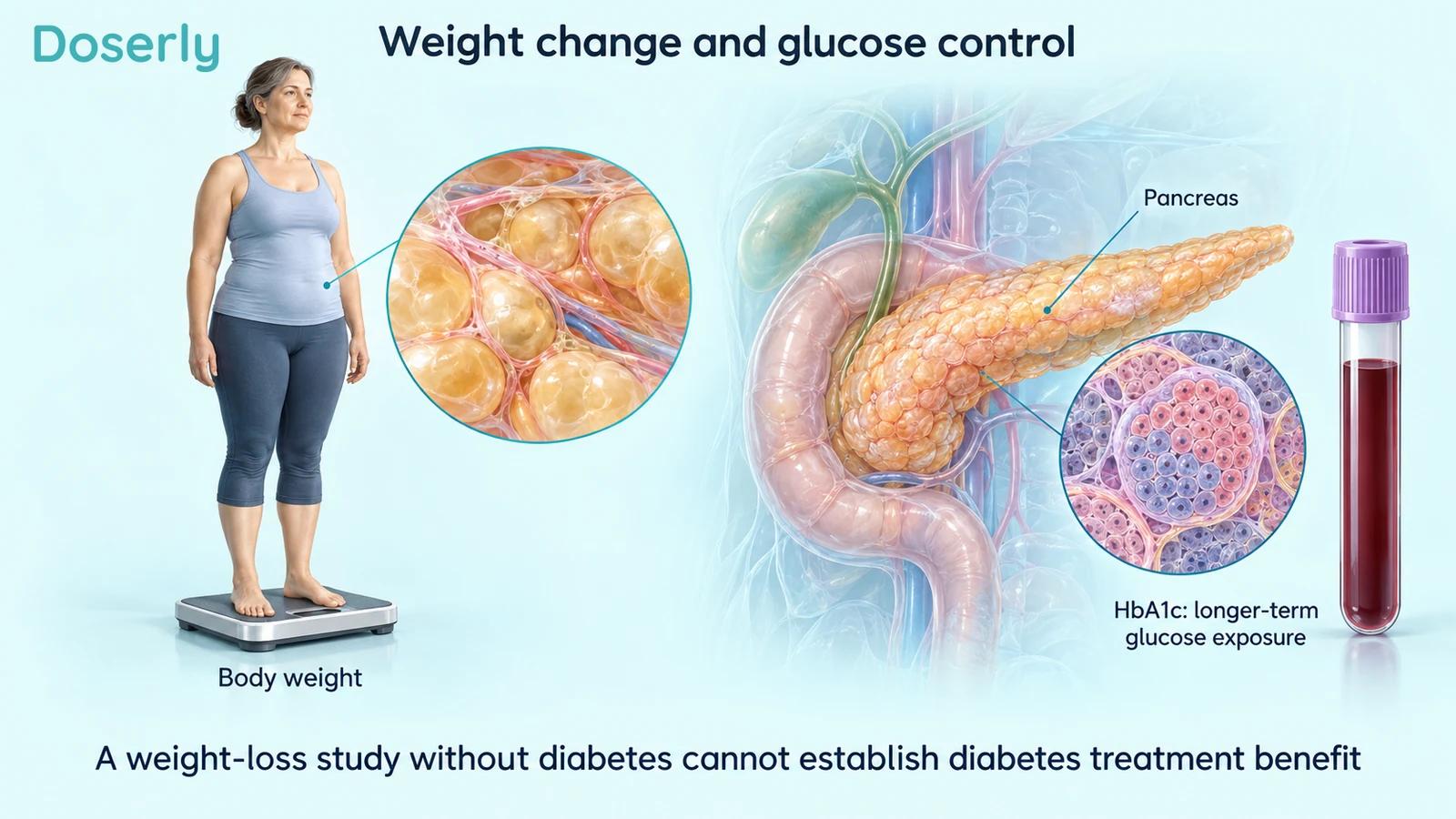
Diabetes changes the clinical question. A treatment conversation may need to address glucose control, existing diabetes medicines, low-glucose risk and complications, alongside weight. A study that excludes diabetes cannot directly establish that full balance.
The early multiple-dose eloralintide study also excluded diabetes. Its glucose-related measurements in people starting without diabetes didn't establish treatment efficacy for people whose glucose regulation was impaired. Phase 1 report
This is why a diabetes-specific study is useful even when weight loss has already been demonstrated elsewhere. Researchers can examine the intended population and relevant outcomes directly, rather than assuming that an effect in one metabolic setting will be identical in another.
ENLIGHTEN-2 is registered specifically for adults with overweight or obesity and type 2 diabetes. Its main endpoint remains weight change at 64 weeks, while secondary outcomes include HbA1c, a measure of longer-term glucose exposure. As checked in October 2026, the registry describes a recruiting trial, not completed results. ENLIGHTEN-2 record
Eligibility includes more than BMI
The phase 2 record excluded several conditions that could complicate safety assessment. These included recent major cardiovascular events, a history of pancreatitis and ongoing or previous bradyarrhythmia or sinus bradycardia at screening. The complete eligibility rules also included restrictions involving other illnesses and previous obesity procedures. Registered phase 2 eligibility
Bradycardia means a slow heart rate; a bradyarrhythmia is a slow rhythm disturbance. These details are particularly relevant because pulse changes were observed in early eloralintide development. They help explain why the trial can't settle safety for every person with a rhythm problem.
An exclusion isn't proof that a medicine would harm everyone with that condition. Sometimes researchers exclude a group to reduce uncertainty in early development or because additional monitoring and specialized study are needed. The appropriate conclusion is that the excluded group's experience isn't adequately answered by this trial.
For a clinician, this is often more actionable than a headline weight-loss percentage. The patient's health history determines whether the trial is a close match and which additional evidence would be necessary.
The smaller studies enrolled different people
The discovery paper's first-in-human study enrolled 48 generally healthy adults with BMI from 18.5 to 32. Participants received a single administration, followed by safety and drug-concentration assessments. It wasn't a year-long obesity trial. Single-dose study
The subsequent 12-week study enrolled 100 adults with overweight or obesity. The average age was about 44, mean BMI was 32.6 and 29% were female. Participants with important chronic heart, liver or kidney conditions and diabetes were excluded. Multiple-dose study
Those differences explain why the three studies shouldn't be treated as repeated measurements of the same population. The single-dose experiment primarily asked whether initial exposure was sufficiently tolerable to continue development. The repeated-dose study explored sustained exposure and early effects. The larger phase 2 study tested weight management over a longer period.
A favorable early safety signal and a larger later weight-loss result can both be true without implying identical experiences across studies.
What does a group average tell you?
An average summarizes a collection of individual changes. It doesn't tell you the range of responses, how many people exceeded a threshold or how many stopped treatment. Those require additional results.
For a simple illustration, two hypothetical participants losing 5% and 15% have an average loss of 10%. That average describes neither person exactly. Clinical trials use larger groups and more sophisticated analyses, but the distinction between a group estimate and an individual outcome remains.
Percentage change also differs from kilograms. A hypothetical 10% loss is 10 kg from a starting weight of 100 kg and 8 kg from 80 kg. This arithmetic explains why percentages help compare different starting weights; it doesn't predict anyone's response to eloralintide.
The clinically relevant question is not merely whether someone can match the mean. It is whether treatment provides worthwhile benefit for their health goals while remaining tolerable and sustainable.
Why the analysis matters alongside the population
The prominent phase 2 results use an efficacy estimand, a defined treatment question that accounts for treatment discontinuation and other events in a particular way. It is important to preserve that label rather than describing the result as an observed outcome guaranteed for all people who start.
Regulatory guidance distinguishes questions about a treatment strategy regardless of discontinuation from hypothetical questions about continued treatment. The analysis must match the question, and missing measurements introduce additional assumptions. ICH E9(R1) guidance
This doesn't make an efficacy estimate invalid. It means its interpretation needs the same care as its population. A useful treatment discussion considers both the effect under sustained treatment and the practical likelihood of remaining on it.
The phase 2 registry describes a mixed-model analysis for repeated weight measurements. Such a model uses the pattern of available measurements to estimate group changes; it doesn't turn unobserved outcomes into directly measured facts. Registered analysis
What about people already using another medicine?
The monotherapy result doesn't answer the question of adding eloralintide to an existing regimen. Someone who has already lost substantial weight with another drug starts from a different situation than a participant beginning the tested strategy.
There may be different appetite responses, different adverse effects or a different remaining amount of weight to lose. A plateau after previous treatment is also a specific clinical circumstance, not simply a smaller version of an untreated starting point.
Combination trials can address these questions, but their findings must be interpreted as combination evidence. A result for eloralintide alone cannot establish an add-on dose, and a result for one combination cannot establish every possible pairing.
This distinction matters when online discussions translate a promising monotherapy percentage into expectations for people already receiving GLP-1-based treatment. The expectation needs direct support in that setting.
There is now a separate diabetes-specific combination result to consider. In September 2026, Lilly disclosed a 48-week study of eloralintide, tirzepatide and combinations in 367 adults with type 2 diabetes. That updates the evidence base, but it does not change who participated in the earlier 263-person obesity trial. The newer numerical results were sponsor-reported and used an efficacy estimand; they should be identified accordingly. Original combination disclosure
This is an example of how evidence grows without making earlier population distinctions obsolete. A new trial supplies information about a new treatment setting. It does not retroactively turn a study without diabetes into a diabetes study, or establish that people already using any glucose-lowering regimen will have the same experience.
Does weight loss establish broader health benefits?
It can be an important treatment outcome, but a scale doesn't measure every consequence of treatment. Changes in blood pressure, glucose, physical function, body composition and quality of life may all matter.
Likewise, preventing a heart attack or reducing kidney failure requires evidence about those events. A weight-loss trial doesn't become a cardiovascular-outcomes trial because obesity is associated with cardiovascular risk.
ENLIGHTEN-1 plans a broader set of measurements, including body fat, patient-reported health measures and longer follow-up for diabetes onset among participants with prediabetes. These are valuable research questions. Their presence in a registry doesn't establish positive answers. ENLIGHTEN-1 record
The right expectation is that larger trials can add information, including findings that differ from early predictions.
Matching the study to your own question
Before focusing on the headline percentage, identify the closest population. Does it include your age group, diabetes status, relevant illnesses and treatment history? Which important features of your situation were excluded or uncommon?
Then identify the outcome you care about. Losing weight, improving glucose control, reducing symptoms and preventing future events are related goals but different research questions. A trial may answer one well while leaving the others uncertain.
Finally, ask how the study handled people who stopped treatment. A realistic expectation includes the possibility of unwanted effects and incomplete persistence, as well as potential benefit.
Eloralintide's phase 2 findings provide a substantial reason to follow its development. They are most useful when described as results in a defined population, with a defined analysis and follow-up period. Our eloralintide guide explains how the population evidence fits with the mechanism and safety findings.
Sources
- Eloralintide (LY3841136): from discovery to clinical proof of concept — translational and human phase1, 2025.
- Eloralintide: Phase 1 proof of concept — human rct, 2026.
- Eloralintide for obesity: a 48-week phase 2 randomized trial — human rct, 2025.
- Eloralintide phase 2 trial, NCT06230523 — trial registry results, 2026.
- ENLIGHTEN-1 — trial registry, 2026.
- ENLIGHTEN-2 — trial registry, 2026.
- ICH E9(R1): Estimands and Sensitivity Analysis in Clinical Trials — regulatory guidance, 2021.
- Lilly EloraTZP phase 2b disclosure, September 30, 2026 — original sponsor disclosure, not a peer-reviewed full report.