
Peptides
October 16, 2026
Eloralintide and selective amylin agonism: what it means
On this page
Eloralintide is an investigational medicine based on amylin, a hormone your pancreas releases after eating. Researchers are studying whether a longer-acting version of this signal can help people with obesity reduce weight through a pathway different from the GLP-1 medicines that receive much of the attention.
Its distinguishing description is selective amylin receptor agonist. That phrase sounds precise, but it can easily become a promise it doesn't contain. Selectivity describes relative activity at receptors in laboratory tests. It doesn't mean the drug acts at only one receptor, causes no nausea or is automatically better than another amylin-based drug.
The interesting question is how its biological design relates to the human findings. We'll start with the body's own amylin, explain what the receptor experiments actually measured and then consider the treatment evidence. The eloralintide guide covers the wider development program.
What does the body's own amylin do?
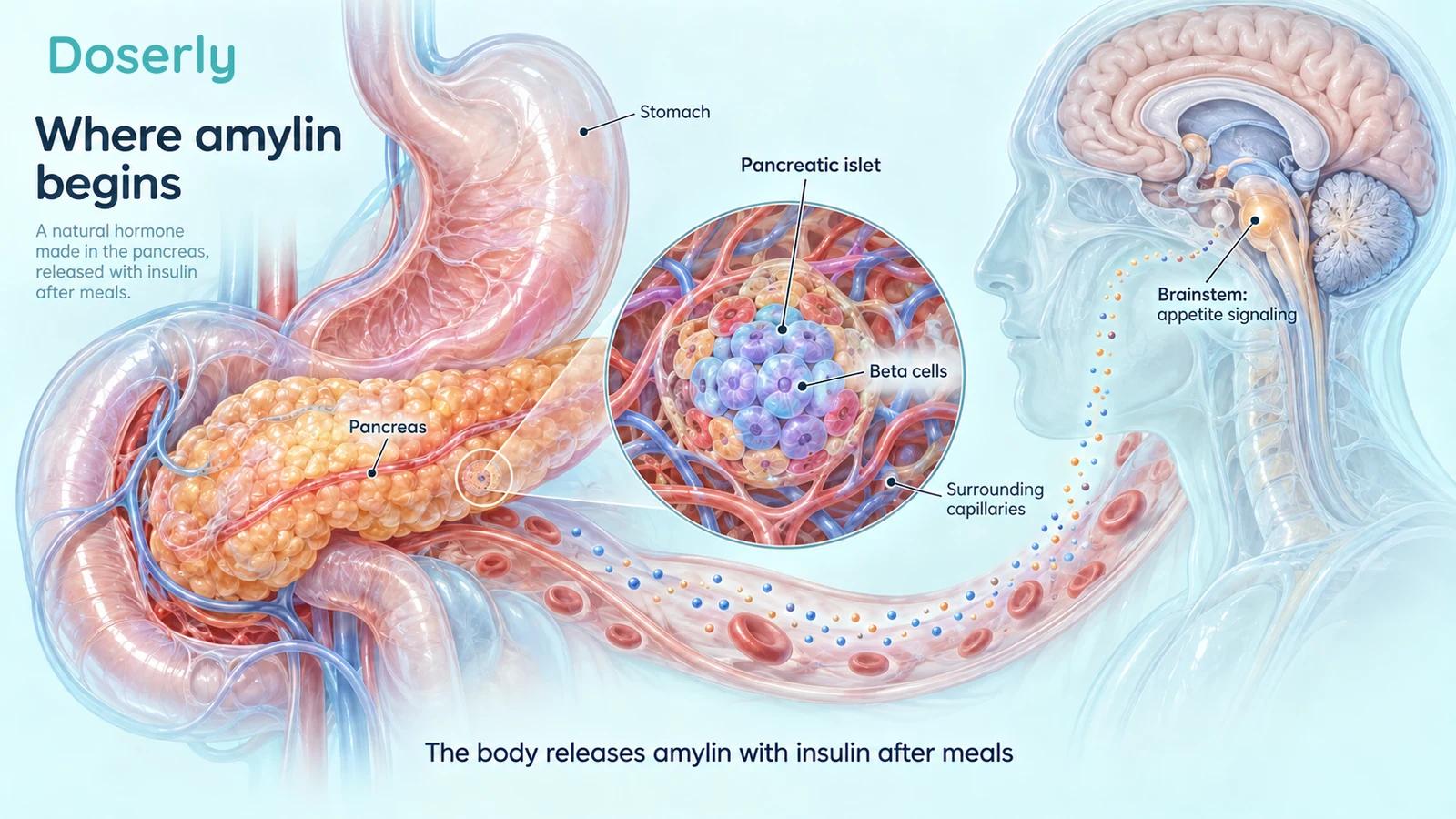
Amylin is a small protein-like hormone, or peptide, made by pancreatic beta cells. These cells release it with insulin in response to nutrients. Insulin and amylin have complementary functions; sharing a source doesn't make them interchangeable.
Amylin participates in signals related to meal size and fullness. It also influences stomach emptying and glucagon release after meals. Those actions help explain why researchers have investigated amylin-like medicines in both diabetes and weight management. Eloralintide discovery paper
Satiation refers to the processes that help bring a meal to an end. Satiety describes the reduced desire to eat afterward. People often use “fullness” for both experiences, but they can differ: someone might stop a meal sooner yet become hungry again at the usual time.
A medicine based on amylin aims to influence this system. It doesn't create a simple on/off state in which hunger is permanently absent. Eating also responds to sensory cues, habits, energy needs and other hormones. A treatment's effect on this network has to be measured in people.
An amylin receptor is a protein partnership
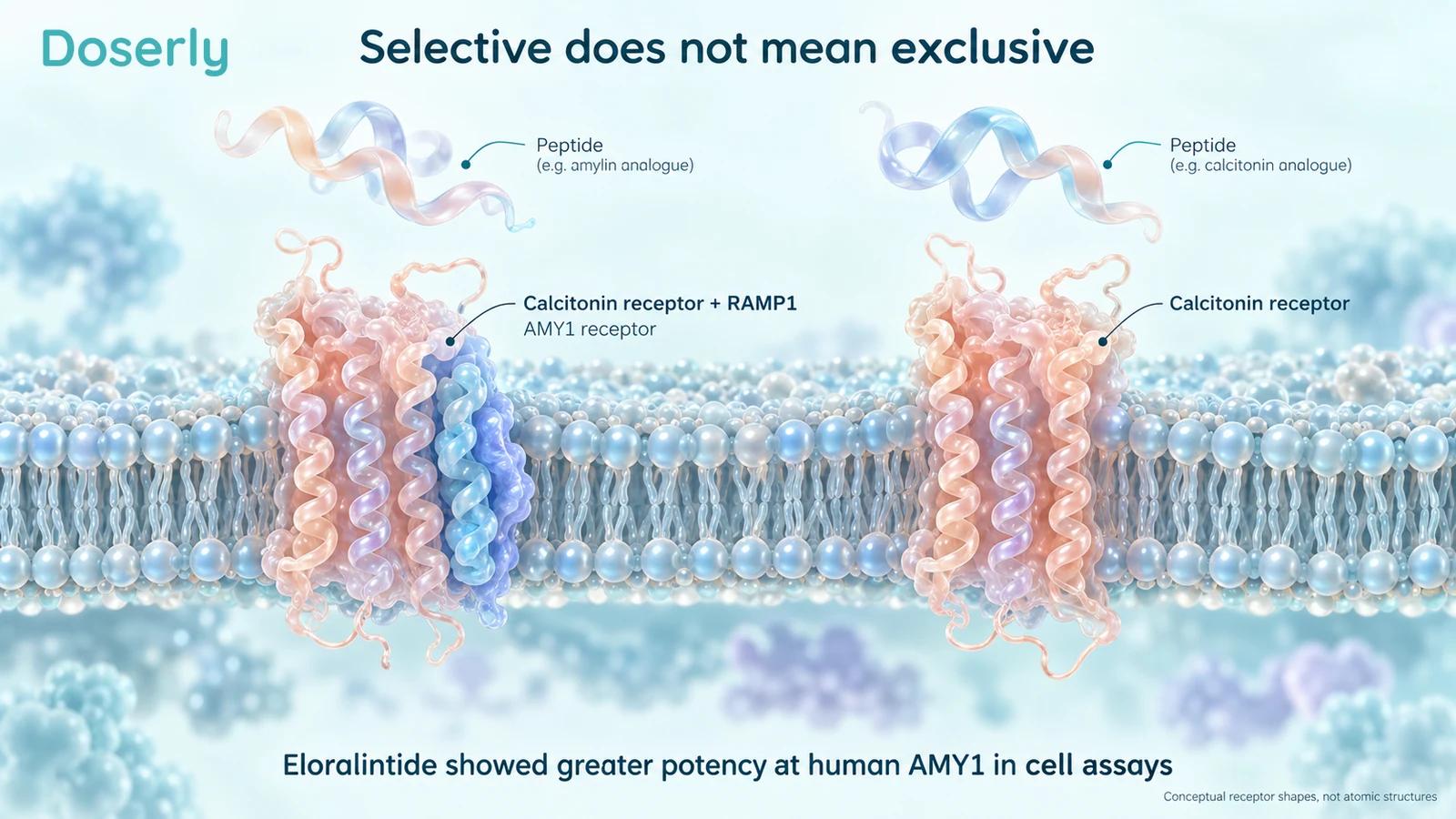
The receptor terminology is less mysterious once you know how the proteins are assembled. The calcitonin receptor can combine with a receptor activity-modifying protein, abbreviated RAMP. Different RAMP partners form different amylin receptor types.
AMY1 refers to the calcitonin receptor combined with RAMP1. The accessory protein changes the behavior of the receptor complex. The calcitonin receptor without that partner is a related but distinct pharmacological target.
This is why descriptions that treat “amylin receptor” and “calcitonin receptor” as completely unrelated structures can be misleading. They share a component. A molecule's behavior depends on which complex is present and on the conditions under which activity is measured. Receptor characterization
For a reader, the practical point is that receptor names aren't treatment outcomes. They tell us where scientists see activity and suggest why molecules may behave differently. They don't establish how a person will feel.
What did “selective” mean in the experiments?
The discovery study used cells expressing specific human receptor types. Researchers measured a signaling response across different drug concentrations. Eloralintide was approximately 12 times more potent at human AMY1 than at the human calcitonin receptor in the reported assay.
Potency describes how much of a substance is needed to produce a specified response under the test conditions. Greater potency doesn't automatically mean a greater maximum effect, and the ratio isn't a prediction of twelve times more weight loss.
The same work found activity at the other tested receptors. Selectivity therefore means preference, not exclusivity. The assays also showed differences between human and rat receptor profiles, another reason not to treat animal effects as a direct human forecast. Primary receptor experiments
Why modify a naturally occurring hormone?
The body releases hormones in changing amounts and clears them over time. A drug intended for sustained treatment needs properties that allow it to remain useful between administrations, remain chemically stable and be manufactured consistently.
Eloralintide is an analogue: a molecule designed from amylin with modifications. It isn't simply the body's native hormone placed in a vial. Its development includes changes intended to extend exposure and improve pharmaceutical properties.
The multiple-dose paper describes slow absorption and a long half-life, supporting investigation of once-weekly treatment. Half-life is the time over which a drug concentration falls by about half under specified conditions; it isn't the time at which the drug suddenly stops working. Phase 1 pharmacokinetic study
These features matter alongside receptor preference. Two compounds with similar receptor activity can create different concentration patterns in the body. Conversely, two drugs administered weekly can still have different absorption, accumulation and elimination. The calendar interval doesn't make them equivalent.
The study's pharmacokinetic discussion gives a concrete example: it describes an approximately two-week half-life and relatively small peak-to-trough concentration differences during weekly treatment. That is an explanation of persistence in the studied setting, not a recommendation to wait two weeks between doses. A half-life and an administration interval describe different features of a regimen.
These observations also offer an alternative explanation for tolerability. If concentrations change gradually, that exposure pattern might matter alongside receptor preference. The investigators discuss both possibilities. Their study did not isolate receptor selectivity from pharmacokinetics in a way that proves which feature caused the observed symptom pattern. Phase 1 interpretation
This is why a claim such as “AMY1 selectivity prevents nausea” goes beyond the data. It assigns a clinical result to one molecular property while ignoring another plausible contributor measured in the same development program. A carefully designed comparison would need to account for both, rather than attributing every difference to the receptor label.
What did the first human study establish?
The earliest published human component involved 48 generally healthy adults, randomized within six single-dose cohorts. Thirty-six received eloralintide and 12 received placebo. This was an initial safety and drug-exposure study, rather than a long-term obesity treatment trial.
All participants completed the study, and no serious adverse events or treatment discontinuations occurred. Gastrointestinal events were reported in two people at the highest tested dose. These observations supported continued development, but the small sample and single exposure limited what could be concluded. First-in-human report
Someone who sees this described simply as “well tolerated in humans” may assume a much broader experience. The precise description is more useful: a selected group was observed after one administration. Repeated treatment, higher cumulative exposure and people with additional illnesses pose further questions.
The study also wasn't a human head-to-head comparison with cagrilintide. Comparisons between those molecules elsewhere in the discovery paper included animal experiments, which cannot settle relative nausea rates in patients.
What happened with repeated treatment?
A separate 12-week randomized study enrolled 100 adults with overweight or obesity. Seventy-three received eloralintide and 27 placebo. Participants were selected to exclude important chronic heart, liver and kidney conditions and diabetes.
Weight reductions increased the interest in further development. The study also collected adverse events, pulse measurements, drug concentrations and exploratory measures of appetite and stomach emptying. That breadth is important: early development asks both whether there is a useful signal and what deserves closer monitoring. Multiple-dose primary report
The findings don't justify reducing the medicine's entire safety profile to nausea. Mood-related events and fatigue were among the observations, and pulse decreased in several groups. Those findings require further characterization; they aren't proof that every person will experience them.
Similarly, the exploratory appetite questionnaires didn't establish a statistically clear improvement in fasting appetite, and post-meal responses lacked a consistent pattern. Weight loss and a specific subjective appetite experience are related questions, but one isn't a direct measurement of the other.
What did the larger weight-management trial add?
The phase 2 trial studied 263 adults for 48 weeks. Participants had obesity, or overweight with a related health condition, and did not have type 2 diabetes. It compared multiple eloralintide schedules with placebo.
The primary outcome was percentage change in body weight. Reported efficacy-estimand group averages ranged from roughly 9% to 20% weight loss, compared with 0.4% on placebo. This moved the evidence beyond a laboratory rationale and a short safety study: it showed a substantial weight-loss signal in a defined clinical population. Phase 2 primary report
It also complicated the idea that receptor preference settles tolerability. Nausea varied markedly by group, from 11% to 64%, while 14% of placebo participants reported it. The mechanism remained the same; the treatment experience wasn't captured by one universal nausea percentage.
The registered protocol is helpful for understanding who was included and excluded, which matters when applying the findings to someone with additional health problems. It doesn't convert the experimental schedules into prescribing instructions. Phase 2 record
Is this just another GLP-1 medicine?
No. Eloralintide's main pharmacological identity is amylin-receptor agonism. GLP-1 and amylin signaling both influence eating and metabolism, but they are distinct systems. Sharing an outcome such as weight loss doesn't mean two medicines share a target.
That distinction is useful for research because a different pathway may offer another treatment option or a potential combination partner. It isn't evidence that combinations are automatically additive or easier to tolerate. Each combination changes the exposure and the safety question.
Pramlintide provides an established example of an amylin analogue used clinically. Its prescribing information concerns use with mealtime insulin and includes a severe hypoglycemia warning. That history shows that amylin-based pharmacology can be clinically useful, but it doesn't transfer pramlintide's indications, dosing or risks directly to eloralintide. SYMLIN prescribing information
A family resemblance can guide hypotheses. Decisions about a specific molecule need its own evidence.
What would make selectivity clinically meaningful?
A useful clinical advantage could take several forms: effective weight reduction with fewer disruptive symptoms, greater persistence, a particular benefit for a defined group or a practical improvement in treatment delivery. A receptor result alone cannot choose among these possibilities.
To connect selectivity with an advantage, researchers need more than separate favorable observations. Ideally, studies would compare relevant drugs or schedules while measuring exposure, benefits and unwanted effects consistently. Otherwise, differences in populations or trial procedures can look like differences in pharmacology.
Larger studies are also needed to establish whether early benefits persist and whether less common harms emerge. ENLIGHTEN-1 is a registered phase 3 trial with a 64-week primary weight endpoint and additional metabolic and patient-reported outcomes. Its registration describes research in progress, not demonstrated phase 3 benefit. ENLIGHTEN-1 record
How to use this information
If you're following eloralintide, separate three layers: what the molecule does in receptor assays, what happened in the tested human population and what remains a development hypothesis. Each is valuable, but each answers a different question.
A claim that the medicine is “selective” should prompt a specific follow-up: selective for which receptor, measured how, and linked to which patient outcome? A claim about tolerability should identify the study group and treatment duration.
Eloralintide has a clear biological rationale and human weight-loss findings worth following. Its receptor preference helps explain the research strategy; the continuing trials will determine its practical role. The eloralintide guide offers more detail on the evidence and its limits.
Sources
- Eloralintide (LY3841136): from discovery to clinical proof of concept — translational and human phase1, 2025.
- Eloralintide: Phase 1 proof of concept — human rct, 2026.
- Eloralintide for obesity: a 48-week phase 2 randomized trial — human rct, 2025.
- Eloralintide phase 2 trial, NCT06230523 — trial registry results, 2026.
- SYMLINPEN prescribing information — prescribing information, 2019.
- ENLIGHTEN-1 — trial registry, 2026.