
Peptides
October 16, 2026
Eloralintide and nausea: what receptor selectivity can—and can't—tell us
On this page
Eloralintide is being studied as an amylin-based treatment for obesity. Amylin participates in signals about eating and fullness, so the appeal is understandable: a medicine might help reduce food intake without making every meal unpleasant.
One reason for interest is eloralintide's receptor selectivity. In laboratory experiments, it preferentially activated one amylin receptor type. Researchers have proposed that this might help separate useful appetite effects from unwanted effects. But a biological hypothesis isn't a guarantee about nausea.
The human findings make that distinction especially important. A small repeated-dose study reported relatively little nausea. The larger 48-week trial showed rates that varied substantially among treatment groups. Both findings belong in the account, together with observations beyond digestive symptoms.
Our eloralintide guide explains the broader development program. Here, the focus is what a person can reasonably learn about treatment experience from the available trials.
Fullness isn't the same as nausea
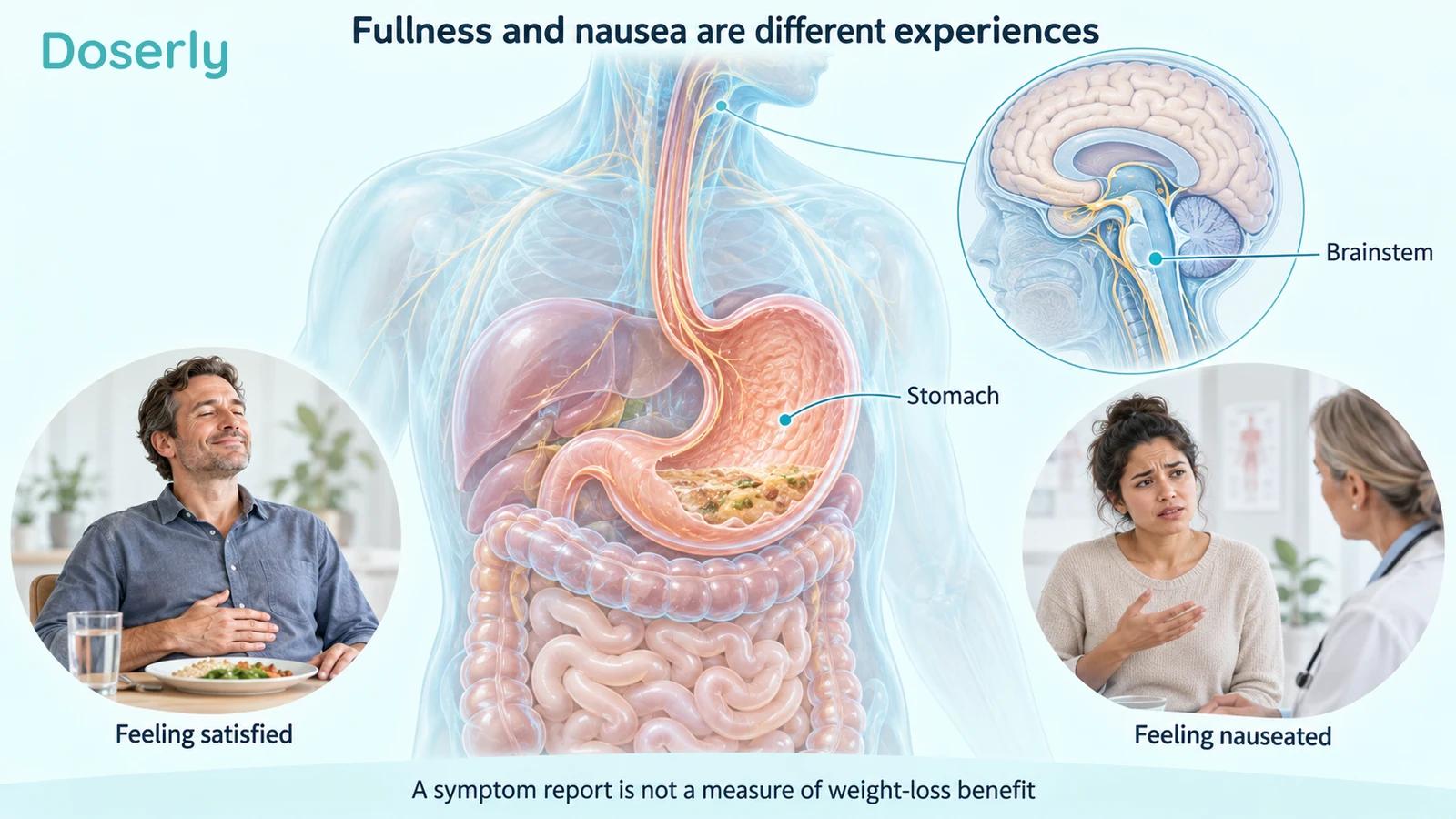
Feeling satisfied after eating and feeling queasy are different experiences. Someone may finish a smaller meal comfortably, or may avoid eating because food feels unpleasant. Both can reduce intake, but they have very different implications for quality of life and nutrition.
Amylin signaling involves appetite-related pathways, including brain regions that process information from the body. Eloralintide's discovery program examined whether its pharmacological profile could produce a useful effect with acceptable tolerability. Discovery research
That doesn't establish that weight loss occurs because participants feel sick, nor that nausea is required for benefit. A trial needs direct measurements and appropriate analyses to investigate relationships between symptoms, eating and weight change.
It is equally inappropriate to interpret the absence of nausea as proof that a medicine isn't working. Symptoms and efficacy are separate observations. A person shouldn't have to experience discomfort to regard treatment as active.
What does selectivity actually describe?
Eloralintide showed approximately 12-fold greater potency at the human AMY1 receptor than at the human calcitonin receptor in a cell-signaling assay. It still showed activity at the other tested receptors. Selective therefore means a relative preference under those conditions, not exclusive activity.
The discovery paper also compared the compounds in rats, including a conditioned taste-avoidance experiment. This measures an animal's learned avoidance of a taste associated with an experience. It is relevant to a tolerability hypothesis, but it isn't the same as a person describing nausea. Receptor and animal experiments
Several features could influence human tolerability. The molecule's absorption, concentration pattern and elimination may matter alongside receptor activity. The repeated-dose authors explicitly discussed pharmacokinetic properties as another possible explanation for their observations. Phase 1 discussion
The evidence hasn't isolated receptor selectivity as the single cause of a better treatment experience.
What happened after a single dose?
The first-in-human study randomized 48 generally healthy adults across six single-dose cohorts. Thirty-six received eloralintide and 12 received placebo. All completed follow-up, and no serious adverse events or treatment discontinuations occurred.
Two active-treatment participants reported gastrointestinal events at the highest tested dose. One had nausea and vomiting, and another had dyspepsia, a term for upper-abdominal discomfort or indigestion. Single-dose clinical report
This was useful early information. It showed that development could proceed with additional evaluation. It didn't describe months of repeated treatment in a broad obesity population.
The distinction is particularly important when an early paper is quoted as showing “almost no gastrointestinal effects.” The observation came from a small selected sample after one administration. Its denominator and exposure period belong beside the claim.
What did the 12-week study find?
The separate multiple-dose study randomized 100 adults with overweight or obesity. Seventy-three received eloralintide and 27 placebo. Across the active-treatment groups, nausea was reported in six people, or 8.2%, and vomiting in three, or 4.1%. No placebo participants reported those events in the table.
Most gastrointestinal events were mild. The report states that these events didn't lead to dose modification and weren't the reason for discontinuations in that study. Multiple-dose primary report
Those details are more informative than the rounded “8% nausea” headline. They identify the treated denominator, duration and severity. They also avoid confusing the number of people with the number of episodes: one person can experience a symptom more than once.
Small numbers remain imprecise. A handful of additional events would noticeably change a percentage based on 73 people. The result supports an early tolerability signal, not a fixed probability for every future patient.
The participant-flow data add an important qualification. Seventy-eight of the 100 randomized participants completed the study; 13 discontinued the study because of adverse events. That included two placebo participants with COVID-19 and 11 eloralintide participants, five of whom had COVID-19. The other listed reasons included mood events, a jaw fracture, somnolence and decreased appetite. The report specifically states that nausea, vomiting and diarrhea did not cause discontinuation. Participant flow and safety results
Consequently, “no gastrointestinal discontinuations” cannot be shortened to “no discontinuations” or “no treatment burden.” Nor should all 13 departures be attributed to the drug. An event recorded after treatment starts can be related, unrelated or uncertain; the reported cause and investigator assessment matter. Keeping those categories separate gives a more accurate account than either presenting every departure as toxicity or leaving the departures out of a favorable nausea summary.
The same discipline applies to study completion: it records participation, not a symptom-free experience. Someone can finish a trial while reporting unwanted effects, and someone can leave for a reason unrelated to tolerability.
What changed in the larger trial?
The 48-week phase 2 study randomized 263 adults without type 2 diabetes. It examined several dose groups and escalation schedules. The primary report gives the following nausea frequencies:
Study group
Eloralintide 1 mg
- Participants reporting nausea
- 11%
Study group
Eloralintide 3 mg
- Participants reporting nausea
- 13%
Study group
Eloralintide 6 mg
- Participants reporting nausea
- 64%
Study group
Eloralintide 9 mg
- Participants reporting nausea
- 33%
Study group
Eloralintide 6-to-9 mg schedule
- Participants reporting nausea
- 54%
Study group
Eloralintide 3-to-9 mg schedule
- Participants reporting nausea
- 25%
Study group
Placebo
- Participants reporting nausea
- 14%
These are study-group labels, not dosing instructions. The differences show why a single overall nausea rate can obscure the treatment experience. Phase 2 primary report
The rates also don't form a simple ladder in which every higher numerical dose caused more nausea. Group sizes were modest, schedules differed and chance contributes to observed frequencies. It would be a mistake to use the table to select a personal starting dose or conclude that one amount is inherently easier to tolerate than another.
Why might a later study look different?
The trials differed in duration, participants and schedules. A 48-week study offers more opportunity to observe symptoms than a 12-week study. Selection criteria and the distribution of participants between groups also matter.
Longer exposure doesn't automatically explain every difference, however. Nor can we identify which design feature caused the observed rates by comparing separate studies. That would require analyses designed to distinguish those factors.
The same principle applies to claims that eloralintide is less nauseating than another amylin drug or a GLP-1 medicine. Different studies may collect symptoms differently and apply different rules for interruptions or dose changes. An apparent advantage needs a properly matched comparison before it becomes a confident clinical claim.
The useful conclusion is concrete: eloralintide's gastrointestinal tolerability depends on the studied setting, and the larger trial does not support a blanket promise of little or no nausea.
Stomach emptying doesn't supply a simple explanation
Amylin biology includes effects on stomach emptying, but a drug analogue doesn't necessarily reproduce every effect of the native hormone in the same way.
The 12-week eloralintide study used oral acetaminophen absorption as an indirect assessment of gastric emptying. Some early changes in exposure were observed, while the later assessment suggested the initial effect had diminished. The authors described this as requiring confirmation. Gastric-emptying analysis
An indirect absorption test isn't a complete measurement of every aspect of digestion. It doesn't establish that eloralintide can never delay stomach emptying, interact with absorption of other medicines or cause upper-digestive symptoms.
Nor does it prove why nausea occurred in one group and not another. A mechanistic finding can guide further research while remaining insufficient to explain an individual symptom.
Tolerability includes more than the stomach
The phase 1 paper also reported fatigue, injection-site reactions, headache and mood-related events. Four participants experienced mood-related events; three in the highest-dose cohort stopped treatment, and the reported symptoms resolved within several days.
Pulse decreased in several eloralintide groups. The report didn't identify symptomatic bradycardia in that study, but the observation deserves attention in further development. These findings don't establish a predictable risk for everyone; they identify what researchers need to characterize more fully. Detailed phase 1 safety results
The phase 2 abstract likewise listed fatigue among common events, with rates varying by group. A tolerability claim based solely on nausea would miss that part of the experience. Phase 2 safety findings

What does trial selection leave unanswered?
The phase 2 eligibility criteria excluded people with certain rhythm problems, recent major cardiovascular events and other conditions. That limits how directly the findings apply to people with those histories. Trial eligibility
Exclusion isn't proof of harm. It means the trial wasn't designed to provide adequate evidence for that group. A person with multiple medical conditions may need information beyond the average experience of selected participants.
Similarly, a study of a few hundred people cannot reliably rule out uncommon events. Further development needs more participants and longer exposure, together with careful assessment of signals that already appeared.
ENLIGHTEN-1 is a larger registered phase 3 trial. Its ongoing status is relevant to the next evidence step, but planned research doesn't yet resolve the safety questions. ENLIGHTEN-1
How should symptoms be described?
For someone in a clinical trial, a useful symptom account includes when it began, how long it lasted, whether it recurred, and what it prevented them from doing. “Nausea after the last visit” is less informative than a dated description of the episodes and their effect on food and fluid intake.
Other changes matter too: new medicines, illness, changes in meals and missed treatment. Recording them doesn't prove what caused a symptom, but it gives the research team a better basis for assessment.
A trial's safety contact should guide decisions about interruptions or changes. Group-level study tables aren't a substitute for that assessment, and an online anecdote cannot establish that a different schedule will solve the problem.
The same attention should extend to mood, fatigue or dizziness. A narrow expectation of “just stomach side effects” can make other experiences easier to overlook.
What can a reader conclude?
Eloralintide's receptor preference is a reasonable subject for scientific interest. The early human studies provided encouraging information, and the larger trial established a substantial weight-loss signal. None of that removes the need to describe nausea and other unwanted effects accurately.
The evidence supports a nuanced statement: gastrointestinal symptoms occurred, their frequency varied substantially by study and treatment group, and receptor selectivity alone doesn't explain or settle tolerability. Larger trials will help define the balance of benefit and burden.
If you're following the research, look for the actual population, schedule, symptom duration and discontinuation information. Our eloralintide guide places those details alongside the mechanism and efficacy findings.
Sources
- Eloralintide (LY3841136): from discovery to clinical proof of concept — translational and human phase1, 2025.
- Eloralintide: Phase 1 proof of concept — human rct, 2026.
- Eloralintide for obesity: a 48-week phase 2 randomized trial — human rct, 2025.
- Eloralintide phase 2 trial, NCT06230523 — trial registry results, 2026.
- ENLIGHTEN-1 — trial registry, 2026.