
Peptides
October 16, 2026
Eloralintide and appetite: how researchers measure what people feel
On this page
Eloralintide is being investigated for obesity because it acts on amylin signaling, a system involved in appetite and the response to eating. For many readers, the hoped-for benefit is personal: feeling comfortably satisfied, thinking about food less often or finding it easier to stop eating when enough is enough.
Those experiences matter, but they aren't all measured by a scale. A trial can show weight loss without establishing exactly how hunger, fullness or thoughts about food changed. Conversely, someone can report less hunger without having enough follow-up to show a durable weight change.
The early eloralintide study illustrates this distinction. Researchers measured appetite directly with questionnaires, but the findings were exploratory and didn't establish a statistically clear fasting-appetite effect. That result deserves explanation rather than being replaced by assumptions about the drug's mechanism. Our eloralintide guide provides the wider clinical context.
Appetite isn't one sensation
People use “appetite” to describe several experiences. Hunger is the desire or drive to eat. Fullness describes a sensation that may arise during or after a meal. Satiety concerns the reduced desire to eat afterward. Prospective food consumption asks how much someone thinks they could eat.
These experiences can move together, but they don't have to. A person might feel physically full yet want a particular food, or feel mildly hungry without finding it difficult to wait for a meal.
The eloralintide phase 1 paper examined an overall appetite score and components including hunger, fullness, satiety and prospective food consumption. That approach recognizes that no single question captures every aspect of eating. Primary appetite analysis
It also means that a claim about one component shouldn't silently become a claim about all of them. Reduced hunger isn't automatically evidence of less craving, improved dietary quality or relief from intrusive thoughts about food.
Why ask participants instead of using a blood test?
Some experiences are known most directly by the person having them. A blood sample can measure a hormone concentration, but it cannot tell a researcher exactly how hungry someone feels at that moment.
A patient-reported outcome comes directly from the participant without someone else interpreting their answer. FDA guidance emphasizes that the instrument must actually measure the concept being claimed, in the relevant population and setting. FDA patient-reported-outcome guidance
This isn't a weaker substitute for “real” data. It is a different kind of data suited to a subjective experience. The scientific challenge is to make the questions clear, collect answers consistently and distinguish meaningful change from noise.
For appetite research, that means specifying whether a question concerns the present moment, a recent meal or a longer period. An answer about hunger right now isn't interchangeable with a weekly account of how often food thoughts interrupted daily life.
How does a visual analogue scale work?
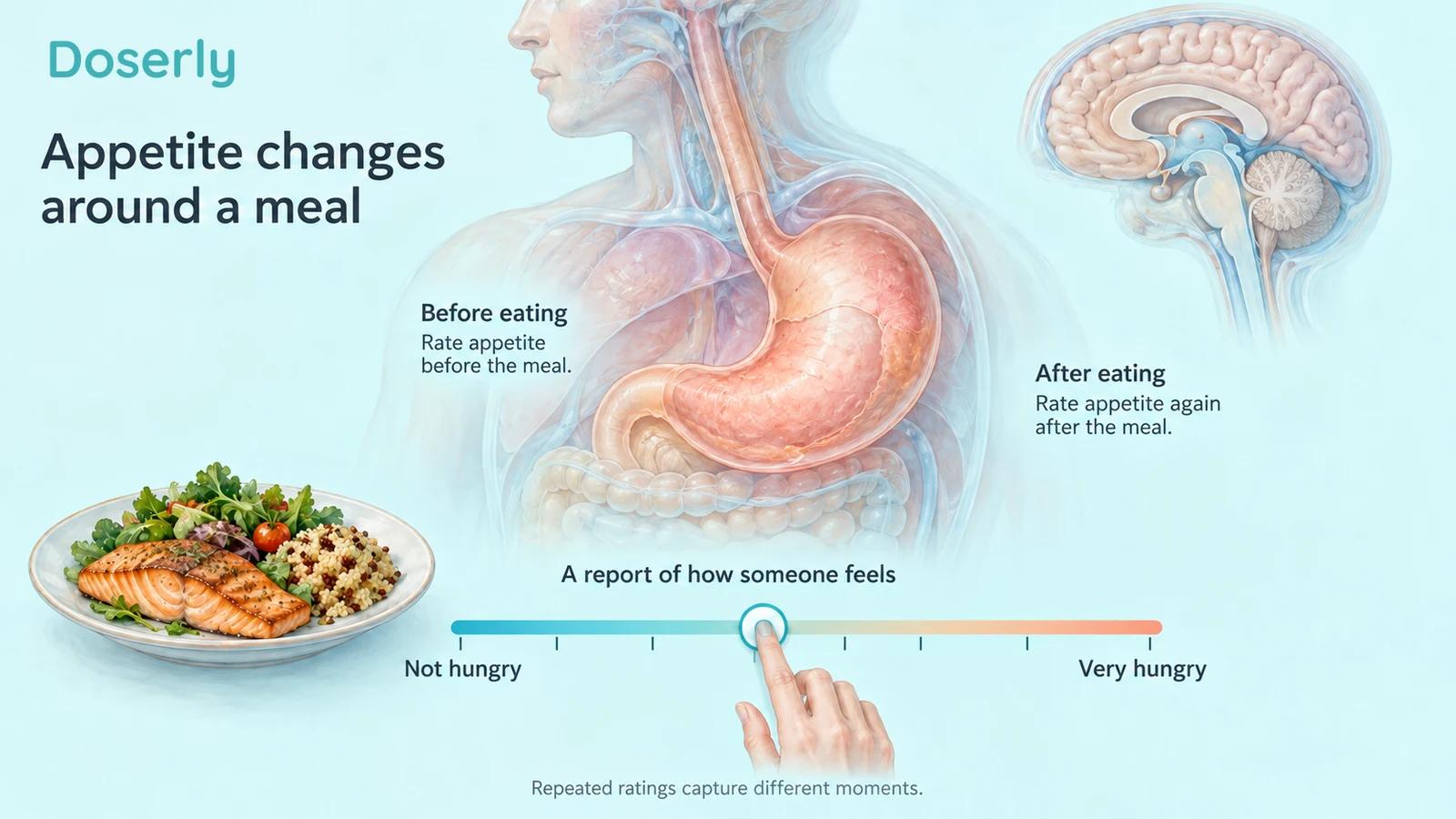
A visual analogue scale, often abbreviated VAS, asks someone to indicate where their experience falls along a line between two descriptions. A hunger scale might run from not hungry to very hungry. The location becomes a score.
The method can detect changes too subtle for a yes/no question. It also requires clear instructions and consistent interpretation. The direction matters: a higher score may mean more of one sensation, while a combined score may be constructed so that higher values mean less overall appetite.
The early eloralintide paper specifically states that an increase in its overall fasting-appetite score corresponded to reduced appetite. Reading an upward score as increased hunger would reverse the finding. Phase 1 scoring interpretation
A score also needs context. A small change on a questionnaire isn't automatically a noticeable improvement in everyday life. Researchers need evidence about reliability and what amount of change matters to participants.
Why measure before and after a meal?
Appetite changes over the course of eating. A fasting assessment examines a different moment from an assessment soon after a meal. Repeated measurements can show whether an effect is sustained, limited to one time point or too variable to identify clearly.
An older methodology study tested appetite ratings in 55 healthy men on two test days. Participants rated sensations before breakfast and repeatedly during the following 4.5 hours. Average ratings across the post-meal period were more reproducible than fasting or extreme values. Flint and colleagues
That study helps explain measurement design. It wasn't an eloralintide trial, and its young, healthy participants don't establish how a drug affects adults with obesity.
The broader lesson is practical: a single rating can be affected by the particular moment. A repeated pattern provides different information from the highest or lowest score on one day.
What did the eloralintide study actually do?
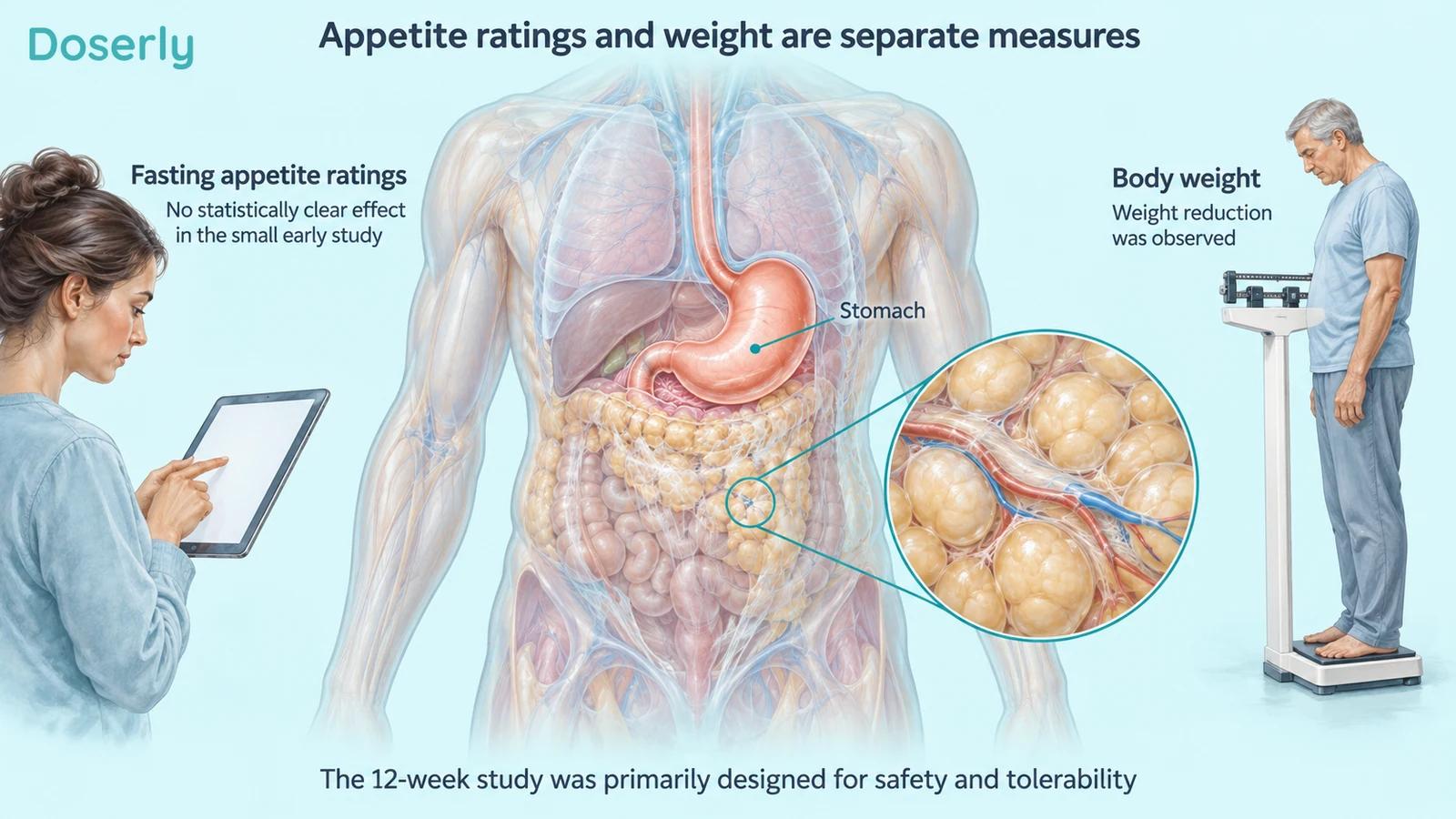
The 12-week phase 1 trial randomized 100 adults with overweight or obesity to eloralintide or placebo. Its primary purpose was safety and tolerability. It also measured drug exposure, body weight and several exploratory metabolic and appetite outcomes.
Appetite was assessed with a visual analogue scale. In the report's comparison of day 81 with the pre-treatment assessment, fasting overall-appetite scores showed a nonsignificant trend in the direction of reduced appetite with eloralintide. Post-meal scores were more variable and didn't show a clear dose- or time-related pattern. Phase 1 report
The same general pattern appeared in individual components. This wasn't a definitive positive appetite trial. Nor was it a study designed with a large sample specifically to establish an appetite benefit.
The authors described the exploratory measures as underpowered and the trends as hypothesis-generating. That tells us what to do next: study the question more directly, rather than treat an uncertain signal as a settled result.
What does “nonsignificant” mean here?
A nonsignificant result means the analysis didn't establish a clear difference under its statistical framework. It doesn't prove that the true effect is exactly zero.
Several possibilities remain: there may be no meaningful effect on that measurement, the effect may be smaller than the study could detect, or variability and sample size may have obscured it. The study alone cannot choose confidently among those explanations.
It is equally wrong to describe the result as proof of appetite suppression simply because the average moved in a favorable direction. A trend is an observation with uncertainty, not a license to remove that uncertainty from the headline.
For readers, the accurate sentence is straightforward: the small early study did not establish a statistically clear fasting-appetite effect, and the post-meal ratings lacked a consistent pattern. That leaves a useful research question open.
How could weight fall without a clear questionnaire result?
Weight and appetite ratings measure different things over different time scales. Body weight reflects accumulated changes over weeks. A questionnaire captures selected aspects of experience at specific assessment times.
A small persistent change in eating behavior might be difficult to detect with a limited set of ratings. People may also change meal size, eating frequency or food choices in ways not fully captured by one composite score. These are possible explanations, not demonstrated mechanisms from this study.
The larger 48-week eloralintide trial made weight change its primary outcome and reported substantial reductions relative to placebo. That is evidence about weight management. It doesn't retroactively make the earlier exploratory appetite result statistically significant. Phase 2 primary report
Is “decreased appetite” as an adverse event the same thing?
No. In a safety table, decreased appetite is an event reported during treatment. It isn't necessarily collected with the same questions, timing or scoring as a planned appetite assessment.
The phase 1 paper listed decreased appetite among reported treatment-emergent events. That observation shouldn't be presented as though the same percentage of participants achieved a validated appetite-treatment goal. Phase 1 safety and appetite sections
The difference is similar to recording that someone mentioned fatigue versus administering a validated fatigue questionnaire at predefined visits. Both can be useful, but they describe different data.
It also matters whether reduced appetite was comfortable or burdensome. Eating less because someone feels satisfied is different from struggling to eat because of nausea. A safety event label doesn't automatically establish the quality of the experience.
What about “food noise”?
“Food noise” is commonly used to describe frequent or intrusive thoughts about food. The phrase may capture something important to a person, but its meaning can vary: cravings, preoccupation, urges triggered by cues or difficulty disengaging from thoughts.
The eloralintide phase 1 appetite ratings weren't a direct, validated measurement of every experience people group under that phrase. A favorable weight result therefore doesn't establish that the medicine reliably eliminates food noise.
The discovery work provides a biological rationale involving amylin signaling. It doesn't measure a patient's internal experience of food thoughts. Mechanistic research
A more direct study would define the experience, use an appropriate instrument and examine whether the change is meaningful to participants. The wording of the claim should stay close to what the instrument actually measures.
What can larger trials add?
ENLIGHTEN-1 includes a Control of Eating Questionnaire among its registered secondary outcomes, alongside weight and other measures. That creates an opportunity to examine aspects of eating experience more systematically. The registry describes a planned assessment, not a positive result. ENLIGHTEN-1 outcomes
Useful reporting would show the size of a change, uncertainty around it and the number of people with complete assessments. It would also explain whether participants noticed an improvement that mattered in daily life.
Repeated assessments could help distinguish an early effect from a sustained one. Recording nausea and other unwanted effects alongside appetite would help clarify whether reduced eating feels comfortable or burdensome.
These questions are relevant even when the weight-loss result is already convincing. They explain what treatment is like to live with.
A statistically detectable questionnaire difference is not automatically a meaningful improvement. Interpretation also depends on the size of the change and evidence that people regard that change as worthwhile. A small average shift may describe a subtle effect, while an individual responder analysis can ask a different question about how many people notice a relevant improvement. Those thresholds should be justified for the particular instrument and population, not chosen afterward because they make the result look stronger. The FDA guidance treats interpretation and the ability to detect change as parts of instrument development, alongside the wording of the questions. Patient-reported outcome guidance
How can someone describe their own experience clearly?
A useful account distinguishes hunger, fullness, cravings and nausea. It also identifies timing: before a meal, after eating, late in the day or around a treatment change.
For example, “I stop eating sooner and feel comfortable afterward” communicates something different from “I avoid meals because I feel queasy.” “I think about snacks less often” describes another aspect. These statements help a clinician understand the goal and the burden without forcing every experience into one appetite score.
A consistent personal record can support that conversation, but it isn't a controlled experiment. Changes in meals, sleep, activity, stress and other treatments can affect the experience. The record helps describe a pattern; it doesn't establish what caused it.
Eloralintide research supports serious interest in amylin-based weight management. Understanding its effect on appetite requires equally careful measurement of what people feel. The eloralintide guide connects those findings with the larger clinical program.
Sources
- Eloralintide: Phase 1 proof of concept — human rct, 2026.
- Eloralintide for obesity: a 48-week phase 2 randomized trial — human rct, 2025.
- Eloralintide (LY3841136): from discovery to clinical proof of concept — translational and human phase1, 2025.
- ENLIGHTEN-1 — trial registry, 2026.
- Patient-Reported Outcome Measures: Use in Medical Product Development — regulatory guidance, 2009.
- Reproducibility, power and validity of visual analogue scales in appetite assessment — human methodology study, 2000.