
Peptides
October 16, 2026
Does Selank avoid sedation? What the studies actually measured
On this page
For someone seeking relief from anxiety, staying alert can be as important as feeling calmer. Work, study, caregiving and driving all depend on attention and coordination. That is why Selank is often discussed as a possible anxiety treatment without the sedating effects associated with some medicines.
The human literature contains favorable tolerability descriptions, but it does not establish that Selank never causes sleepiness or leaves every aspect of performance unchanged. The strongest interpretation depends on how sedation was assessed, which treatment was compared and whether Selank was used alone.
The Selank guide covers its broader evidence. Here, we'll separate sleepiness, cognitive performance and general tolerability so that “non-sedating” becomes a question a study can actually answer.
Sleepiness is only one part of the question
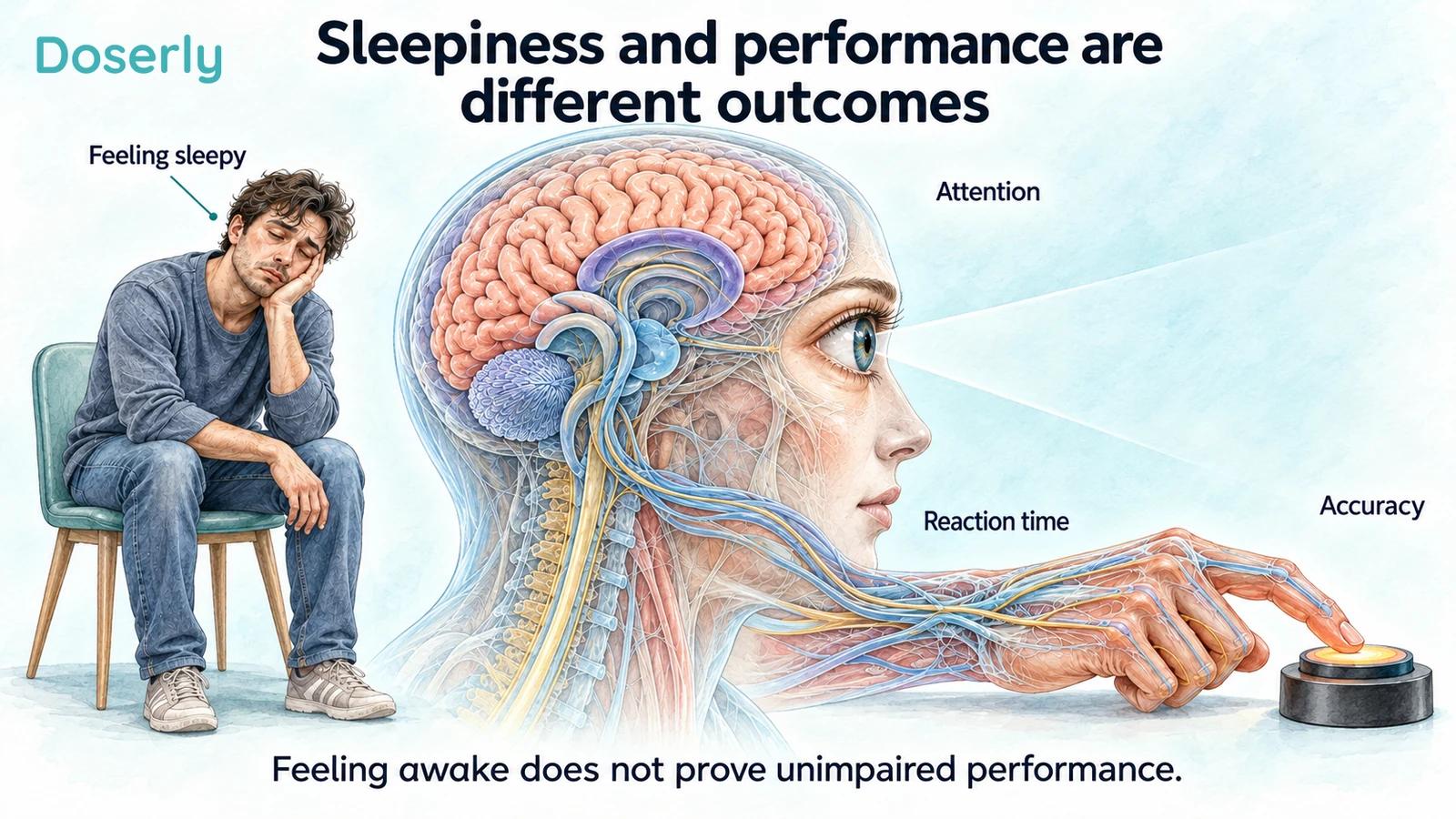
Sedation commonly refers to reduced alertness or drowsiness. But a person can be concerned about several related experiences: feeling sleepy, thinking slowly, reacting late, forgetting information or having difficulty coordinating movement.
These experiences need different measurements. A self-rating can describe how sleepy someone feels. A performance task can measure how quickly and accurately they respond. A clinical interview can explore whether the change affects daily activities.
They are related, but one cannot stand in for all the others. FDA's guidance about medicines and driving includes effects on alertness, concentration, movement and reaction time, illustrating why a simple “I feel awake” judgment is incomplete. FDA medicines and driving information.
For Selank, the relevant claim should therefore be specific. Does a study show fewer reports of sleepiness than a comparator? Better scores on a particular test? No difference from placebo? Those are distinct findings with different practical implications.
What the early clinical descriptions tell us
The 2008 Selank–medazepam report describes anxiety-relieving effects and additional effects on asthenia and activation. It involved 62 patients with generalized anxiety disorder or neurasthenia. Original report.
That language is relevant to interest in a treatment that feels less sedating. However, an investigator's description of an activating or anti-asthenic effect is not the same as a complete assessment of psychomotor impairment.
The accessible abstract does not provide a numerical sedation incidence, a driving assessment or a full time course of performance. It would be inappropriate to supply a “zero sedation” rate from that summary.
A separate 2014 comparison with phenazepam involved 60 patients and reported favorable clinical effects and quality of life. Its title includes tolerability, but the accessible abstract does not provide a detailed adverse-event table. Original 2014 comparison.
Together, these reports provide preliminary clinical observations. They do not justify a universal promise that every person will remain fully alert on every Selank product.
The add-on study used more specific assessments
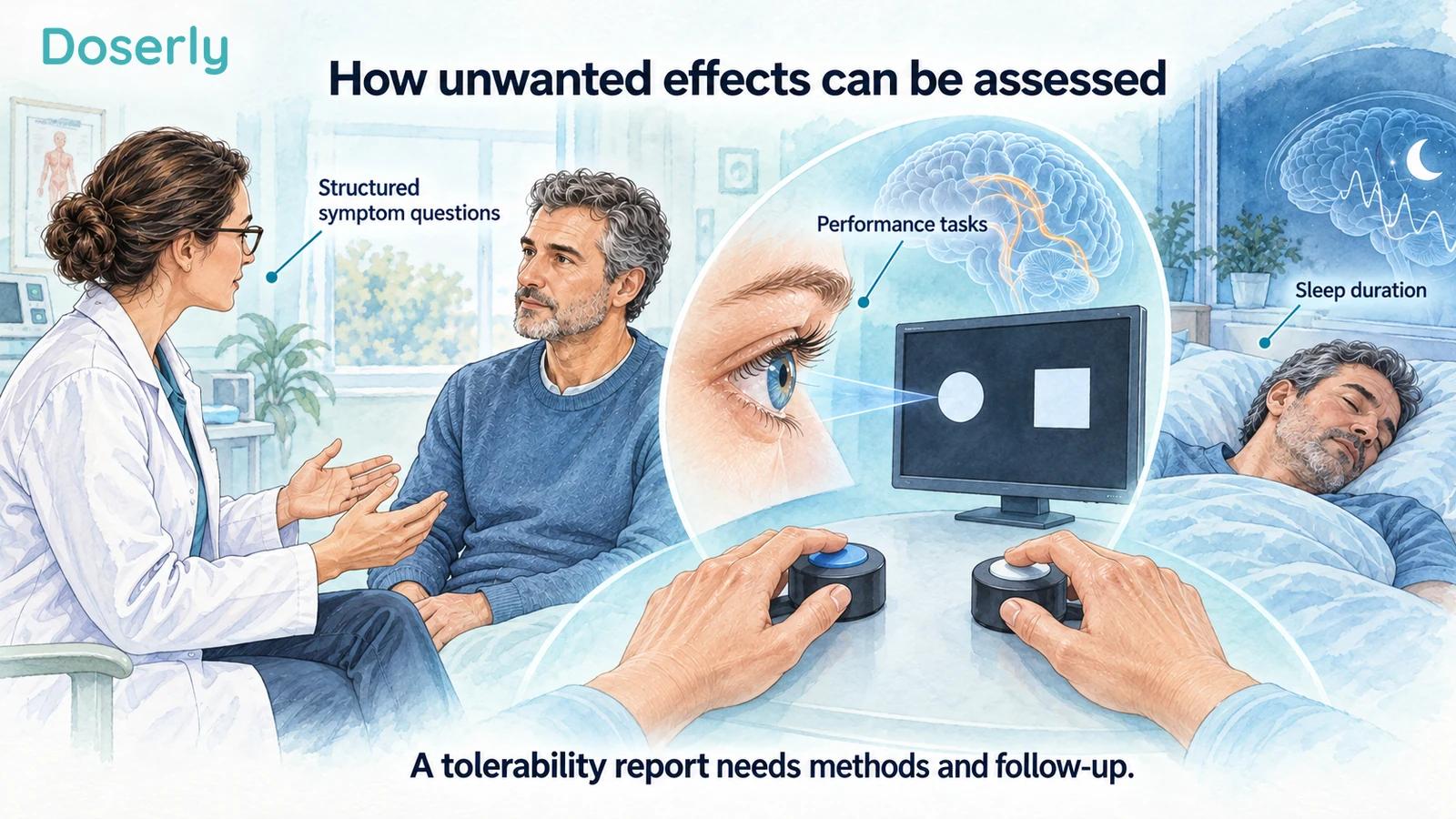
The 2015 study compared phenazepam alone in 30 patients with phenazepam plus Selank in 40. It explicitly names the UKU side-effect scale, Stroop and verbal-fluency tests, and the SF-36 quality-of-life questionnaire. The authors reported fewer unwanted effects with the combination, including sedation and increased sleep duration. Original 2015 study.
This is more informative than a vague statement that treatment was tolerated because it identifies methods used to seek side effects and assess performance. It also shows why the design must remain attached to the finding: participants in the combination group still received phenazepam.
The result does not establish Selank's isolated effect on sleepiness. It suggests a question about whether adding it changed the measured experience of another treatment. That question needs confirmation with detailed, adequately controlled data.
The accessible abstract also does not provide the full numerical effect for each unwanted symptom. We cannot calculate how much an individual's sedation risk would fall or promise protection against benzodiazepine impairment.
What do those cognitive tests measure?
A Stroop-type task asks a person to respond while competing information creates interference. In a familiar version, the task concerns naming an ink color when the written word names a different color. Performance can reflect aspects of attention and the ability to manage interference.
Verbal-fluency tasks ask participants to produce words under a rule within a time limit. They examine a different set of abilities. Doing well on one task does not establish that every aspect of cognition is unaffected.
The report's use of these tasks is therefore relevant, but the outcome needs to be described at the level actually measured. A favorable test result would not automatically prove preserved judgment during a complicated real-world activity.
Repeat testing can also introduce practice effects. Participants may become more familiar with a task, independent of a treatment. A well-designed comparison and appropriate testing schedule help researchers distinguish familiarity from a drug-related change.
Why sleep duration is not a complete sedation measure
Sleeping longer may be an unwanted effect, a response to previous sleep loss, a change accompanying anxiety relief or a consequence of another factor. The interpretation depends on baseline sleep and how the person feels and functions afterward.
Likewise, sleeping for the same number of hours does not prove that daytime alertness is unchanged. Sleep duration, sleep quality and daytime performance are separate outcomes.
A useful study would document when symptoms occurred relative to administration, whether they changed over repeated use and whether they persisted the following day. It would distinguish a brief subjective sensation from a recurring functional problem.
These are questions for future assessment, not claims that Selank produces a particular sleep disturbance. The reviewed reports do not provide enough detailed information to define a reliable individual time course.
Why the comparator affects the headline
If a substance produces less sleepiness than a sedating comparator, it may still produce more sleepiness than placebo. A relative advantage and an absence of impairment are different conclusions.
Benzodiazepines can cause drowsiness, dizziness and other unwanted effects. FDA also warns about interactions with other central nervous system depressants. FDA benzodiazepine safety communication.
That makes comparator selection important. A trial intended to establish that a new treatment does not impair performance would need sensitive measures and an appropriate control, rather than rely only on a favorable comparison against another medicine.
It would also need enough participants to detect meaningful differences. A nonsignificant finding in a small sample can reflect uncertainty. It should not be rephrased as proof that no effect exists.
What should a sedation study report?
A useful report would state how drowsiness was defined, how often participants were asked about it and whether the assessment was the same in all groups. It would distinguish a symptom volunteered spontaneously from one identified through systematic questions.
For performance outcomes, it would report baseline values, changes, uncertainty and both speed and accuracy. Faster responses are not necessarily better if errors increase. Average results should also be considered alongside participants with substantial worsening.
Reasons for stopping matter. If people who become very sleepy leave the study, a final analysis of the remaining participants can miss an important part of the treatment experience.
Finally, the report should describe the actual preparation and co-treatments. A finding with one nasal product cannot certify a different derivative, spray or combination. The word Selank on a label is not a complete description of exposure.
Does a different mechanism guarantee less sedation?
A proposed mechanism can help explain why researchers expect a difference. It cannot establish the difference by itself. Brain signaling is complex, and the relationship between a molecular effect and everyday alertness must be measured.
Nor does an animal anxiety test establish preserved human psychomotor performance. Changes in exploratory behavior or receptor-related measurements are useful for hypothesis development, but they are not a driving or workplace safety assessment.
The same restraint applies to calling Selank “non-sedating” because it is a peptide. Chemical category does not determine a complete clinical side-effect profile. The relevant evidence is what people experienced and what appropriately sensitive tests found.
FDA's Selank acetate entry identifies important missing human safety information and potential immunogenicity concerns. Those concerns are different from sedation, but they underscore why one favorable tolerability claim cannot describe overall safety. FDA compounding information.
What does this mean for driving or safety-sensitive work?
The reviewed Selank reports do not establish driving safety. A symptom questionnaire or a limited cognitive task cannot be converted into a guarantee that someone can drive safely after using a product.
If a treatment causes drowsiness, slowed thinking, dizziness or visual changes, those symptoms matter regardless of whether a website calls it non-sedating. Discuss them with a clinician or pharmacist before driving or operating machinery. FDA advises reviewing medicines and their effects on driving with health professionals. FDA driving guidance.
A home reaction-time game cannot certify fitness to drive. It samples a narrow task under controlled circumstances and may not detect problems in divided attention, judgment or unexpected situations.
It is also important to disclose other medicines and substances. A favorable experience with a product alone does not establish safety in a different combination.
A more useful clinical conversation
If avoiding sedation is a priority, explain the activities you need to preserve. “I need to remain alert during night shifts” and “I am worried about memory while studying” identify different concerns.
Ask which study measured the relevant outcome, whether Selank was given alone and whether the result was compared with placebo or another treatment. Ask how adverse effects were collected and what follow-up was available.
A dated record of sleep, symptoms and difficulties with everyday tasks can make the conversation concrete. It can help identify a pattern, but it does not prove causation or replace professional assessment.
The small Selank reports support further investigation of tolerability. They do not establish zero sedation, universal cognitive neutrality or protection against another medicine's impairment. The Selank guide provides additional context for discussing the broader benefit–risk picture.
Sources
- Selank versus medazepam, 2008.
- Selank versus phenazepam, 2014.
- Selank plus phenazepam, 2015.
- FDA: some medicines and driving do not mix.
- FDA benzodiazepine safety communication.
- FDA Selank acetate safety entry.