
Peptides
October 16, 2026
Does ARA-290 pain improvement prove nerve regeneration?
On this page
When nerve pain eases, the improvement matters. Sleeping through the night, tolerating a bedsheet against your feet or walking with less discomfort can change daily life. But feeling better and demonstrating that damaged nerve fibers have regrown are different achievements. ARA-290 research is interesting precisely because it has tried to examine both.
ARA-290, also called cibinetide, is a small laboratory-made peptide developed from part of erythropoietin, a hormone best known for stimulating red blood cell production. Its developers aimed to preserve tissue-protective activity without that blood-cell effect. The original evidence for this design came from laboratory and animal experiments; it was a reason to conduct human trials, not proof that the peptide repairs human nerves. Original peptide-development study
Human studies have since reported changes in symptoms, corneal nerve images and skin markers. Pain improvement alone cannot identify the mechanism, and the ARA-290 findings do not yet establish durable, whole-person nerve recovery. Understanding the measurements makes the promising parts easier to appreciate without turning them into a cure claim.
Why pain and nerve structure can change differently
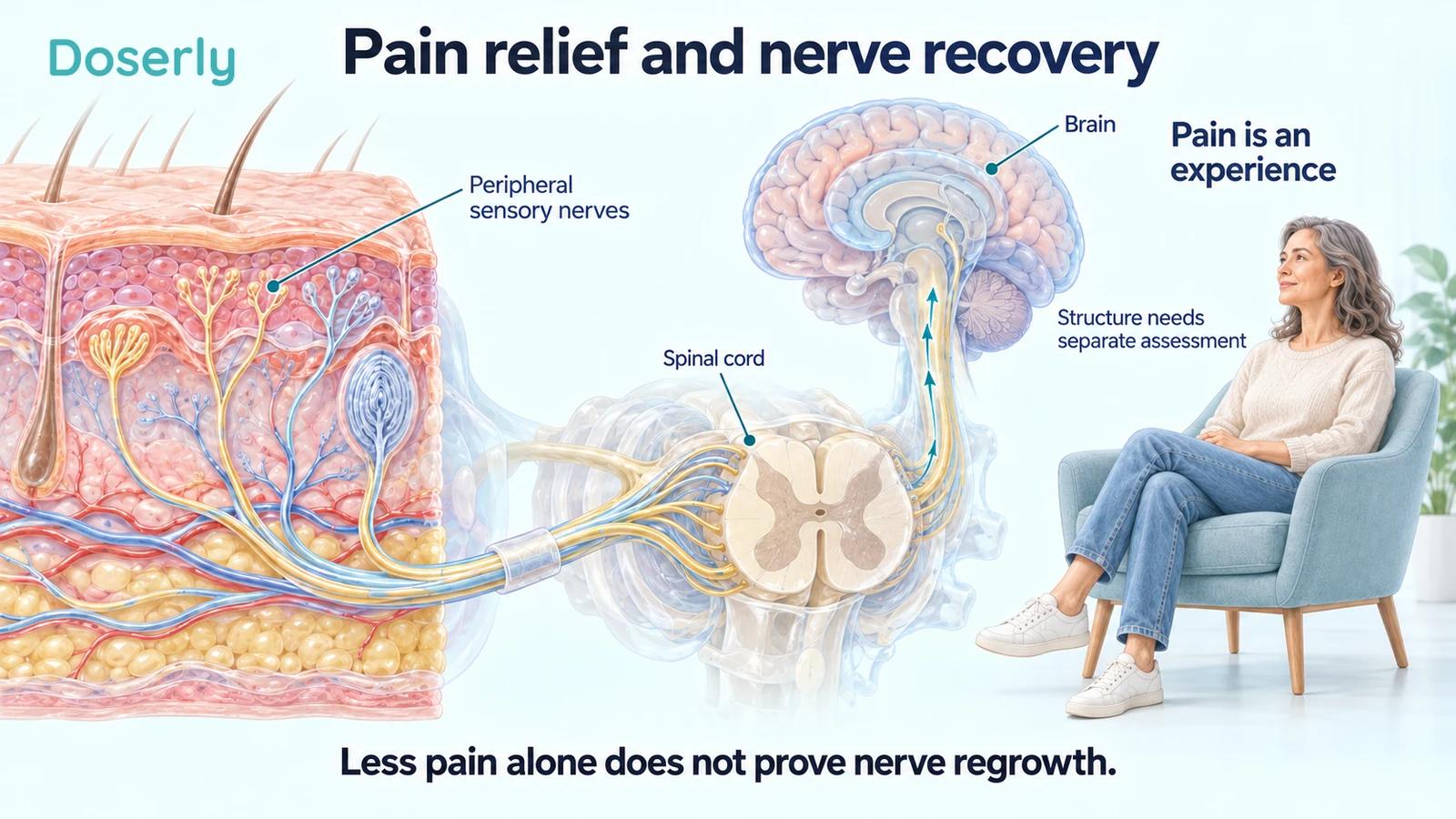
Nerve pain is an experience produced through activity in peripheral nerves, the spinal cord and the brain. The amount of pain a person reports is not a direct count of missing nerve fibers. Neuropathy may involve burning, tingling, unpleasant responses to light touch and reduced sensation at the same time.
That distinction already exists in ordinary care. NIDDK explains that medicines used for diabetic nerve pain can reduce pain without changing the underlying nerve damage. Relief can therefore be valuable even when a treatment is not regenerative. Conversely, less pain should not automatically be interpreted as restored protective sensation in the feet. NIDDK peripheral neuropathy information
“Regeneration” is a stronger biological claim. It implies new growth or restoration of nerve structures. To evaluate it, researchers need appropriate tissue or imaging measurements, and then need to establish what those changes mean for sensation and function. A person's report of relief cannot answer every part of that question, however convincing the relief feels.
What the early sarcoidosis studies actually measured
Sarcoidosis is an inflammatory condition that can be accompanied by small-fiber neuropathy. Its small-fiber symptoms can include sensory complaints and problems involving automatic body functions. A questionnaire covering that wider symptom burden will not necessarily behave like a simple pain-intensity scale.
In a 2012 exploratory trial, 22 people with sarcoidosis and small-fiber neuropathy symptoms received intravenous ARA-290 or placebo for four weeks. The small-fiber symptom score improved by an average 11.5 points with ARA-290 and 2.9 with placebo. However, Brief Pain Inventory pain scores and fatigue scores improved similarly in both groups. The study therefore supported a signal on one symptom instrument, not a consistent treatment advantage across all pain-related outcomes. 2012 randomized pilot
A 2013 trial went further by combining symptoms with corneal imaging, skin biopsies and functional testing in 38 participants. The small-fiber symptom questionnaire and pain interference favored ARA-290, while pain intensity fell by about 9% in both groups. Corneal nerve area increased in the treatment group, but the skin nerve-density changes were not significant. 2013 primary trial
These findings are not contradictory simply because they differ. Intensity asks how strong the pain is; interference asks how it affects activities. A person can become more able to function while still feeling substantial pain. What would be misleading is selecting the favorable instrument and describing it as proof that all pain measures improved or that nerve repair caused the improvement.
The diabetes trial: one questionnaire improved more, another did not
The diabetes study enrolled 49 people with type 2 diabetes and painful neuropathy; 48 were included in the main analysis after one participant stopped because kidney function worsened. Participants received ARA-290 or placebo for 28 days and were followed for another month. Their existing diabetes and neuropathic-pain medicines generally continued. Diabetes trial methods
PainDetect, a questionnaire about neuropathic symptoms, improved more with ARA-290. At day 28, the reported mean improvement was 3.3 points with treatment and 1.1 with placebo. By day 56, the corresponding improvements were 4.2 and 0.74 points. Another instrument, the Neuropathic Pain Symptom Inventory, improved by roughly 20% in both groups during treatment, without the same treatment-specific pattern. Diabetes trial results
A reader should be able to see both findings. Different questionnaires emphasize different aspects of pain, and a small study can produce an uneven pattern. The trial offers a reason to investigate symptom benefit further, but not to describe all participants as pain-free or recovered.
The study also did not show a significant overall corneal nerve-density increase. A post hoc analysis of participants with lower starting nerve density found a signal and a relationship with PainDetect changes. Because that subgroup was selected after the original planning, it needs confirmation in a trial that defines the subgroup in advance. Correlation within that group still does not prove that nerve growth caused relief.
What the larger trial adds to the regeneration question
The 2017 phase 2b trial randomized 64 people with sarcoidosis-associated small nerve fiber loss and neuropathic pain. It compared three cibinetide amounts with placebo over 28 days. Its main measurement was corneal nerve fiber area, which describes the area occupied by visible fibers in the sampled images.
Only the 4 mg group showed a statistically significant advantage over placebo on that primary endpoint. A skin marker associated with growing fibers, GAP-43, also increased in that group. Total intraepidermal nerve fiber density did not show a corresponding between-group difference. Pain improved in every group; even the more favorable pain comparison in participants with moderate-to-severe pain was not statistically conclusive. 2017 primary report
The biological interpretation is more specific than “nothing happened” and narrower than “the nerves were healed.” The investigators found structural and growth-associated signals compatible with regenerative activity. They did not demonstrate that every damaged nerve returned to normal or that the observed tissue changes produced a reliable pain advantage over placebo.
A positive growth-associated marker is useful because it adds information beyond a symptom score. But a marker associated with growth is not a complete account of mature nerve function. It is possible to detect early tissue activity before an important clinical benefit emerges; it is also possible for a tissue signal not to become a worthwhile benefit. Longer, better-powered trials have to resolve that uncertainty.
What would convincing recovery look like?
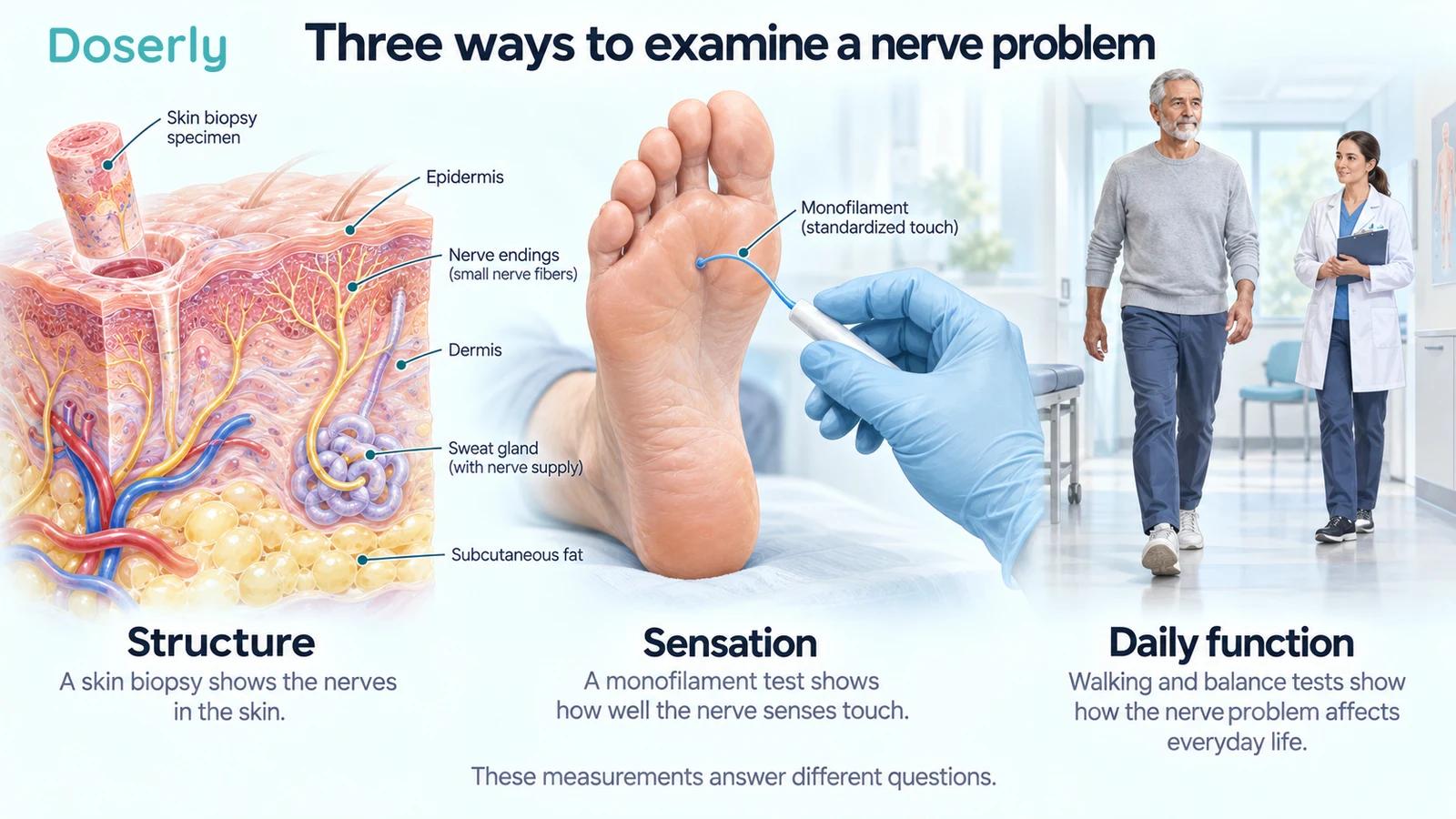
A useful assessment would combine several domains. Structural measurements would show what changed in the sampled tissue. Sensory testing would examine whether relevant nerve functions improved. Patient-reported outcomes would describe pain, sleep and daily limitations. Functional testing could ask whether the person walks or performs important activities more easily.
These are complementary rather than interchangeable. For example, a monofilament examination checks aspects of protective touch sensation; it is not a direct count of small fibers or a complete small-fiber test. Temperature testing examines another sensory function. A six-minute walk test is influenced by more than nerves, including fitness and other disease. Researchers need to understand each measure's limitations when interpreting agreement or disagreement.
Durability is another part of recovery. If symptoms improve during an intervention but return afterward, the treatment may still have a useful symptomatic effect. That is different from a lasting alteration of the underlying disease. The 2017 researchers reported that the corneal area change moved back toward baseline after dosing stopped. This follow-up matters when claims use words such as permanent or restorative. 2017 report
Why placebo improvement does not make the pain imaginary
People in a placebo group can experience genuine symptom changes. Symptoms fluctuate, people may enter a study during a bad period, and the attention and expectations surrounding care can influence how symptoms are experienced and reported. Those possibilities do not invalidate the person's experience.
They do explain why a treatment needs a suitable comparison. If pain improves in both groups, the improvement from baseline in the active group cannot all be attributed to the drug. The question is how much extra improvement treatment produces compared with what happened under otherwise similar conditions.
This is especially important in small studies with several symptom scales. A favorable change on one scale, no difference on another and uncertain function results should be described together. A reader should not have to reconstruct the missing comparisons from the paper's tables.
Blood sugar changes do not identify the repair mechanism
The diabetes trial also reported a small improvement in HbA1c, a measure related to average blood glucose. That observation raises additional questions about how metabolic changes and nerve symptoms might relate. It does not prove that better glucose control mediated the pain result, or that the peptide directly regenerated nerves independently of other effects. Diabetes trial
Separating mechanisms would require measurements and analyses designed for that purpose. Researchers would need to consider when metabolic and nerve changes occur, whether they track together, and whether an alternative explanation fits. Simply finding two favorable outcomes in the same short trial cannot establish the causal sequence between them.
For a patient, the distinction matters because an explanation can sound more certain than the actual benefit. “It repairs nerves by correcting metabolism” goes well beyond the demonstrated results. A more accurate account is that a small trial reported mixed symptom findings and metabolic signals that deserve further investigation.
What to do with an improvement you notice
If symptoms change during treatment, describe the change concretely: which sensation improved, how much it affected sleep or walking, and when it started. Record other medication changes and new symptoms too. A dated account helps a clinician understand your experience, although it cannot by itself identify the cause.
Do not use reduced pain as the only reason to assume your feet are protected from injury. In diabetic neuropathy, NIDDK recommends daily foot checks and attention to wounds because reduced feeling can hide damage. A foot problem needs clinical assessment even if the overall pain seems better. NIDDK guidance
When discussing ARA-290, ask whether the proposed benefit is symptom relief, structural change, restored sensation or all three, and which human result supports each claim. Also ask how adverse effects and a lack of benefit would change the plan. Our ARA-290 guide's evidence section and risk discussion provide background for that conversation.
Relief is worth measuring in its own right. Calling it nerve regeneration requires additional evidence, and calling regeneration a durable clinical recovery requires more still.
Explore the research
- Brines et al., 2008 peptide-development experiments: preclinical rationale, not human efficacy.
- Heij et al., 2012 randomized pilot: different symptom instruments yielded different results.
- Dahan et al., 2013 sarcoidosis trial: symptoms, tissue measurements and function.
- Brines et al., diabetes trial: mixed pain outcomes and post hoc corneal analysis.
- Culver et al., 2017 trial: corneal area, GAP-43 and pain comparisons.
- NIDDK peripheral neuropathy guidance: symptoms, treatment goals and foot protection.