
Peptides
October 16, 2026
Does amylin therapy have to work through nausea?
On this page
A medicine that reduces appetite can create an uncomfortable question: does it help people eat less because they feel satisfied, or because they feel sick?
For amylin-based treatments, the evidence supports a distinction. Controlled human experiments have observed lower food intake without a corresponding increase in nausea ratings. That means nausea is not a necessary explanation for every appetite effect of amylin agonism. It does not mean that amylin medicines never cause nausea, or that every newer drug has proved its weight effects completely independent of symptoms.
Those conclusions can coexist. Understanding how researchers separate appetite from illness makes the emerging petrelintide evidence easier to interpret—and helps avoid treating an unpleasant side effect as a sign that treatment is working.
Fullness, satiation and nausea are different experiences
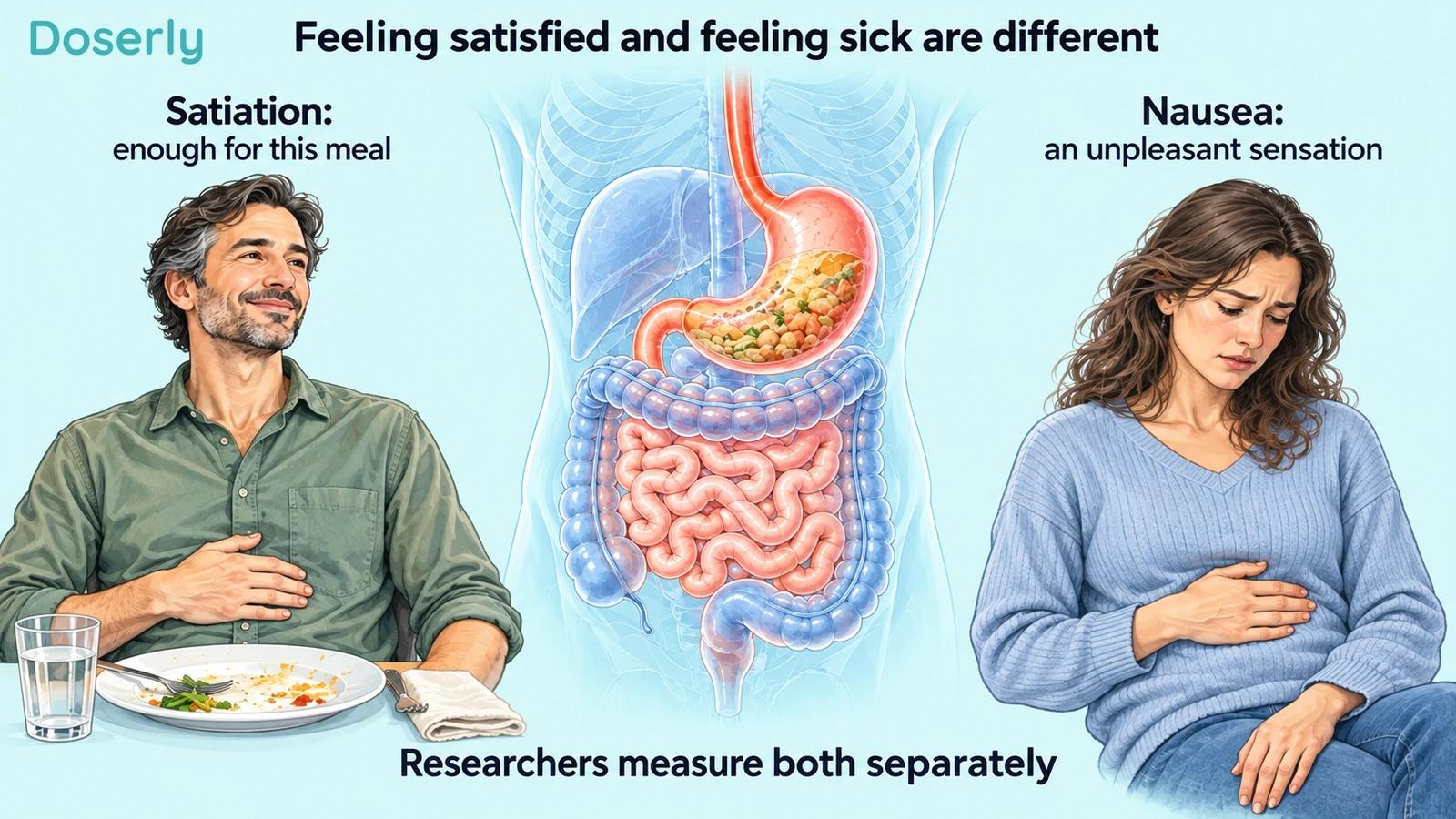
Satiation is the process that brings a meal to an end. Satiety refers to the reduced desire to eat after a meal. In everyday conversation, people often describe both as feeling full or satisfied.
Nausea is an unpleasant sensation associated with the feeling that vomiting might occur. A person can stop eating because a meal feels sufficient, because food seems unappealing, because the stomach feels uncomfortable or because they feel nauseated. The outward behavior—leaving food on a plate—does not identify the reason.
That is why good appetite research measures more than meal size. Researchers can record how much food a participant actually eats and separately ask about hunger, fullness and nausea. These measurements are related, but they are not interchangeable.
Amylin is released by pancreatic beta cells alongside insulin. Its established physiological actions include effects on meal-related glucose regulation and appetite. The older amylin analogue pramlintide provides human evidence that the pathway can affect eating behavior. Its official prescribing information also recognizes nausea as an adverse reaction. Biology and side effects should therefore be discussed together without reducing one to the other. FDA pramlintide label
A small human experiment gives a direct answer
A 2007 randomized, double-blind crossover study tested a single low dose of pramlintide in 15 healthy men with normal-range BMI. Each participant underwent a standardized meal test on two occasions, receiving pramlintide on one occasion and placebo on the other.
After a small standardized meal, participants were offered a buffet. Researchers measured food intake and meal duration and repeatedly recorded hunger, fullness and nausea ratings.
Participants ate about 14% fewer calories after pramlintide than after placebo, and the meal was shorter. Nausea ratings remained near baseline and did not differ between treatments. This is direct human evidence that reduced food intake can occur without an accompanying rise in reported nausea in that experimental setting. Primary meal-test study
The limits are as important as the result. The study involved only 15 men, a single exposure and a controlled meal. It did not study petrelintide, long-term obesity treatment, women or people with substantial gastrointestinal disease. A small acute experiment cannot establish how an entire drug class behaves over months.
It can answer the narrower question well: an appetite effect does not logically require a nausea effect. That is a more defensible statement than either “these drugs only work by making people sick” or “amylin medicines cannot cause nausea.”
Earlier and longer studies add context
A 2005 crossover study examined pramlintide in 11 men with insulin-treated type 2 diabetes and 15 men with obesity without diabetes. It also used standardized meal tests. Food intake fell in both groups, and the appetite measurements supported an effect on satiation. 2005 primary study
These experiments are useful because they observe eating under controlled conditions instead of inferring appetite entirely from changes on a scale. They help establish that amylin signaling has a measurable human behavioral effect.
A separate six-week randomized trial in 88 adults with obesity extended the observation beyond one meal. Pramlintide treatment was associated with reductions in measured daily intake, portion sizes and intake during a standardized highly palatable meal challenge, alongside weight reduction. Six-week primary study
That longer study does not settle every mechanism. People may experience multiple effects at once, and symptom patterns can change over time. Its contribution is that the appetite-related findings were not limited to an isolated laboratory exposure.
The trials also used different doses, schedules and populations. Their results should not be added together as though they describe one standardized treatment. They form a collection of experiments supporting human appetite effects, with different strengths and limitations.
Why these findings do not make nausea irrelevant
An effect can be biologically useful and still be difficult to tolerate. Nausea can interfere with eating, drinking, work and the willingness to continue treatment. Even when a symptom is classified as mild, its frequency and duration can matter to the person experiencing it.
There is also a difference between showing that a mechanism can operate without nausea and showing how much of a particular trial's weight change occurred independently of nausea. The first can be addressed by a controlled meal experiment. The second requires analyses of the actual treatment population, its symptoms and its outcomes over time.
A simple comparison of people who reported nausea with those who did not may help, but it has limitations. Participants are randomized to treatment, not to experiencing nausea. The symptom groups can differ in dose exposure, adherence, sensitivity to the drug and other characteristics. Those differences complicate causal interpretation.
Researchers can strengthen the analysis by considering when symptoms occurred, whether they preceded changes in eating, how long they lasted and whether effects persisted after symptoms resolved. None of these methods makes self-reported symptoms perfectly measurable, but they produce a more useful answer than assuming that all reduced intake has the same explanation.
What petrelintide's published trials show
Petrelintide is a longer-acting amylin analogue under investigation for weight management. The petrelintide guide explains the broader development program. Its clinical studies provide evidence about weight and tolerability, but they should not be presented as complete maps of the biological reasons participants ate less.
The published phase 1 program included a 16-week multiple-dose portion with 48 participants. Weight reductions and gastrointestinal symptoms were both reported. The small dose groups and selected population limit how confidently their symptom percentages can be generalized. Phase 1 primary report
The larger ZUPREME-1 phase 2 publication gives a more informative view. Among treated participants, nausea was reported by 79 of 404 people receiving petrelintide and five of 81 receiving placebo—about 20% and 6%, respectively. The study also demonstrated weight reductions relative to placebo. ZUPREME-1 primary report
These numbers rule out describing petrelintide as nausea-free. They also show that most treated participants did not have a recorded nausea adverse event. What they do not provide, by themselves, is the weight change specifically attributable to mechanisms independent of nausea.
The weight result is a group result. The nausea percentage is another group result. Combining the two does not identify each person's symptom experience, appetite response or causal pathway. An article should resist converting those aggregate observations into a claim that every participant without nausea achieved the same benefit.
“No reported nausea” is a measurement, not mind-reading
Adverse-event tables record events according to a study's collection and coding methods. A participant may describe an experience using terms such as fullness, stomach discomfort, reduced appetite or nausea. How those experiences are elicited and categorized affects what appears in the final table.
An appetite questionnaire asks a different type of question from a safety interview. Repeated ratings during a meal can detect changes that a periodic adverse-event report was not designed to capture. Conversely, a brief meal experiment may miss symptoms occurring later in the day or after repeated dosing.
Neither method is inherently useless. They serve different purposes. The most convincing explanation brings together food intake, appetite ratings, symptom reporting and treatment exposure, while acknowledging where those measures do not align.
This also explains why two trials can report different nausea rates without proving that one drug is intrinsically gentler. The participants, escalation schedules, follow-up periods and collection methods may differ. A direct comparison with consistent methods is more informative than a ranking assembled from unrelated tables.

Gastric emptying is another separate question
Amylin-related appetite effects are sometimes reduced to the idea that food simply stays in the stomach longer. The historical pramlintide label describes slowing of gastric emptying, but that does not establish the magnitude or duration of the effect for every newer analogue.
A meal can be smaller for several reasons, and a person can feel nauseated without a direct measurement showing delayed gastric emptying. Conversely, altered gastric emptying does not automatically establish that nausea caused the observed weight change.
To answer the gastric-emptying question for a specific drug, researchers need appropriate measurements in people receiving that drug. Animal experiments, receptor activity and results from pramlintide can help form hypotheses, but they do not replace those measurements.
This is particularly relevant when a new treatment is promoted as preserving normal stomach function or avoiding a familiar class effect. Such statements require direct evidence for the actual molecule, dose and treatment duration. A favorable symptom table alone does not demonstrate the underlying mechanism.
What would make the next studies more informative?
A useful next step would be to combine detailed appetite testing with repeated symptom assessments over the course of treatment. Early escalation, established maintenance treatment and periods after interruptions may produce different experiences.
Researchers could also report how symptoms affected ordinary activities and food intake, rather than only whether a participant ever experienced an event. A short mild episode and weeks of persistent discomfort should not become indistinguishable simply because each person contributes one entry to a percentage.
Nutritional adequacy and physical function deserve attention alongside total weight. Eating less is not a complete description of a beneficial outcome. Studies that characterize what participants can eat, how they feel and whether they remain able to carry out daily activities would make the appetite findings more useful.
Those are evidence needs, not claims that petrelintide has already demonstrated these outcomes. They also explain why a detailed phase 2 report is more useful than a slogan about “clean satiety.”
How to interpret the distinction personally
For someone using a prescribed medicine, nausea should not be treated as a target or a badge of effectiveness. The absence of nausea is not evidence that a treatment is failing, and its presence does not quantify how much benefit a person will obtain.
If symptoms are affecting eating or drinking, describing their timing, persistence and effect on daily life can help a clinician assess them. That conversation should follow the guidance for the actual prescribed medicine. Petrelintide research does not provide a personal dose adjustment plan, and pramlintide's insulin-related precautions cannot simply be transferred to a different investigational drug.
The best-supported answer is therefore specific: human amylin research demonstrates that appetite effects can occur without increased nausea in controlled settings. Newer amylin therapies still need their own careful evaluation of symptoms, exposure and sustained outcomes. Comfortable satisfaction and feeling ill are different experiences, and good trials should preserve that distinction.
Sources
- Low-dose pramlintide meal study.
- Pramlintide satiety study in two populations.
- Six-week pramlintide eating-behavior trial.
- FDA pramlintide prescribing information.
- Petrelintide phase 1 primary report.
- Petrelintide ZUPREME-1 phase 2 report.