
Peptides
October 16, 2026
Does a sermorelin-driven IGF-1 change predict better sleep?
On this page
A rise in IGF-1 after sermorelin shows that the growth hormone pathway responded. It does not establish that sleep improved, and the available research does not validate IGF-1 as a way to predict who will sleep better with sermorelin.
There is a biological reason to study the question. Growth hormone secretion and sleep are linked, and experimental administration of growth hormone-releasing hormone can influence sleep under some conditions. But the evidence becomes more complicated when researchers move from an overnight laboratory experiment to months of treatment in older adults.
The distinction is particularly important when a blood result is used to explain a personal experience. “My IGF-1 went up” and “I feel more rested” can both be accurate observations. Demonstrating that the first change predicts or causes the second requires additional evidence.
What IGF-1 can tell you
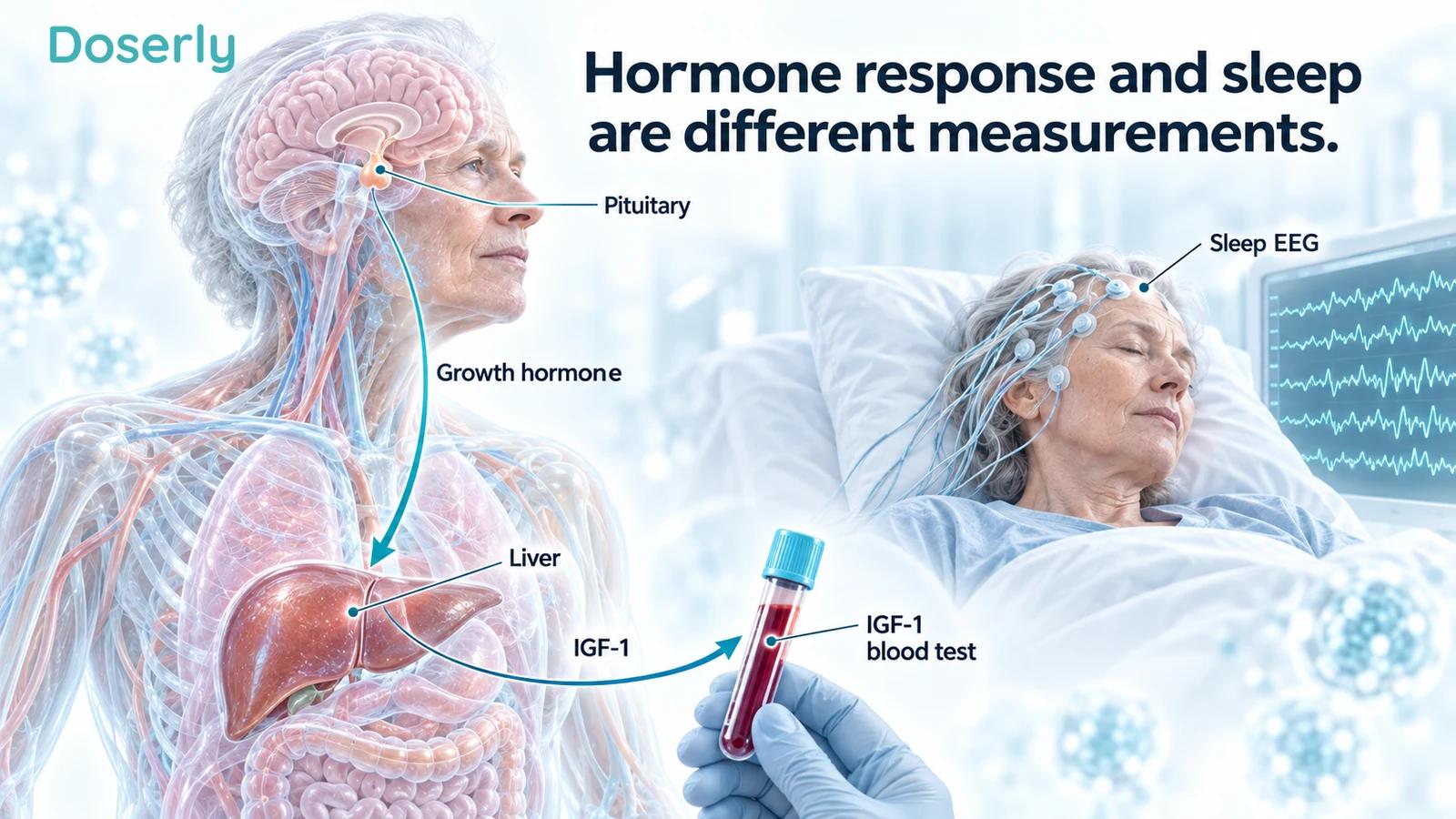
Sermorelin is a growth hormone-releasing hormone fragment that stimulates the pituitary to release growth hormone. Growth hormone then acts on several tissues, including the liver, which produces circulating insulin-like growth factor 1, or IGF-1.
In this setting, an IGF-1 increase is evidence of a downstream hormonal response. It is not a measurement of time asleep, awakenings, breathing interruptions, sleep-stage distribution, or next-day function. Those outcomes require their own assessment.
The distinction is not merely semantic. A biomarker can be useful for understanding exposure or biological activity without being a validated substitute for a clinical outcome. To use IGF-1 as a sleep predictor, a study would need to show that changes in IGF-1 reliably distinguish people who experience meaningful sleep improvement from those who do not.
It would also need to test that relationship in the relevant population and treatment setting. An association found in healthy young men during an acute experiment would not automatically predict the response of older adults with insomnia, sleep apnea, or multiple medications.
The Doserly sermorelin guide provides background on the compound. For the sleep question, the decisive information is whether sleep itself improved under adequately controlled conditions.
Why the growth hormone–sleep link is not a one-way chain
A classic 1968 study of sleep and growth hormone secretion followed eight young adults over repeated nights and found a relationship between sleep onset, deep sleep, and growth hormone secretion. That observation helped establish why sleep and the growth hormone axis deserve to be studied together.
It does not establish a simple chain in which more circulating growth hormone inevitably produces better sleep. Sleep can influence hormone secretion, while hormonal and neural signals can also affect sleep. Timing, age, sleep stage, and the route of an experimental intervention may change the response.
This matters when a treatment explanation runs backward from an association. If a hormone pulse commonly occurs around deep sleep, it does not follow that producing a pulse by another route recreates normal sleep architecture. It also does not follow that raising a downstream blood marker recreates the original physiological pattern.
A treatment can produce a measurable endocrine response while leaving the desired sleep outcome unchanged. Several of the studies below make that possibility concrete.
Acute GHRH experiments show effects that depend on the experiment
Small human studies have explored whether administering GHRH changes sleep. They are useful for understanding physiology, but their designs differ substantially from routine chronic sermorelin treatment.
In a 1992 study involving seven men, researchers administered repeated intravenous GHRH boluses during the night and recorded sleep EEG and hormones. GHRH increased growth hormone secretion and the proportion of slow-wave sleep under those conditions.
That is a positive experimental result. It does not establish a durable benefit for people seeking treatment for insomnia. The intervention consisted of repeated intravenous administration during a monitored night, not a long-term trial of a home sermorelin regimen.
A 1993 experiment found that the sleep response varied with the timing of intravenous GHRH administration. Early-night administration did not produce the same slow-wave sleep response as administration later in the sleep period. The study supports a role for timing in the biology; it does not supply a validated bedtime treatment schedule.
The findings were not uniformly positive across experiments. A 1991 study of growth hormone-releasing factor found an immediate increase in growth hormone release without major changes in sleep EEG, including slow-wave sleep.
Together, these experiments support a narrower conclusion than “GHRH improves sleep.” They show that manipulating this system can affect sleep in some laboratory conditions, while a hormonal response does not guarantee a sleep response.
A different route can separate sleep and hormone responses
An intranasal GHRH study published in 1999 included 12 young and 11 older men in a blinded crossover experiment. Researchers measured sleep with polysomnography and sampled hormones through the night.
The experiment reported changes in later-night slow-wave and REM sleep while early-night growth hormone secretion was reduced. That combination is especially relevant to the proposed biomarker shortcut: the sleep and hormone responses did not simply move together in the intuitive direction.
The study cannot be turned into evidence for chronic injected sermorelin. The route was different, the experiment was short, and its participants were not a broad population with diagnosed insomnia. Its value here is explanatory. It shows why the nervous system effects of GHRH and the circulating endocrine response should not be treated as identical measurements.
It also illustrates why collecting favorable results from different GHRH-related interventions can create a misleading composite. A nasal experiment, an intravenous bolus experiment, and a months-long injected treatment study do not together become one replicated sermorelin trial.
The chronic sermorelin report does not show better subjective sleep
The more directly relevant evidence includes an investigator report on age-related hormones, sleep, and cognition. Published in 2001, it describes preliminary findings from studies of older adults treated with sermorelin acetate, identified as Geref, over several months.
This source needs a precise label. It is an investigator-authored review containing preliminary original trial findings, rather than a definitive final publication establishing insomnia treatment efficacy.
The investigators reported increases in growth hormone and IGF-1. They also observed that treatment produced a large growth hormone burst after administration without restoring a youthful pattern of nocturnal growth hormone secretion. A higher overall hormonal response therefore did not mean that the timing pattern had been normalized.
The sleep findings were not an improvement story. In the reported subjective assessment, the active-treatment group of 37 participants had a small increase in Pittsburgh Sleep Quality Index scores, while the placebo group of 38 showed little change. Higher scores on that questionnaire indicate worse reported sleep quality.
That should not be exaggerated into proof that sermorelin causes insomnia. The reported statistical result concerned change within the active group, which is not the same as a demonstrated between-group treatment effect. The authors described the change as small and nonspecific, and objective sleep results were not established in that preliminary account.
The result does, however, challenge the assertion that raising IGF-1 necessarily produces better sleep. In the report most directly identifying chronic sermorelin treatment, hormonal increases were not accompanied by improved subjective sleep.
A modified analogue study is related evidence, not the same drug
Another often-relevant paper studied a modified GHRH(1–29) analogue in older men and women. Its molecule contained a norleucine substitution at position 27, commonly written as [Nle27]GHRH(1–29)-NH2.
That molecular distinction should remain visible. The study is not a trial of unmodified sermorelin merely because both agents share a GHRH(1–29) framework.
Ten women and nine men underwent a four-week placebo lead-in followed by 16 weeks of analogue treatment. Early increases in IGF-1 waned toward baseline by the end of treatment, and reported sleep quality did not change.
The sequential design also limits interpretation. A placebo lead-in followed by active treatment is not equivalent to a concurrently randomized placebo comparison throughout the treatment period. Time effects and changes unrelated to the intervention are harder to separate.
The study therefore contributes related biological evidence, with clear limitations. It does not validate an IGF-1 target for better sleep, and it should not be described as a successful chronic sermorelin sleep trial.
What would make IGF-1 a useful sleep predictor?
A persuasive prediction study would need more than a treatment-group average showing that both hormones and sleep changed. It would need individual-level evidence connecting the marker to a clinically meaningful outcome.
For example, researchers could measure baseline sleep, track IGF-1 changes, and assess predefined sleep outcomes during a randomized trial. They would then examine whether the marker predicts improvement after accounting for baseline symptoms, age, treatment assignment, and relevant competing explanations.
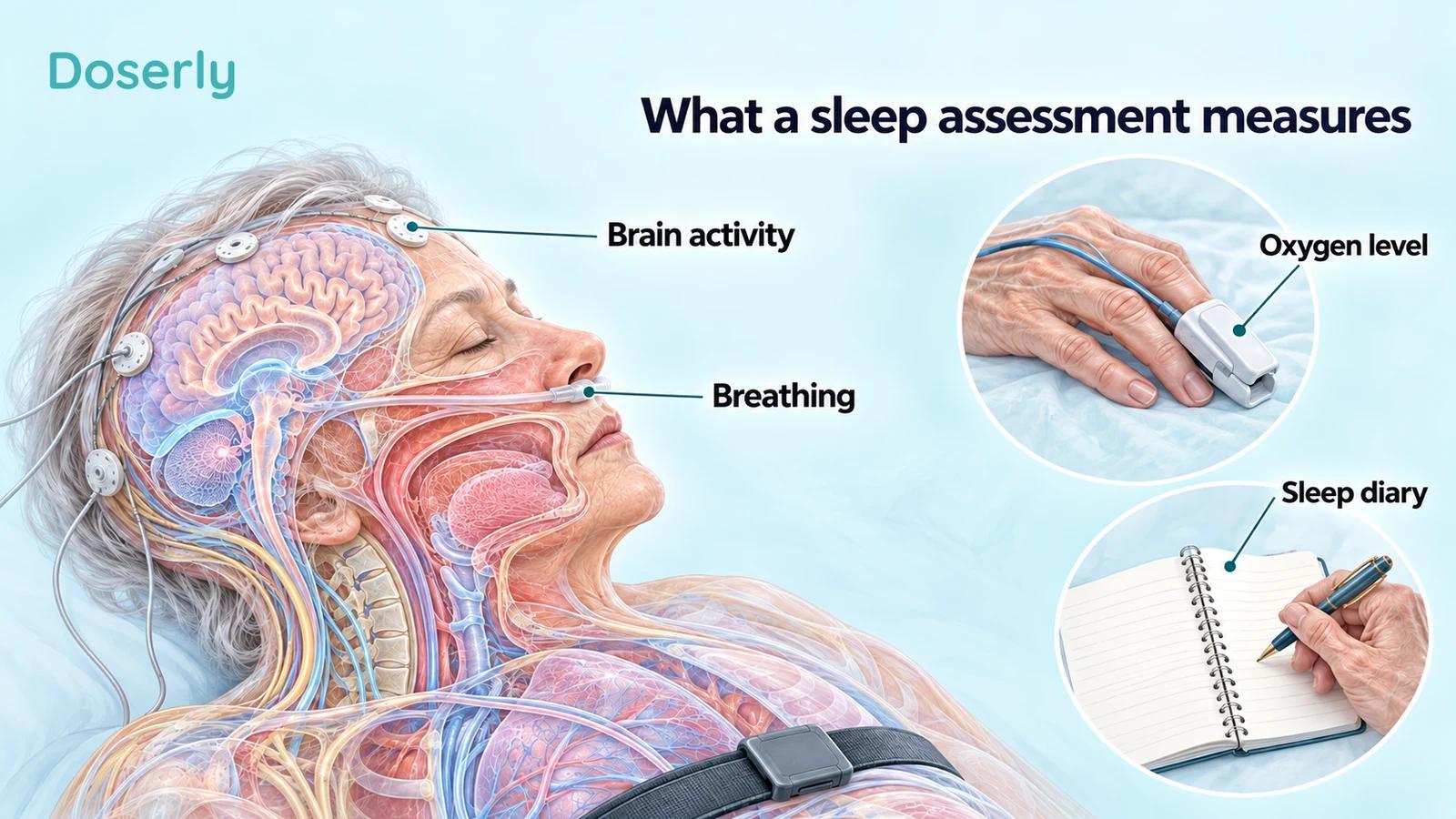
The outcome must also be specified. Falling asleep faster, spending less time awake after sleep onset, having fewer breathing interruptions, and functioning better the next day are not interchangeable benefits. A person can improve on one measure without improving on another.
An increase in slow-wave sleep during one laboratory night would be interesting, but it would not alone establish relief of chronic insomnia or better daytime function. Likewise, a statistically detectable questionnaire change may be too small to matter to the person experiencing it.
Finally, a prediction rule needs testing beyond the same small group used to create it. Without that step, a promising relationship may reflect chance or the particular participants studied. The studies reviewed here do not establish such a validated IGF-1-based sleep prediction tool.
How to interpret a personal improvement without dismissing it
Someone who sleeps better after starting a treatment has an observation worth taking seriously. The uncertainty concerns its explanation and durability, not whether the experience felt real.
Several changes may occur around the same time: bedtime routines, exercise, caffeine or alcohol use, other medicines, expectations, or the reason treatment was started. Sleep symptoms also fluctuate. Improvement after a particularly bad period can occur even without a specific treatment effect.
A simple sleep diary can make the experience more interpretable. Consistent entries about bedtimes, estimated time to fall asleep, awakenings, wake time, and next-day function provide a clearer record than a retrospective impression. Recording other changes helps a clinician assess alternative explanations.
An IGF-1 result can remain part of the endocrine assessment without becoming the sleep score. A clinician can evaluate the hormonal response and the sleep complaint as related but separate questions.
That separation also avoids a dangerous inference: if sleep has not improved, a higher IGF-1 result is not evidence that treatment merely needs to push the marker further. The reviewed studies do not define a hormone target that reliably produces better sleep.
Evaluate the sleep problem that is actually present
Poor sleep is not one diagnosis. Difficulty sleeping despite an adequate opportunity, repeated breathing interruptions, an irregular schedule, and insufficient time in bed require different approaches.
For chronic insomnia, the American Academy of Sleep Medicine guideline strongly recommends multicomponent cognitive behavioral therapy for insomnia. That recommendation comes from evidence directed at the sleep disorder itself.
Symptoms such as loud snoring, witnessed pauses in breathing, or substantial daytime sleepiness can warrant evaluation for sleep apnea. The National Heart, Lung, and Blood Institute describes these symptoms, and its diagnosis guidance explains the role of sleep studies when appropriate. A growth hormone or IGF-1 response does not evaluate those breathing events.
For a person considering sermorelin principally to sleep better, the research supports a measured conversation: identify the sleep complaint, measure outcomes that matter, and ask which evidence actually involves sermorelin in a comparable population. The acute GHRH literature provides biological interest. It does not turn an IGF-1 increase into a reliable prediction of restful sleep.
Explore the research
- Treating age-related changes in somatotrophic hormones, sleep, and cognition (2001): Review containing investigators' preliminary original trial findings; not a completed definitive sleep-trial report.
- Endocrine and metabolic effects of long-term administration of [Nle27]growth hormone-releasing hormone-(1-29)-NH2 in age-advanced men and women (1997): Modified Nle27 analogue, not unmodified sermorelin; sequential phase design.
- Effects of growth hormone-releasing hormone and somatostatin on sleep EEG and nocturnal hormone secretion in male controls (1992): Acute GHRH experiment, not chronic sermorelin treatment for insomnia; primary abstract accessed.
- Sleep-promoting effects of growth hormone-releasing hormone in normal men (1993): Timed intravenous GHRH experiment; cannot establish chronic sermorelin benefit or bedtime prescribing instructions.
- The effect of GRF on the EEG sleep of normal males (1991): Acute experiment; primary abstract rather than full methods reviewed.
- Sleep and endocrine changes after intranasal administration of growth hormone-releasing hormone in young and aged humans (1999): Different route, experimental setting and population from chronic injected sermorelin use; primary abstract accessed.
- Growth hormone secretion during sleep (1968): Physiology study, not a sermorelin treatment trial or proof that raising GH treats insomnia.
- Behavioral and psychological treatments for chronic insomnia disorder in adults: an American Academy of Sleep Medicine clinical practice guideline (2021): Clinical guideline for diagnosed chronic insomnia, not a peptide trial.
- Sleep Apnea — Symptoms (2025): Symptoms are not diagnostic by themselves.
- Sleep Apnea — Diagnosis (2025): Does not validate consumer sleep-stage estimates or endocrine treatment.