
Peptides
October 16, 2026
Does a growth-hormone pulse predict GHRP-6 recovery benefits?
On this page
GHRP-6 can stimulate the pituitary gland to release growth hormone. That effect is real and has been measured in human experiments. If you're interested in recovering from an injury, though, a different question matters: does that hormone response help you heal faster, move better or return to normal activity?
The human endocrine studies don't answer that question. They measured growth hormone and sometimes insulin-like growth factor 1, or IGF-1, rather than recovery from an injury. Understanding what those measurements represent helps explain both why researchers are interested in GHRP-6 and why the results cannot be converted into a recovery promise. Early human GHRP-6 study, intranasal hormone study.
What does a growth-hormone pulse mean?
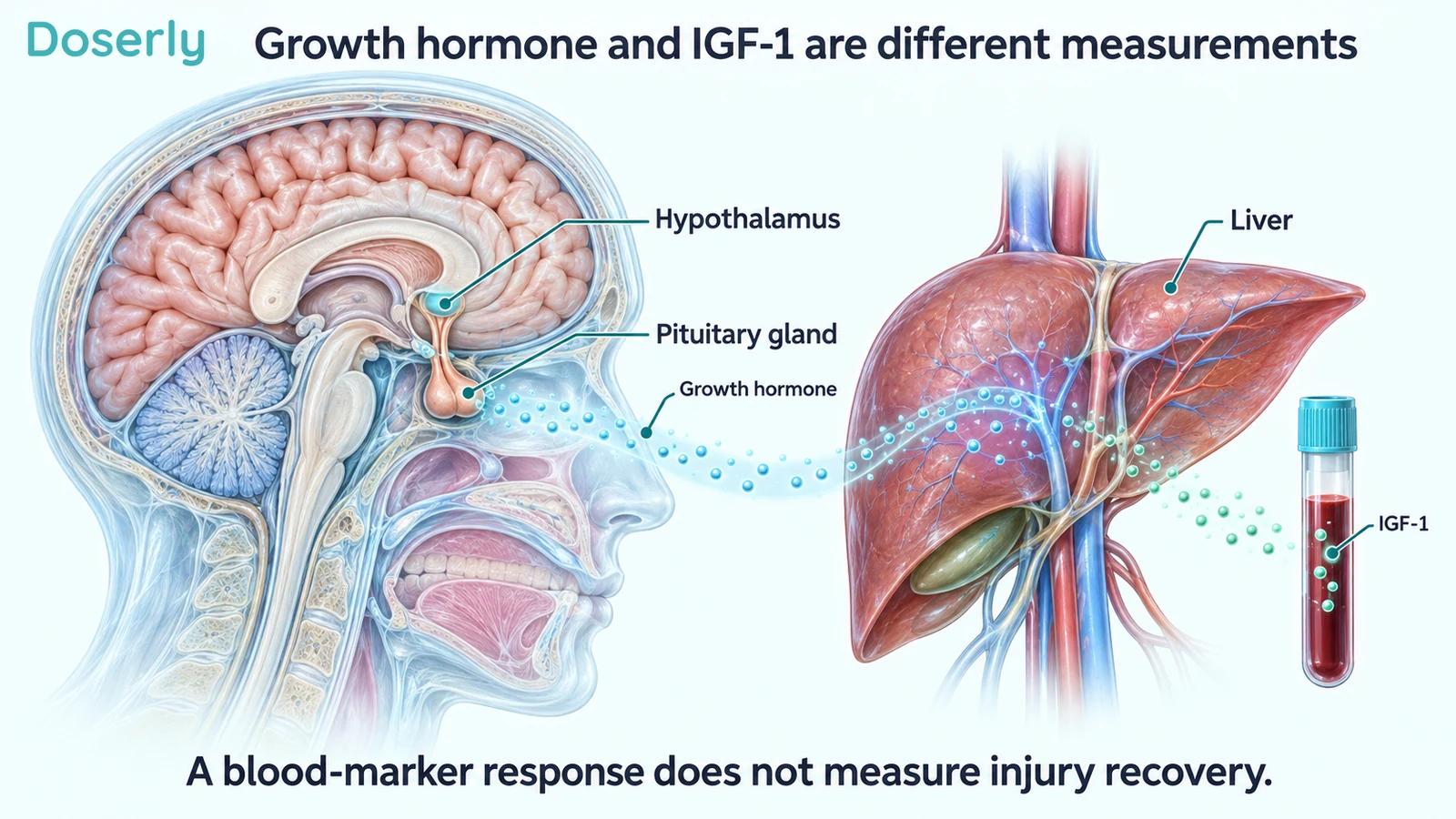
Growth hormone, often shortened to GH, is released from cells in the anterior pituitary, the front part of a small gland beneath the brain. Its concentration changes over time rather than remaining at one steady level. A pulse is a period of increased secretion, followed by a decline.
The hypothalamus helps regulate that pattern. Growth hormone-releasing hormone, or GHRH, stimulates release; somatostatin inhibits it. IGF-1 participates in feedback, and age, sleep, food intake, exercise and body composition also influence the system. These are reasons a single blood sample doesn't describe an entire day's secretion. Endotext: normal growth-hormone physiology.
GHRP-6 is called a secretagogue because it stimulates release of a hormone. It doesn't supply growth hormone itself. That distinction explains its mechanism, but it doesn't establish that the resulting exposure is ideal or free of adverse effects. An externally administered stimulus still changes the behavior of the endocrine system.
The Doserly GHRP-6 guide gives broader background on the compound. To assess a recovery claim, the next step is to ask exactly what happened in the human studies and what the investigators did not measure.
How large was the hormone response in the early study?
A 1990 study examined acute responses in 18 healthy men. Researchers gave intravenous GHRP-6 at different amounts and compared the response with placebo and GHRH. Mean peak GH was approximately 1.2 micrograms per litre after placebo and 7.6, 16.5 and 68.7 after increasing GHRP-6 exposures. Combining lower GHRP-6 exposures with GHRH produced a synergistic GH response. Bowers and colleagues.
That establishes dose-related hormone activity in the conditions studied. The reported numbers are group means with substantial variability, not targets for an individual. The study also found increases in prolactin and cortisol at the highest tested GHRP-6 exposure. It did not enroll patients with tendon injuries, compare rehabilitation programs or measure time to return to sport.
Peak concentration is the highest sampled value after a stimulus. It differs from the total amount of hormone secreted across a day, the duration of exposure, and any subsequent tissue response. A larger peak can look impressive without answering whether a person's recovery changes.
The synergy finding is equally specific. It means the combined endocrine response exceeded what the researchers expected from the separate stimuli under those conditions. It does not demonstrate synergistic injury healing, nor validate replacing GHRH with any commercially marketed analogue and assuming the same clinical effect.
What does IGF-1 add to the picture?
IGF-1 is a signaling protein influenced by growth hormone. Clinicians and researchers often measure it when evaluating the GH system because it provides a different view from a brief GH peak. It remains a laboratory marker, and its interpretation depends on the person and clinical setting. Endotext physiology.
A 1991 study examined six healthy men using intravenous and intranasal GHRP-6. After seven repeated nasal administrations, mean IGF-1 increased from 94.5 to 125.8 micrograms per litre, and the short-term GH response was not attenuated. The experiment showed that this exposure could change more than a single immediate GH measurement. Hayashi and colleagues.
It still did not test injured tissue or functional recovery. The participants were healthy men, the repeated exposure was brief, and the route was intranasal. Those features matter when the result is used to support a much longer injection course for a different population.
Another study helps show why GH and IGF-1 shouldn't be collapsed into one result. Seven women aged 65–82 received oral GHRP-6 for four days. Their GH response remained present after treatment, but IGF-1 did not increase significantly. Ghigo and colleagues, 1994.
The two small studies don't establish that sex, age or route explains the difference; several features changed at once. They do show that a maintained GH response does not guarantee a statistically clear IGF-1 rise in every setting. It would be a further unsupported step to say that either measurement guarantees better recovery.
Why does the brain–pituitary connection matter?
GHRP-6's effect depends on the endocrine system it is stimulating. In a mechanistic study of nine healthy young men, researchers blocked the action of endogenous GHRH before giving GHRP-6. The maximal GH increase fell from 33.8 to 6.2 micrograms per litre. The authors concluded that the body's own GHRH was necessary for most of the response. GHRH-antagonist experiment.
This is a useful explanation of physiology. The experiment altered one signaling input to learn what GHRP-6 required. It did not demonstrate that adding more stimuli is clinically better, or identify a combination for musculoskeletal recovery.
The finding also helps explain why people shouldn't compare isolated GH results as if everyone starts with the same endocrine system. A response depends on more than the name of the administered substance. Clinical interpretation considers the underlying reason for testing, the testing conditions and the person's health.
If a clinician suspects genuine adult GH deficiency, evaluation is a distinct medical process. The Endocrine Society guideline describes circumstances in which stimulation testing is needed and notes that an IGF-1 result alone may be insufficient. Treatment decisions for diagnosed deficiency cannot simply be transferred to otherwise healthy people hoping to accelerate recovery. Endocrine Society clinical practice guideline.
What about the clinic study of men taking several peptides?
A 2017 retrospective review is sometimes used to support longer-term secretagogue use. Investigators reviewed records from 105 men receiving testosterone therapy who were prescribed GHRP-6, GHRP-2 and sermorelin together. Only 14 met the study's strict inclusion criteria. Their mean IGF-1 rose from 159.5 to 239.0 ng/mL during a mean 134 days of continuous combination treatment. Sigalos and colleagues.
This is a small, selected chart-review cohort rather than a randomized trial. Everyone received a combination, and participants were already receiving testosterone. Some also used medicines affecting estrogen production or action. The measured change therefore cannot isolate GHRP-6's contribution.
The men's reasons for seeking treatment included body-composition goals. That doesn't mean the study proved those goals were achieved. The reported outcome was a laboratory change, not demonstrated injury healing, strength improvement or fat loss attributable to GHRP-6.
This is especially important when a summary says “studied for recovery” or “used for muscle.” A person's motivation for receiving treatment, a researcher's biological hypothesis and a measured clinical outcome are three different things. The clinic report supports an association with higher IGF-1 in a selected combination-treatment group; it doesn't supply the missing recovery comparison.
Can a higher hormone marker coexist with no functional benefit?
Yes. A randomized trial of the different ghrelin mimetic MK-677 in healthy older adults illustrates why clinical outcomes need their own measurements. It increased GH and fat-free mass, but did not improve measured strength or function. It also affected glucose handling. Nass and colleagues.
MK-677 is not GHRP-6, so this is not evidence that GHRP-6 has the same outcome. Its value here is conceptual: a treatment can move a hormone or body-composition measure without delivering the functional improvement a reader hopes for.
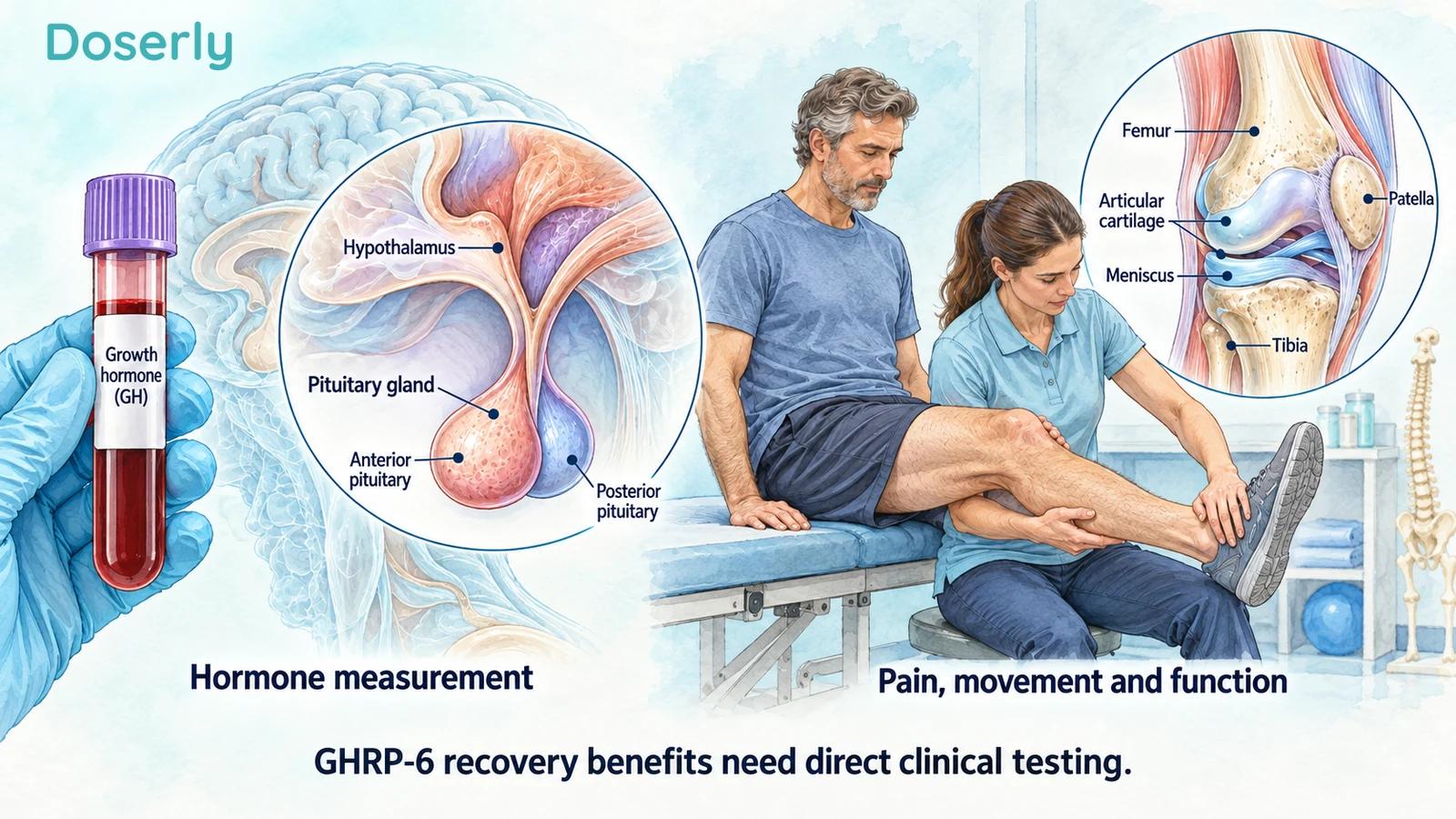
For an injured person, recovery might mean less pain with a particular movement, improved range of motion, restored strength or a safe return to work. Those outcomes can change at different rates. A blood marker cannot tell you whether a tendon tolerates load, a joint is ready for a task, or an activity is appropriate that day.
Even if an intervention ultimately proves helpful, its useful effect may depend on the injury, stage of recovery and other care. “Recovery” is too broad a label to assume that one favorable laboratory result covers all these situations.
What evidence would connect the hormone response to recovery?
A direct trial would identify a particular injury or clinical condition, use a characterized GHRP-6 formulation, and compare it with a suitable control while keeping rehabilitation and other care comparable. The main outcome should reflect the patient's goal and be specified before the results are examined.
Researchers could measure GH and IGF-1 alongside pain, strength, function and adverse effects. That would allow them to examine whether a hormone response actually relates to a clinical benefit, rather than assuming the relationship. Follow-up would need to be long enough to distinguish a temporary symptom change from sustained recovery.
Simply comparing a person's condition before and after a course would leave several explanations unresolved. Many injuries improve over time; rehabilitation, activity changes and other treatment can contribute. A control group helps estimate how much of an observed change is attributable to the experimental intervention.
A positive result would still apply first to the condition, route and formulation studied. It wouldn't automatically validate an unrelated injury, a different peptide mixture or a higher exposure chosen to produce a larger laboratory number.
How to use hormone results in a clinical conversation
If you have a GH or IGF-1 result, ask what clinical question prompted the measurement and what the result changes about your care. If your concern is an injury, also ask which functional measures will guide rehabilitation and return to activity. These conversations can overlap without treating a blood test as a recovery score.
Safety deserves separate attention. FDA identifies GHRP-6 concerns involving cortisol, insulin sensitivity, blood glucose and possible immune reactions associated with peptide impurities or aggregation. The available information doesn't establish a safe long-term recovery regimen. FDA safety entry.
A dated record of symptoms, activity, treatments and laboratory testing can make a review more useful. It helps describe what changed and when, but it cannot prove which intervention caused improvement. Avoid treating a stronger hormone response as a reason by itself to increase exposure.
The clearest reading of the research is that GHRP-6 has demonstrated endocrine activity in people. The clinical recovery benefit remains a separate, unproven question. Our GHRP-6 human research section places those experiments alongside the compound's other studies.
Explore the research
- Bowers et al., 1990: acute GH response and GHRH synergy in 18 men.
- Hayashi et al., 1991: intranasal exposure, GH and IGF-1 in six men.
- Ghigo et al., 1994: four-day oral study in seven older women.
- GHRH-antagonist study, 1998: dependence on endogenous GHRH signaling.
- Sigalos et al., 2017: selected chart review of three secretagogues with testosterone therapy.
- Nass et al., 2008: related MK-677 trial with functional outcomes.
- Endotext, updated 2025: normal GH physiology.
- Endocrine Society guideline: clinical evaluation of adult GH deficiency.
- FDA safety information: GHRP-6-specific concerns.