
Peptides
October 16, 2026
Does a BPC-157 and TB-500 stack have combination evidence?
On this page
There is now direct animal research comparing BPC-157, a product called TB-500, and the two together. There is also a small retrospective human knee-pain report that included four people given BPC-157 with thymosin beta-4. Those findings make “the combination has never been studied” too broad a statement.
They do not establish that a BPC-157–TB-500 stack improves human recovery more than either substance alone. The controlled rat study reported no added benefit from combining the treatments, while the human report was not designed to isolate a combination effect. Molecular identity, injury type, route, and outcome further limit what can be transferred to products marketed as a stack.
The useful question is therefore more specific than whether both names appear in a paper. Did investigators test the same substances together, compare them with each ingredient alone, and measure an outcome that matters for the intended use?
“Both may help” is not evidence that combining them helps more
Combination claims often begin with two separate explanations. BPC-157 is linked to repair-related signaling; thymosin beta-4 is linked to actin biology and cell movement. The proposed conclusion is that they should complement one another.
The mechanisms are real subjects of research. A BPC-157 study investigated VEGFR2-related angiogenic signaling in experimental systems. A structural study of thymosin beta-4 and actin examined how actin-binding interactions relate to polymerization. Neither study tested whether a combined product improves recovery in people.
Even if two interventions affect different upstream processes, their effects may overlap downstream. They may also operate at different times, require exposures that are not achieved together, or change an outcome that is not the main limit on recovery. These are possible explanations to investigate, not established descriptions of this stack.
The opposite shortcut is also unhelpful: the absence of a demonstrated combination benefit does not prove that every possible pairing or schedule is ineffective. It means that a claim of added benefit needs direct supporting evidence. Mechanistic plausibility gives researchers a reason to ask the question; it does not give consumers the answer.
What the 2026 rat experiment actually adds
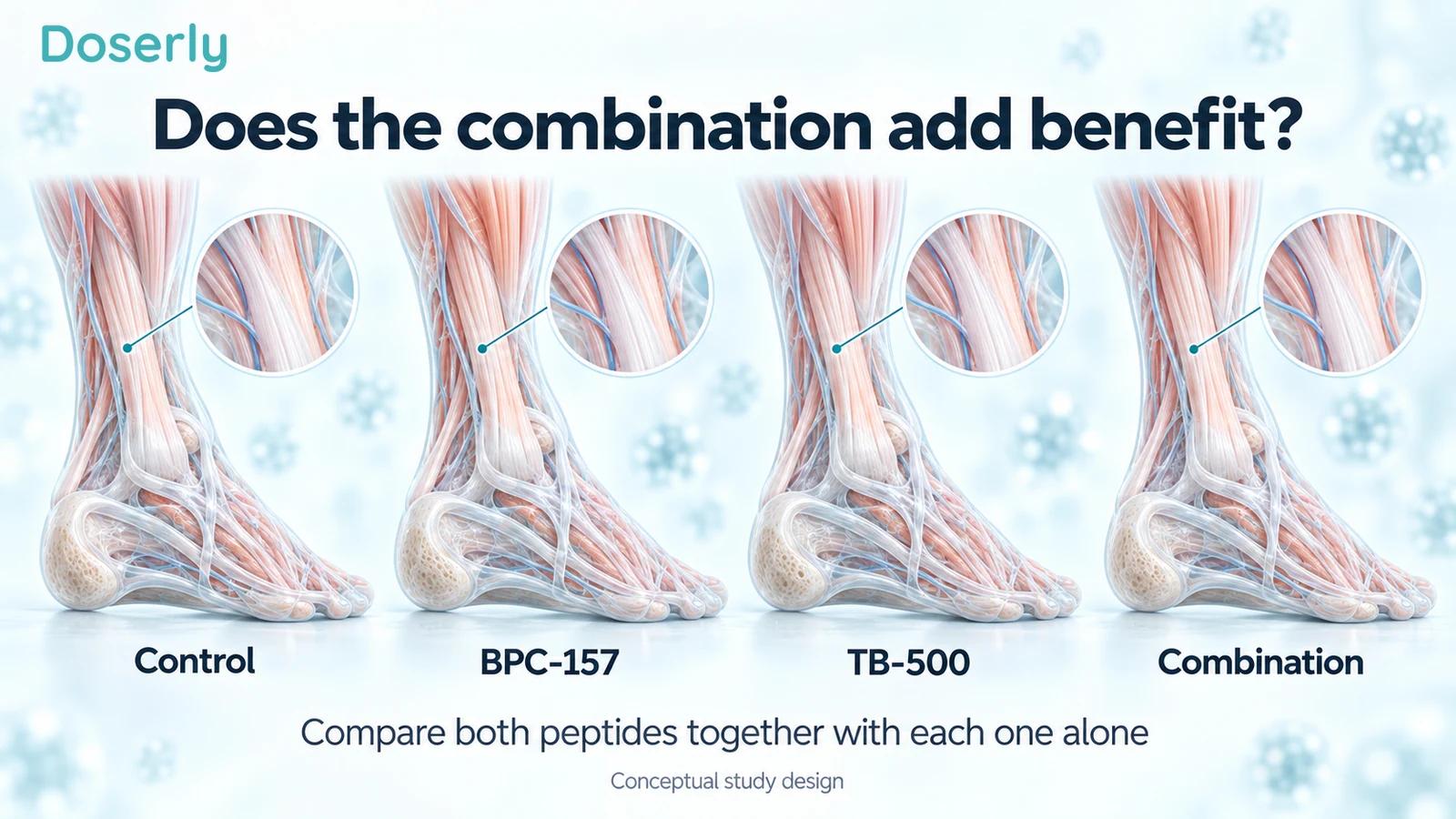
The 2026 Achilles tendon study randomized 32 male rats after tendon transection and surgical repair to control, BPC-157, TB-500, or both. Treatment was intraperitoneal, with assessment around four weeks. Although each group contained eight animals, four tendons per group were used for mechanical testing and four for histology.
TB-500 alone significantly increased maximum load to failure versus control. The combination improved one total histological score versus control but did not outperform the individual treatments. The investigators therefore did not demonstrate an added combination benefit. The methods name a commercial TB-500 product but do not establish its amino-acid sequence through a reported analytical identity test.
This is a useful direct comparison, with important limits: a small animal experiment, a surgically repaired injury, one assessment period, and unresolved material identity. It does not validate the seven-residue fragment or every commercial product sold under the TB-500 name.
Improvement against control is a different claim from added benefit
Suppose a combination group has a better tissue score than a control group. That comparison can support a claim about the combination versus control in that experiment. It does not reveal whether adding the second ingredient was necessary. One ingredient might account for all of the observed difference.
The direct comparisons with the individual treatments address that next question. If the combination does not clearly outperform them, the result cannot be advertised as proof that the ingredients work better together. A favorable-looking microscopic image is not a substitute for that comparison.
“Synergy” is a stronger claim again. In a formal combination analysis, researchers must define what response would be expected if the ingredients did not interact, then test whether the combination exceeds that expectation. The model depends on the outcome and design. Simply finding that both ingredients have biological activity is not a synergy test.
This vocabulary matters because it changes the promise being made. “The combination was examined,” “the combination differed from control,” “adding the second ingredient improved the result,” and “the ingredients acted synergistically” are four different statements. A paper may support one without supporting the others.
It is equally important not to reverse the statistical mistake. Failure to detect an added benefit in a small experiment does not establish exact equivalence between treatments. A larger, appropriately designed study could narrow that uncertainty. Until then, the evidence supports neither a confident superiority claim nor a universal declaration that all combination strategies must fail.
The human knee-pain report cannot isolate a stack effect
The 2021 retrospective report reviewed patients treated with intra-articular BPC-157, either alone or with TB4. Sixteen patients were reached by telephone. Eleven of 12 people in the BPC-157-only group reported improvement; three of four in the combination group did so.
There was no randomized allocation, placebo comparison, or validated measurement of functional improvement. The report concerned several causes of knee pain and did not establish tendon repair with follow-up imaging. Its TB4 description also does not by itself authenticate the seven-amino-acid fragment marketed as TB-500.
Those observations can generate questions for future studies. They cannot show that the combination is better than BPC-157 alone, and the small descriptive percentages should not be used to claim that it is worse either. People receiving different treatments may differ in their conditions, treatment history, or other care. Without a design that addresses those differences, the comparison remains uncertain.
The report also illustrates why pain relief and tissue repair should be kept separate. A person can accurately report less pain without that observation establishing a particular structural change. A useful clinical trial would measure both the patient's experience and the relevant function, with imaging or other structural assessments used for a clearly defined purpose.
TB-500 identity changes which evidence belongs in the discussion
FDA's 2026 TB-500 briefing evaluated Ac-LKKTETQ, an N-acetylated seven-residue fragment of thymosin beta-4. Full-length thymosin beta-4 is a different peptide. A paper using TB4, a product labeled TB-500, and an analytically confirmed fragment should not automatically be treated as studies of the same intervention.
The Doserly identity guide explains this distinction. For combination research, it creates an additional requirement: both ingredients need to be characterized. Otherwise, even a positive comparison can leave uncertainty about which molecular pair produced it.
This is not merely theoretical concern about naming. A primary analysis of online peptide products reported composition differences in products marketed as TB500 and TB1000 relative to earlier descriptions. That finding does not characterize every available product. It does show why a commercial name cannot carry the full burden of identity verification.
A careful evidence summary can preserve an experiment without overidentifying its materials. It can say that investigators tested a product they called TB-500, describe their reported methods, and state when sequence confirmation is not available. That is more informative than silently choosing the identity that best fits a marketing claim.
A premixed vial introduces a separate product question
Research in which two substances are administered during the same experiment does not automatically validate a finished product containing both in one vial. Co-administration and co-formulation are different claims. The latter adds questions about the identity and amount of each ingredient, the formulation, and whether relevant quality attributes remain acceptable together over time.
For example, an analysis that confirms one peptide in a mixture does not establish the amount of the other. A result for each raw ingredient separately does not by itself characterize the final mixture. A label listing two ingredients also cannot show that their relative amounts match the formulation used in a study.
These are product-evidence questions, not instructions for preparing or combining peptides. They remain relevant even if future clinical research establishes a useful combination. A successful trial would support the defined investigational product and conditions; products with the same names would still need a justified connection to that evidence.
FDA's BPC-157 briefing and TB-500 review separately assess substance identity, quality, and clinical evidence. Neither turns a consumer stack name into a standardized, clinically validated treatment. Combining unresolved ingredients does not remove the unresolved questions attached to each.

What a persuasive human combination trial would need
The intended condition should be narrow enough to interpret. A trial of a defined tendon injury would answer a different question from a trial combining unrelated sources of joint pain. Participants would need a clear diagnosis, a documented stage of injury, and appropriate standard care throughout the study.
To test added benefit, the design would ideally compare the combination with each ingredient alone and an appropriate control, provided such a study were ethically and scientifically justified. Rehabilitation and other treatment should be comparable across groups. Otherwise, a difference attributed to the peptides might reflect a difference in care or activity.
The investigators would need to choose the main outcome in advance. For recovery, a credible package might include patient-reported symptoms, objective function, strength, and later reinjury, with enough follow-up to distinguish an early symptom change from durable recovery. These are proposed evidentiary requirements, not claims that the current stack has met them.
The sample size should address the actual combination question. A study designed only to detect a large difference versus no treatment may be too imprecise to establish a smaller difference between the combination and either ingredient. Reporting effect sizes and uncertainty would help readers assess how much improvement remains plausible, rather than reducing every result to “significant” or “not significant.”
Safety assessment would also need to cover the combination directly. A tolerability observation for one substance, in a different population or by another route, cannot establish the adverse-event profile of both together. If a study observed no important harms, the number of participants and duration would still determine how much reassurance that finding could provide.
How to read a recovery story without turning it into a trial
A person may describe real improvement after beginning a stack. That experience can matter to them while remaining unable to establish why they improved. Changes in rehabilitation, loading, sleep, other treatments, and the natural course of an injury may occur at the same time.
The especially difficult question is contribution. Even if an intervention helped, a two-ingredient story cannot show whether both were needed. Adding more details about the person's schedule does not create the missing comparison with what would have happened under another treatment.
The Doserly BPC-157 evidence guide and TB-500 evidence guide provide the broader context for each substance. The combination literature should be read alongside those limitations, not used to bypass them.
The current answer is specific: there is preliminary combination research, including a direct rat comparison, but it has not established superior human recovery from a BPC-157–TB-500 stack. The next useful advance would be better-defined materials and a study designed to measure added clinical benefit—not a more confident explanation of why two mechanisms ought to work together.
Explore the research
- Effects of BPC-157 and TB-500 on Achilles tendon healing in rats — Randomized animal experiment.
- Intra-Articular Injection of BPC 157 for Multiple Types of Knee Pain — Retrospective uncontrolled human report.
- Therapeutic potential of pro-angiogenic BPC157 is associated with VEGFR2 activation and up-regulation — cell-animal.
- Structural basis of thymosin-β4/profilin exchange leading to actin filament polymerization — structural-biochemistry.
- FDA Evaluation of TB-500-Related Bulk Drug Substances (TB-500 free base and TB-500 acetate) — regulatory-briefing.
- TB500/TB1000 and SGF1000: A scientific approach for a better understanding of misbranded and adulterated drugs — analytical-product-study.
- FDA Briefing Document: BPC-157-Related Bulk Drug Substances — regulatory-briefing.