
Supplements
October 16, 2026
Curcumin absorption upgrades: what better exposure can—and cannot—tell you
On this page
Curcumin is one of the naturally occurring compounds that give turmeric its yellow color. It has attracted interest for joint pain and inflammation, but swallowing it doesn't mean much of it reaches the bloodstream. That has led to supplements designed to improve its absorption, sometimes advertised with striking claims about being many times more bioavailable.
For someone with an aching knee, the question is more practical: will this particular product make walking or climbing stairs easier, and what are its risks? Better absorption can be a useful formulation achievement without proving a better health outcome. Studies of blood concentrations and studies of symptoms answer different questions. Some human trials show encouraging pain findings; others show that increased exposure can occur without the hoped-for changes in blood markers.
This article explains how to connect those findings without losing the distinction. Our turmeric and curcumin guide provides broader background on the ingredient and its different formulations.
Why curcumin formulations differ
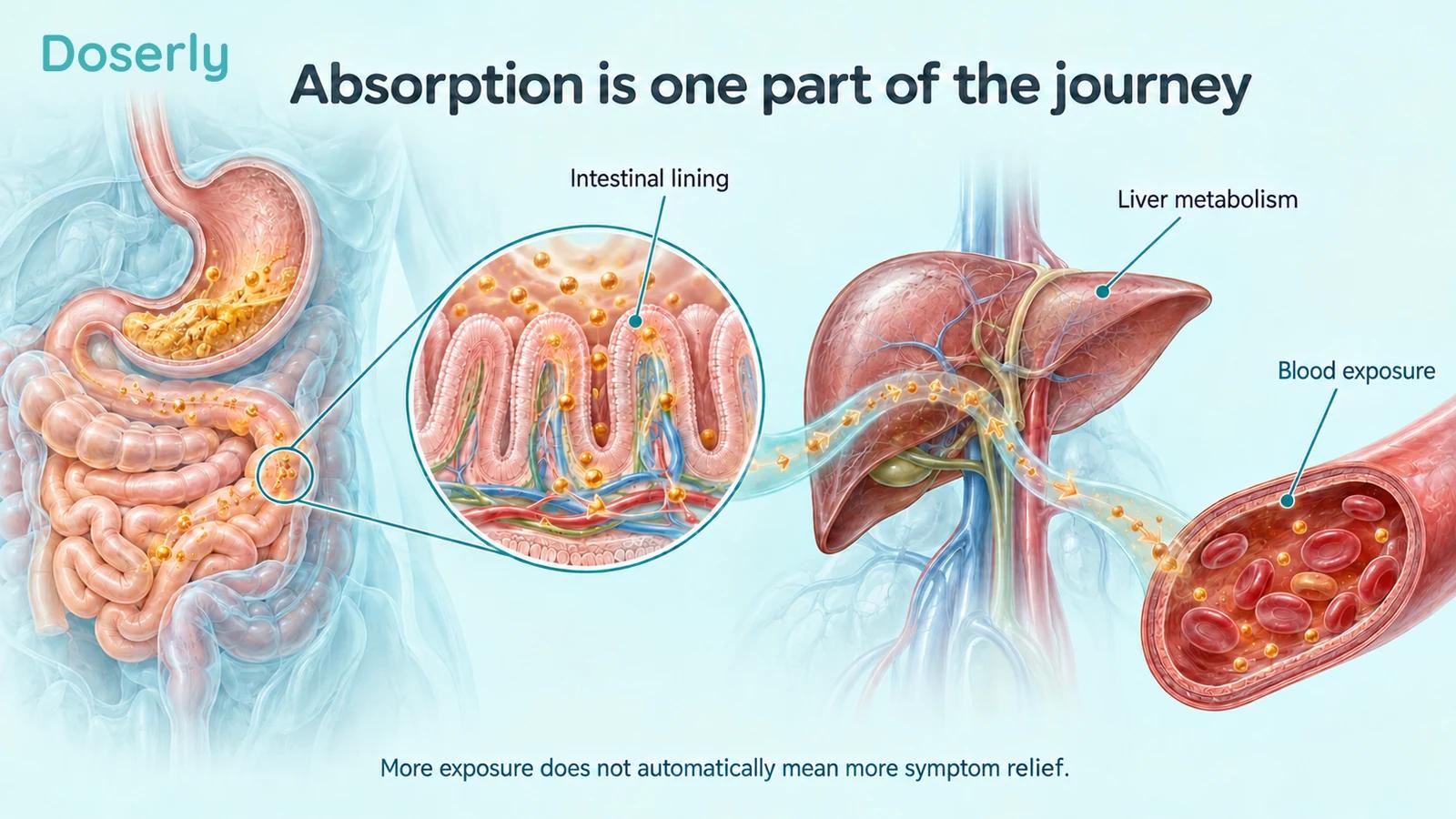
A supplement first has to disperse in the digestive tract. Material that crosses the intestinal lining can then be changed by metabolism before and after reaching the liver. Curcumin's limited intestinal uptake and rapid metabolism help explain why ordinary powder produces low circulating concentrations. An absorption study therefore measures the combined consequences of several processes, rather than just how quickly a capsule opens. Schiborr and colleagues
Formulators have approached this in different ways. Micronization makes particles smaller. Micellar formulations disperse curcuminoids within tiny structures that help them mix with the surrounding fluid. Piperine, a constituent of black pepper, has also been investigated as a way of changing curcumin exposure. These approaches are not identical, and a result for one formulation cannot establish the behavior of every product described as enhanced. Human micellar study and piperine study
There is also a basic label distinction: turmeric powder, a concentrated turmeric extract, curcumin and a mixture of curcuminoids are different descriptions. The number of milligrams on the front of two containers may refer to different materials. Before comparing amounts, look for the ingredient specification and the amount of curcuminoids actually supplied. An impressive front-label number is hard to interpret without that information. NCCIH turmeric overview
What an absorption multiplier measures
Researchers often take repeated blood samples after a dose and calculate the area under the concentration-time curve, usually shortened to AUC. It summarizes exposure across the sampling period. That is different from the highest concentration reached, how long the substance remains detectable, or how much reaches a particular tissue.
Imagine two formulations tested with the same ingredient amount and sampling schedule. If one produces a larger AUC, that supports greater blood exposure under those study conditions. It does not, by itself, tell us whether a painful joint receives a useful concentration. Nor does it identify the best exposure level: a larger number could be useful, irrelevant to the intended outcome, or accompanied by additional risks.
The laboratory method matters too. A measurement of total curcuminoids should not silently become a claim about unchanged, freely circulating curcumin. Before comparing multipliers from separate papers, the measured substances, reference preparation, dose and sampling window need to match. Otherwise, the apparent ranking can reflect different experiments rather than a true head-to-head comparison.
In a 2014 randomized crossover experiment, 23 healthy adults—13 women and 10 men—received a single 500 mg curcuminoid dose in different formulations. Samples were collected over 24 hours. The authors reported approximately ninefold higher overall exposure with micronized powder and 185-fold higher exposure with liquid micelles than with native powder. The multiplier differed between women and men. This was a formulation study in healthy volunteers, not a trial of arthritis relief. Original pharmacokinetic study
Those numbers explain why enhanced formulations deserve investigation. They do not supply a conversion rule for treating a symptom. Dividing an ordinary product's amount by an absorption multiplier would assume that all other aspects of exposure and response remain equivalent, something this experiment did not test.
What about the familiar black-pepper claim?
A frequently cited 1998 experiment compared curcumin with and without piperine. In the human portion, 2 g of curcumin alone produced very low or undetectable serum concentrations; adding 20 mg of piperine increased exposure. The authors described a 2,000% increase in bioavailability. These were research conditions, not a general instruction for combining supplements. Shoba and colleagues
The useful finding is that a coingredient changed pharmacokinetics: what the body did with the ingested substance. It did not show a corresponding twentyfold improvement in pain, inflammation or any other clinical benefit. An absorption enhancer also deserves consideration as an active part of the product, rather than being treated as inconsequential packaging.
A pharmacist reviewing a supplement needs the full ingredient list, including piperine and other added extracts. Saying only “I take turmeric” leaves out information that may matter when assessing medicines and symptoms. Avoid assuming that a kitchen amount of black pepper, a concentrated piperine ingredient and a proprietary delivery system are interchangeable exposures.
When greater blood exposure did not improve the intended markers
A 2016 double-blind crossover trial provides a direct example of the gap. Forty-two adults with moderately elevated cholesterol and C-reactive protein received a highly bioavailable micellar preparation or placebo for six weeks, with a four-week washout between periods. The preparation supplied 294 mg of curcuminoids daily.
Curcuminoids accumulated in blood, yet blood lipids and measured inflammatory markers did not differ between the active and placebo periods. Glucose-related measures also did not show the hoped-for change. Kocher and colleagues
This result is narrower than “curcumin never works.” It says that achieving measurable exposure was insufficient to improve those outcomes in that group over six weeks. It is particularly relevant to someone buying an enhanced formulation because its absorption result is presented as proof that it must lower cholesterol or inflammation.
The study also illustrates why a measurable biological step can be scientifically useful without being a patient benefit. Researchers learned that the product reached circulation. They simultaneously learned that the expected downstream changes were not demonstrated. Both findings belong in the same explanation.
What knee-osteoarthritis trials actually found
Knee pain is one of the better reasons to examine symptom trials directly. A 2020 randomized study enrolled 70 people with symptomatic knee osteoarthritis and ultrasound evidence of effusion-synovitis, involving joint fluid and the synovial lining. Participants received Curcuma longa extract or matched placebo for 12 weeks.
The average between-group difference in pain on a 100 mm visual scale favored the extract by 9.1 mm, with a 95% confidence interval from 0.4 to 17.8 mm in the direction of benefit. The MRI measurement of effusion-synovitis did not clearly improve, and the studied cartilage-composition measurement did not improve. Wang and colleagues
That is a meaningful distinction for a reader hoping to stay active. Feeling less pain can matter even if imaging does not change. But symptom relief should not be described as cartilage restoration, reversal of arthritis or proof that the joint's inflammatory changes disappeared. The uncertainty around the pain estimate also spans a very small effect through a larger one.
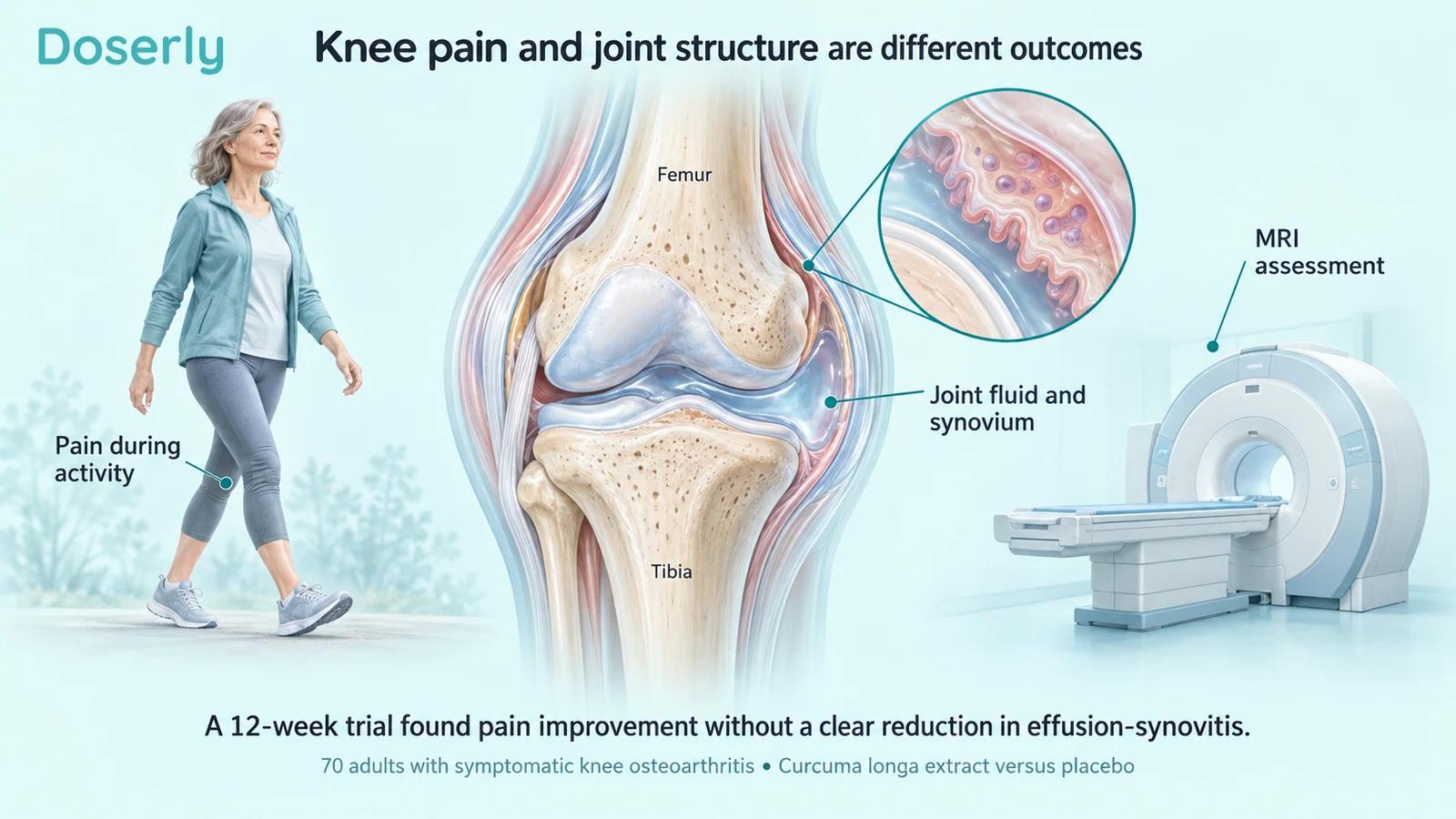
Image sources: Trial source
How much does the newer enhanced-formulation trial add?
A 2026 trial tested CurcuBoost as an addition to standard care in 50 adults aged 40–75 with radiographically confirmed knee osteoarthritis. Participants received the formulation plus usual care or usual care alone for eight weeks. All completed follow-up. The study reported greater improvements in pain and function in the supplement group; its responder counts were 20 of 25 versus 12 of 25. Bansal and Kumar
The trial was open-label, meaning participants and investigators knew the treatment allocation. That matters when major outcomes involve reported pain and function. It was also small and short, and it did not compare enhanced curcumin with an otherwise equivalent ordinary-curcumin product. Consequently, it cannot isolate the benefit of the absorption upgrade itself.
The result supports further study of that particular adjunctive treatment. It does not establish that every high-absorption product works, that it replaces standard care, or that the same response lasts for years. No treatment-related serious adverse events were reported, but 50 participants followed for eight weeks cannot settle uncommon or delayed safety questions.
Absorption and safety belong in the same conversation
Turmeric supplements have been linked to uncommon but potentially serious liver injury. In a US Drug-Induced Liver Injury Network case series, investigators described ten adjudicated cases, five requiring hospitalization and one ending in death from acute liver failure. Seven available products were tested; three contained piperine. DILIN primary report
This was a case series, not a survey of every supplement user. It cannot calculate an individual's probability of injury or prove that piperine caused the cases. Its value is identifying a credible safety problem and its clinical features. The absence of serious harm in a small efficacy trial does not negate that evidence.
Australia's Therapeutic Goods Administration advises that medicinal turmeric or curcumin can rarely cause liver injury and that enhanced absorption or higher amounts may increase risk, although it cannot conclusively rank products. Its advisory distinguishes supplements from typical culinary amounts of turmeric. It recommends avoiding these products with current or previous liver problems and stopping them promptly while seeking medical advice if concerning symptoms occur. Yellowing skin or eyes, dark urine and unexplained illness are reasons to act. TGA safety advisory
How to make a formulation comparison useful
Start with the problem you want to improve. For knee pain, a useful discussion concerns walking, stairs, sleep interrupted by pain and the care you already receive. For cholesterol, it concerns lipid measurements and overall cardiovascular care. A formulation can have good exposure data and still lack convincing results for your particular goal.
Bring the exact label to the appointment. Look together for a human study of that preparation, whether the comparator was placebo or usual care, and whether the measured outcome matches your concern. If a product only has a single-dose absorption experiment, that should be described honestly as formulation evidence.
A dated record can make follow-up more concrete. Note the product, start date, other treatment changes, symptoms and any adverse effects. For an activity-related goal, recording the same activity in comparable circumstances is more interpretable than a vague impression that things are better. That record cannot prove causation, but it can help a clinician decide whether continuing makes sense.
The choice is not simply between ordinary and enhanced absorption. It is between specific products with different amounts of evidence for a specific benefit and different practical safety considerations. The Doserly curcumin guide can help you prepare that more focused conversation.
Sources
- Schiborr et al., 2014: human crossover bioavailability experiment.
- Shoba et al., 1998: piperine and curcumin pharmacokinetics.
- Kocher et al., 2016: micellar curcuminoids and blood markers.
- Wang et al., 2020: knee pain and effusion-synovitis trial.
- Bansal and Kumar, 2026: open-label adjunctive CurcuBoost trial.
- Halegoua-DeMarzio et al., 2023: DILIN liver-injury case series.
- TGA: turmeric and curcumin liver-safety advisory.
- NCCIH: turmeric overview and safety.