
Supplements
October 16, 2026
Creatine for Alzheimer's: what the 2025 pilot can tell families
On this page
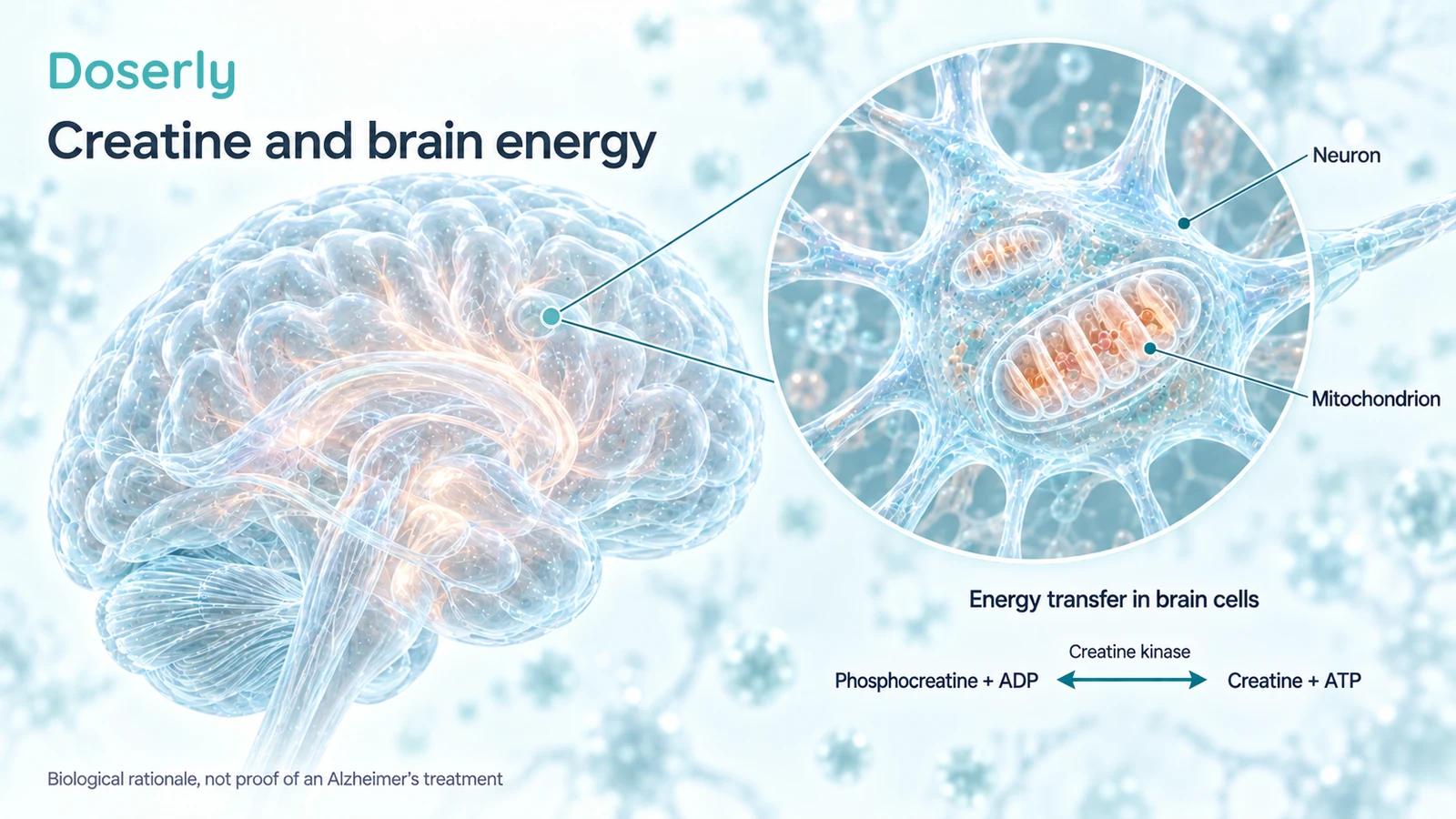
Creatine helps cells maintain a supply of usable energy. It is familiar as a sports supplement, but the brain also uses the creatine–phosphocreatine system. That has led researchers to ask whether supplementing creatine could help when brain energy metabolism is disrupted, including in Alzheimer's disease.
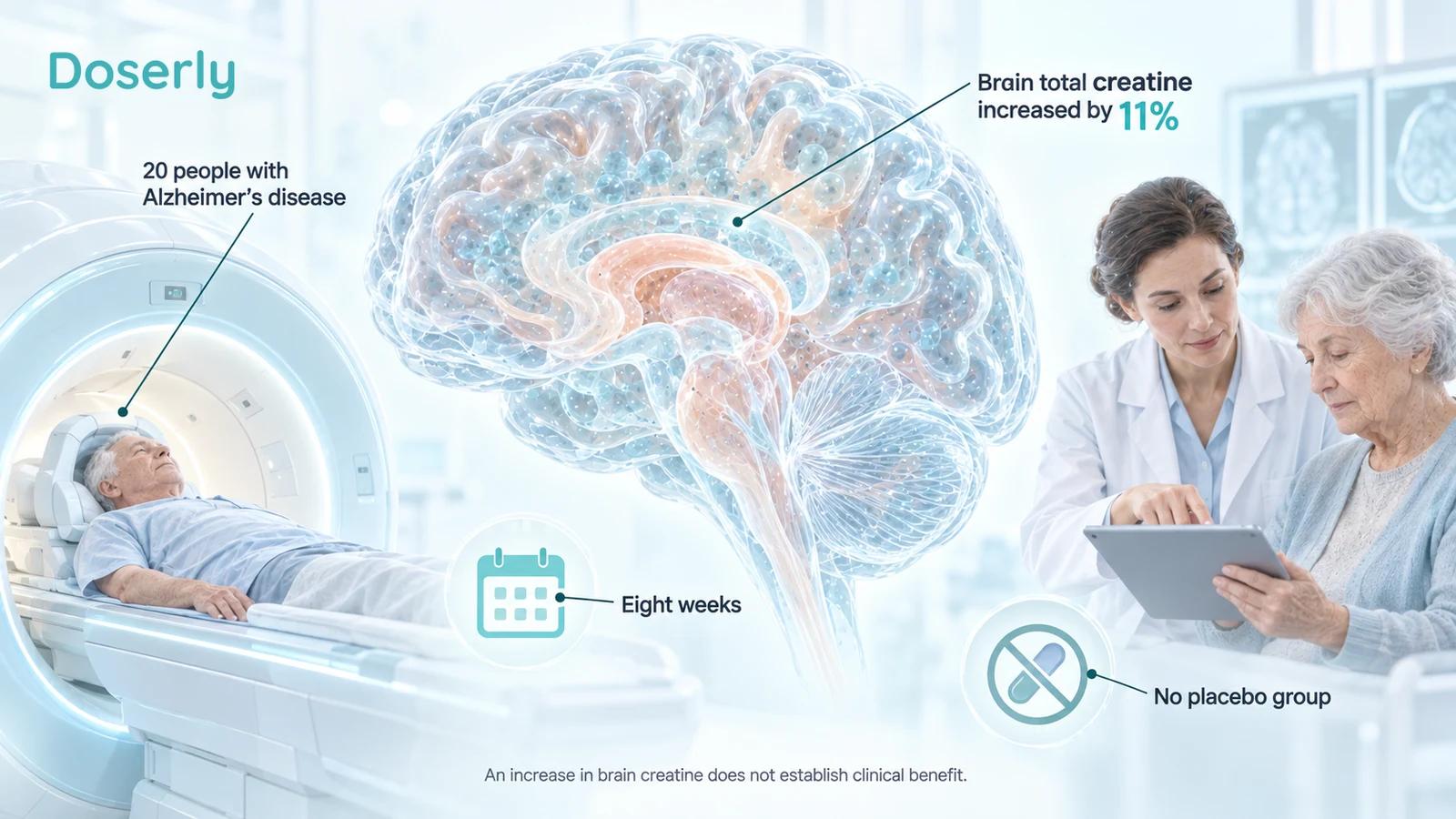
A 2025 pilot study offered an early human answer to part of that question. Twenty people with Alzheimer's took creatine monohydrate for eight weeks, and researchers found increased brain total creatine and improvements on selected cognitive tests. There was no placebo group, so the study could not establish that creatine caused a cognitive benefit or slowed the disease. CABA pilot report.
For families, both parts matter. The result gives researchers a reason to continue, while the design prevents it from being treated as a proven treatment. Here is what the study measured, why the brain result is different from a memory result, and what should be discussed before turning a research dose into a home routine. Our creatine guide covers the compound's wider uses and safety background.
Why brain energy is a reasonable research target
Neurons require energy to maintain their internal conditions and communicate with other cells. Alzheimer's involves more than one biological process, including abnormal protein accumulation, inflammation, cell dysfunction and changes in energy use. The National Institute on Aging describes reduced glucose entry and energy production as part of the disease picture. NIA explanation of the Alzheimer's brain.
Creatine is involved in a reversible energy-transfer reaction. When energy demand rises, phosphocreatine can help regenerate ATP, a molecule cells use to support energy-requiring work, from ADP. The enzyme creatine kinase facilitates the reaction. This provides a rationale for studying creatine when energy availability may be under strain; it does not mean Alzheimer's is simply a creatine deficiency. Creatine cognition trial background.
A useful treatment would need to do more than increase the amount of one compound in the brain. It would need to improve an outcome that matters: thinking, daily function, quality of life or the rate of decline, with acceptable risks. An energy-related mechanism can guide the experiment without predicting the clinical answer in advance.
What the CABA researchers did
CABA stands for Creatine to Augment Bioenergetics in Alzheimer's. This was a single-arm pilot, so all participants received the intervention. Researchers gave 20 g daily of creatine monohydrate for eight weeks to 20 people with Alzheimer's, measured adherence and safety, and assessed brain total creatine and cognition before and after treatment. Nineteen participants met the threshold of taking at least 80% of the expected doses. CABA methods and results.
The study used considerable support: a dietitian provided education, study partners helped record intake, and weekly calls monitored adherence and adverse events. This context matters to a family thinking about feasibility. A powder that can be consumed under a supported research protocol may still be difficult to manage alongside a person's medications, appetite changes or daily care needs.
The reported dose is a description of the experiment. It is not a validated Alzheimer's regimen or a reason to increase an existing supplement. The pilot was designed to learn whether a larger efficacy study was practical, not to determine the lowest effective dose, the best duration or who should receive it in routine care.
What an 11% increase in brain creatine means
Researchers used magnetic resonance spectroscopy, a technique related to MRI that estimates particular chemical signals in a selected area. Average brain total creatine increased by 11%. Total creatine combines free creatine and phosphocreatine; the method used did not separately establish their individual changes or directly measure an 11% improvement in brain energy production. CABA brain measurements.
That is a useful pharmacological observation: supplementation was associated with a measurable change in the brain compartment being studied. But a larger pool of an energy-related compound is not the same as showing that neurons work better, that memory has improved by the same percentage or that the underlying disease has slowed.
The scan also does not demonstrate that lost brain tissue grew back. If you see an image with a damaged brain becoming intact after creatine, that goes beyond what this study established. The relevant result concerns a chemical measurement, not regeneration.
For a family comparing research reports, it helps to keep three questions separate: did the compound reach or alter the brain, did people perform better on tests, and did daily life or disease progression improve? CABA offers preliminary information about the first two. It does not provide a controlled answer to the third.
Why better test scores do not settle efficacy
Selected cognitive scores improved after supplementation. However, people were tested repeatedly and knew they were participating in an intervention study. Without a comparison group undergoing the same schedule, it is difficult to separate a treatment effect from practice, expectation, ordinary variation or other changes during the study.
This does not mean the improvements were imaginary. It means their cause is uncertain. A test score can truly change while the study remains unable to identify why. The researchers themselves describe the findings as preliminary and call for controlled efficacy trials. CABA discussion.
A progressive disease does not solve this design problem. Although Alzheimer's tends to worsen over time, an individual test result does not have to decline at every short interval. Familiarity with a task, attention on the test day, fatigue and support can affect performance. An eight-week improvement therefore cannot be assumed to represent a reversal of the long-term trajectory.
A randomized placebo-controlled study would give both groups comparable visits, encouragement and testing. If the creatine group then performed better, researchers would have stronger grounds for attributing the difference to the intervention. Longer follow-up would be needed to assess whether any benefit persisted and whether it changed daily functioning.
What studies in people without Alzheimer's add
A 2023 randomized, blinded crossover study tested 5 g daily for six weeks per condition in 123 adults, approximately half vegetarian and half omnivorous. Its two main cognitive tests did not meet the conventional significance threshold: backward digit span had P=0.064 and abstract reasoning P=0.327. Bayesian analyses supported a possible small effect, while exploratory tasks did not show improvement. Sandkühler and colleagues.
These analyses are not contradictory simply because they use different language. They assess the evidence using different statistical frameworks. The overall result leaves room for a small benefit but does not support a large, reliable improvement across cognitive domains. It also does not test Alzheimer's treatment.
A separate 2024 study examined a single high dose during sleep deprivation, combining cognitive testing with brain energy-related measurements. It reported effects under that acute experimental stress. Sleep-deprivation study.
Being temporarily sleep-deprived is biologically and clinically different from living with a neurodegenerative disease. An intervention that helps a particular task overnight may not slow years of decline. These studies strengthen the rationale for asking targeted questions; they cannot fill the missing placebo comparison in CABA.
How an independent assessment frames cognitive claims
In 2024, the European Food Safety Authority assessed a proposed health claim for creatine and cognitive function. It concluded that the submitted evidence did not establish a cause-and-effect relationship for improvement in cognitive domains. That assessment preceded the 2025 Alzheimer's pilot and concerned a general food health claim, not a decision about an Alzheimer's medicine. EFSA scientific opinion.
The distinction matters in both directions. The opinion should not be presented as an assessment of a study that had not yet been published. But a later uncontrolled pilot also does not erase the need for stronger controlled evidence. A family should be cautious about a marketing claim that treats a preliminary disease study as proof that creatine reliably improves cognition in everyone.
Tolerability and kidney-related blood tests
All 20 participants completed CABA. The researchers recorded 13 mild adverse events, including digestive symptoms, muscle discomfort and sleep disturbance. Serum creatinine increased slightly. This is useful safety information, but the sample and duration were too small to rule out uncommon or long-term problems. CABA safety results.
Creatine and creatinine are related but different substances. Creatinine is used in common estimates of kidney filtration. A change in that marker during supplementation needs clinical interpretation rather than an automatic assumption that it proves kidney damage—or that it can safely be ignored. The person's history, other measurements and treatment context matter.
For someone with Alzheimer's, feasibility also includes swallowing or mixing difficulties, medication burden and the ability to report symptoms accurately. Caregivers may notice changes the person does not mention. Those practical observations should be part of any clinician-led decision, rather than treating the supplement as a simple addition with no monitoring needs.
What families can usefully track and discuss
Bring the exact product and proposed amount to the clinician who manages the person's care. Explain whether the goal is better attention, maintaining a daily activity, muscle function or slowing cognitive decline. Those goals may call for different assessments, and the evidence for one does not automatically support the others.
A short, consistent record can be more useful than frequent informal memory quizzes. Record changes in products, medicines, sleep, appetite and symptoms, along with concrete observations such as needing more help with a familiar task. Avoid turning every good or difficult day into a verdict on treatment. A clinician can help decide what patterns are meaningful and what warrants evaluation.
New or worsening cognitive symptoms also deserve appropriate assessment. Alzheimer's diagnosis can involve a history, cognitive testing, laboratory work and imaging to consider other causes of symptoms. A supplement trial at home should not delay that process or replace established care. NIA diagnostic guidance.
If participation in research is of interest, ask about a suitable registered trial rather than trying to reconstruct a study protocol independently. Research teams specify eligibility, consent, product quality, monitoring and outcomes. Those safeguards are part of what makes a study interpretable and manageable for participants.
What would make the next result more convincing?
The most informative next step would be a randomized, blinded comparison with placebo, enough participants to estimate a meaningful effect, and outcomes chosen before the results are examined. Cognitive tests should be accompanied by measures of daily function and adequate follow-up. Reporting who withdrew and why would be as important as reporting average score changes.
Mechanistic measurements could then help explain any clinical result. For example, investigators could examine whether people with larger changes in brain creatine also show greater functional benefit, while recognizing that correlation alone would not prove the pathway. Dose comparisons could address whether a lower exposure provides a similar effect with less burden.
CABA makes such questions more concrete. It showed that a supported eight-week intervention was feasible and that brain total creatine could rise in this small Alzheimer's sample. It did not establish a treatment benefit. Families can take the research seriously while keeping current care anchored to evidence that directly addresses the person's condition and daily needs.
Explore the research
- Creatine monohydrate pilot in Alzheimer's: Feasibility, brain creatine, and cognition (2025).
- NIA: What Happens to the Brain in Alzheimer's Disease?.
- The effects of creatine supplementation on cognitive performance—a randomised controlled study (2023).
- Single-dose creatine during sleep deprivation (2024).
- EFSA: Creatine and improvement in cognitive function (2024).
- NIA: How Is Alzheimer's Disease Diagnosed?.