
Peptides
October 16, 2026
Thymosin beta-4 and cancer: what conflicting experiments mean
On this page
Thymosin beta-4 participates in processes related to cell movement and tissue responses to injury. Those properties help explain interest in wound repair. They also raise a reasonable question: could a substance involved in cell movement and blood-vessel growth influence cancer?
Laboratory research gives reasons to take that question seriously, but not a reliable numerical estimate of risk for a person receiving thymosin beta-4. Some experiments link greater thymosin beta-4 activity with tumor growth, invasion or spread. Another study found an inhibitory effect in a particular mouse model combining lung fibrosis and cancer. The findings are not interchangeable, and neither direction establishes what happens with long-term treatment in humans.
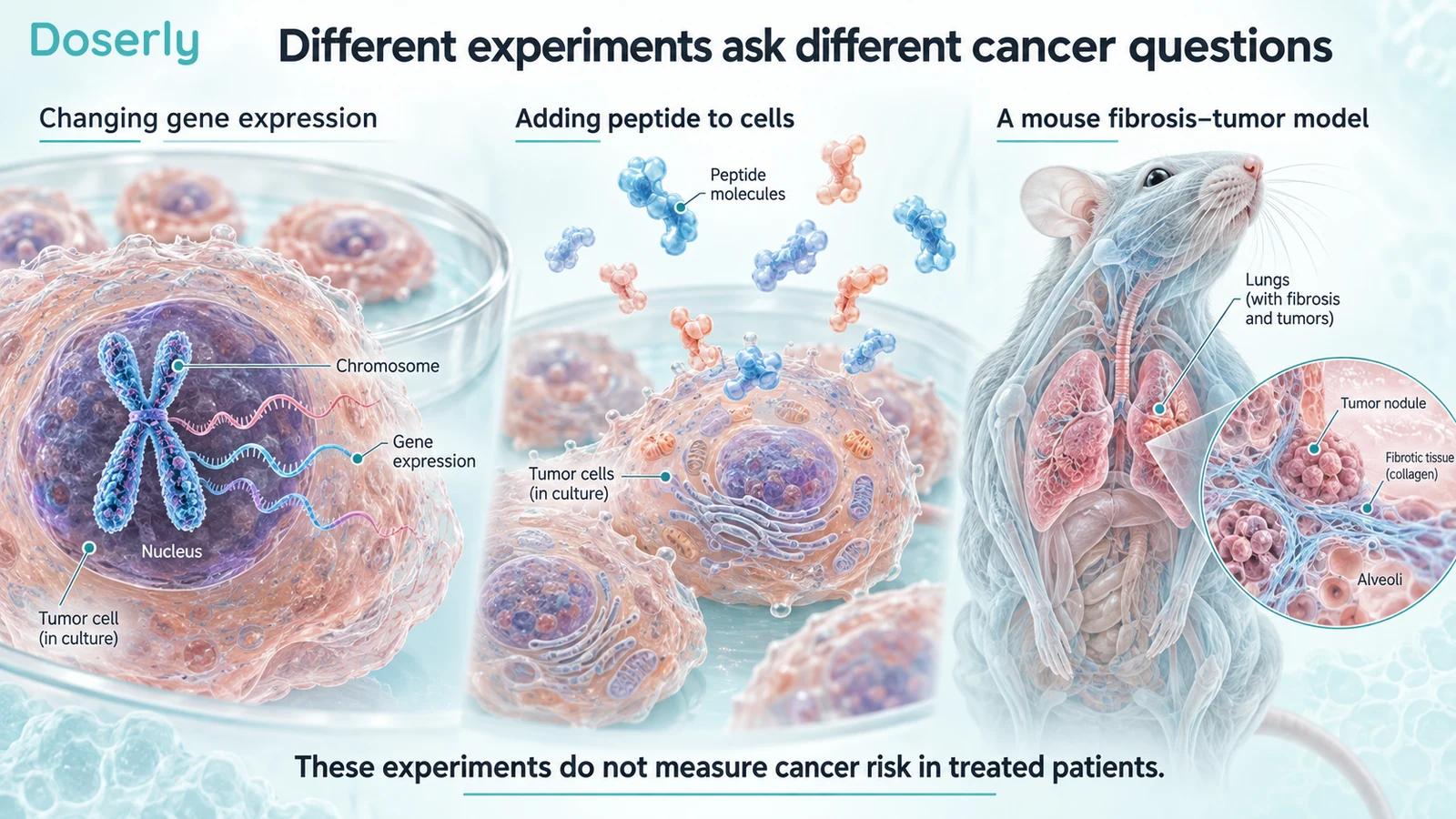
The useful approach is to identify what each experiment changed and measured. Was it the amount a cancer cell produced, peptide added to cells in a dish, or a treatment administered to an animal? Those distinctions are essential before interpreting the results as either evidence of danger or reassurance. Our thymosin beta-4 guide covers the broader clinical research and formulation differences.
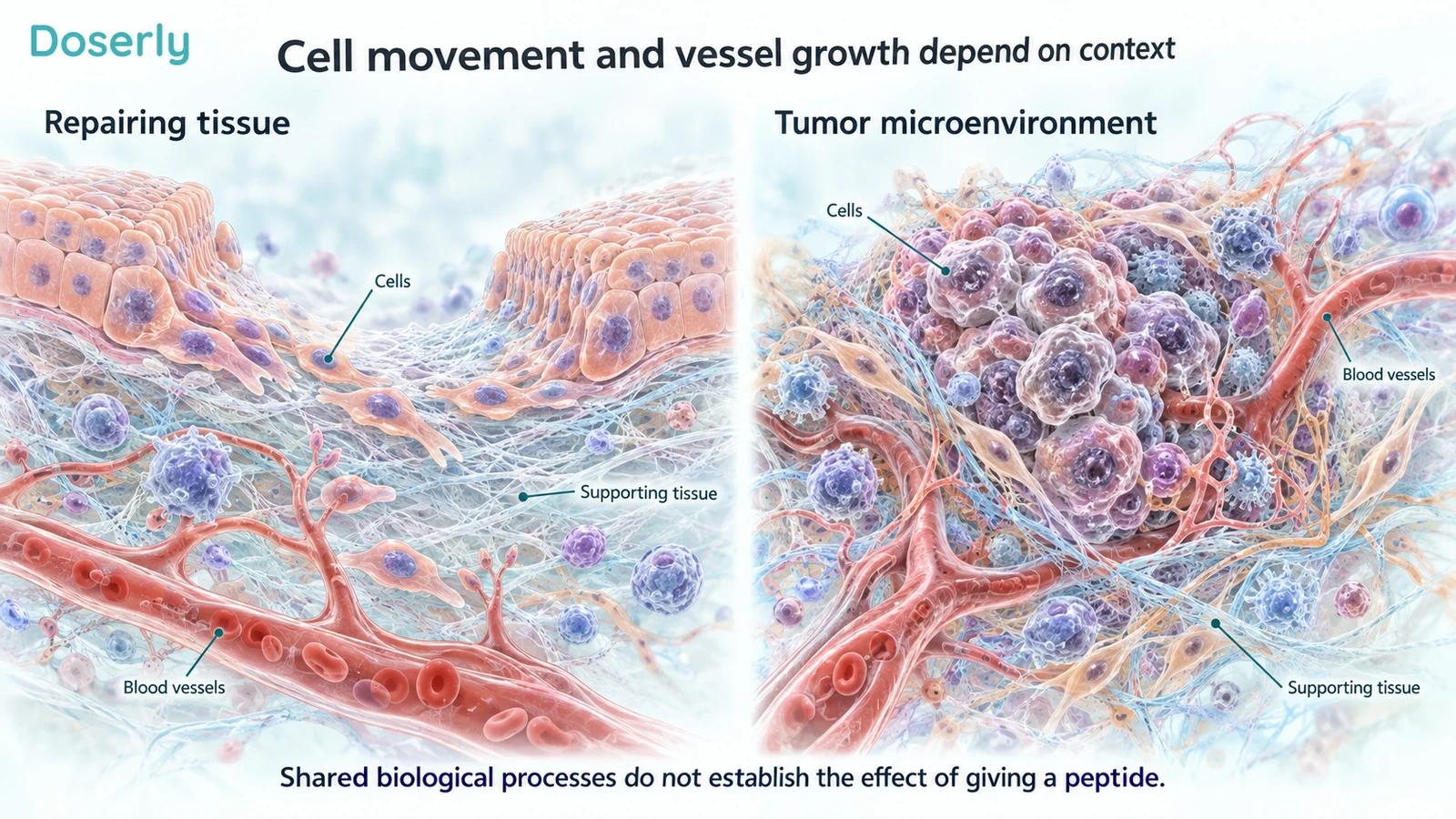
Why cancer biology is more than a cell growing faster
Cancer involves abnormal growth and can include invasion into nearby tissue and spread to distant sites, called metastasis. Tumors also interact with surrounding immune cells, supporting cells, blood vessels and structural material. Together these surroundings are called the tumor microenvironment. National Cancer Institute.
A laboratory experiment might measure any one of several behaviors: cell multiplication, movement across a surface, passage through a barrier, growth of a tumor or the number of distant lesions. Those measurements answer different questions. A treatment could affect one without affecting all the others.
Thymosin beta-4 binds actin, a structural protein involved in cell shape and movement. That makes migration a biologically plausible research target. It does not make every change in migration a diagnosis of cancer, nor does it establish that injecting thymosin beta-4 initiates a tumor.
For a patient, there are also different safety questions: could an exposure affect an existing cancer, alter recurrence risk after treatment or contribute to a new cancer over time? The studies below do not provide dependable answers to all three. Their value is in showing which biological interactions deserve investigation.
What happened when melanoma cells produced more thymosin beta-4?
A 2003 study used mouse melanoma cells engineered to express more thymosin beta-4. Researchers introduced those cells into mice and compared them with control cells. This changed the tumor cells themselves; it was not a trial in which people received a peptide for an injury.
The engineered cells produced larger tumors and more lung nodules in the experimental settings. In one comparison, the reported average number of lung nodules was 46.7 versus 10.9. Cell migration and blood-vessel density also increased, while some other laboratory behaviors did not. Melanoma study.
That is a meaningful experimental signal that increased expression can support aspects of tumor progression in this model. It is not a cancer-risk percentage for someone using a product. The intervention was genetic overexpression in a particular mouse cell line, with tumor cells introduced by specific routes. Exposure, cell type and disease context differ from clinical use.
It would be equally misleading to ignore the result because it is preclinical or to say it proves that a peptide injection causes melanoma. The finding establishes a reason for caution and further work, not a measured human probability.
What did the colorectal cancer studies add?
A 2004 study examined engineered SW480 colon cancer cells and matched human primary colorectal tumors and liver metastases. Increasing thymosin beta-4 expression in the cell line was associated with greater invasion and changes in proteins involved in adhesion and signaling. The human tissue comparisons found higher expression of several related factors in metastatic lesions. Colorectal study.
The tissue observations are relevant to human disease, but the patients were not assigned to receive thymosin beta-4. A molecule being more abundant in a metastasis does not establish that administering it caused the metastasis. It may contribute to the process, reflect other changes or both.
A separate study used colorectal cancer stem cells derived from patients. Researchers reduced thymosin beta-4 expression with a genetic approach. The cells grew and migrated less in culture, and their xenografts—tumors formed after implantation into mice—were smaller and less aggressive. Changes in PTEN, ILK and Akt signaling accompanied those effects. Cancer-stem-cell study.
This strengthens the case that the protein can matter in some tumor systems. It does not validate giving a blocking treatment to patients, and it does not quantify the risk of adding an external peptide. Reducing a protein inside a tumor cell and administering a peptide to a whole person are different interventions.
Was peptide actually added to cancer cells in any experiment?
Yes. A study of the SKOV3 ovarian cancer cell line added full-length thymosin beta-4 and several derived fragments to cultured cells. The researchers reported increased migration, invasion and proliferation, with changes in RACK-1 protein expression. Even fragments without the actin-binding motif showed activity in that experiment. Ovarian-cell study.
This is closer to an external-exposure experiment than genetic overexpression, but it remains a cell-culture study. A dish does not reproduce human absorption, metabolism, immune surveillance, tissue distribution or cancer treatment. The concentrations and exposure conditions need to be matched to any proposed clinical interpretation.
The fragment findings also show why “the active part” can be an oversimplification. Different portions of a peptide may have effects through different processes. The experiment does not make all fragments equivalent to full-length thymosin beta-4, and it does not establish that a marketed product called TB-500 behaves the same way.
For someone with ovarian cancer, the study is a reason to bring the specific substance to the oncology team rather than assume that repair-related marketing implies safety. It cannot predict an individual's tumor response.
Why did another study report an anticancer effect?
A 2023 study used mice with bleomycin-induced lung fibrosis followed by implantation of lung-cancer cells. It therefore examined a deliberately constructed combination of scarring and cancer, not spontaneous lung cancer in otherwise healthy animals.
In that model, externally administered recombinant human thymosin beta-4 was associated with less lung damage and inhibited tumor growth. The investigators also reported inhibitory effects in cell experiments and proposed involvement of the JAK2/STAT3 signaling pathway. Fibrosis–lung-cancer study.
The result should be reported, because it demonstrates that the direction of an effect can depend on the model. It does not cancel the melanoma, colorectal or ovarian findings. Those studies used different tumors, interventions and surrounding tissue conditions. There is no scientific basis for treating one favorable model as a universal safety result.
It also does not support thymosin beta-4 as a treatment for human lung cancer or pulmonary fibrosis. A clinical trial would need to evaluate the defined preparation in the relevant patients, with appropriate comparison and monitoring. The authors' proposed mechanism is a research explanation, not an established patient benefit.
How can effects point in different directions?
Several differences can change the answer. A cancer cell making more of a protein experiences a different pattern of exposure from a cell receiving peptide externally. A fibrotic lung has a different inflammatory and structural environment from an isolated ovarian cell line. Tumor genetics and the balance of signaling pathways also vary.
The measured outcome matters too. Movement, invasion, proliferation and tumor size are not one interchangeable endpoint. An effect on the surrounding tissue could indirectly change tumor behavior, while a different experiment isolates a direct effect on cancer cells.
These are explanations for why conflicting results are possible, not proof that we know the full reason for every discrepancy. Researchers would need experiments designed to compare the relevant conditions. It is more accurate to preserve the uncertainty than to declare the peptide universally “pro-cancer” or “anticancer.”
For a clinical decision, conflicting preclinical results do not average into a neutral or safe effect. They indicate that the response may be context-dependent and that the information needed to estimate benefit and risk is incomplete. A personal medical history can matter even when no study provides a precise risk number for that history.
Do the human safety studies resolve cancer risk?
The recombinant NL005 phase 1 study enrolled healthy volunteers: 54 in a single-dose portion and 30 in a multiple-dose portion. Repeated dosing lasted ten days, with follow-up to day 28. The study reported no serious adverse events or dose-limiting toxicities, while mild and moderate events occurred. Healthy-volunteer study.
The investigators measured several tumor-associated blood markers and discussed transient abnormalities, including squamous-cell carcinoma antigen. Such a marker is not a cancer diagnosis, and a short-lived laboratory change cannot establish that a tumor developed. Conversely, no tumor-related event over a short follow-up cannot establish long-term oncologic safety.
A study lasting weeks is not designed to measure cancer incidence or recurrence over years. Its participants also do not represent every person with a prior or active malignancy. The study supports a limited conclusion about the tested product's early tolerability; it cannot close the cancer-risk question.
This is why “no cancer was reported” needs a denominator, duration and population. Without them, a reassuring sentence can imply a level of surveillance the study never performed. The absence of a measured event is useful only within the study's ability to detect it.
What evidence would make the safety answer more useful?
The most informative evidence would identify the exact product, route and exposure, describe who received it and follow participants long enough to assess relevant outcomes. For people with a cancer history, recurrence and interaction with cancer treatment may matter more than short-term general tolerability.
Researchers would also need to distinguish new cancers from progression of an existing cancer, and compare observed outcomes with an appropriate control group. A case report can reveal a possible concern, but it cannot establish incidence by itself. Equally, many uneventful anecdotes cannot supply a controlled long-term safety estimate.
No such dependable risk estimate emerges from the studies reviewed here. That limitation should remain explicit when someone presents a wound-healing claim as evidence that the peptide is suitable for everyone. Potential benefit in one tissue does not settle safety in another clinical context.
A practical conversation with the oncology team
If you have active cancer, a previous cancer or an unexplained finding under investigation, discuss any proposed thymosin beta-4 or TB-500 product with the team managing that condition. Bring the exact name, formulation and reason it was suggested. A broad description such as “a healing peptide” hides information needed to assess the proposal.
Ask whether there are human data relevant to your diagnosis and treatment, and whether the intended benefit has been demonstrated with that preparation. The answer may be that the evidence is too limited to estimate the balance. That is different from a proven increase in cancer risk, but it is also different from established safety.
Doserly's thymosin beta-4 research section separates the clinical studies from experimental biology. The cancer literature gives a specific message: thymosin beta-4 can influence tumor-related processes in several models, sometimes in opposing directions. It does not currently provide a reliable human cancer-risk estimate or justify using the peptide as an anticancer treatment.
Sources
- National Cancer Institute: what cancer is.
- Mouse melanoma overexpression study, 2003.
- Colorectal invasion and human tissue study, 2004.
- Colorectal cancer stem-cell targeting study, 2010.
- Ovarian cancer cell peptide-exposure study, 2021.
- Mouse fibrosis–lung-cancer study, 2023.
- Recombinant thymosin beta-4 phase 1 study, 2021.