
Peptides
October 16, 2026
Could pemvidutide treat liver disease and alcohol use disorder?
On this page
Pemvidutide is being developed around a useful biological possibility: a medicine that influences appetite and liver metabolism might help with more than body weight. Its two targets are the GLP-1 receptor, involved in appetite and metabolic regulation, and the glucagon receptor, which has important effects in the liver.
That makes several research questions plausible. Could it reduce liver fat? Could it improve inflammatory liver disease? Could effects on appetite and reward-related pathways also change harmful drinking? These questions overlap, but they aren't interchangeable.
The evidence now includes randomized liver studies and a sponsor-reported alcohol-use trial. It also includes ongoing research in alcohol-associated liver disease. Understanding which benefit belongs to which population is essential for anyone hoping one medicine could address several connected problems. Our pemvidutide guide introduces the compound and its broader development history.
Why one molecule can have several possible uses
A receptor is a protein that responds to a signal. An agonist activates a receptor; a dual agonist activates two receptor types. This describes how a molecule interacts with biological systems, not the number of diseases it has been shown to treat.
GLP-1-related signaling can influence eating and metabolic regulation. Glucagon-related signaling has direct effects on liver fuel handling. The early pemvidutide liver paper describes the rationale for combining these activities: weight-related changes and liver-directed effects might both contribute to reducing liver fat. MASLD randomized study
Those pathways provide a reason to conduct trials. They don't tell us in advance which effect will dominate, whether a benefit will persist or whether it will outweigh unwanted effects. A drug can act on a relevant pathway without producing a clinically worthwhile result for a particular disease.
This matters especially when several conditions coexist. A person can have obesity, harmful alcohol use and liver disease at the same time. Improving one feature may be valuable without resolving the others. The clinical task is to identify which problems need treatment and which outcomes show that treatment is helping.
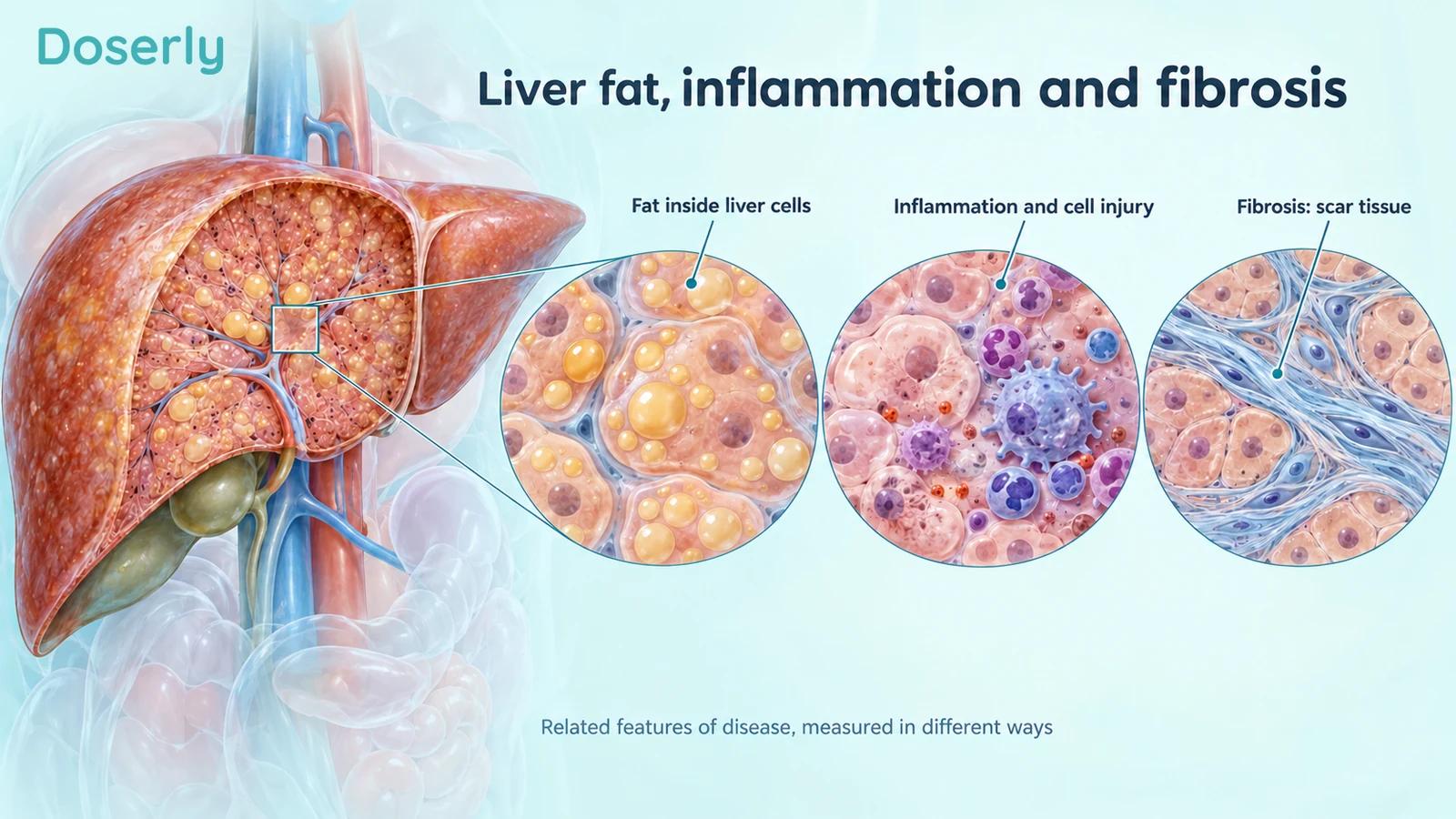
Liver fat, MASH and fibrosis aren't the same finding
Metabolic dysfunction-associated steatotic liver disease, or MASLD, describes fat accumulation in the liver associated with metabolic dysfunction. MASH, its inflammatory form, includes liver-cell injury and inflammation. Fibrosis means scar tissue that develops in response to injury.
These terms describe related features, but a scan showing fat doesn't by itself establish the amount of scarring. Nor does a blood-test improvement automatically establish that inflammation has resolved. Earlier patient resources use NAFLD and NASH terminology; the same basic distinction between fat accumulation, inflammation and scar formation remains useful. NIDDK liver-disease explanation
For a patient, this is more than vocabulary. Someone with excess liver fat and someone with advanced fibrosis may face different risks and need different follow-up. A study designed to detect a rapid change in fat content won't necessarily answer whether treatment prevents liver failure years later.
What did the early liver-fat trial show?
A randomized study assigned 94 people with elevated liver fat and a BMI of at least 28 to pemvidutide or placebo for 12 weeks. Twenty-nine percent had type 2 diabetes. The primary measurement was liver fat assessed by a specialized MRI technique.
At the 1.8 mg study dose, the reported relative reduction in liver fat was 68.5%, compared with 4.4% on placebo. This was a reduction relative to each person's starting liver-fat measurement, not a 68.5-percentage-point fall and not a statement that 68.5% of patients were cured. Primary MASLD report
For illustration, a relative reduction and an absolute percentage-point change behave differently. Reducing a hypothetical measurement from 20% to 10% would be a 50% relative reduction and a 10-percentage-point decrease. That example explains the arithmetic; it isn't an additional pemvidutide result.
The trial supported further investigation of liver disease. Its duration and endpoint couldn't establish prevention of cirrhosis, transplantation or death. Those would require different outcomes and substantially longer observation.
What changed when researchers examined liver tissue?
IMPACT moved to biopsy-confirmed MASH with F2 or F3 fibrosis. Researchers randomized 212 people and evaluated two main tissue outcomes at 24 weeks: MASH resolution without worsening fibrosis, and fibrosis improvement without worsening MASH.
The peer-reviewed report described MASH resolution in approximately 58% and 52% of the two pemvidutide groups versus 20% on placebo. The differences were statistically significant. Fibrosis improvement was reported in approximately 33% and 36% versus 28%, but those differences weren't statistically significant. IMPACT primary publication
These are distinct results. The study provided evidence for improvement in inflammatory disease under its defined tissue criteria. It didn't establish a clear benefit for the separate fibrosis endpoint at that time point.
It is tempting to compress this into “reverses liver damage.” That wording loses the distinction the trial was designed to examine. Resolution of MASH under a biopsy definition is meaningful, but it doesn't mean every aspect of liver disease has disappeared.
The same distinction helps interpret later noninvasive findings. Blood-based fibrosis scores and liver stiffness can supply useful additional information, yet they aren't interchangeable with a biopsy outcome or a clinical event such as decompensation.
Why study alcohol use disorder?
Alcohol use disorder, or AUD, involves difficulty controlling alcohol use despite harmful consequences. It isn't simply a high liver-fat measurement or a matter of willpower. Treatment can include behavioral approaches, medications and support tailored to the person's needs. NIAAA treatment resource
Research on GLP-1-related pathways has raised questions about effects on reward and consumption. For pemvidutide, this created a separate clinical hypothesis: could treatment reduce heavy drinking in people with AUD? The right way to answer is to measure drinking in that population, not to infer it from weight loss.
This distinction also protects against a misleading explanation of recovery. Eating less and drinking less aren't necessarily the same experience. Drinking behavior can involve dependence, withdrawal, mental health, social context and established routines. A change in body weight doesn't quantify those dimensions.
What did RECLAIM report?
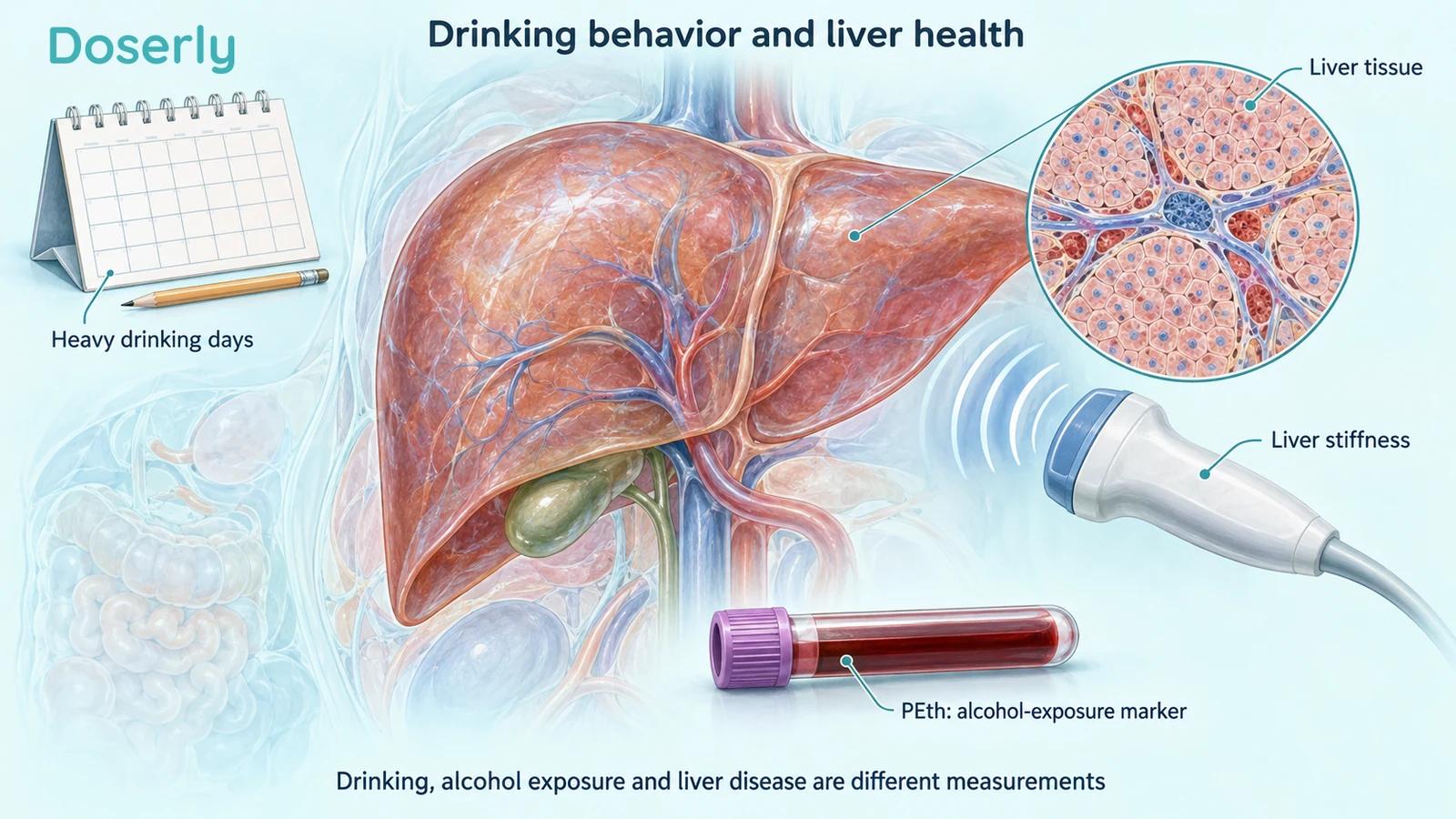
In July 2026, Altimmune disclosed results from RECLAIM, a 24-week randomized trial of approximately 100 adults with AUD and a BMI above 25. The primary outcome was change in heavy drinking days per week.
The sponsor reported decreases of 4.20 days per week with pemvidutide and 2.75 with placebo, a difference of 1.45 days favoring pemvidutide. The placebo improvement is part of the result; reporting only the treated group's change would overstate what was attributed to assignment to the medicine.
The release also described more participants achieving zero heavy drinking days during weeks 21–24 and improvements in PEth, a biomarker of alcohol exposure. These were sponsor-reported topline findings, with journal submission planned, rather than a peer-reviewed full report in the material checked here. RECLAIM disclosure
Zero heavy drinking days isn't necessarily abstinence. Someone can drink below the trial's heavy-drinking threshold and still meet that endpoint. Likewise, a lower exposure marker doesn't by itself show that liver fibrosis improved. Each outcome needs its own interpretation.
The same disclosure also reported nausea in 22 of 50 pemvidutide participants, compared with 12 of 50 receiving placebo. Five treated participants stopped because of events judged related to study drug, versus none receiving placebo. One serious event of hyponatremia was considered possibly related by the investigator. These findings belong beside the drinking outcomes, because a multi-condition treatment has to be usable by the people it aims to help. The sponsor's overall description of tolerability does not replace those event-level details. Nor does this AUD experience establish tolerability in people with more advanced liver disease, whose clinical needs may differ. RECLAIM safety table
Does reducing heavy drinking establish a liver benefit?
It creates an important reason for optimism, but it doesn't supply the missing measurement. A trial can show reduced drinking without being designed or long enough to establish a change in advanced liver disease.
Conversely, an apparent change in a liver measurement doesn't tell us how much came from reduced drinking, weight change, direct drug effects or other care. Determining the contribution of each pathway requires more detailed research than comparing a before-and-after blood test.
For a person with both AUD and liver disease, the practical goal is coordinated care. It may involve reducing alcohol-related harm, addressing withdrawal risk, improving nutrition and monitoring liver function. An investigational drug result doesn't replace those needs.
NIAAA's treatment guidance emphasizes that several effective approaches are available and that matching treatment to the person matters. Someone seeking help doesn't need to wait for the next pemvidutide trial before discussing established care. Finding alcohol treatment
What is the alcohol-associated liver disease trial testing?
RESTORE addresses alcohol-associated liver disease, or ALD. In its August 2026 update, the sponsor reported completed enrollment and described approximately 120 participants followed for 48 weeks. The amended primary endpoint evaluates liver stiffness at week 48 and then week 24 in a hierarchical analysis. Secondary measures include a fibrosis-related blood score, alcohol consumption and weight.
That announcement describes the study and its updated plan. It isn't a positive ALD result. The sponsor projected topline reporting in the second half of 2027, which remains a forecast. August 2026 development update
Liver stiffness is measured noninvasively and can be useful in evaluating liver disease. It should still be interpreted alongside other information; it isn't simply a direct reading of “percent scar removed.” The eventual report will need to explain the magnitude, uncertainty and clinical meaning of any difference.
Could one person eventually benefit in several ways?
Possibly. The most persuasive evidence would show that people with the relevant combination of conditions experience worthwhile improvements in each important outcome, with tolerability that permits sustained treatment.
That is more demanding than assembling separate positive headlines. The liver-fat trial, MASH trial and AUD trial enrolled different populations and used different durations and endpoints. Their results cannot be added together into a guaranteed package of benefits for an individual.
A multi-condition treatment claim also needs attention to competing needs. Weight loss may be desirable for one person, while maintaining nutrition may be particularly important for another. Severity of liver disease, other medicines and ability to tolerate treatment can change the balance.
The question isn't whether multiple benefits are biologically conceivable. It is which benefits have been measured together, in whom, and over what period.
What should a reader take to an appointment?
Describe the actual diagnoses and the outcome you most want to improve. “Fatty liver” can refer to very different clinical situations, and AUD deserves its own assessment. Ask which test or symptom will be used to judge progress.
For a proposed pemvidutide benefit, ask whether the evidence comes from liver imaging, tissue examination, drinking reports or clinical events. Ask whether it is a full publication, a sponsor announcement or a study still collecting data. Those distinctions make a treatment conversation more precise without dismissing promising research.
Pemvidutide may eventually offer benefits across connected metabolic and alcohol-related conditions. The current research supports specific findings and further trials, while leaving important questions about durability, fibrosis and long-term outcomes. Our pemvidutide guide provides additional context for following that evidence as it develops.
Sources
- Safety and efficacy of weekly pemvidutide versus placebo for MASH (IMPACT): 24-week results — human rct, 2025.
- Effect of pemvidutide on MASLD: randomized placebo-controlled study — human rct, 2024.
- RECLAIM phase 2 topline results — sponsor trial disclosure, 2026.
- Altimmune second-quarter 2026 business update — sponsor development update, 2026.
- Definition and facts of NAFLD and NASH — government patient education, 2021.
- Treatment for Alcohol Problems: Finding and Getting Help — government patient education, 2025.