
Peptides
October 16, 2026
Humanin and cancer: why cell survival can have tradeoffs
On this page
Humanin’s appeal often begins with cell protection. But protecting a cell is not automatically the same as protecting a person. In normal tissue under stress, limiting cell death might be useful. In a tumor being treated with a drug intended to kill malignant cells, a survival signal could have a different consequence.
That concern is more than a theoretical objection. Experimental breast-cancer and glioma studies have reported tumor-supporting or treatment-resistance effects involving Humanin. Other animal work has reported protection of normal tissue without losing the chemotherapy effect in a different tumor model. The evidence therefore calls for context, not a universal verdict that Humanin either causes cancer or is safe around every cancer treatment.
This article examines those distinctions. Doserly’s Humanin guide provides the broader peptide background; the question here is what the cancer research actually means for claims about safety and cell protection.
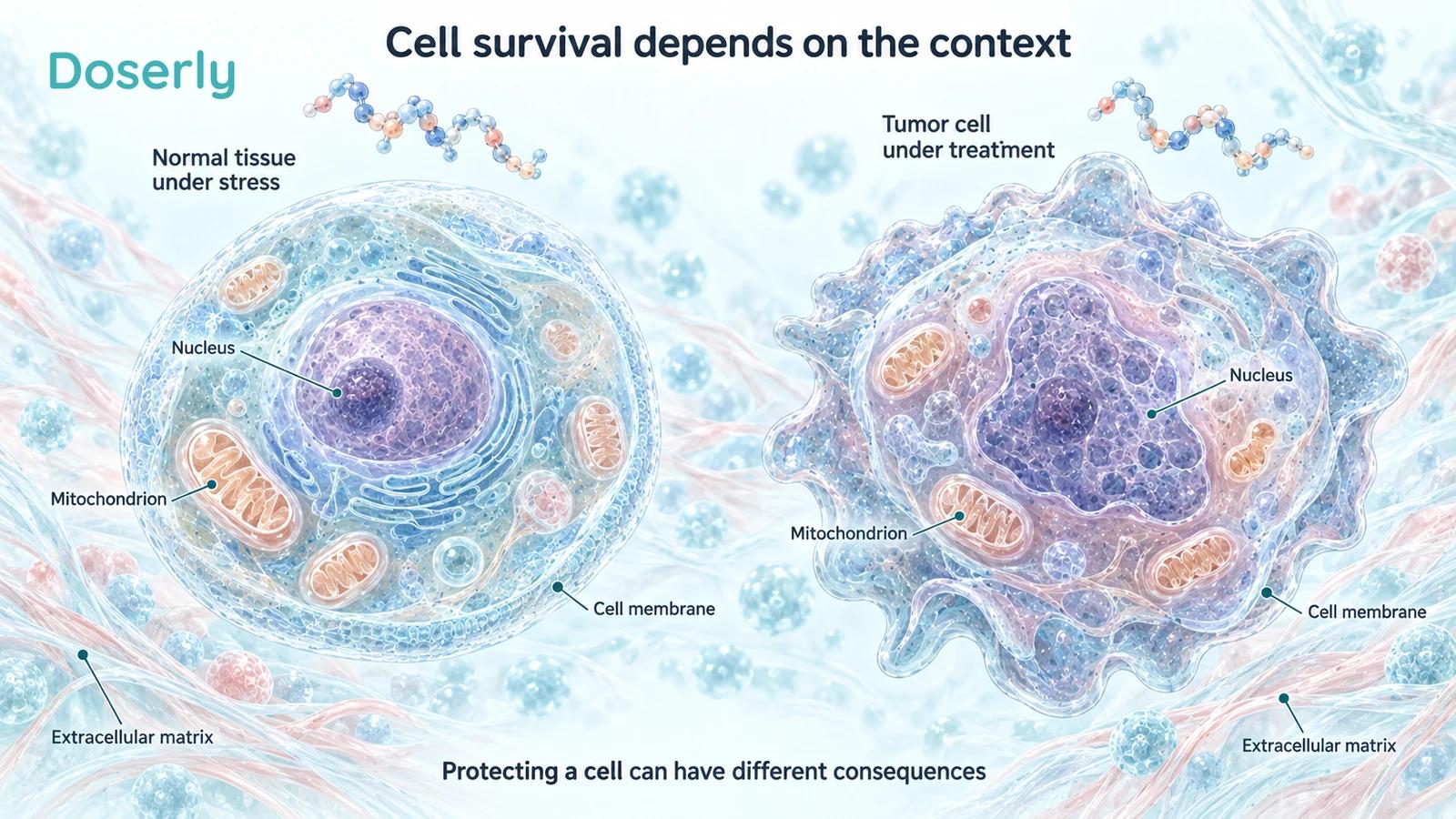
Cell survival has different implications in normal tissue and malignant tissue. The comparison is conceptual and does not depict Humanin causing a normal cell to become cancerous.
Cell death is part of the biological question
A foundational 2003 study found that Humanin could interfere with activation of Bax, a protein involved in a mitochondrial cell-death pathway. That work helped explain how Humanin might suppress apoptosis under particular experimental conditions. It did not establish the long-term cancer safety of giving Humanin to healthy people. Bax mechanism study.
The point is not that every anti-apoptotic effect is dangerous. It is that the desired direction depends on which cells are affected and why they are dying. A proposed protective therapy needs to distinguish rescue of useful tissue from rescue of cells that a treatment is meant to eliminate.
This is an experimental selectivity problem. Researchers must ask whether a candidate reaches normal and malignant tissue differently, whether those cells respond differently, and whether treatment changes that response. The phrase “mitochondrial protection” does not answer any of those questions by itself.
It also helps to separate cancer initiation from cancer progression. Showing that a molecule changes the growth of an existing experimental tumor is not the same as showing that it creates cancer in a previously healthy person. Both questions can matter, but the evidence needed to answer them is different. Keeping the distinction visible prevents a legitimate safety concern from becoming an unsupported prediction.
Humanin signaling is not one universal pathway
A 2009 cell study implicated receptor complexes involving CNTFRα, WSX-1 and gp130 in Humanin-related neuronal protection. That provides evidence about a particular cellular setting. It should not be used to assume that every Humanin-responsive tumor uses the same receptor arrangement or downstream response. Neuronal receptor-complex study.
A receptor name can make a biological explanation feel complete when it is only the beginning. The surrounding cell state, available signaling machinery and experimental conditions can affect the response. A cancer paper needs to demonstrate its own mechanism rather than inherit a neuronal pathway diagram unchanged.
This matters especially for illustrations. Drawing a single arrow from Humanin to “cell survival” can hide the unresolved questions about cell type and context. A useful explanation specifies where the pathway was tested and what the measured consequence was. It does not turn a receptor label into a promise of benefit across the body.
The breast-cancer experiment raises a concrete concern
A 2020 study examined experimental triple-negative breast cancer. It included analyses of human tumor material, cell experiments and a mouse tumor model. Added Humanin protected tumor cells from selected apoptotic stresses. In tumor-bearing mice, systemic Humanin impaired the antitumor and antimetastatic effects of the studied chemotherapy regimen and supported tumor progression. Primary breast-cancer study.
These are material findings for a proposed cell-protective intervention. They show a setting in which the desired protection of normal tissue cannot simply be assumed to spare the tumor. The study’s different experimental components strengthen the rationale for investigating the problem, while still leaving the magnitude and relevance of risk in treated people unresolved.
The human tumor samples did not turn the mouse intervention into a human treatment trial. Tissue expression tells researchers that a molecule or related signal is present in a disease setting. It does not establish what happens when a patient receives an exogenous preparation, how exposure compares with the model, or what clinical outcome follows.
The result should therefore be described at the level tested: tumor progression and chemotherapy response in an experimental breast-cancer model. It is a reason for careful cancer-specific safety research. It is not a numerical estimate of a healthy person’s chance of developing breast cancer after Humanin exposure.
Glioma research adds the surrounding cells
A 2024 study investigated interactions between glioma cells and myeloid cells in the tumor environment. It linked Humanin-related signaling through GP130 to chemotherapy resistance in experimental systems, including human-derived glioblastoma cultures. Sensitivity differed among cultures. The reported downstream findings included ERK1/2 signaling rather than a simple repetition of a universal STAT3 explanation. Primary glioma study.
This broadens the question beyond the tumor cell in isolation. A tumor exists alongside immune-related cells and other local structures. Signals exchanged within that environment can influence how cells behave under treatment. Testing an isolated cell line may reveal part of the mechanism without capturing the entire interaction.
The variation among cultures is equally important. “Humanin affects glioblastoma” is a broader statement than the experiments support if it implies identical sensitivity in every tumor. A response seen in a subset can be scientifically important precisely because it points to differences that may help explain treatment resistance.
The study also investigated ways to interrupt the signaling. That is a research finding, not a reason to repurpose a pathway inhibitor independently. Blocking a signal can have consequences in normal tissue, and an experimental combination needs its own clinical evaluation. Neither adding Humanin nor blocking it becomes a validated personal cancer strategy from these results.
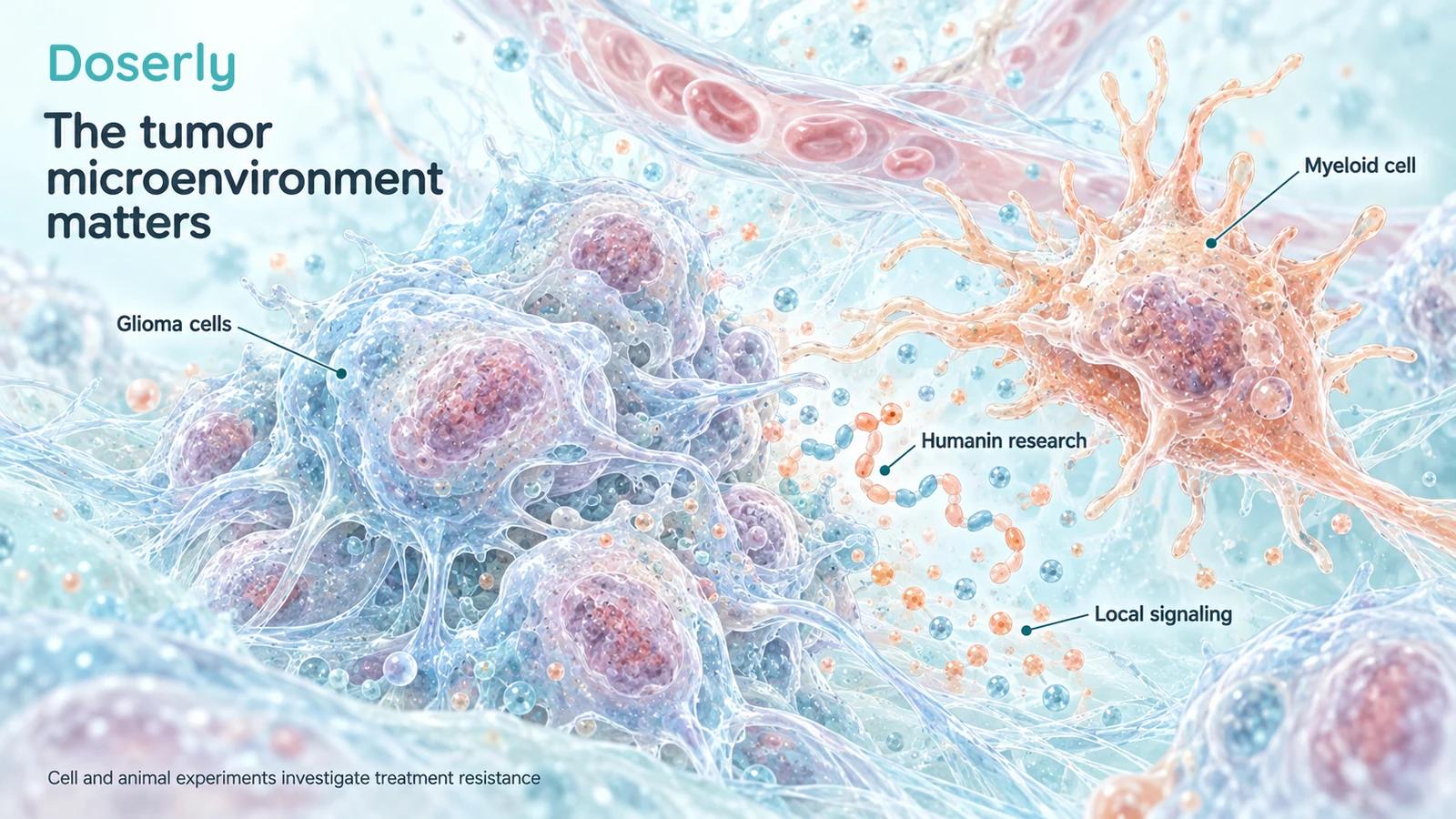
The glioma experiments examined local interactions as well as tumor-cell behavior. This illustration shows conceptual cell relationships, without claiming an exact receptor structure or a proven clinical treatment effect.
Another tumor model produced a different result
A 2019 study used HNG, the S14G Humanin analogue, in immunodeficient mice bearing human medulloblastoma cells implanted under the skin. It reported protection against selected temozolomide-associated harms without compromising the observed antitumor effect in that model. The experiment included small treatment groups and a particular tumor cell line, host and treatment schedule. Medulloblastoma xenograft study.
That finding deserves inclusion because the literature is not uniformly tumor-promoting. It does not erase the breast-cancer and glioma findings. The studies differ in candidate molecule, tumor biology, immune environment, implantation site and experimental treatment. A favorable result in one combination cannot be borrowed as a safety guarantee for another.
The analogue distinction matters here. HNG is modified Humanin. It should be named rather than silently treated as native Humanin, especially when comparing experiments that used different preparations. Molecular changes can alter activity and exposure, so “the same peptide family” is not equivalent to “the same intervention.”
Similarly, human-derived tumor cells growing in mice remain an animal experiment. The origin of the cells improves relevance to a particular biological question, but the host, tumor location and treatment environment still differ from a patient’s disease. A xenograft result cannot establish a safe supportive-care protocol for people receiving chemotherapy.
A human blood association answers neither safety question
A 2026 case-control study compared 75 women newly diagnosed with nonmetastatic breast cancer with 70 healthy volunteers. Serum Humanin was higher in the cancer group. The investigators explored diagnostic discrimination within that sample; they did not administer Humanin or follow exposed healthy people for incident cancer. Human serum study.
This adds human observational evidence, but it cannot tell us whether higher circulating Humanin contributes to the cancer, reflects a response to it, or relates to another feature of the participants. The direction of causation is not established by the group difference.
Nor does a candidate diagnostic association validate a screening test. A useful clinical test needs evidence in the setting where it will be used, including the people likely to receive it and the decisions it would change. Comparing diagnosed cases with healthy volunteers is an early research design, not proof that a threshold can reliably detect cancer in an unselected population.
For the same reason, a lower personal Humanin reading would not certify that exogenous Humanin is safe. A blood concentration is not a comprehensive assessment of tumor biology, susceptibility, product exposure or interactions with treatment. Trying to turn a research biomarker into a safety clearance would ask it to perform a job these studies have not tested.
What can and cannot be concluded about risk
The strongest justified concern is specific: Humanin-related cell-survival signaling has supported tumor behavior or treatment resistance in some experimental contexts. That finding belongs in an honest discussion of therapeutic development. Experimental breast-cancer study. It prevents “the body makes it” and “it protects cells” from being treated as sufficient safety arguments.
What remains unknown is equally specific. These studies do not quantify cancer incidence after chronic Humanin use in otherwise healthy adults. They do not establish a safe exposure threshold, a screening strategy that removes the concern, or a universally compatible combination with cancer treatments. The absence of those answers should remain an uncertainty rather than being converted into either reassurance or a deterministic warning.
Endogenous signaling and externally administered exposure also need separation. The body’s local production, distribution and regulation do not necessarily resemble the concentration and timing produced by a preparation. A molecule’s physiological presence is evidence that it participates in biology; it is not evidence that adding more is harmless in every setting.
A broad longevity claim makes this especially relevant. If the proposed benefit is maintaining health over many years, safety needs to be assessed over a compatible period and in the intended population. A short experiment showing normal-tissue protection cannot establish that long-term balance.
What better evidence would look like
A development program would need to identify the actual candidate, exposure and intended use. Protection during one defined chemotherapy regimen is a different proposal from long-term use by people without cancer. Those purposes would require different study designs and different acceptable tradeoffs.
Preclinical testing should examine tumor control alongside normal-tissue outcomes, rather than treating tumor response as an optional secondary detail. Replication across relevant models would help determine whether a finding is robust or highly context-dependent. The candidate should be tested with the treatment combinations for which claims are being made.
Clinical studies would then need to establish both benefit and safety in people. For supportive care, less toxicity would not be an adequate success if cancer control worsened. For a general health intervention, a small short-term biomarker change would not offset an uncharacterized long-term risk. The outcomes need to reflect the actual decision a patient would face.
Bring the exact product and claim into the conversation
For someone receiving cancer treatment, the useful question is whether the oncology team has evidence about the proposed product alongside the exact regimen. A broad claim about mitochondrial health cannot substitute for that information. The discussion should include the product identity, any exposure already taken, and the source of the claimed benefit.
These papers do not support stopping prescribed cancer therapy, adding Humanin to protect against its side effects, or using an experimental pathway blocker independently. They support a more focused research question: can beneficial tissue protection be achieved without protecting the tumor, for a specific molecule and clinical setting?
Humanin’s cell-survival biology makes that question necessary. The cancer evidence is neither a universal condemnation nor a blanket reassurance. It is a set of experimentally grounded tradeoffs that a credible clinical program must resolve before claiming broad safety or benefit.
Sources
- Guo et al., 2003: Humanin and Bax activation.
- Hashimoto et al., 2009: neuronal receptor complexes.
- Moreno Ayala et al., 2020: experimental triple-negative breast cancer.
- Glioma/myeloid GP130 study, 2024.
- Jia et al., 2019: HNG and medulloblastoma xenografts.
- Mohamed et al., 2026: serum Humanin in breast cancer.