
Supplements
October 16, 2026
CoQ10 and statin muscle symptoms: why the evidence remains mixed
On this page
Coenzyme Q10, usually shortened to CoQ10, helps cells produce usable energy. Because statins can lower circulating CoQ10, taking a supplement to address muscle discomfort seems biologically reasonable. The important question is whether that reasoning translates into less pain or better function while someone continues cholesterol-lowering treatment.
The trials have not given a consistent answer. Some small studies report improvement; others find no benefit even when blood CoQ10 rises substantially. Studies that directly examined muscle tissue have also challenged the assumption that swallowing more CoQ10 reliably corrects a muscle-energy problem.
If you're experiencing aching, cramps or weakness after starting a statin, your symptoms deserve attention. The next step is to understand their possible cause and preserve an effective cardiovascular treatment plan—not to assume either that CoQ10 will fix them or that the symptoms cannot be medication-related. Our CoQ10 guide covers the supplement's other uses and formulations.
Why CoQ10 is a plausible candidate
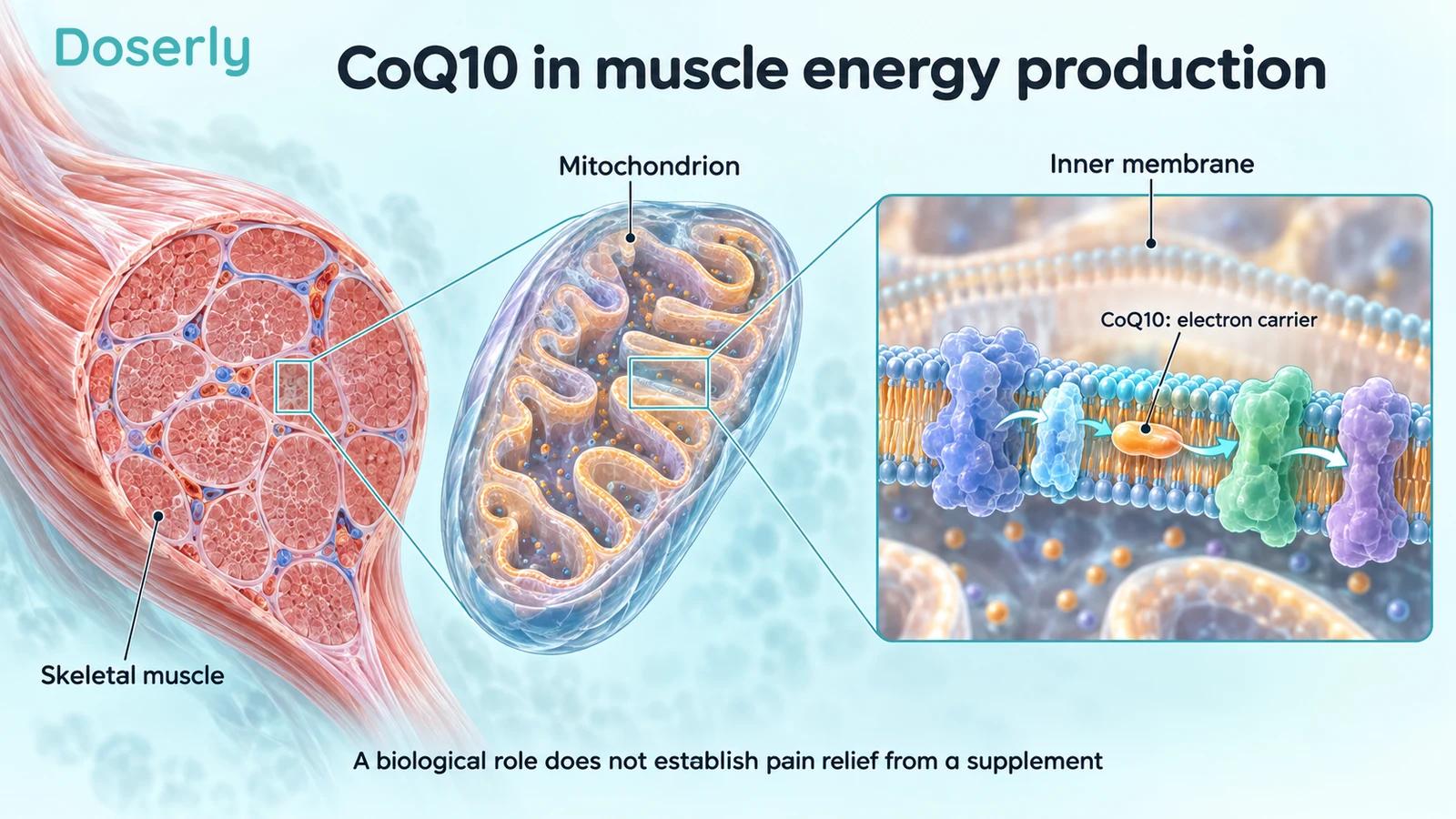
CoQ10 participates in electron transfer within the inner membrane of mitochondria, the structures that help cells convert fuel into energy. Statins inhibit an enzyme in the mevalonate pathway, which contributes to both cholesterol and CoQ10 production. This overlap helped generate the hypothesis that lower CoQ10 could contribute to some muscle symptoms. National Lipid Association clinical perspective
Several steps separate that hypothesis from a successful treatment. A fall in blood CoQ10 must reflect a relevant problem in muscle; an oral preparation must alter the relevant tissue process; and that alteration must improve symptoms. A supplement can affect one of those steps without completing the whole sequence.
This is why a blood test cannot by itself prove that muscle pain is caused by a CoQ10 deficit. It is also why comparing blood concentrations is informative but insufficient when the treatment goal is climbing stairs comfortably, sleeping without cramps or returning to usual activity.
What counts as a statin-associated muscle symptom?
The term statin-associated muscle symptoms, or SAMS, includes symptoms occurring during statin treatment. “Associated” does not necessarily mean pharmacologically caused by the drug. Muscle pain is common, and its timing can overlap with changes in exercise, other medicines or an unrelated condition.
The National Lipid Association explicitly distinguishes all symptoms temporally related to statin use from those caused by the statin's pharmacological action. That distinction helps explain why symptom estimates differ across routine clinical practice and blinded trials. It is not a reason to dismiss a patient's experience. NLA clinical perspective
A clinician may assess the location and severity of symptoms, their timing, medication interactions and other possible causes, including thyroid disease or a recent increase in physical activity. The European Atherosclerosis Society's consensus describes this structured approach rather than assuming one explanation from timing alone. EAS consensus
The trial that first confirmed symptoms under blinded conditions
A 2015 study began with people who had previously reported statin muscle symptoms. Researchers used a blinded crossover comparison of simvastatin and placebo to identify participants whose pain occurred with the statin but not placebo. Forty-one participants meeting that pattern then entered the CoQ10 treatment comparison. Taylor and colleagues
They received simvastatin with either 600 mg daily of ubiquinol, a form of CoQ10, or placebo for eight weeks. Blood CoQ10 increased substantially with supplementation, but muscle pain did not improve. The study also found no benefit in the measured strength and aerobic-performance outcomes.
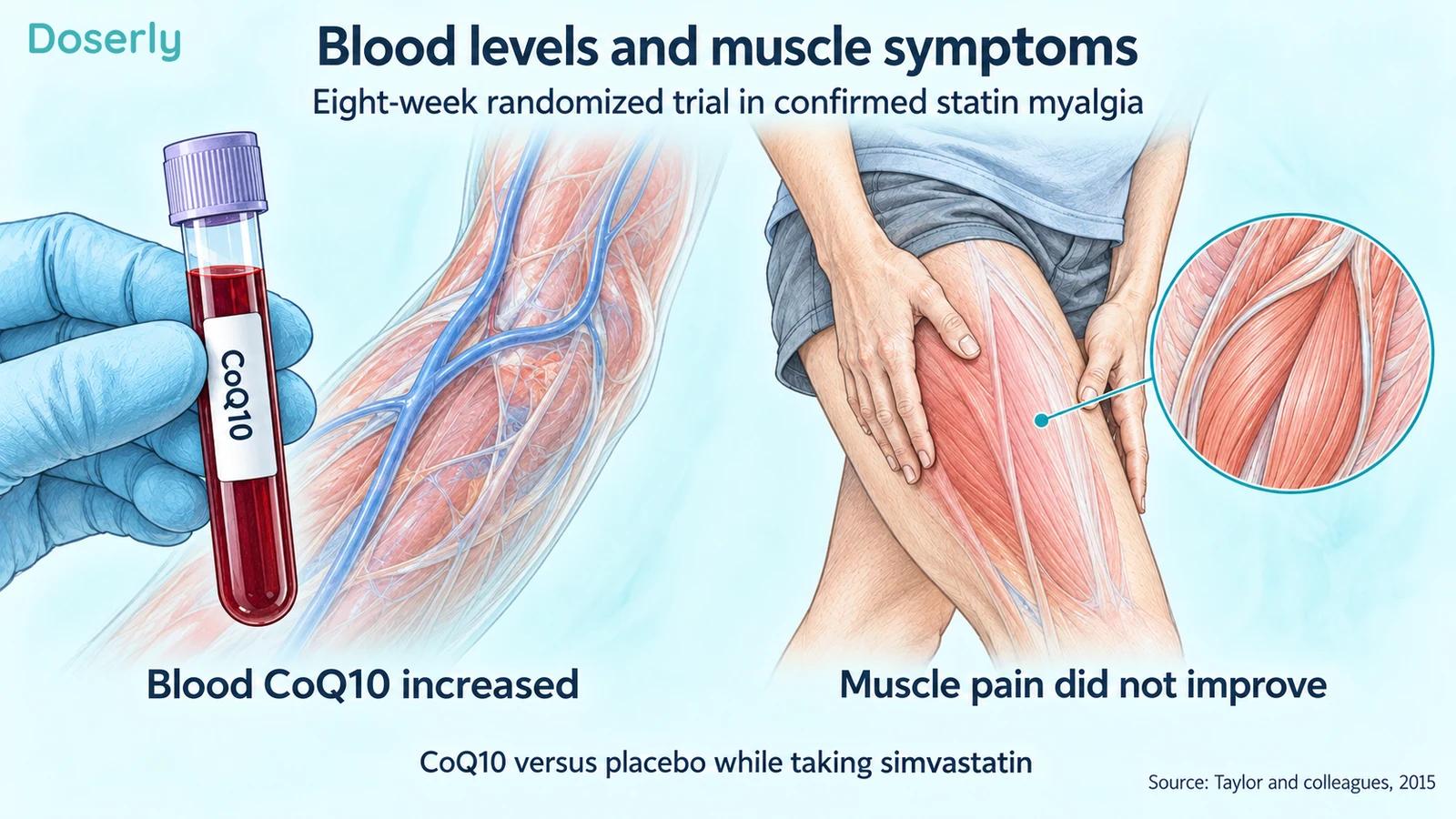
The confirmation stage makes this trial especially relevant to the proposed treatment mechanism. It reduced the chance that researchers were mainly treating pain unrelated to statin exposure. The negative result doesn't prove that every preparation is ineffective in every person, but it directly challenges the expectation that restoring a blood measurement should reliably relieve confirmed symptoms.
Why did another trial report improvement?
A 2014 randomized study enrolled 50 statin-treated patients with mild-to-moderate muscle symptoms. Twenty-five received 50 mg CoQ10 twice daily and 25 placebo for 30 days. The investigators reported reductions in pain severity and the extent to which pain interfered with daily activities. Relative changes in both scores favored CoQ10. Skarlovnik and colleagues
That is positive human evidence, not something to ignore because other trials were negative. It was also a small, short study in a selected symptom group. Its selection process, formulation, duration and symptom history differed from the later blinded-confirmation trial.
These differences help explain why a single impressive percentage should not become a universal expectation. A pain score can improve for several reasons, and its meaning depends on the comparison, starting severity and measurement method. The useful result is a reproducible difference that matters to patients, not simply a statistically significant change from baseline in one group.
What happened when researchers sampled muscle itself?
A 2022 placebo-controlled trial randomized 37 men and women taking simvastatin, with or without muscle pain, to 400 mg CoQ10 daily or placebo for eight weeks. Researchers measured muscle CoQ10, mitochondrial respiration, mitochondrial-content markers and reactive-oxygen-species production, as well as reported pain. Muscle-tissue trial
Supplementation did not improve muscle CoQ10 content, mitochondrial function or myalgia in that study. Individual changes in muscle CoQ10 were not correlated with changes in pain intensity.
This adds a different kind of information from a symptom questionnaire alone. It tests part of the proposed explanation inside the tissue of interest. The sample was still small, and participants were not all symptomatic, so it cannot settle every clinical use. Nevertheless, it makes “more CoQ10 in the capsule means more energy in the muscle” an unreliable assumption.
A higher dose is therefore not automatically an answer to a disappointing trial. Dose, formulation and tissue delivery can matter, but any revised strategy needs a clinical comparison of its own. The study amounts above identify the experiments; they are not a recommended escalation schedule.
What does newer research add?
A 2025 observational study compared 106 people with clinically identified SAMS, half receiving CoQ10 and half no supplementation. The supplemented group had greater improvement in pain and interference scores. Because treatment was not randomly assigned, differences between the groups or their care could contribute to the association. Observational study
A 2025 systematic review and meta-analysis pooled seven randomized trials involving 389 participants. Four trials reported significant improvement and three did not. The pooled pain-intensity estimate favored supplementation, but its confidence interval was wide and approached no difference: weighted mean difference −0.96, 95% CI −1.88 to −0.03. The authors called for more research to support recommendations. Updated evidence synthesis
A meta-analysis combines results; it doesn't remove differences in who was studied or how symptoms were confirmed. The pooled number also isn't a prediction that every person will improve by one meaningful unit on their own symptom scale. These newer findings help explain continued interest, while the small and inconsistent trial base limits confidence in a routine benefit.
What placebo-controlled symptom research teaches us
The SAMSON trial studied 60 people who had stopped statins because of side effects. Participants received months of atorvastatin, placebo and no tablets in a randomized sequence, recording symptoms daily. Forty-nine completed the full 12-month protocol. Average symptom scores were higher during both statin and placebo months than during no-tablet months, with no significant difference between statin and placebo. SAMSON primary report
These results concern the influence of taking a tablet and expecting adverse effects, often described as a nocebo effect. The symptoms were experienced, not fabricated. The study does not mean that statins never cause muscle injury or that any individual patient's pain can be diagnosed from the group average.
It does explain why improvement after stopping a medicine—or after adding a supplement—may be difficult to interpret without a comparison. Symptoms fluctuate, activity changes and expectations matter. A thoughtful clinical evaluation can take those influences seriously while continuing to investigate pharmacological causes.
How can symptoms be assessed without losing cardiovascular protection?
The aim is to find a tolerable plan that still addresses the reason the statin was prescribed. Depending on the clinical assessment, a prescriber may consider a supervised interruption and rechallenge, a different statin, a lower or modified regimen, or additional nonstatin treatment. The choice depends on cardiovascular risk and the nature of the symptoms. EAS management framework
Don't make a supplement trial the sole response to substantial new weakness or severe symptoms. Severe muscle pain accompanied by dark urine or marked weakness warrants prompt medical assessment because serious muscle injury needs evaluation. The clinician may use creatine kinase and other tests when appropriate; a normal or abnormal value must be interpreted in context. EAS consensus
For less urgent symptoms, a clear record helps. Note which muscles are affected, whether discomfort occurs at rest or with activity, the statin and dose, other new medicines and major changes in exercise. Recording these observations is more useful than writing only “statin intolerance,” which doesn't describe the pattern.
If CoQ10 is considered, define what would count as worthwhile
A clinician and patient may still discuss a monitored supplement trial in an individual situation. The uncertainty should be explicit. Agree on a symptom or functional goal, a review point and how other treatment changes will be handled. Changing the statin, exercise routine and several supplements simultaneously makes it difficult to know what helped.
The supplement is not interaction-free. NCCIH notes possible interactions with warfarin and insulin, as well as potential incompatibility with some cancer treatments. Digestive upset and insomnia can occur. Its consumer evidence page is dated 2019, so its broad efficacy statement should not be mistaken for a review of every later trial. NCCIH CoQ10 information
Bring the exact product and formulation to the discussion. “Ubiquinol” on a label isn't proof of superior pain relief, and the negative confirmed-symptom trial already used that form. A more expensive preparation should be judged by relevant comparative outcomes rather than its absorption claim alone.
CoQ10 remains a plausible but inconsistently supported option for statin-associated muscle symptoms. The practical priority is to take the symptoms seriously, investigate their cause and find an effective, tolerable cardiovascular plan. Supplement use should fit that plan rather than delay it.
Sources
- National Lipid Association SAMS clinical perspective (2023)
- European Atherosclerosis Society consensus (2015)
- CoQ10 in confirmed statin myalgia (2015)
- CoQ10 in mild-to-moderate symptoms (2014)
- CoQ10 muscle-tissue randomized trial (2022)
- CoQ10 observational symptom study (2025)
- Updated randomized-trial meta-analysis (2025)
- SAMSON crossover trial (2021)
- NCCIH CoQ10 information