
Supplements
October 16, 2026
Collagen for joints: symptom relief is not proof of cartilage repair
On this page
Collagen helps give connective tissues their structure. It is present in cartilage, tendons, ligaments, skin and bone, although the types and organization differ between tissues. That makes oral collagen an appealing idea for an aching knee: if the joint contains collagen, could eating more help it recover?
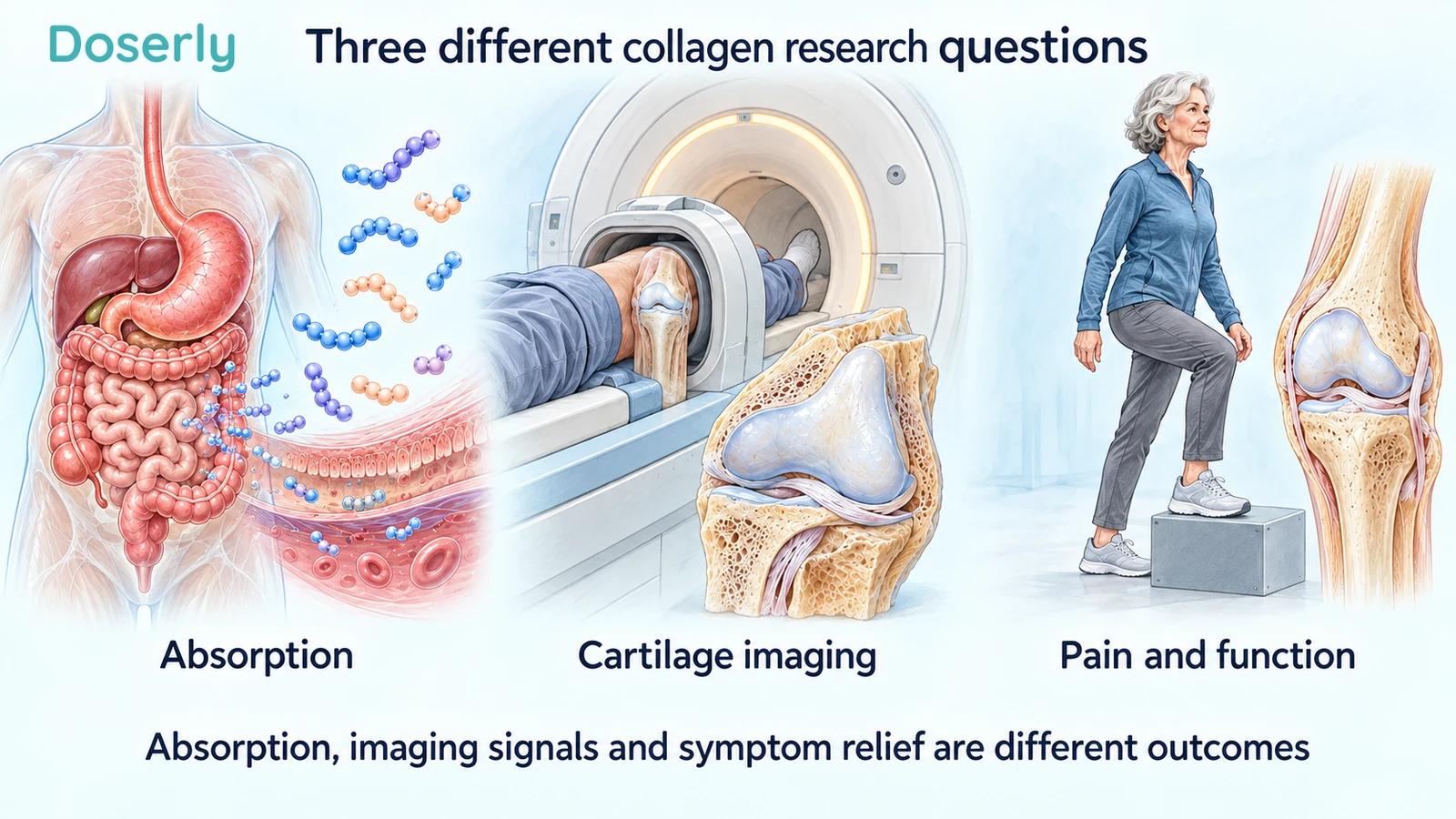
The answer requires several steps. Swallowed collagen is digested. Some of its amino acids and small peptides appear in blood. Researchers then need to establish whether a particular preparation improves symptoms or changes joint tissue in a useful way. Absorption is plausible and measurable; rebuilding worn cartilage is a much stronger claim.
Human trials suggest that some collagen preparations may improve joint discomfort or osteoarthritis symptoms. The evidence does not justify promising structural repair, preventing joint replacement or treating every cause of knee pain. We'll look at the clinical findings and the mechanistic studies often used to support those larger claims.
A knee contains more than cartilage
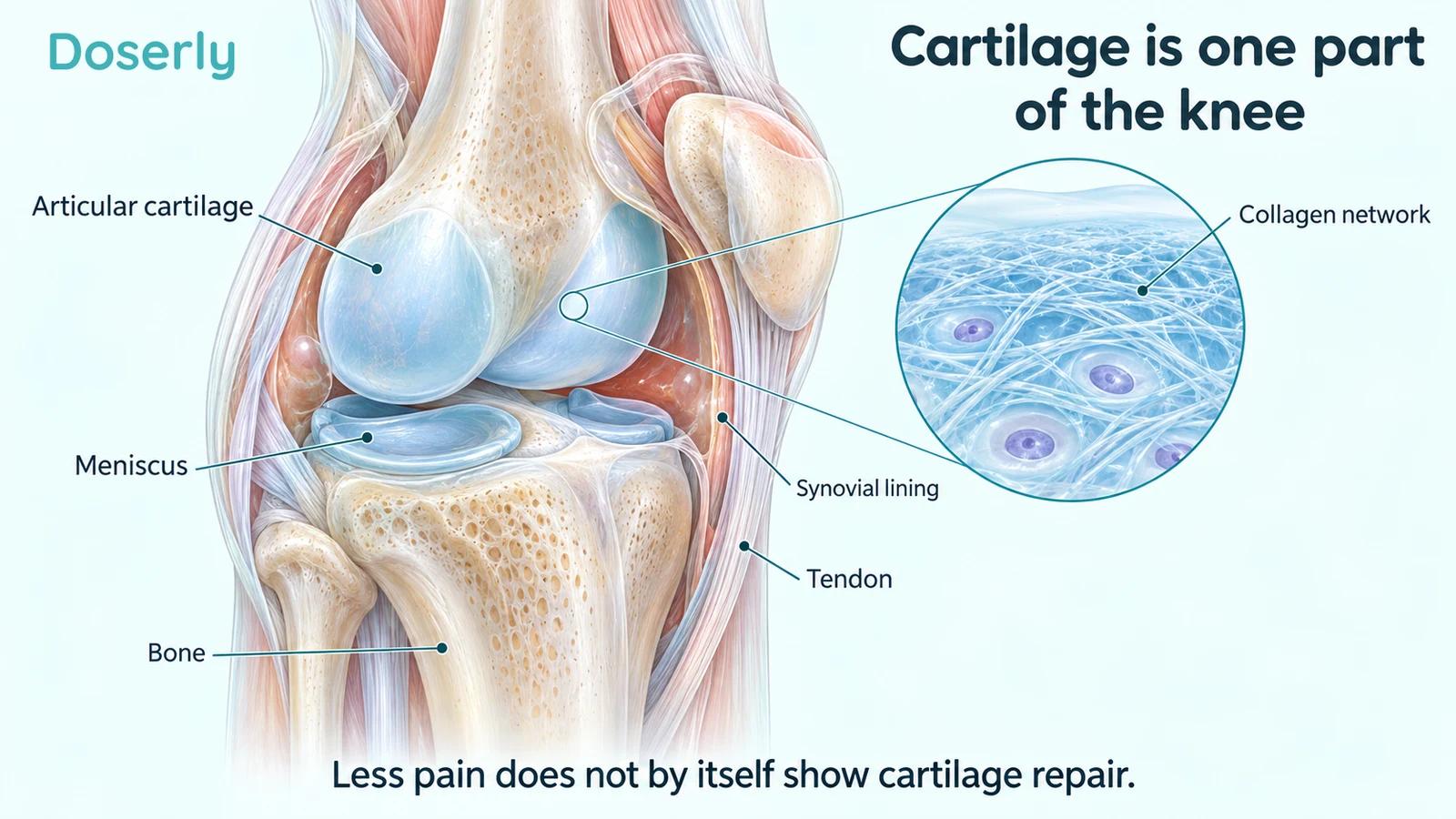
Articular cartilage covers the ends of bones where they meet in a joint. Its matrix contains a collagen network and molecules that help retain water. Cartilage cells maintain this environment. The knee also includes menisci, ligaments, tendons, underlying bone, a capsule and a synovial lining.
Pain and function reflect the whole joint and the person using it. A change in pain cannot identify which tissue changed, and an imaging finding doesn't perfectly describe how someone feels. This is one reason osteoarthritis care emphasizes symptoms and daily function rather than treating a scan as the entire condition. NICE osteoarthritis recommendations.
For someone with knee discomfort, the first question is whether the symptoms actually represent osteoarthritis, an activity-related problem or another condition. A study in young athletes without diagnosed joint disease cannot answer every question for someone with established osteoarthritis. The diagnosis and the goal help determine which trial is relevant.
What happens to collagen after swallowing it?
Hydrolyzed collagen has been broken into smaller protein fragments, often described as collagen peptides. Digestion further changes these fragments, supplying amino acids and some small peptides. It isn't accurate to picture an intact scoop traveling straight into the cartilage and becoming a replacement surface.
A human absorption study identified hydroxyproline-containing peptides in blood after volunteers consumed gelatin hydrolysates. Hydroxyproline is an amino acid particularly associated with collagen. The researchers detected small peptides such as proline-hydroxyproline, showing that oral collagen isn't represented in the circulation only as isolated amino acids. Iwai and colleagues.
That supports further investigation of nutritional and signaling effects. It does not show that the detected peptides reached a painful knee in a therapeutic concentration, became new cartilage, or improved walking. Those are separate questions. Absorption studies help explain how an intervention could act, while clinical trials determine whether a useful benefit occurs.
The Doserly collagen guide gives a broader introduction to the preparations. Undenatured type II collagen has a different proposed mechanism and is covered separately in our UC-II guide; its milligram-scale trials should not be treated as interchangeable with gram-scale collagen-peptide studies.
What trials in active people have found
A 24-week trial recruited 147 athletes with activity-related joint pain and no evidence of joint disease. Participants received a collagen-hydrolysate drink or placebo. Data from 97 of the 147 could be statistically evaluated. Several pain measures favored collagen, including pain during walking and standing. Clark and colleagues, 2008.
The reduction in the evaluable sample matters: the results do not represent complete outcome data from everyone recruited. Multiple symptom measures and a knee-pain subgroup also require careful interpretation. The trial supports a possible effect on discomfort in active people; it did not demonstrate less cartilage loss or prevention of later osteoarthritis.
A 2017 trial studied 139 athletic adults with functional knee pain. Specific collagen peptides or placebo were taken for twelve weeks. Activity-related pain improved in both groups, with a larger average improvement in the collagen group. Participant-rated changes were 19.5 versus 13.9 points on the study's visual analogue scale, a between-group difference of 5.6 points in change. Resting pain and joint mobility did not show the same clear between-group benefit. Zdzieblik and colleagues.
This distinction is practical. A statistically significant average difference doesn't mean every participant noticed a worthwhile change. It also doesn't mean all pain improved equally. The activity-related endpoint fits the population studied, while resting symptoms and structural disease remain separate questions.
What about diagnosed knee osteoarthritis?
An updated systematic review, published in a 2025 journal issue, combined eleven randomized trials involving 870 participants. It reported average improvements in pain and function with collagen-based supplementation compared with placebo. The search covered studies through October 2023, so its publication year should not be mistaken for a search through 2025. Updated knee-osteoarthritis review.
There was substantial variability between studies: the reported heterogeneity was 88% for pain and 75% for function. Heterogeneity describes how much the study results differ beyond what sampling variation alone would predict. Here it is a reason to look at the underlying preparations, populations and measurement methods rather than treat the pooled estimate as a result for every collagen product.
The review is evidence synthesis, not an additional trial in 870 newly treated people. Its favorable symptom findings are worth considering, but they don't establish a particular mechanism or cartilage regrowth. A pooled pain score cannot answer a structural question that the contributing studies did not measure.
For a reader deciding whether a specific product is worth discussing, the more useful follow-up is whether that preparation resembles one actually studied in people with comparable symptoms. A generic “collagen” label may conceal differences in source, processing and composition.
The cartilage-imaging pilot needs careful interpretation
A small randomized pilot in mild knee osteoarthritis tested collagen hydrolysate using specialized MRI measurements. The published abstract described a sample of thirty randomized participants. Its main assessment used dGEMRIC, an imaging method sensitive to aspects of cartilage composition, at twenty-four weeks.
Signals changed favorably in two tibial cartilage regions with collagen compared with placebo. The other four regions did not show significant differences. T2 mapping, a different MRI measurement, and clinical outcomes also did not differ significantly. McAlindon and colleagues, 2011.
This is preliminary evidence of a possible compositional signal in selected regions. It is not a photograph of newly grown cartilage, a measurement of a restored joint surface or proof that symptoms improved. The pattern across multiple regions and methods is important: highlighting two positive measurements while omitting the others would exaggerate the result.
A convincing repair claim would need reproducible structural changes with clear clinical relevance and adequate follow-up. It would also need to show that the change was attributable to the intervention. This pilot provides a reason for more research, not a basis for promising reversal of osteoarthritis.
What the gelatin-and-vitamin-C experiment really measured
Another frequently discussed study involved eight healthy men in a crossover experiment. They consumed vitamin-C-enriched gelatin or placebo before brief rope-skipping exercise. The researchers measured blood amino acids and a marker of type I collagen formation. They also exposed engineered ligament tissue in the laboratory to serum collected from the participants. Shaw and colleagues.
The higher gelatin condition increased the circulating collagen-formation marker. Engineered tissue exposed to participant serum showed changes in collagen content and mechanical properties. These are two different parts of one paper: a human feeding-and-exercise experiment and a laboratory tissue experiment. The men's ligaments were not removed, tested and shown to become stronger.
The blood marker also doesn't identify a repaired tendon or cartilage surface. Type I collagen is not the predominant collagen type in articular cartilage, and a systemic marker cannot precisely locate the tissue contributing to it. The study offers a plausible nutritional research direction, not proof that a timing routine heals a knee injury.
Why a plausible mechanism can still lead to a modest benefit
A joint symptom can have several contributors at once. Supplying amino acids may not address the factor limiting comfort or movement. A person may already have adequate nutritional intake, while muscle weakness, loading patterns, sleep, injury or another condition remains important. That is why a convincing biological pathway is a starting point for trials rather than a prediction of personal response.
The same reasoning applies to differences between products. A study of a specific hydrolysate doesn't establish that another peptide mixture produces the same blood exposure or symptom effect. Conversely, the absence of cartilage-repair evidence does not mean a genuine symptom improvement would be worthless. Relief that helps someone stay active can matter without implying disease reversal.
A useful discussion therefore separates the goal from the explanation. “Will this help my activity-related knee pain?” is a reasonable clinical question. “Will this rebuild my cartilage because cartilage contains collagen?” skips several unproven steps.
Keep established joint care in the picture
NICE recommends therapeutic exercise tailored to the person's needs for osteoarthritis, including local strengthening and general aerobic activity. It also recommends weight management when appropriate and information that supports self-management. These measures address function and symptoms within a broader care plan. NICE guidance.
A supplement discussion should fit around that plan. If discomfort limits exercise, a clinician or physiotherapist can help adjust the activity rather than assuming that waiting for a powder to work is the only option. Sudden swelling, an acutely hot joint, inability to bear weight or symptoms after a significant injury require assessment for their own cause.
Before trying a product, agree on the outcome that would make continued use worthwhile. Examples include less discomfort during a familiar walk, better tolerance of prescribed exercise or reduced need for a rescue medicine under clinical guidance. Choose a review point that matches the weeks-to-months timeframe of the symptom trials, and consider cost and tolerability alongside any improvement.
Read the label and record the whole plan
Collagen products can come from fish, bovine, porcine or chicken sources, which matters for allergies and dietary preferences. Check the source, preparation and additional ingredients rather than treating “joint support” as a standardized product. A blend containing several compounds makes it difficult to attribute any benefit to collagen alone.
Keep medication, exercise and supplement changes dated. Pain naturally varies, and people often start a supplement when symptoms are particularly troublesome. Improvement afterward may reflect several changes or a return toward a more typical symptom level. A record makes the conversation more precise without claiming to prove causation.
The most defensible expectation is a possible symptom benefit with some studied preparations, alongside considerable uncertainty about magnitude and who responds. The human evidence does not establish cartilage regeneration. Collagen can be discussed as one potential adjunct while the diagnosis, activity plan and meaningful functional goals remain central.
Explore the research
- Human absorption of collagen-derived peptides, 2005: absorption, not joint efficacy.
- Athlete joint-pain trial, 2008: 147 recruited, 97 evaluable.
- Activity-related knee discomfort, 2017: specific peptides and symptom outcomes.
- Updated knee-osteoarthritis meta-analysis, 2025 issue: eleven trials, search through October 2023.
- Cartilage MRI pilot, 2011: selected compositional signals, no clinical difference.
- Gelatin, vitamin C and exercise, 2017: human markers and separate engineered-tissue experiments.
- NICE osteoarthritis recommendations: established management context.