
Peptides
October 16, 2026
CJC-1295 raises GH and IGF-1: what does that mean for health?
On this page
CJC-1295 was designed to stimulate growth hormone release for longer than the body's own growth-hormone-releasing hormone. Early human studies showed that the long-acting form could raise growth hormone, or GH, and insulin-like growth factor 1, or IGF-1, for days after an injection.
That is a real pharmacological effect. It is also narrower than demonstrating stronger muscles, better sleep, easier recovery or longer life. If someone shows you a higher IGF-1 result as evidence that CJC-1295 improved their health, the missing question is what changed beyond the blood test.
The published studies discussed here support a hormone-response claim, not a general health-benefit claim. To see why, we need to understand the signaling system, what the investigators measured and how a laboratory response differs from a result you can feel or use. Our CJC-1295 guide gives additional background on the molecule and its safety concerns.
How the GH–IGF-1 system works
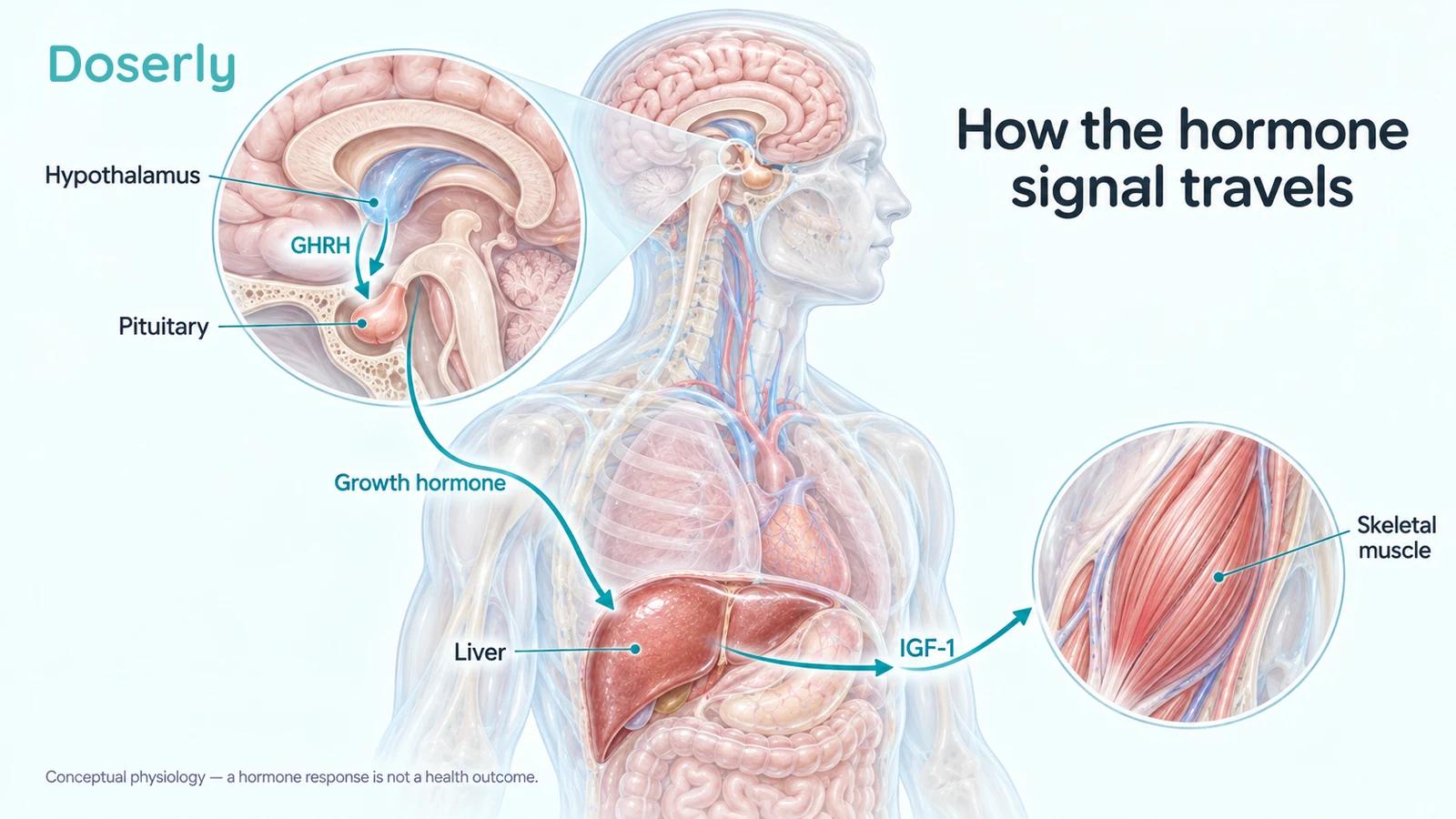
The hypothalamus, a small region of the brain, helps regulate hormone release. One of its signals is growth-hormone-releasing hormone, abbreviated GHRH. This acts on cells in the pituitary gland that make and release GH. GH then influences tissues directly and promotes production of IGF-1, including production by the liver.
CJC-1295 is a GHRH analogue: a synthetic molecule designed to act along that pathway. The original long-acting version includes an albumin-binding modification commonly called DAC. Albumin is an abundant protein in blood. Binding to it was intended to prolong the peptide's presence and activity. Early development experiments examined that design in laboratory systems and rats. Jetté and colleagues, 2005.
This is stimulation of a hormone-producing system, rather than administration of GH itself. It depends on the pituitary retaining the ability to release GH. That distinction explains the mechanism, but it does not establish that stimulation is preferable to another treatment for any particular patient.
What did the original human trials actually test?
Teichman and colleagues reported two randomized, placebo-controlled, double-blind dose-escalation trials in healthy adults aged 21–61. The study periods were 28 and 49 days. Participants received single or limited repeated subcutaneous doses of the long-acting investigational molecule. The main measurements concerned drug exposure and GH and IGF-1 concentrations. Teichman and colleagues, 2006.
After a single injection, mean GH concentrations rose approximately 2- to 10-fold for at least six days, depending on dose. Mean IGF-1 concentrations rose approximately 1.5- to 3-fold for nine to eleven days. The estimated drug half-life was 5.8–8.1 days. Repeated administration produced a cumulative response, with mean IGF-1 remaining above baseline for up to 28 days.
These figures describe hormone and exposure measurements in the study's healthy volunteers. They are not percentages of muscle gained, fat lost or symptoms relieved. They also are not a dosing recommendation. The investigators were characterizing a drug candidate, including how its effect varied with exposure.
A fold-change needs its starting value to be interpretable. Doubling a low measurement and doubling a high measurement produce different final levels. More fundamentally, even a precisely measured increase does not identify the best level for a person's health. The clinical question remains whether changing that signal improves a defined problem enough to justify its risks.
A longer signal did not erase the pulses
GH secretion normally varies over time, so a single blood sample can miss much of the pattern. Ionescu and Frohman investigated secretion using blood collection every 20 minutes during a 12-hour overnight period, before and one week after CJC-1295 administration in healthy men. Ionescu and Frohman, 2006.
Pulsatility persisted. The frequency and magnitude of the measured secretory pulses were not significantly changed, while trough GH levels rose about 7.5-fold. Mean GH increased 46% and IGF-1 increased 45%. In other words, the low points between pulses changed substantially even though the pulses remained.
This is more informative than describing the effect as either completely natural or entirely flat. A pattern can retain recognizable pulses while differing from its pretreatment state. The study measured that difference; it did not test whether the altered pattern improved sleep, strength or long-term health.
The investigators also reported that the IGF-1 increases did not correlate with the measured GH-secretion parameters. That does not make either measurement useless. It shows why the relationship cannot be reduced to a simple rule in which one larger number reliably predicts every downstream response.
What is a biomarker, and what can it tell you?
A biomarker is a measurable feature of biology, such as a hormone concentration. It can help establish that an intervention affected the intended system, guide further research or contribute to clinical assessment. A surrogate endpoint goes further: it is used in place of an outcome that directly matters to patients. That requires evidence that the substitute reliably represents the relevant clinical result in the setting where it is being used.
For CJC-1295, a higher IGF-1 level shows a biological response. It does not become a validated substitute for better sleep simply because GH and sleep are physiologically related. Nor does it become a measurement of muscle growth because IGF-1 participates in growth signaling.
A small laboratory study by Sackmann-Sala and colleagues examined serum from 11 healthy men before and one week after CJC-1295 exposure. It found changes in several protein spots and proposed potential biomarkers of GH or IGF-1 action. The paper explicitly left the biological meaning of those changes unresolved. Sackmann-Sala and colleagues, 2009.
This illustrates the useful role of exploratory biomarkers. They can generate hypotheses about what to measure next. Finding additional changed proteins does not, by itself, turn a pharmacology experiment into evidence of improved health.
A change from an individual baseline and a comparison with a laboratory reference interval also answer different questions. Someone can show a measurable treatment response without that response establishing either a previously missing hormone signal or a clinically useful correction.
Why a hormone response cannot diagnose a deficiency
Someone may reasonably wonder whether a low IGF-1 result or persistent fatigue means they need more GH activity. That requires clinical assessment, not just a response to an experimental secretagogue.
The Endocrine Society's adult GH-deficiency guideline explains that confirmation usually requires stimulation testing, with exceptions in certain well-defined genetic or structural circumstances. It discusses treatment for diagnosed deficiency and the need to weigh benefits and risks for the individual. Endocrine Society guideline.
That population is different from healthy volunteers whose hormone levels were pharmacologically increased. Demonstrating that a gland can respond to stimulation does not establish that it was previously producing too little hormone or that the person needs continued stimulation.
The distinction matters when symptoms are nonspecific. Fatigue, changes in exercise tolerance or concern about body composition can prompt a medical evaluation, but none of them turns a CJC-1295 response into a diagnosis. The treatment question should follow the clinical problem being evaluated, rather than being defined by whichever laboratory number is easiest to raise.
What would count as a meaningful health benefit?
The answer depends on the reason for treatment. If the goal is improved physical function, researchers need to measure function. If it is better sleep, they need appropriate sleep outcomes. If it is reduced disease risk, they need studies capable of observing the relevant clinical events.
These outcomes can disagree. A change in tissue mass does not necessarily mean stronger muscle. A participant can report feeling better without an objective performance change, and an objective improvement can occur without a noticeable symptom difference. Neither finding should be hidden; they describe different aspects of the response.
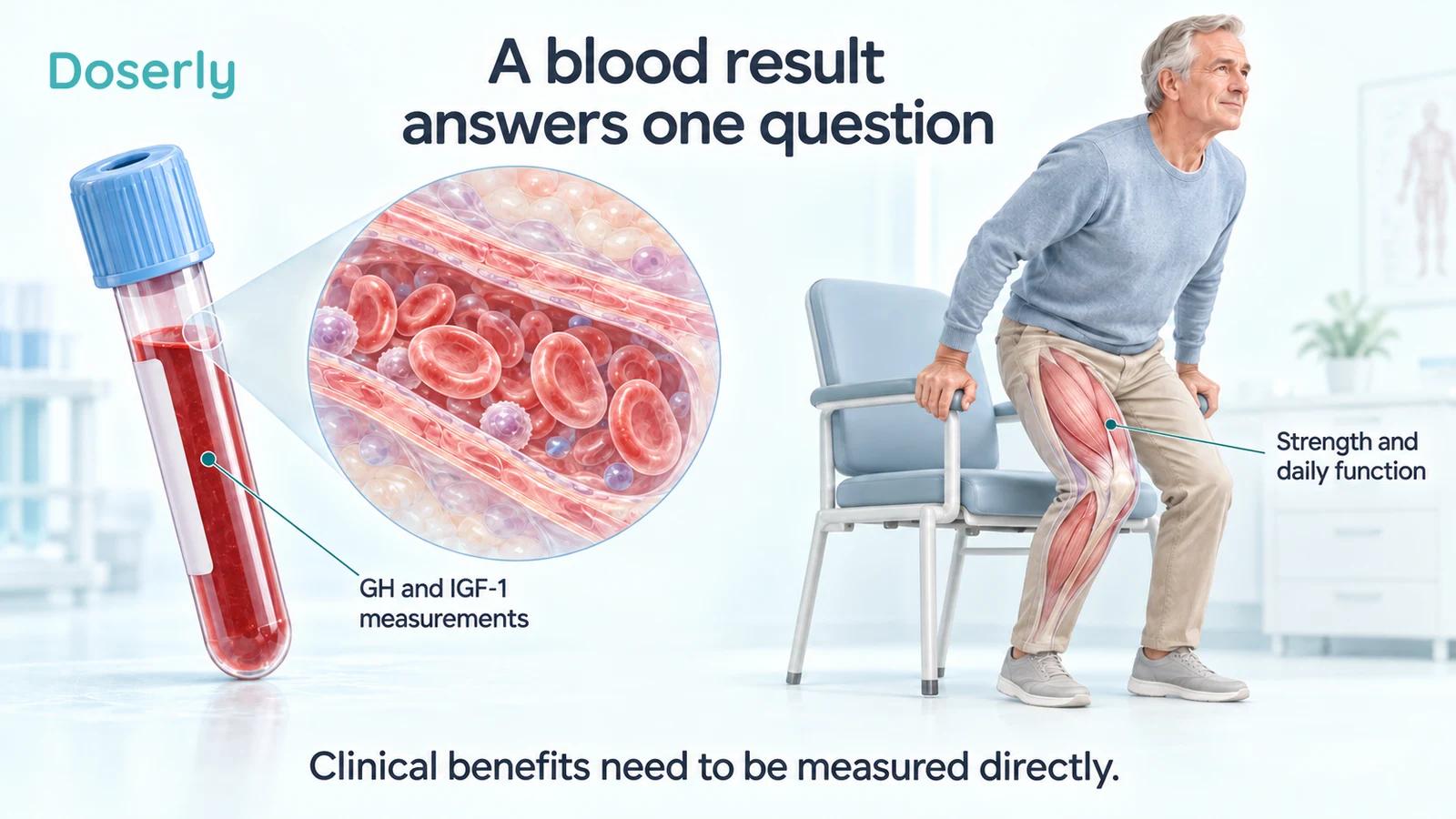
A useful study would choose its main outcome before reviewing the results and specify how large a difference would matter. It would also keep important influences such as other treatment reasonably comparable. Otherwise, even a dramatic laboratory response may leave the central patient question unanswered.
What can studies of growth hormone itself contribute?
Research on another intervention can clarify why hormone-related claims need direct measurement, provided the distinction stays explicit. Meinhardt and colleagues studied administered GH, not CJC-1295, in 96 recreational athletes over eight weeks, followed by a six-week washout. Meinhardt and colleagues, 2010.
GH increased measured lean body mass through increased extracellular water. Sprint capacity improved, while other tested performance measures did not significantly change. The sprint improvement was not maintained six weeks after treatment stopped. The investigators noted that the study was too small to settle safety.
This does not predict the effects of CJC-1295. Its value here is narrower: even when researchers directly manipulate the GH system, body composition, different forms of performance and persistence of effects can tell different stories. It would be especially unwarranted to infer all those outcomes from IGF-1 alone.
Does a normal-range IGF-1 result establish safety?
No single laboratory result can establish the safety of an investigational product. A reference interval describes a comparison with a reference population under a particular assay. It is not a comprehensive boundary between harmless and harmful treatment.
The original CJC-1295 report described no serious adverse reactions in those trials, but this statement belongs to a small, short program. FDA's current compounding-risk information identifies limited clinical data and reports serious adverse events associated with CJC-1295, including increased heart rate and systemic vasodilatory reactions. The agency also raises immunogenicity and characterization concerns. FDA compounding-risk information.
“Associated with” does not prove that every event was caused by the drug, and it does not provide a reliable event rate for a different product. It does mean the evidence cannot be summarized as an absence of risk. A hormone measurement cannot detect every product-quality problem, immune response or cardiovascular effect.
The product name must match the study
The human pharmacology findings above concern the long-acting, DAC-containing molecule. FDA's detailed review distinguishes CJC-1295-related substances with and without DAC and notes uncertainty about exact salt forms in some published reports. It does not treat the different active moieties as interchangeable. FDA CJC-1295 review.
Consequently, a product described as “CJC-1295 no DAC,” or a blend containing that name and ipamorelin, cannot simply inherit these trial results. Removing a duration-extending feature or adding another active substance changes the intervention. The evidence needs to match the actual product and question.
How to make a laboratory result useful
If you have hormone results to discuss, bring the dates, laboratory reference ranges, medicines or products used, and the symptoms or goals that led to testing. The useful conversation is about what the result means in that clinical context, not whether it increased enough to look impressive.
Ask what patient outcome is expected to improve and what evidence connects the proposed treatment with that outcome. Ask how unwanted effects would be assessed and what would lead to reconsidering the plan. A dated record can help explain the timeline, but it cannot validate an unstudied regimen.
CJC-1295's early studies answered an important development question: the long-acting molecule can stimulate the GH–IGF-1 system in people. The remaining question is whether that response delivers a worthwhile clinical benefit for a defined group. A blood test alone does not answer it.
Explore the research
- Jetté et al., 2005: albumin-binding design and preclinical activity.
- Teichman et al., 2006: human exposure and hormone-response trials.
- Ionescu and Frohman, 2006: overnight GH sampling and preserved pulses.
- Sackmann-Sala et al., 2009: exploratory serum-protein changes.
- Endocrine Society, 2011: diagnosis and treatment of adult GH deficiency.
- Meinhardt et al., 2010: a different intervention, administered GH, with direct performance measurements.
- FDA compounding-risk information: safety concerns and limited clinical data.
- FDA CJC-1295 briefing, 2024: substance distinctions and evidence assessment.