
Peptides
October 16, 2026
CJC-1295 and the GHRH pathway: why a specific target does not guarantee benefit
On this page
Knowing where a molecule acts is valuable. It can explain why a laboratory result changes and help researchers design a better experiment. It cannot, by itself, establish that the change improves health or that every consequence of the intervention is desirable.
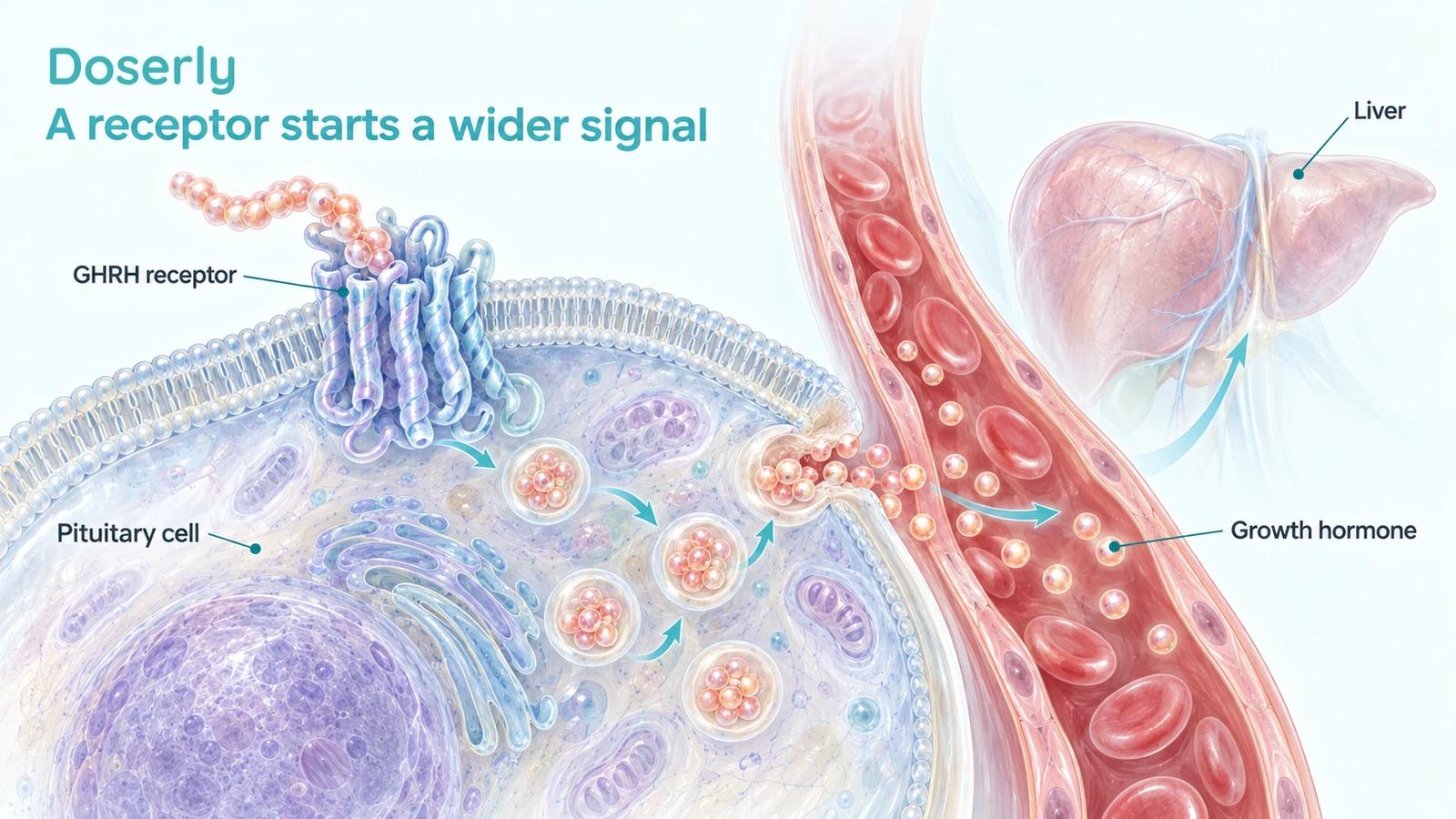
CJC-1295 illustrates this distinction. It was developed to stimulate the growth hormone-releasing hormone, or GHRH, pathway. That gives it an identifiable biological target. The target then participates in a hormone system whose effects extend beyond the receptor where stimulation began.
A specific starting point is not the same as a narrowly confined result. To assess CJC-1295, we need to follow the signal from the pituitary to downstream measurements, while preserving the differences between receptor experiments, animal models and human outcomes. Our CJC-1295 guide introduces the compound and the evidence behind its long-acting form.
Where does the GHRH signal enter the system?
The hypothalamus and pituitary work together to regulate growth hormone, or GH. GHRH stimulates GH production and release, while somatostatin provides inhibitory input. GH acts in tissues and promotes production of insulin-like growth factor 1, or IGF-1, including in the liver. Feedback from the system helps regulate further secretion. Endotext: Normal Physiology of Growth Hormone in Normal Adults.
This arrangement matters because a GHRH analogue does not have to bind directly to every downstream tissue to influence a circulating hormone system. The initial receptor interaction and the later tissue effects occur at different levels of the pathway.
An everyday description such as “stimulates GH release” therefore identifies only the beginning of the story. It does not specify the duration of exposure, the resulting hormone concentrations, the tissues affected or the balance between useful and unwanted effects. Those questions require additional evidence.
Nor is the system simply an on/off switch. Endogenous GH secretion varies over time, and several inputs participate in its regulation. A molecule can alter one input while other regulatory processes remain active. Their continued activity does not demonstrate that the overall exposure is unchanged.
What did the original CJC-1295 experiments establish?
The early development work investigated modified GHRH fragments designed to bind serum albumin, a circulating protein. Albumin attachment was used to extend the peptide's persistence. Researchers tested the resulting compounds in cultured rat anterior-pituitary cells and in rats, rather than beginning with a claim about human health outcomes.
The albumin-linked compounds remained biologically active in a GH-secretion assay. In rats, the selected molecule, CJC-1295, produced a larger GH response over a two-hour observation than the natural GHRH fragment used for comparison and remained detectable in plasma beyond 72 hours. Jetté and colleagues, 2005.
Those findings connected molecular design to biological activity and longer exposure. They did not establish that a person would gain strength, sleep better or recover faster. A rat pituitary assay can answer whether a construct still stimulates secretion; it cannot answer how a healthy adult feels after months of use.
It is also important not to overstate the word “selective.” Demonstrating activity at the intended pathway is not automatically a comprehensive survey of every possible interaction in the body. A claim of selectivity needs to specify the targets compared, experimental system and concentrations tested. Otherwise, a precise-sounding term can exceed the underlying experiment.
Three different meanings often hide inside “targeted”
First, a compound can have a defined molecular target. For CJC-1295, the relevant intended target is the GHRH pathway at the pituitary. That is a mechanistic statement about how stimulation begins.
Second, a drug can preferentially affect one measured response compared with others in an experiment. Such a finding depends on which hormones or pathways were actually measured. An unmeasured effect does not become absent simply because it was outside the study's scope.
Third, a treatment can produce a useful clinical benefit in a selected population. That is an outcome claim, requiring evidence about the people treated, the comparison group, the size and durability of benefit, and harms.
These meanings are related, but they are not interchangeable. A mechanistic experiment can support the first and contribute to the second without establishing the third. When an advertisement moves directly from a receptor name to a promise of healthy aging, the missing step is not vocabulary. It is clinical outcome evidence.
A useful scientific summary states both the finding and its boundary: “This construct stimulated GH secretion in this experimental system.” Removing the final qualification can turn a legitimate observation into an unsupported promise.
Human hormone responses confirm activity, not every intended benefit
Two early randomized, placebo-controlled CJC-1295 studies in healthy adults demonstrated prolonged increases in GH and IGF-1. The estimated half-life of the long-acting molecule was 5.8–8.1 days. These results showed that the development strategy translated into sustained biological activity in humans. Teichman and colleagues, 2006.
The distinction between exposure and outcome remains essential. The trials' central hormone measurements do not establish improvements in physical function, injury recovery or long-term health. Those outcomes need direct assessment rather than inference from a marker moving in an anticipated direction.
The study design also limits what can be said about time. The reported observation periods were 28 and 49 days, with single or limited repeated administrations. They were not evidence of uninterrupted daily treatment throughout those periods, and they were not long-term wellness studies.
The investigators reported no serious adverse reactions in those early trials. That is useful information about the observed circumstances. It cannot establish the frequency of uncommon events or the consequences of prolonged exposure in a broader population. Mechanistic confidence and clinical uncertainty can coexist.
Preserved pulses do not mean an unchanged hormone environment
A separate human experiment sampled GH frequently overnight before and one week after a single CJC-1295 administration. GH secretion remained pulsatile, but mean and trough levels increased. The result showed that prolonged GHRH stimulation could coexist with continuing pulses. Ionescu and Frohman, 2006.
This is different from saying that the treatment recreated an entirely normal hormone environment. A waveform can retain peaks while its background level changes. The presence of peaks alone does not describe total exposure or establish that all downstream effects remain within a desirable range.
The finding also should not be reversed into a claim that CJC-1295 eliminates physiological regulation. The study observed continuing pulsatility. Accurate interpretation preserves both parts: regulation was still evident, and hormone concentrations had changed.
For someone evaluating a mechanism-based claim, this is a useful example of why the complete result matters. “Pulses preserved” and “baseline elevated” are compatible observations. Selecting only the reassuring half changes the meaning of the study.
Downstream effects can be consequences of the intended pathway
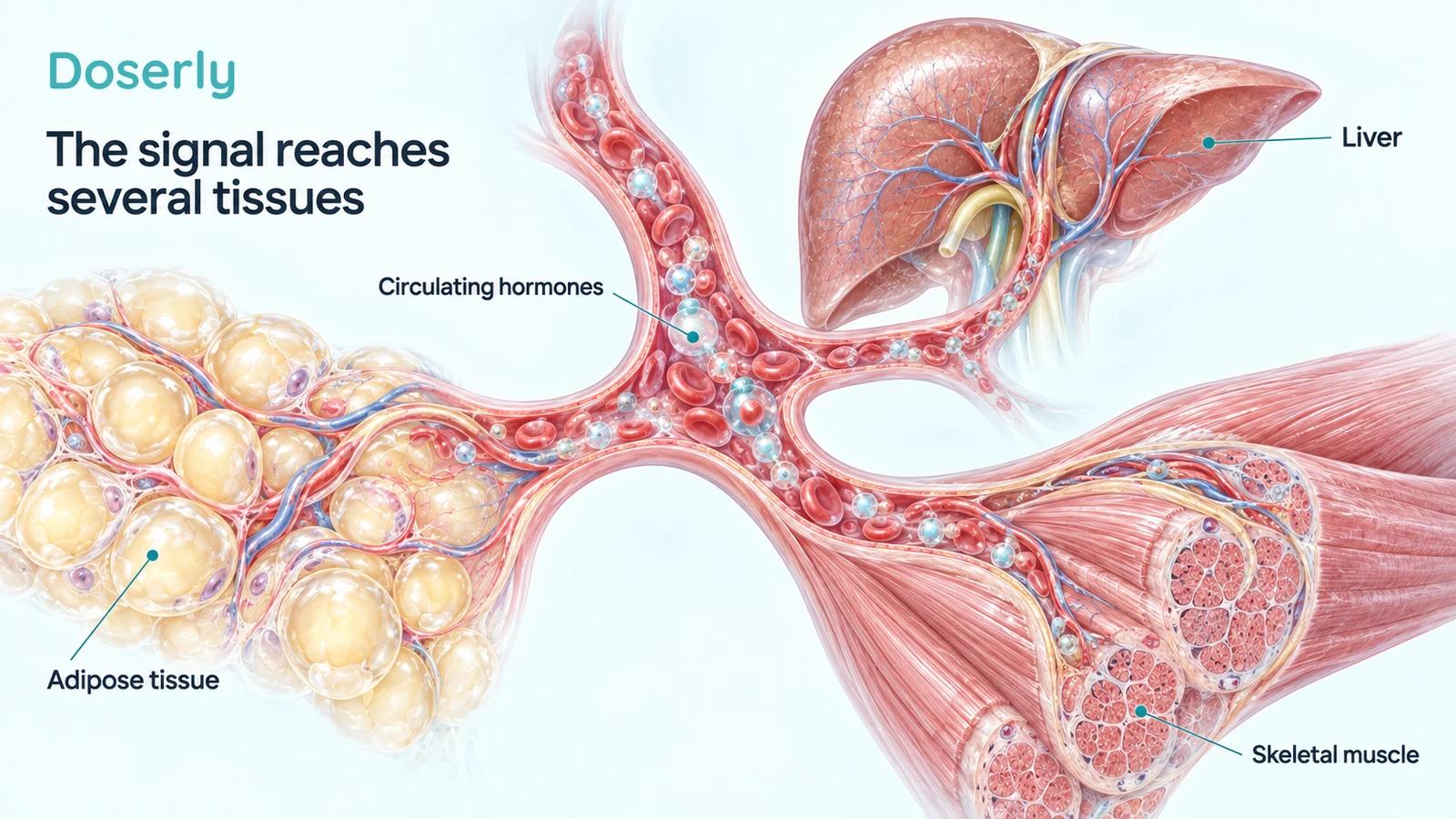
An unwanted effect does not have to come from an accidental interaction with an unrelated receptor. A hormone system has several physiological roles, so intensifying an intended signal can produce consequences beyond the benefit being sought. Endotext describes GH effects on lipid and glucose metabolism and the tissue distribution of GH–IGF signaling. GH physiology reference.
That principle does not establish that CJC-1295 causes every adverse effect associated with every GH-related condition. It explains why a receptor-specific mechanism cannot replace compound-specific safety data. Researchers still need to measure the outcomes that matter at the exposure and duration being studied.
The practical distinction is between an off-target effect and an unwanted on-pathway effect. Both can matter to a patient. A claim that a molecule avoids some other receptor does not answer whether sustained stimulation of its intended pathway is beneficial, excessive or neutral in a particular population.
This is also why safety monitoring and proof of efficacy are separate. Monitoring can detect selected problems; it does not turn an unproven benefit into a demonstrated one. A favorable laboratory panel is not a substitute for an appropriate outcome trial.
A mouse experiment shows why duration deserves study
In a 2020 study of pituitary biology, researchers administered CJC-1295 repeatedly to adult male mice for eight weeks. They examined pituitary growth and DNA-damage-related findings, alongside other experimental work. The CJC-treated mice showed increased pituitary weight and changes in DNA-damage markers. Ben-Shlomo and colleagues, 2020.
This is a preclinical finding, not a demonstrated incidence of cancer in people using CJC-1295. The paper also included analyses of human pituitary tumors, but those human tumor samples were not a cohort of people exposed to CJC-1295. Combining the two parts as if they established human drug causation would be incorrect.
The relevant lesson is narrower: repeated stimulation of the intended pathway can be studied for tissue consequences, and a short hormone-response experiment cannot answer every longer-term biological question. The mouse result identifies a reason for further safety investigation. It does not supply a numerical human risk estimate.
Readers should resist both extremes—ignoring an animal signal because it is not human proof, or treating it as a diagnosis waiting to happen. The scientific value lies in preserving the model, exposure period and measured endpoint.
Why the underlying diagnosis changes the benefit question
Treating a diagnosed hormone deficiency is a different clinical question from increasing hormone output in an otherwise healthy person. The Endocrine Society's adult GH-deficiency guideline describes a diagnostic process that usually requires stimulation testing, with exceptions in defined circumstances, and discusses treatment in that diagnosed population. Endocrine Society guideline.
That evidence should not be transferred automatically to CJC-1295 use for general wellness. The intervention, baseline physiology and treatment objective differ. An outcome that is meaningful when correcting a deficiency does not establish that additional stimulation above an individual's existing state is beneficial.
This distinction is especially important when symptoms such as tiredness or poor recovery are used to imply a specific hormone diagnosis. A marketing description cannot establish the cause of a symptom. Clinical evaluation determines what problem is present before a treatment's mechanism can be matched to it.
For a reader, the useful question is therefore not merely “Does this peptide affect GH?” It is “What condition was studied, with which intervention, and what outcome improved?” The receptor name answers only a small part of that question.
What selectivity leaves unresolved
FDA's CJC-1295 assessment distinguishes related bulk substances and identifies limits in the available evidence. Its separate safety communication raises concerns including immunogenicity, peptide-related impurities and reported serious reactions involving increased heart rate and systemic vasodilation. These issues are not resolved by naming the intended receptor. FDA scientific review, FDA peptide safety information.
Product identity, manufacturing characteristics, exposure and patient context remain relevant. These questions concern the actual preparation and recipient, rather than only the intended receptor interaction. A proposed mechanism cannot authenticate a vial, establish equivalence between DAC and non-DAC substances or predict every response to repeated administration.
The appropriate conclusion is specific: CJC-1295 research supports activity through a defined hormone-release pathway, and early human studies support sustained GH–IGF-1 responses. Benefit and safety require their own evidence. Keeping those claims separate makes the mechanism more useful, because it explains what the research achieved without asking it to prove something it never measured.
Explore the research
- Original CJC-1295 development experiments
- CJC-1295 human hormone-response studies
- GH pulsatility after CJC-1295
- Normal adult GH physiology
- Pituitary biology and repeated CJC-1295 exposure in mice
- Adult GH-deficiency clinical guideline
- FDA CJC-1295 assessment
- FDA peptide safety information