
Peptides
October 16, 2026
CJC-1295 and anti-doping: endogenous hormone stimulation still matters
On this page
CJC-1295 is explicitly prohibited under the World Anti-Doping Agency's 2026 Prohibited List. The fact that it stimulates the body's own growth hormone release does not create an exemption. The rule addresses growth hormone-releasing factors as well as growth hormone itself. WADA 2026 Prohibited List.
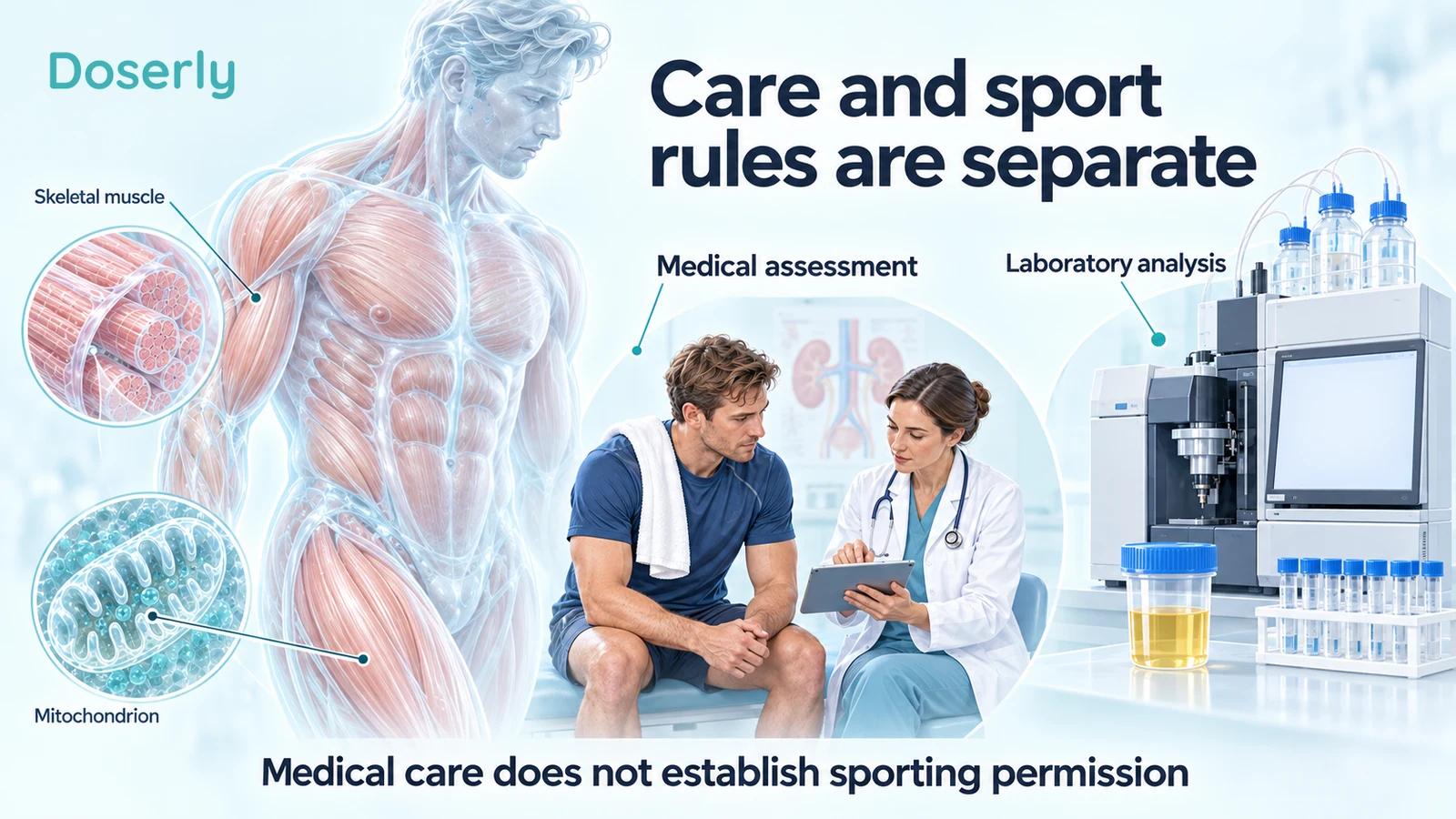
That answers the eligibility question for sport governed by these rules. It does not answer whether CJC-1295 reliably improves strength, recovery or body composition. Anti-doping classification, clinical evidence and personal medical care are separate questions, even when they concern the same molecule.
This article explains how those questions fit together, what the public enforcement record actually shows, and where athletes can obtain an authoritative answer about their own obligations. The rules were checked on October 15, 2026. Our CJC-1295 guide covers its pharmacology and clinical research in greater depth.
What does the current list say?
The 2026 list names CJC-1295 among GHRH analogues in section S2.2.4, within the broader class of peptide hormones, growth factors, related substances and mimetics. The prohibition applies both in and out of competition. The same section separately names ipamorelin among growth hormone secretagogues. WADA 2026 list, section S2.
“All times” therefore includes training periods. It is not a rule that starts only when an athlete arrives at a competition venue. Nor does pairing CJC-1295 with another hormone-releasing peptide change the status of either ingredient.
The published 2027 list also names CJC-1295, but its effective date is January 1, 2027. Reading a forthcoming document is useful for planning; it should not be confused with identifying the edition currently in force. As of this article's research date, that is the 2026 edition. WADA 2027 Prohibited List.
Why “it releases my own hormones” does not resolve the issue
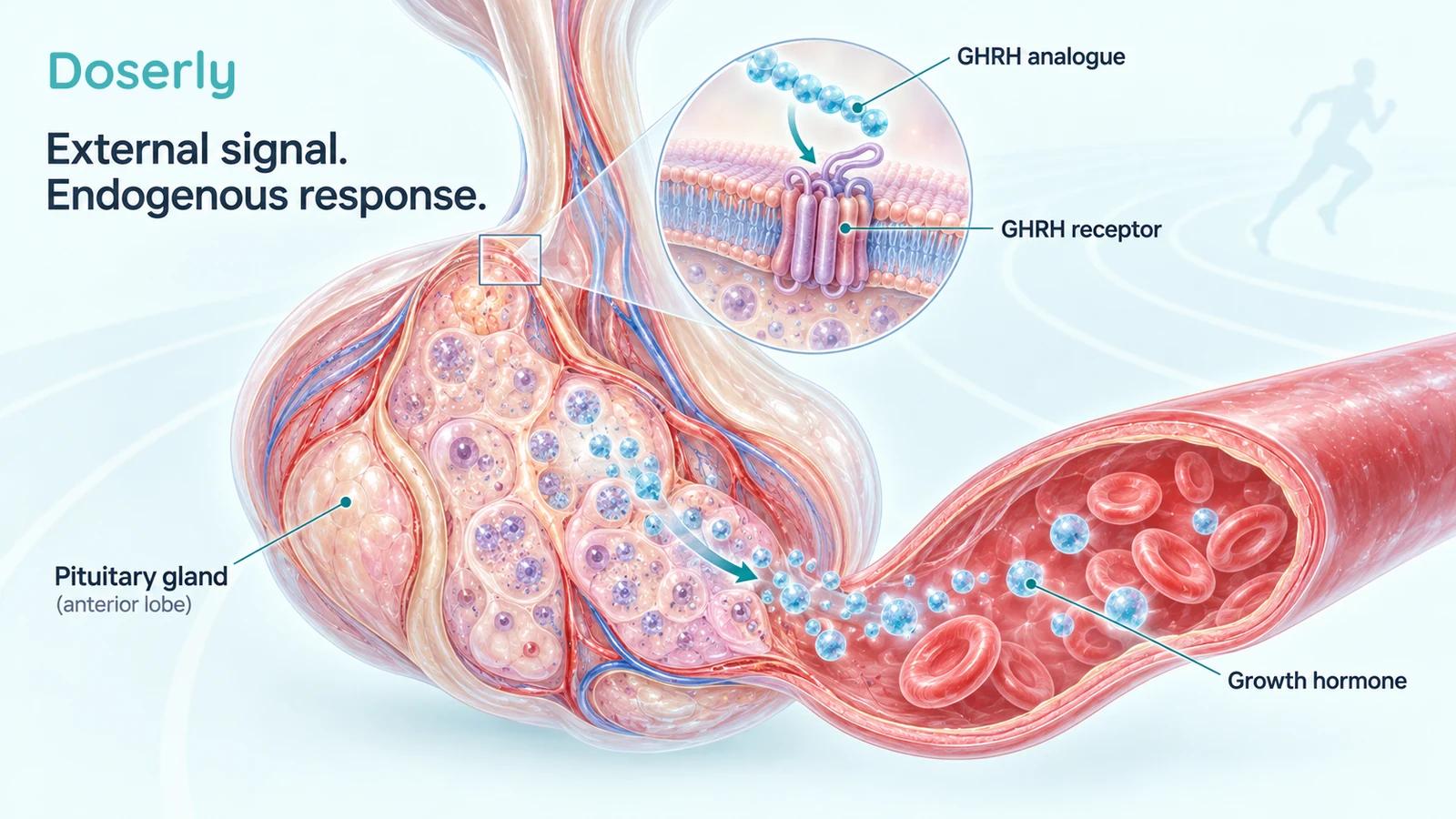
CJC-1295 was developed as an analogue of growth hormone-releasing hormone, or GHRH. Its intended action is upstream of GH: stimulation of the pituitary's hormone-release pathway. That differs from injecting GH itself, but both approaches intervene in the same broader endocrine system.
In early human studies, long-acting CJC-1295 increased circulating GH and IGF-1 for days after administration. These were measurable pharmacological effects in healthy volunteers. Describing the resulting GH as endogenous is physiologically relevant, but it does not mean the intervention was simply ordinary unassisted hormone secretion. Teichman and colleagues, 2006.
A related study found that GH pulses persisted after CJC-1295 while mean and trough concentrations increased. Preserved pulsatility is a description of the secretion pattern, not evidence that the system was unchanged. Ionescu and Frohman, 2006.
This is where marketing language can create confusion without making an explicitly false biochemical statement. “Your own GH” may describe the hormone's source, yet leave out the external substance used to alter its release. An athlete needs the identity and status of that external substance, not merely a description of where the downstream hormone was made.
Prohibition is not a performance guarantee
The World Anti-Doping Code describes criteria for including substances on the list. These encompass actual or potential performance enhancement, actual or potential health risk, and conflict with the spirit of sport; meeting two of those criteria can support inclusion. This is not the same evidentiary framework as a clinical trial designed to quantify a specific athletic benefit. World Anti-Doping Code, article 4.3.
A banned substance is therefore not necessarily a proven shortcut to muscle gain or faster recovery. Conversely, uncertain efficacy does not make a prohibited substance permissible. Under the Code, success or failure of use is not what determines whether use constitutes a violation.
For CJC-1295, the published early trials chiefly established hormone responses over short observation periods. They did not demonstrate a general athletic recovery benefit. A person can misunderstand the evidence and still encounter a clear anti-doping prohibition. There is no need to exaggerate the compound's performance effects to explain the eligibility risk.
The two questions should remain explicit: “Is this permitted under my rules?” and “What clinical outcome has this intervention demonstrated?” A yes or no to one cannot be borrowed as the answer to the other.
Responsibility does not disappear with a recommendation
USADA's athlete education explains that athletes are responsible for prohibited substances found in their bodies regardless of intent. That is why a coach's reassurance or a product's wellness language is not an adequate medication check. USADA Anti-Doping 101.
This principle should not be distorted into a prediction that every case receives an identical sanction. Establishing a violation and determining its consequences involve different parts of the rules. Individual circumstances and applicable procedures matter; a blog cannot decide a case in advance.
For the practical decision, however, the important point comes before any dispute. Tell the treating clinician that you compete under anti-doping rules, identify every active ingredient, and use the governing organization's resources. A description such as “recovery support” is too vague to establish what has been proposed or whether it is permitted.
A product label also cannot settle scientific identity by itself. FDA distinguishes CJC-1295 substances with and without the drug affinity complex as different active moieties. That naming issue matters when interpreting research, but it is not a basis for assuming an unlisted spelling or “no DAC” label creates permission in sport. Resolve an ambiguous product through the responsible anti-doping organization. FDA CJC-1295 assessment.
What the public cases actually show
In January 2021, USADA announced that weightlifting athlete Scott Hisaka had accepted a four-year suspension involving possession of multiple prohibited substances. Its investigation identified purchases of products containing several substances, including CJC-1295. The announcement describes a possession case; it should not be rewritten as a CJC-only positive drug test. USADA's Hisaka announcement.
A different case, announced in September 2025, involved triathlete Anthony McCauley. USADA reported possession and use of BPC-157 and TB-500, as well as social-media promotion of several prohibited substances, including CJC-1295. It characterized encouragement to purchase and use prohibited substances as attempted complicity. McCauley accepted four years of ineligibility. USADA's McCauley announcement.
Those details matter. The McCauley announcement does not establish that he personally used every substance he promoted. The Hisaka announcement does not establish that a laboratory detected every purchased product in a sample. Accurate reporting preserves the actual conduct described by the authority.
Together, these cases show why discussing only urine-test detection misses part of anti-doping enforcement. Investigations and evidence of conduct can matter. Neither case establishes a clinical benefit from CJC-1295, and neither supports predicting the sanction in someone else's situation.
Detection research answers a narrower question
A 2021 analytical study investigated detection of four GHRH analogues, including CJC-1295 with and without a drug affinity complex. The researchers examined metabolism in vitro and developed a mass-spectrometry method using fortified urine and reference materials. This was laboratory method development, not a clinical trial of athletic performance. Advances in the detection of GHRH synthetic analogs.
The distinction between fortified urine and samples collected after controlled human administration is important. Adding known materials to a sample helps evaluate an assay, but it does not establish a universal real-world detection window for every product, route or exposure.
It would be equally misleading to read an older paper's description of detection difficulties as a durable promise that a substance cannot be identified. Analytical methods develop, and anti-doping investigations are not limited to a single assay.
The useful conclusion is modest: researchers have specifically studied ways to identify these analogues and their metabolites. That work provides no basis for a “safe” timing strategy, and laboratory uncertainty does not change the substance's prohibited status.
What if there is a genuine medical need?
A therapeutic use exemption, or TUE, is a formal process for necessary medical treatment involving a prohibited substance or method. It is not the same as possessing a prescription, obtaining a clinic's recommendation or deciding that a hormone value should be higher.
USADA's current process directs athletes to check medication status and, where appropriate, submit a TUE pre-check or application. The requirements depend on competition level and the substance's status. Applications require medical documentation and are reviewed against the applicable standards; permission should not be assumed from submitting paperwork. USADA TUE guidance.
The same guidance emphasizes that emergency medical care takes priority. Athletes should obtain necessary emergency treatment, retain documentation and follow the relevant process afterward. Anti-doping concerns should not delay urgent care.
None of this implies that a TUE for CJC-1295 would be granted. The point is to use the actual medical and regulatory process, with the appropriate organization, rather than treating “medical supervision” as a blanket exception.
Recreational competition still deserves an explicit check
An athlete does not have to receive a professional salary to encounter anti-doping rules. USADA's recreational-athlete guidance addresses people entering sanctioned events and encourages them to identify their obligations before competing. It also explains that violations include conduct beyond a positive sample. USADA Recreational Athlete Checklist.
The relevant question is which rules govern the event, membership or federation. An informal gym session and a sanctioned competition are different contexts. A participant should not infer either exemption or coverage solely from how seriously they train.
A useful inquiry to the governing organization includes the exact event, competition category, product name and active ingredients. Keep the response and any medication-search reference with the underlying documentation. This is a practical recordkeeping step, not a guarantee of eligibility; the answer still needs to come from the organization responsible for the rules.
Keep the scientific and sporting conclusions separate
CJC-1295 can stimulate the endogenous GH–IGF-1 system, and the human studies demonstrate that biological activity. They do not establish all the performance claims attached to the molecule. Separately, the current WADA list explicitly prohibits it in and out of competition.
For an athlete, the actionable sequence is to identify the substance, establish which rules apply, and obtain authoritative guidance before relying on a wellness recommendation. For a reader assessing the science, the task is to examine the actual population and outcome studied. Neither process can be replaced by the word “natural,” the presence of a prescription or the assumption that a prohibited substance must work as advertised.
Explore the research
- WADA 2026 Prohibited List
- WADA 2027 Prohibited List, effective January 2027
- World Anti-Doping Code
- CJC-1295 hormone-response trial
- GH secretion pattern after CJC-1295
- FDA CJC-1295 assessment
- USADA athlete introduction
- USADA Hisaka case
- USADA McCauley case
- GHRH-analogue analytical research
- USADA therapeutic use exemptions
- USADA recreational-athlete checklist