
Supplements
October 16, 2026
Citrulline, the workout pump and the harder question of training benefit
On this page
Citrulline is an amino acid involved in the body's handling of nitrogen and production of arginine. Arginine can be used to make nitric oxide, a signaling molecule that helps regulate blood vessels. That connection has made citrulline a familiar ingredient in pre-workout products, often marketed around blood flow and a fuller-looking muscle “pump.”
A pump is immediate feedback. Lasting strength and muscle gains take longer to assess. Even when a supplement changes a blood marker or helps someone complete more repetitions in one session, it has not automatically demonstrated greater muscle growth over a training program. The human research on citrulline includes promising acute findings and clear negative trials, making the distinction especially useful.
Here we'll look at what the supplement does, how the actual exercise studies differ, and what a small 2026 trial adds. The aim is to connect the result you can feel or see during a workout with the result you actually want afterward.
From citrulline to nitric oxide: a real pathway with several steps
Citrulline can raise circulating arginine, supplying a precursor for nitric oxide production. Nitric oxide can signal the smooth muscle around blood vessels to relax. The endothelium, the thin layer lining a vessel, is central to this regulation. This is different from the skeletal muscle that contracts when you lift a weight.
In a randomized crossover study of twenty healthy volunteers, oral L-citrulline raised blood arginine and changed some markers of nitric-oxide-related signaling. Yet no treatment improved flow-mediated dilation over baseline, the study's ultrasound measure of blood-vessel response. The researchers observed a correlation in a pooled analysis, but that does not turn the treatment comparison into a positive result. Schwedhelm and colleagues, pharmacology study.
The finding illustrates a useful point about the proposed mechanism. Raising a precursor is one step; changing vascular function is another; improving exercise is another still. These steps are biologically connected, but a positive measurement at the beginning doesn't establish every later outcome.
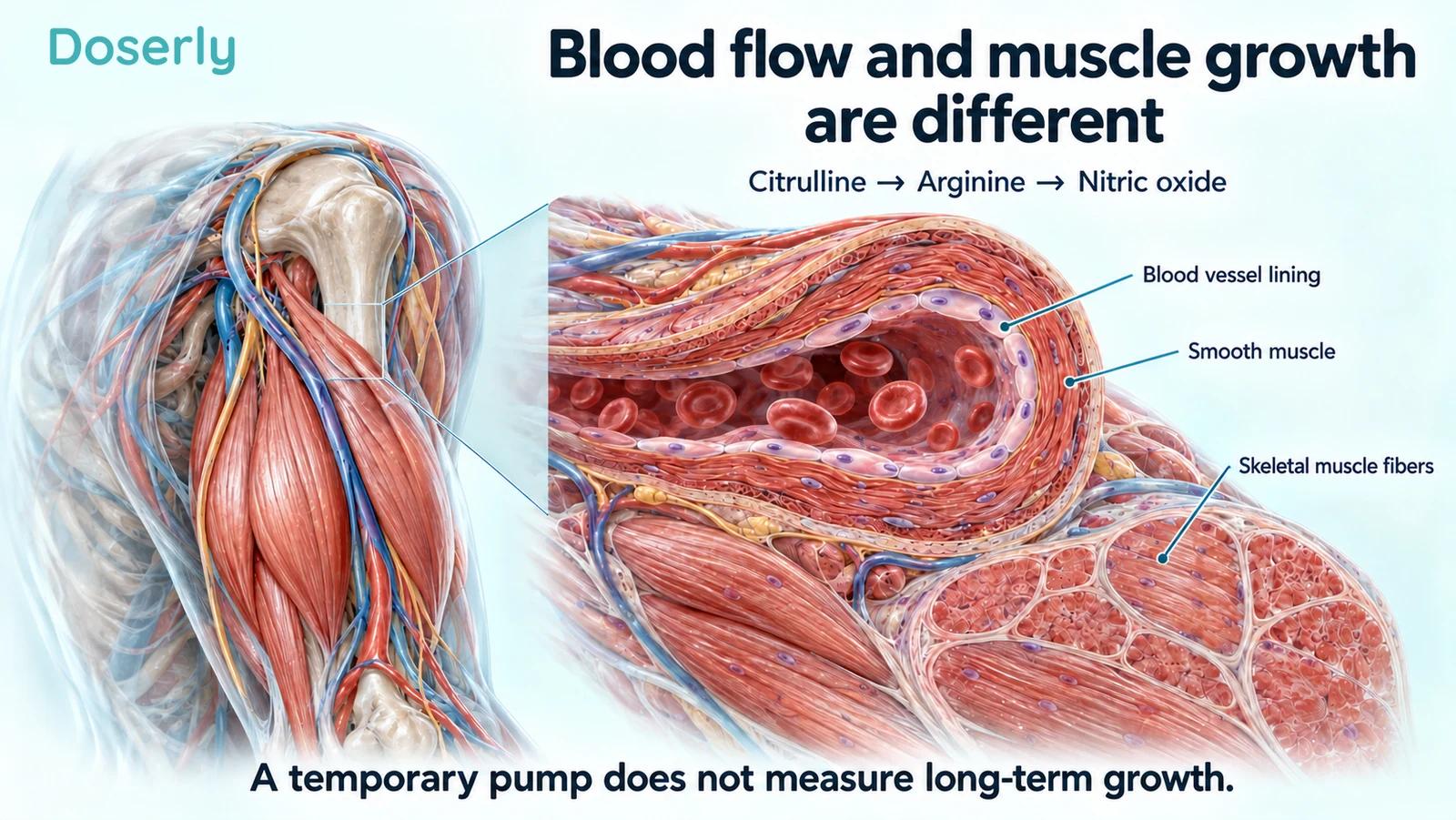
What is the pump actually telling you?
During a resistance-training session, working muscles can feel fuller and look temporarily larger. Blood flow and fluid shifts contribute to that experience. Lighting, exercise selection, repetition range and the way a person poses can also affect what they see. A photograph taken immediately after training is therefore not a measurement of long-term hypertrophy, the enlargement of muscle fibers.
The pump can be an enjoyable part of training without becoming a surrogate for progress. If your aim is muscle growth, the relevant question concerns tissue changes measured under comparable conditions after a training period. If your aim is muscular endurance, the useful result may be repetitions completed at a standardized load. Neither is established by the intensity of a sensation.
A 2023 crossover study directly examined this issue in eighteen resistance-trained men and women. Participants received 8 grams of pure L-citrulline or placebo before tests of force, bench-press performance and muscle oxygenation, alongside subjective ratings including pump. The investigators did not find an enhancement of force, muscular endurance or muscle oxygenation under their protocol. Primary trial.
This doesn't prove that every person experiences the same sensation. It does mean that a plausible blood-flow mechanism and a product's reputation aren't enough to predict a measurable performance gain in a controlled test.
Citrulline malate isn't the same amount as pure citrulline
Research uses both L-citrulline and citrulline malate, a preparation combining citrulline with malate. The total weight of citrulline malate includes both components. Eight grams of that preparation should not be described as eight grams of pure L-citrulline.
The ratio matters, too. In a 2018 study, chemical analysis found a citrulline-to-malate ratio of about 1.11:1 in the tested product, lower than the advertised 2:1 ratio. That changes the actual citrulline exposure associated with a serving. The researchers explicitly warned about discrepancies between measured composition and manufacturers' claims. Chappell and colleagues.
This is one reason apparently identical “8-gram” studies may not test the same intervention. It doesn't excuse an unfavorable result or establish that a different ratio would have worked. It means comparisons should retain the product's identity and verified composition wherever available.
The Doserly L-citrulline guide explains the broader formulation background. When comparing a label with a trial, look for the amount of the ingredient actually studied, rather than assuming the front-of-container number tells the whole story.
Some acute studies found more repetitions
An early randomized crossover trial in forty-one men tested 8 grams of citrulline malate versus placebo during a demanding chest-training protocol. Participants completed repeated bench-press sets at a fixed proportion of their maximum. The investigators reported more repetitions in later sets and less reported soreness afterward. Stomach discomfort was reported by about 15% of participants. Pérez-Guisado and Jakeman, 2010.
A frequently repeated claim from this paper is an approximately 53% increase in repetitions. That figure referred to the last evaluated set, not a 53% increase in strength, whole-session work or eventual muscle size. Late in a fatiguing protocol, a change from a small number of repetitions to a somewhat larger number can produce a large percentage. Keeping the denominator and set-specific context attached prevents a dramatic number from becoming a different claim.
A separate crossover trial in fifteen resistance-trained women found more repetitions with citrulline malate during bench press and leg press. Total bench-press repetitions averaged 34.1 versus 32.9; leg-press totals averaged 66.7 versus 55.13, with substantial variability. The study measured an acute session, not a multi-month change in muscle size. Glenn and colleagues.
These studies provide evidence that an acute performance effect can occur under particular conditions. They don't establish a uniform response across exercises or a guaranteed practical benefit for everyone who uses a pre-workout product.
Other protocols found no advantage
The 2018 Chappell trial used repeated single-leg exercise on an isokinetic dynamometer, a machine that controls movement speed. Participants attempted a demanding ten-set protocol after citrulline malate or placebo. Total repetitions were not significantly different: about 91 with the supplement and 94 with placebo. Force measures also did not show an advantage, and reported soreness was higher with citrulline malate. Primary report.
This isn't the same exercise as a barbell bench press. Training history, movement, rest intervals, fatigue and formulation can all contribute to differences between studies. At the same time, a negative trial remains part of the evidence. We cannot simply select the positive exercise and describe it as a general effect on resistance training.
Taken together with the pure-citrulline trial, the findings suggest that response is inconsistent. They also show why “pump,” oxygenation, soreness and repetitions need separate reporting. One can change without another, and an unpleasant recovery experience doesn't necessarily track the amount of work performed.
What the 2026 pilot actually found
A 2026 randomized, double-blind crossover pilot enrolled twelve resistance-trained adults, seven women and five men. Each completed trials after 8 grams of citrulline malate, 12 grams or placebo, taken one hour before exercise. The protocol used bent-over rows and leg presses: two sets of ten followed by a set to exhaustion, all at 70% of one-repetition maximum.
The statistical model identified an effect for the higher amount, with improvements observed in leg press. Estimated marginal means for leg-press repetitions were 17 with placebo, 19 with the moderate condition and 20 with the higher condition. These are model-based estimates; they are not a promise that an individual will complete three extra repetitions. The moderate condition did not show the same significant main effect. 2026 pilot trial.
The authors characterized the improvement as small and called for further investigation. Twelve people and single-session testing cannot establish a generally optimal serving or a durable muscle-building effect. The study also did not identify the mechanism responsible, so it would be inaccurate to claim that a measured increase in blood flow explained the result.
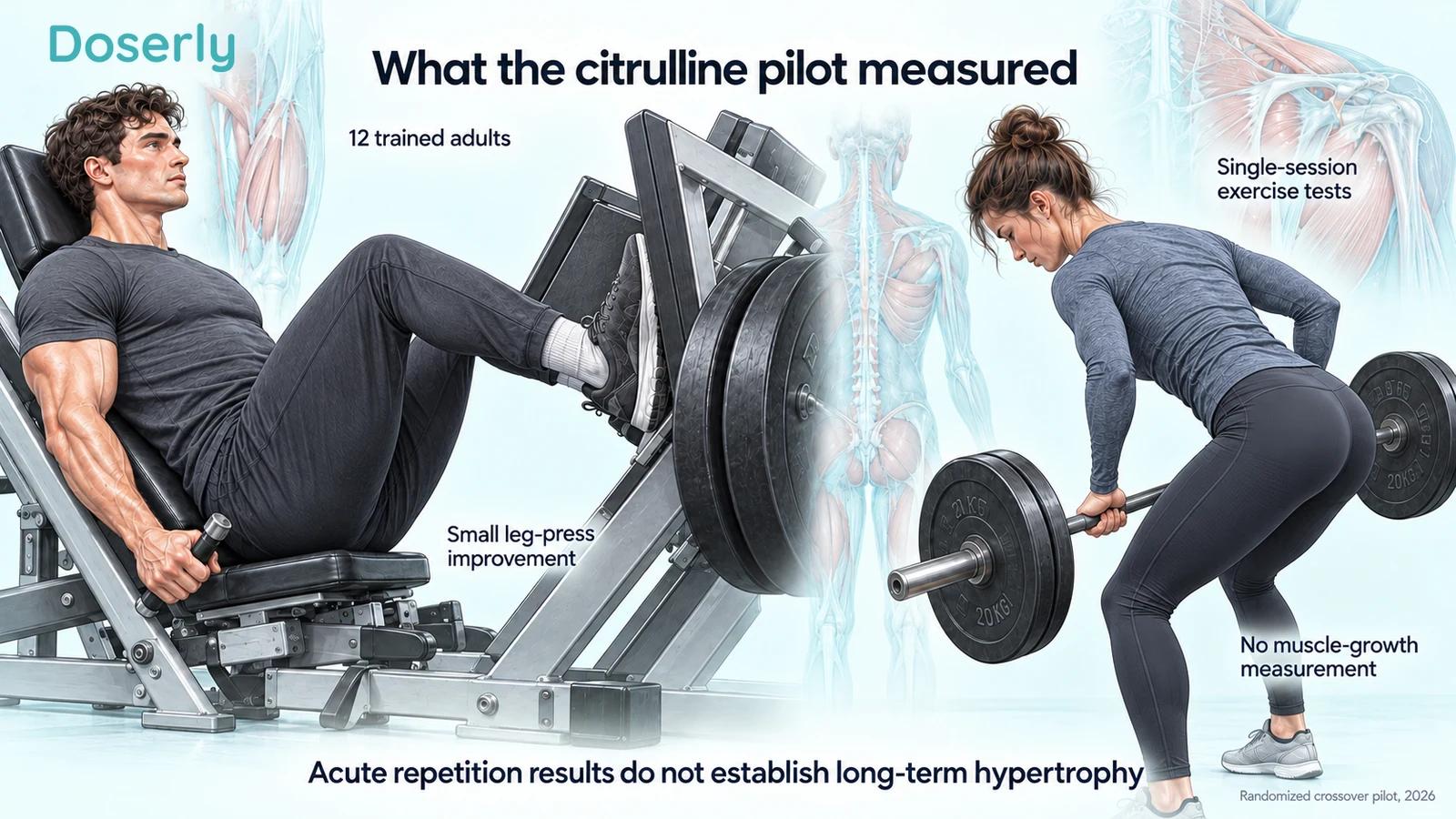
Image sources: Source
Why extra repetitions might matter without proving hypertrophy
An additional repetition can be useful if it contributes to a suitable training stimulus. But whether it produces more growth depends on what happens over repeated sessions: load progression, total training, recovery, adherence and nutrition. A person may adjust later sets or reduce work elsewhere. An acute study cannot observe those longer-term adjustments.
To establish a lasting benefit, researchers need a training study with comparable programs and a meaningful duration. Muscle-size measurements should be taken under standardized conditions that reduce the influence of the immediate pump. Strength should be tested consistently, and the analysis should compare groups rather than simply note that everyone improved after training.
The practical implication isn't that acute research is unimportant. It helps identify conditions worth testing. It just answers the narrower question of performance on the studied day. The next study has to demonstrate the next step rather than inherit it from a mechanism or a workout photograph.
Longer-term research asks a different population question
There is some training-period research, so it would be too broad to say that all citrulline evidence is acute. A study in twenty-four sedentary postmenopausal women with hypertension compared L-citrulline with placebo for eight weeks, adding slow, low-intensity resistance exercise during the final four weeks. The combined intervention favored citrulline for leg lean mass and leg-curl strength, alongside a vascular-function measurement. Leg lean-mass changes were 0.49 versus 0.07 kilograms. Kang and colleagues.
This is relevant to a clinical population and a specific training approach. It is a small study, and lean mass is not a direct measurement of individual muscle-fiber growth. Its findings should neither be ignored nor transferred wholesale to young experienced lifters taking citrulline malate before hard sessions. They show why the population and preparation remain important even when research follows participants beyond one workout.
Making the result useful for your own training
Start with a concrete goal. “A stronger pump” is a subjective experience; “more repetitions at the same load with the same rest” is a performance goal; “larger muscle size over months” is an adaptation goal. A supplement can be appealing for one reason without having established the others.
If you track training, record load, repetitions, range of motion and rest periods alongside any supplement changes. Note stomach symptoms and other ingredients, particularly stimulants. A multi-ingredient pre-workout makes it difficult to attribute an effect specifically to citrulline. A better session after a new product may reflect caffeine, expectations, food intake or ordinary variation as well as the ingredient of interest.
Don't assume that the higher condition in a small pilot is a personal recommendation to keep increasing intake. More powder changes tolerability and may change exposure to other ingredients. If you have a medical condition, use medication affecting circulation, or experience dizziness or persistent gastrointestinal symptoms, discuss the exact product with a clinician or pharmacist. The available short exercise studies aren't comprehensive interaction studies. The NIH supplement assessment also emphasizes the limitations of citrulline efficacy and safety data.
The most supportable conclusion is specific: citrulline has a plausible vascular mechanism and some positive acute muscular-endurance findings, but effects vary across trials. A visible pump doesn't establish the mechanism, an extra repetition doesn't establish hypertrophy, and a single small dose-comparison study doesn't settle the best approach for long-term training.
Explore the research
- Citrulline and arginine pharmacology, 2008: blood markers and vascular measurement.
- Pure L-citrulline exercise trial, 2023: eighteen trained adults, performance and oxygenation.
- Bench-press crossover trial, 2010: set-specific effects and soreness.
- Resistance-trained women, 2017: acute upper- and lower-body performance.
- German Volume Training trial, 2018: negative performance finding and composition checks.
- Moderate- and high-dose pilot, 2026: twelve-person crossover comparison.
- NIH exercise-supplement fact sheet: safety and efficacy context.
- Citrulline and low-intensity training in postmenopausal women, 2023 issue: eight-week clinical-population trial, published online December 2022.