
Supplements
October 16, 2026
Cinnamon and glucose: the species and the study both matter
On this page
Cinnamon research is often summarized as though every jar of spice and every capsule contained the same intervention. They do not. Different cinnamon species, ground bark, extracts and combinations have been studied, sometimes with incomplete descriptions. A result from one preparation cannot automatically establish what another will do. NCCIH identifies unclear species and plant-part reporting as a major obstacle to interpreting the research. NCCIH cinnamon overview.
The health question also changes from study to study. Lower glucose during a short monitoring period is different from a sustained HbA1c improvement, and both differ from preventing diabetes or its complications. A positive result may be worth following without being large or durable enough to support a treatment claim.
Recent trials make the topic more interesting than a simple dismissal of cinnamon. They also make precision more necessary. A small trial used Indonesian cinnamon with continuous glucose monitoring, while newer trials specifically evaluated Ceylon cinnamon extracts. Understanding those distinctions is more useful than choosing a product because an advertisement says “clinically studied cinnamon.”
Name the preparation before comparing the results
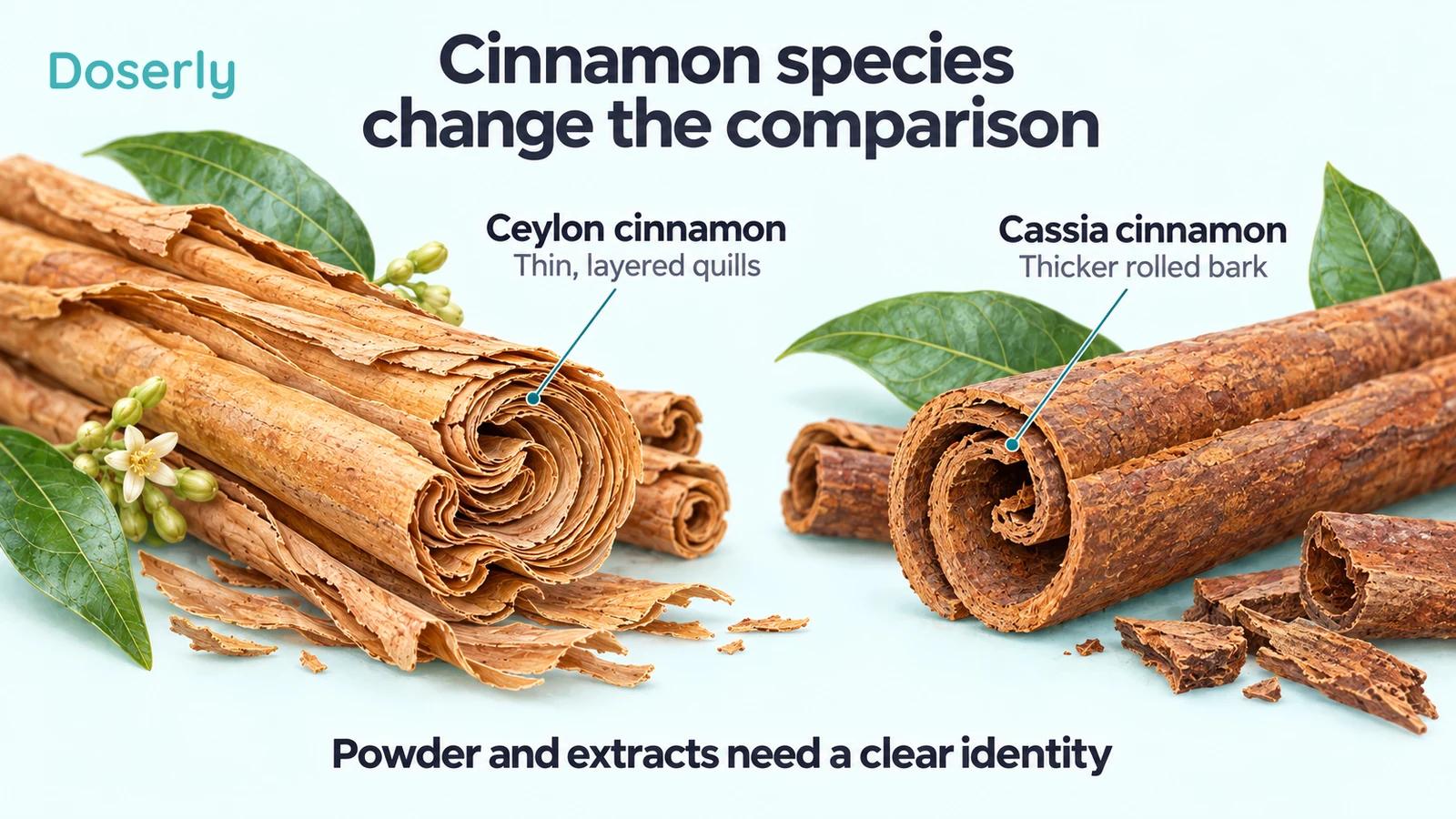
Ceylon cinnamon is commonly identified as Cinnamomum verum or Cinnamomum zeylanicum. Cassia is a broader commercial category that includes other commonly sold cinnamon types. One practical difference is coumarin content: Ceylon cinnamon generally contains much less, while cassia can contain substantially more. Coumarin exposure matters because it can affect the liver in susceptible people. NCCIH, German Federal Institute for Risk Assessment, or BfR.
That is a safety distinction, not proof that Ceylon cinnamon lowers glucose more effectively. It is possible for a product to have a preferable composition for one safety concern while still lacking strong evidence for the intended benefit. Keeping those questions separate avoids turning “lower coumarin” into “better diabetes treatment.”
The Doserly Ceylon cinnamon guide provides further background. When comparing it with a research paper, look for the Latin name, whether the material was bark powder or an extract, how the extract was standardized, and the actual amount of each component. Milligrams of extract cannot be converted into grams of ordinary kitchen spice without information about the preparation.
A blend makes the comparison more complicated. If a capsule contains both an extract and bark powder, its total weight does not tell us the amount of either one. If another active ingredient is added, the trial can assess the combination but cannot necessarily assign its effect to cinnamon alone. A familiar label word is only the beginning of matching a product to a study.
The 18-person glucose-monitoring trial
The 2024 crossover trial enrolled 18 adults with obesity and prediabetes. Each received 4 g daily of cinnamon or placebo for four weeks, followed by a two-week washout and the other intervention. The preparation was C. burmannii, or Indonesian cinnamon, delivered in capsules. Participants followed a low-fiber, low-polyphenol diet during the study. The primary AJCN report.
Continuous glucose monitoring produced 66,624 glucose observations across 694 follow-up days. Average 24-hour glucose was statistically lower during cinnamon than placebo, and some other glucose measures also favored cinnamon. Digestive symptoms did not differ between conditions. The indexed trial report.
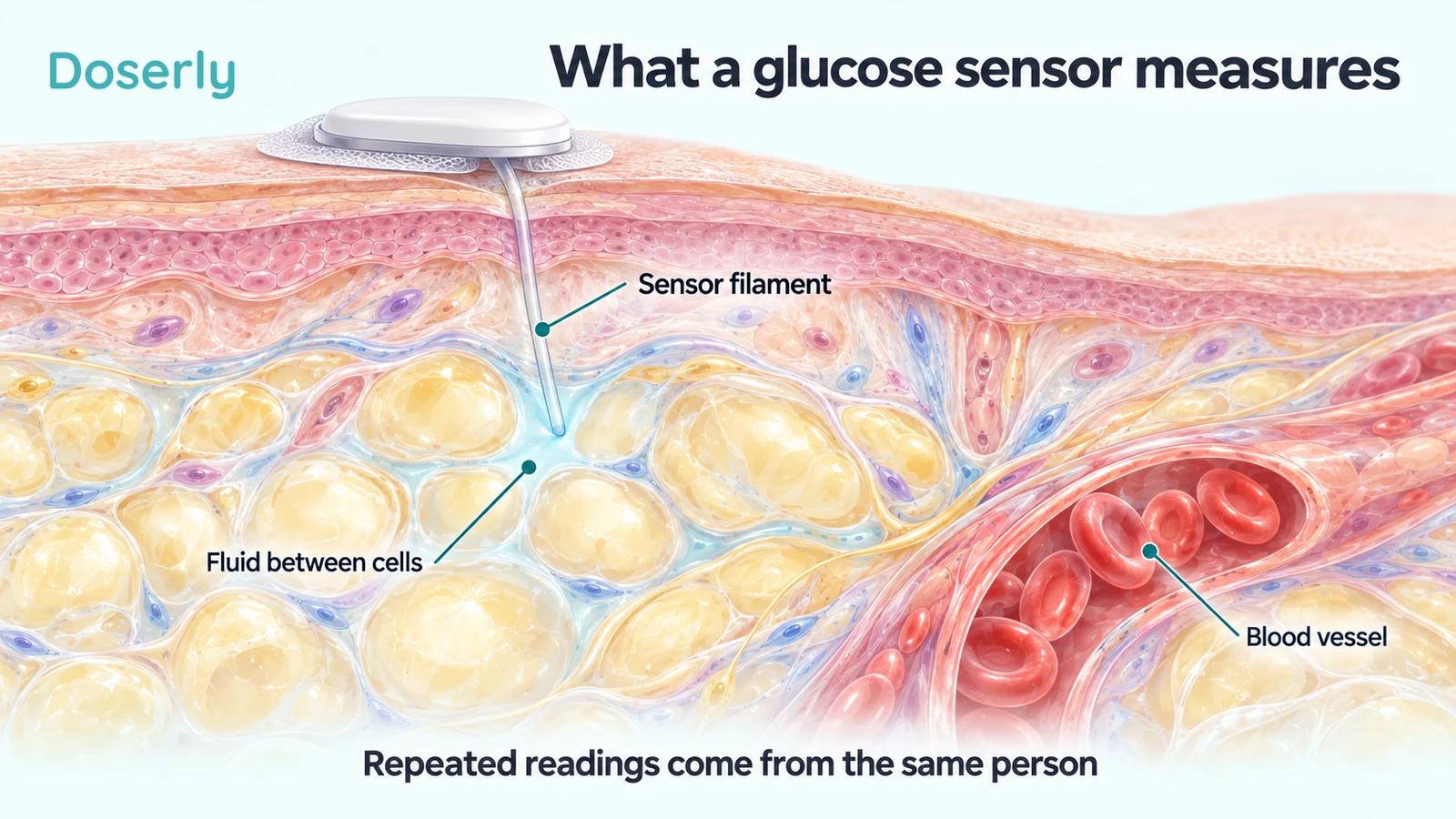
The dense data are useful: they show more of a person’s daily glucose pattern than a single fasting sample. They do not make the participant population large. Repeated readings from one person remain related to that person’s physiology, meals and daily circumstances. They are not equivalent to recruiting another independent participant each time the sensor records a value.
The study’s controlled dietary background also matters. It makes the intervention easier to isolate, while leaving uncertainty about how the result translates to a more varied everyday diet. It would be inappropriate to recommend adopting the study’s low-fiber diet just to make a supplement experiment easier to copy. The protocol describes how investigators studied a question; it is not a complete nutritional plan.
What the sensor measured—and what it did not
A continuous glucose monitor estimates glucose from fluid between cells under the skin. Its sensor does not sit inside a blood vessel. The resulting measurements help show trends over time, whereas a laboratory fasting-glucose test samples blood at a defined time. NIDDK’s explanation of continuous glucose monitoring.
This distinction is not an argument against sensor research. It clarifies the endpoint. The cinnamon study tested whether a particular preparation changed monitored glucose under specified conditions. It did not establish that participants avoided diabetes years later, needed fewer medicines, or had fewer kidney or cardiovascular complications.
Statistical significance also needs a clinical question attached to it. A small, consistent difference can be detected with repeated measurements. Whether that difference is worth acting on depends on its size, persistence, safety and relevance to the individual. A low P value cannot decide those issues by itself.
For a person looking at their own sensor trace, the same caution applies. One meal with cinnamon and another without it are not automatically a controlled comparison. Portions, accompanying foods, timing and activity can differ. A favorable trace is something to discuss in context, not a reason to alter prescribed treatment or infer that cinnamon has corrected insulin resistance.
The earlier prediabetes trial used a mixed preparation
A 2020 randomized trial assigned 54 adults with prediabetes to cinnamon or placebo for 12 weeks. Each active capsule contained 300 mg of cinnamon extract plus 200 mg of C. burmannii powder, taken three times daily. Fasting glucose rose in the placebo group while remaining stable in the cinnamon group, producing a mean between-group difference of about 5 mg/dL. Glucose-tolerance measures also favored cinnamon. Romeo and colleagues, 2020.
That result is useful but specific. It was not a trial of pure Ceylon bark, and the difference largely reflected prevention of a rise in the comparator group rather than a large fall from baseline with cinnamon. The researchers called for longer, larger trials to test progression to type 2 diabetes. The observed laboratory result did not already answer that prevention question. The primary report.
Comparing this study with the 2024 trial shows why a single “cinnamon dose” is misleading. One used a blend of extract and powder; the other used a specified spice powder. One followed separate groups for 12 weeks; the other compared periods within the same people. Both contribute evidence, but neither creates a universal regimen that can be transferred to any product.
Newer Ceylon trials deserve their own interpretation
A 2025 trial randomized 150 adults with elevated LDL cholesterol to a standardized C. zeylanicum extract or placebo. The primary outcome was LDL change after 12 weeks, with 127 participants assessed at the end. The LDL difference was not statistically significant. Fasting blood sugar, a secondary outcome, favored the extract by an adjusted difference of about 8.6 mg/dL. Muthukuda and colleagues, 2025.
This was not simply a positive diabetes trial. It was a cholesterol-focused trial with a negative primary outcome and a promising secondary glucose finding. Participants had different baseline glycemic states, and the report described a larger signal among those with type 2 diabetes. Complete-case analysis and the smaller subgroups add uncertainty. The primary study supports further work on that preparation, rather than a claim that every Ceylon supplement has demonstrated glucose-lowering efficacy.
Another trial, published in December 2025, randomized 210 people with type 2 diabetes to two C. zeylanicum extract amounts or placebo; 186 completed four months. The abstract reports improvements from baseline in fasting glucose and HbA1c in the extract groups, and regression analyses identified treatment as a predictor of change. Ranasinghe and colleagues, 2025.
The abstract does not provide a clear numerical placebo-adjusted HbA1c effect with its confidence interval. That limits what can responsibly be quantified from it. The report adds encouraging Ceylon-specific evidence, but a description of statistical significance is not enough to promise a particular HbA1c reduction or equivalence to a diabetes medicine.
These newer findings also explain why the evidence should not be frozen at an older institutional summary. The literature is developing. Updating it means incorporating new trials with their actual methods and limits, rather than treating every new positive conclusion as the final answer.
Coumarin is a reason to avoid copying high-dose spice routines
BfR uses a tolerable daily intake for coumarin of 0.1 mg per kilogram of body weight. This is a long-term exposure benchmark, not a sharp threshold at which one extra serving causes injury. Coumarin concentrations vary, so a fixed spoonful of cassia does not correspond to a fixed exposure. BfR recommends Ceylon cinnamon for people who frequently use large quantities as a spice. BfR coumarin guidance.
The 2024 glucose-monitoring trial reported 3.64 mg of coumarin per gram of its cinnamon powder. Multiplying that concentration by the study’s 4 g daily amount gives approximately 14.6 mg per day. That is a calculation from the tested product, not an estimate for every cinnamon jar. The trial’s formulation analysis.
This calculation illustrates why a short trial’s absence of digestive complaints cannot settle the safety of long-term self-prescribing. It is possible to observe an interesting glucose effect at an exposure that still needs careful safety evaluation. The benefit and safety analyses must travel together.
Conversely, choosing lower-coumarin Ceylon cinnamon does not make unlimited use sensible. An extract may differ from the spice, other ingredients may be present, and a person’s medicines or liver history can change the review. NCCIH advises discussing supplemental use with a clinician and notes greater concerns with larger amounts or prolonged use. NCCIH cinnamon safety guidance.
Turn the claim into a useful clinical conversation
If cinnamon is simply a flavor you enjoy, there is no need to attach a glucose-treatment promise to it. If the purpose is managing prediabetes or diabetes, bring the exact product to the discussion and identify the outcome you hope to improve. A fasting-glucose target, HbA1c target and concern about future diabetes are related, but they are not the same question.
Ask how that outcome will be assessed and what else is changing at the same time. If medication, diet and supplement use all change together, a subsequent improvement cannot be confidently attributed to cinnamon alone. A record of the preparation and dates helps interpret the result without pretending that an ordinary routine is a randomized trial.
The amount in a study should also be read as a description of the experiment, not a personalized prescription. People with prediabetes are not interchangeable with people receiving multiple diabetes medicines, and a short study cannot settle years of exposure. Neither a favorable sensor trace nor an appealing botanical name removes those differences.
Cinnamon research now includes several plausible human signals. The responsible interpretation is preparation-specific and outcome-specific: small glucose changes are worth studying, newer Ceylon trials are relevant, and coumarin exposure remains part of the comparison. A useful choice begins with those details rather than a promise that a kitchen spice can stand in for diabetes care.
Sources
- NCCIH. Cinnamon.
- BfR. FAQ on coumarin in cinnamon and other foods.
- Effect of cinnamon spice on continuously monitored glycemic response, AJCN, 2024; indexed primary abstract.
- NIDDK. Continuous Glucose Monitoring.
- Romeo et al. Cinnamon in individuals with prediabetes, 2020.
- Muthukuda et al. Ceylon cinnamon extract, lipids and glucose, 2025.
- Ranasinghe et al. Ceylon cinnamon extract in type 2 diabetes, December 2025.