
Peptides
October 16, 2026
Cibinetide and erythropoietin: a related design with a different aim
On this page
Cibinetide, also called ARA-290, was designed using part of the three-dimensional surface of erythropoietin, or EPO. That origin explains the research idea: could scientists retain some tissue-protective activity associated with EPO while avoiding its stimulation of red blood cell production?
It does not mean cibinetide is a smaller interchangeable version of an EPO medicine. It does not establish that it repairs nerves in everyday clinical practice, and it does not make it free of adverse effects.
The design work is scientifically interesting because it attempts to separate two biological activities. The clinical question remains whether that separation produces a useful, durable and acceptably safe treatment for a specific human condition. Original peptide-design research
EPO has an established role in red-cell production
Erythropoietin is best known for supporting the production of red blood cells in bone marrow. Pharmaceutical erythropoiesis-stimulating agents, or ESAs, use this biology to treat selected forms of anemia.
Epoetin alfa, for example, has approved indications that include certain patients with anemia associated with chronic kidney disease and other specified settings. Its use requires attention to the indication, hemoglobin response and risks described in its prescribing information.
Those risks matter. The Epogen label includes serious cardiovascular and thrombotic warnings, as well as cancer-related warnings in particular treatment settings. EPO medicines are not general-purpose recovery agents that can be used without regard to the clinical context. Epogen prescribing information
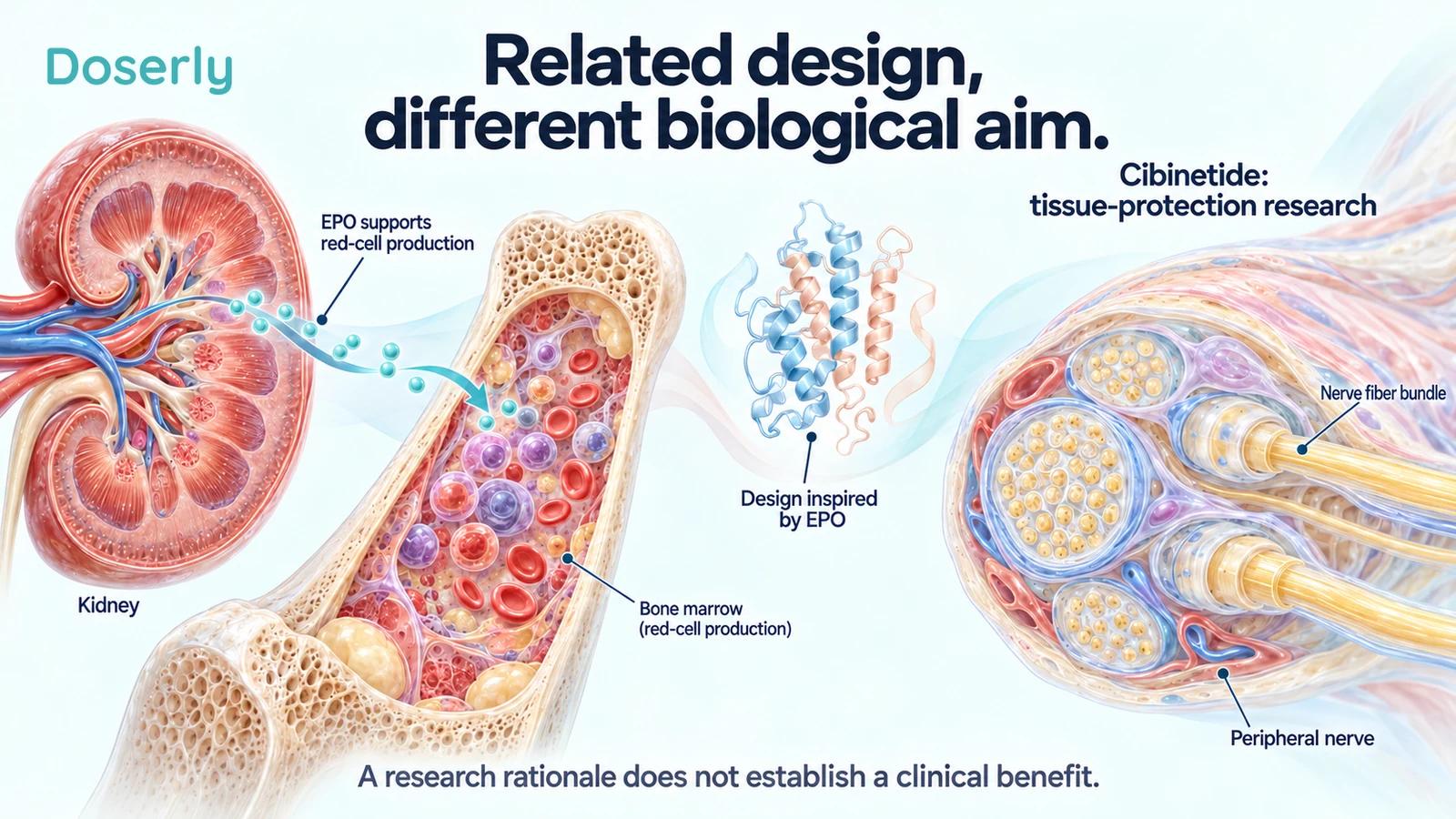
At the same time, laboratory researchers found evidence that EPO and some derivatives could affect injured tissues through pathways not explained solely by making more red cells. That raised a development question: could those activities be separated?
Cibinetide emerged from that line of investigation. Its relationship to EPO is therefore a design history, not evidence that all EPO effects transfer to the peptide.
The receptor hypothesis came before the clinical peptide trials
A 2004 study investigated a proposed tissue-protection receptor involving an EPO receptor component and the common beta receptor subunit, also called CD131.
The researchers used tissue and cell experiments to examine association between these receptor components. They also studied animal injury models in which the common beta subunit was absent. In those models, EPO or carbamylated EPO did not produce the same protective response.
These results supported the hypothesis that a receptor complex distinct from the conventional red-cell pathway could mediate tissue protection. They were preclinical findings, not a trial of cibinetide for human neuropathy. 2004 receptor study
That chronology matters. A paper about EPO and modified EPO cannot be relabeled as proof that ARA-290 treats a particular disease. It can help explain why the later peptide was designed and which biological questions investigators pursued.
The phrase “innate repair receptor” is commonly used in this research program for the proposed tissue-protection complex. It is a mechanistic label, not a guarantee that activating it will repair every injured tissue in a patient.
What “derived from EPO” means here
Proteins are three-dimensional structures. Amino acids that are separated in the linear sequence can appear near one another on a folded surface. A molecule designed to mimic that surface need not reproduce an entire protein or behave like the original protein in every assay.
The 2008 peptide-design paper focused on EPO's helix B region and its outward-facing surface. The investigators described an 11-amino-acid surface-mimicking peptide with tissue-protective activity in experimental models and no erythropoietic activity in the assays they used.
The models included experimental ischemic injury, such as stroke and renal ischemia-reperfusion. These results established a rationale for additional research. They did not establish treatment benefits in people with stroke, kidney disease, or chronic neuropathy. 2008 primary research
“Derived” can consequently be misleading if it suggests that someone simply cuts a short, interchangeable dose out of an EPO medicine. Cibinetide is a designed peptide with its own identity, pharmacology and evidence requirements.
The World Health Organization's naming document lists cibinetide's chemical identity as an eleven-residue peptide. Human research papers also describe ARA-290 as a linear 11-amino-acid peptide. It should not be described as a nine-residue or cyclic peptide. The ring within its terminal pyroglutamate does not make the whole peptide cyclic. WHO nomenclature record, human study methods
A formal chemical name identifies the substance. It does not approve a use, establish a clinical dose, or verify the contents of a product sold under that name.
The two receptor stories answer different questions
In the conventional red-cell pathway, EPO acts through a pair of EPO receptor components. The tissue-protection research concerns a proposed complex involving EPO receptor and CD131 components.
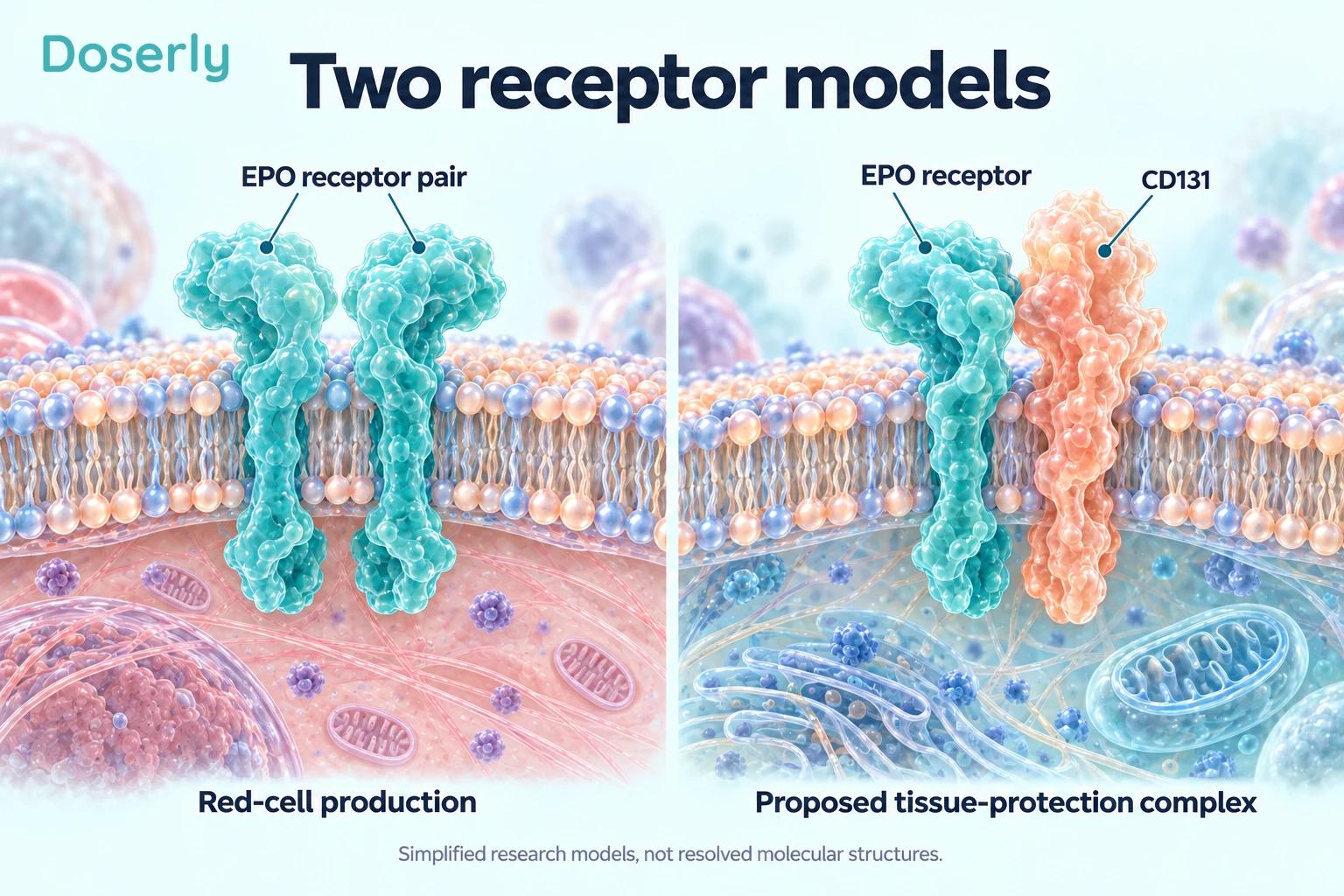
This model helps explain the design aim: preserve selected signaling associated with protection or repair while avoiding stimulation of erythropoiesis.
It does not mean every downstream effect is known. A receptor diagram cannot establish how much compound reaches a relevant human tissue, how disease changes the response, whether a laboratory signal translates into function, or what happens after repeated exposure.
Likewise, the word “selective” describes a pharmacological claim that depends on the experiments performed. It should not be expanded into “acts only where needed” or “cannot affect healthy tissues” without direct evidence.
The useful distinction is between a mechanistic rationale and a demonstrated patient benefit. A plausible rationale makes a clinical trial worth doing. The trial still has to show what happens to symptoms, function, safety and longer-term disease.
What “nonerythropoietic” does—and does not—establish
“Nonerythropoietic” means that a compound does not stimulate red-cell production under the conditions being discussed. In the early peptide work, this was an experimental property used to distinguish the candidate from EPO's familiar hematologic action.
The term is not equivalent to “biologically inactive outside injured nerves.” It does not prove that the compound has no cardiovascular, immune, psychiatric, injection-related or other risk. Different risks require their own observations.
Human data provide a limited additional check. In a small 2012 sarcoidosis pilot, investigators did not find significant differences in hematology or chemistry between the treatment groups, and hemoglobin did not show a treatment-associated increase over the four-week period. That is consistent with the design aim, but a small short study cannot establish lifelong hematologic safety. 2012 randomized pilot
The reverse inference also needs restraint. Epoetin alfa's boxed warnings should not simply be copied onto cibinetide as though the compounds were interchangeable. Nor can they be declared irrelevant on the basis of the word “nonerythropoietic.”
The right question is what safety evidence exists for the actual molecule, population, exposure and outcome being considered.
The human nerve findings were promising but uneven
Cibinetide's best-known clinical work concerns small-fiber neuropathy associated with sarcoidosis. A 2017 randomized phase 2b trial assigned 64 participants to placebo or three active-treatment groups for 28 days.
The middle study group showed a significant increase in corneal nerve fiber area compared with placebo. A skin analysis also found a signal in the length of fibers positive for GAP-43, a growth-associated marker.
However, conventional skin nerve fiber density did not show a significant treatment-group difference. The pain comparison with placebo was also inconclusive, despite an estimated effect favoring treatment in a more symptomatic subgroup. 2017 trial
That combination supports further investigation of nerve biology. It does not establish reliable pain relief, comprehensive nerve restoration, or permanent disease modification. After dosing stopped, the corneal measurement trended back toward baseline.
These distinctions are particularly important when a mechanism explanation is used to sell a clinical conclusion. “Designed to support repair” and “proved to restore nerves and eliminate pain” are separated by several unanswered questions.
Doserly's ARA-290 guide provides additional background on the compound and the human evidence. The mechanism should be read alongside the trial limitations, not used to bypass them.
Diabetes research adds another context, not a universal answer
A separate short trial studied people with type 2 diabetes and neuropathic symptoms. It examined metabolic markers, several symptom questionnaires, sensory testing and corneal nerves.
Some findings favored ARA-290, including the PainDetect questionnaire and changes in metabolic measures. Other symptom instruments did not show the same clear benefit, and the full-group corneal nerve-density change was not statistically significant.
A post hoc subgroup with reduced baseline corneal nerve density had a more favorable within-group result. That is useful for generating a more focused research question, but it is weaker than a prespecified positive comparison in the entire trial population. Type 2 diabetes trial
The study also illustrates why safety cannot be summarized from an abstract alone. Its full report described four serious adverse events in the active-treatment arm, with varying assessments of possible relationship to treatment. One participant stopped treatment after worsening renal function in a setting that also involved a diuretic change.
That report does not prove cibinetide caused each event. It does rule out an uncomplicated claim that the clinical studies recorded no serious events or that the design eliminated safety uncertainty.
Why a research dose is not an EPO conversion
EPO medicines and cibinetide differ in molecular identity, intended biology and supporting evidence. Their quantities cannot be translated by taking the ratio of their molecular sizes or comparing milligrams with the activity units used for an EPO product.
A clinical trial's study-arm dose is a detail of that protocol. It is not an approved prescription for another patient, and it cannot establish equivalence to material supplied outside the trial.
The 2017 dose-ranging result also does not support a simple “higher is stronger” rule. The middle group had the clearest structural signal; the highest group did not demonstrate a statistically significant corneal-area benefit over placebo. Small groups and uncertain estimates prevent that pattern from becoming a universal dosing rule.
For a patient already prescribed an ESA, this research offers no reason to replace it with cibinetide. For someone reading about neuropathy, an ESA prescription does not become an alternative route to the experimental peptide's proposed tissue effects.
What evidence would make the design clinically useful?
A convincing clinical program would need to connect the molecular idea to outcomes in a defined disease. That means sufficient participants, appropriate comparators, prespecified endpoints, meaningful symptom or functional improvement, and follow-up long enough to understand durability.
It would also need to characterize adverse effects, including uncommon events that small trials can miss. In the 2017 sarcoidosis study, one serious event of suicidal ideation in the highest group was considered possibly related. That uncertainty belongs beside the structural nerve signal, not outside the discussion. Full clinical report
No approved cibinetide product was identified in the US FDA approval database during the October 2026 research check. That statement is limited to the US records examined; it is not a claim to have searched every regulator worldwide. FDA approval databases
Cibinetide's connection to EPO is a reason to understand the science carefully. It explains an attempt to separate biological functions. Whether that attempt becomes a dependable treatment depends on clinical evidence that the design itself cannot supply.
Sources
- 2004 EPO receptor research
- 2008 peptide-design study
- WHO cibinetide nomenclature
- Epogen prescribing information
- 2012 sarcoidosis pilot
- 2017 sarcoidosis trial
- Type 2 diabetes trial
- FDA approval databases