
Supplements
October 16, 2026
Chamomile tea and capsules: what the sleep studies actually tested
On this page
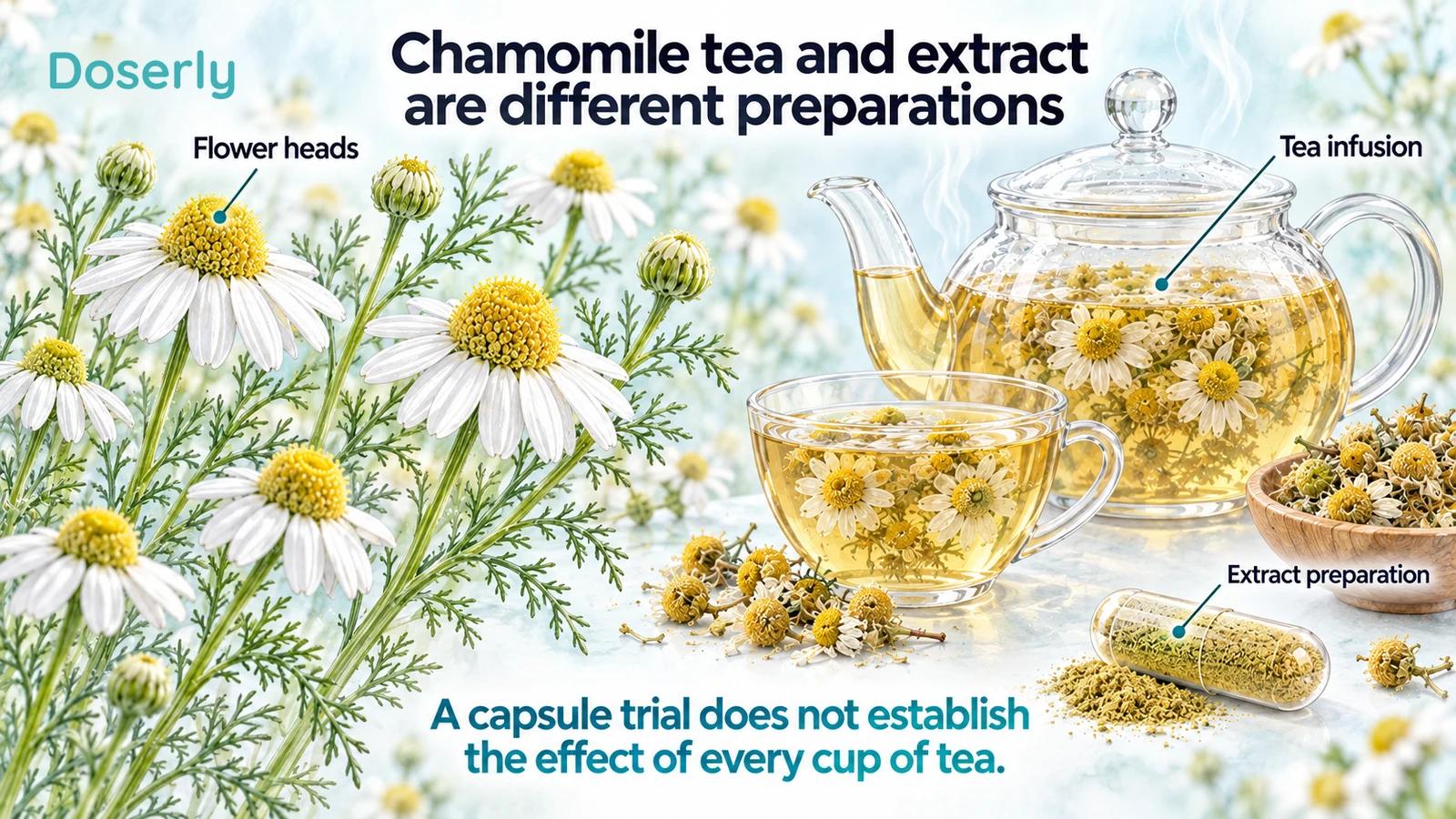
Chamomile is familiar as a warm evening drink, but the name also appears on concentrated extracts, capsules and aromatherapy products. Those preparations do not expose a person to the same mixture in the same way. They also come with different experiences: brewing tea creates a pause and a routine, while swallowing a capsule is a different intervention.
That distinction is central to the sleep research. A small blinded trial of an oral extract in chronic insomnia did not find significant advantages over placebo on its sleep-diary measures. A tea study in postpartum women found some short-term benefits compared with usual care, but the differences did not persist at the later assessment. Neither result can simply be transferred to every chamomile product. Insomnia extract trial and postpartum tea trial
If you enjoy chamomile tea, the question is not whether that enjoyment needs laboratory validation. It is whether the drink, or a supplement marketed alongside it, has been shown to treat the sleep difficulty you want to address. Our chamomile guide introduces the plant; this article follows the human studies across preparations and sleep settings.
The preparation changes the question
A tea infusion extracts some constituents from plant material into water. A standardized extract is manufactured to defined specifications and may concentrate a different mixture. An essential oil contains volatile constituents and, when inhaled, is administered by a different route again.
The label “chamomile” therefore does not identify a single dose or intervention. Even two oral products may differ in plant species, extract composition, accompanying ingredients and the amount actually consumed. The 2011 insomnia trial specifically studied a standardized Matricaria recutita extract; it did not test an ordinary cup of tea. Standardized-extract trial
This is why converting a trial's capsule amount into a number of tea bags is not justified without formulation and extraction data. A capsule's weight is not a universal measure of all biologically relevant constituents, and the weight of dried flowers does not tell you how much enters a finished drink.
For the same reason, an inhalation study should never be read as an instruction to swallow an essential oil. Route is part of the intervention, not a minor product detail. The useful comparison is between the preparation you are considering and the preparation actually studied.
What did the chronic-insomnia capsule trial find?
The 2011 pilot enrolled 34 adults aged 18–65 with primary insomnia lasting at least six months. Participants received 270 mg of chamomile extract twice daily or placebo for 28 days. The trial was randomized and double blind, and the main outcomes came from sleep diaries.
There were no significant between-group differences in changes in total sleep time, sleep efficiency, time to fall asleep, time awake after falling asleep, sleep quality or awakenings. Some estimated effects favored chamomile, but total sleep time favored placebo; the overall pattern was mixed. Adverse-event reports did not differ between groups. Zick and colleagues
A pilot of this size cannot rule out a small benefit. It also cannot support a claim that the extract reliably treats chronic insomnia. The appropriate reading is that the study did not establish a clear advantage on the sleep outcomes it measured.
This matters when a product description selects a favorable estimate from the paper and omits the uncertainty. An effect-size estimate can help plan a larger trial even when the current comparison is inconclusive. That planning value is different from demonstrated benefit for someone deciding what to take tonight.
What did the postpartum tea study find?
The tea study involved 80 Taiwanese postpartum women with poor sleep quality. Forty were assigned to drink chamomile tea for two weeks, and forty received usual postpartum care. The study used questionnaires addressing postpartum sleep, fatigue and depressive symptoms.
Immediately after the intervention, the tea group had better scores on physical-symptom-related sleep inefficiency and depressive symptoms. At the four-week assessment, the groups had similar scores on all three instruments. The report therefore suggested a short-term effect rather than a sustained difference. Chang and Chen, 2016
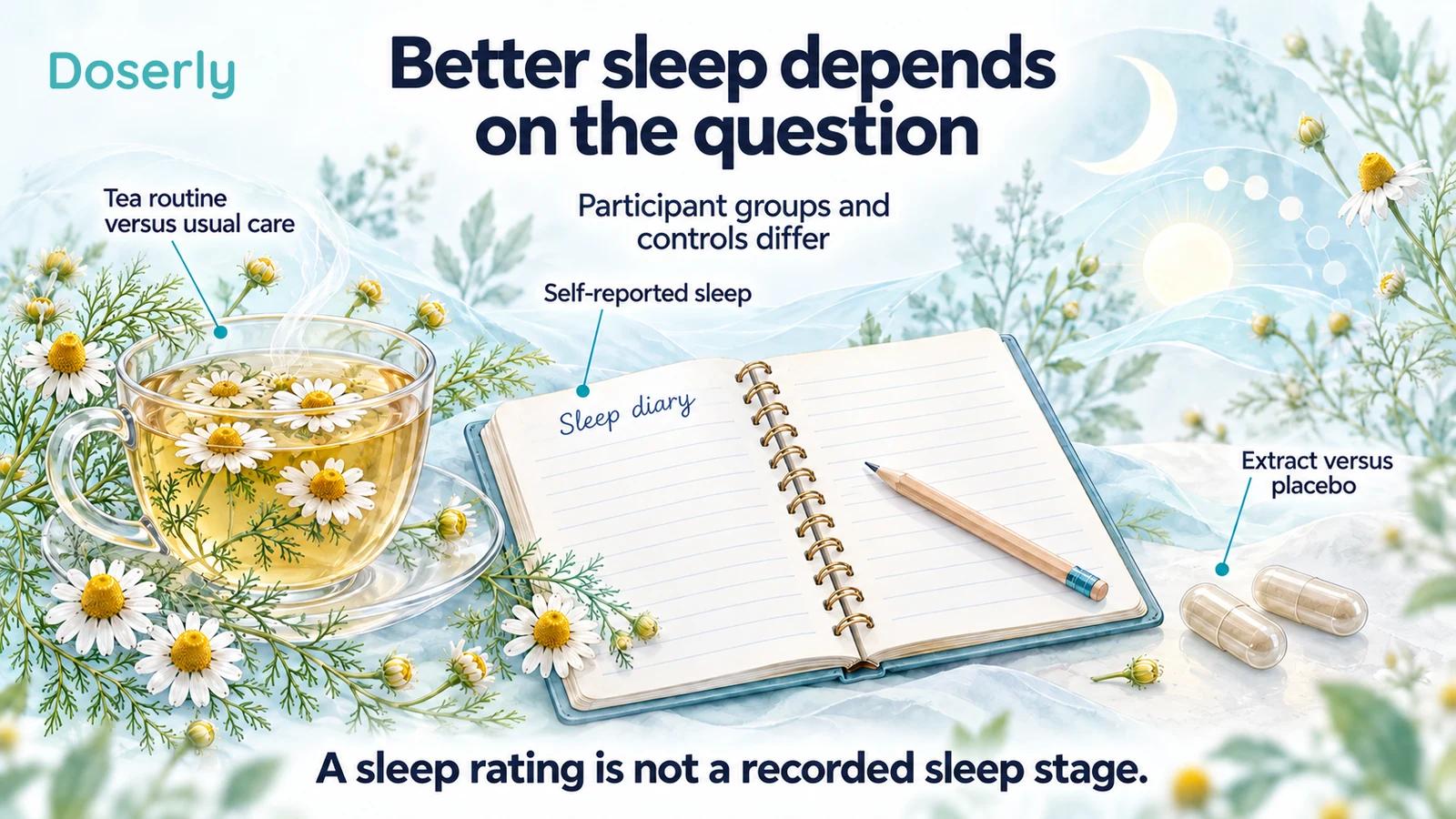
The comparator is crucial. Usual care is not a taste-matched placebo tea. Participants knew whether they had been asked to drink the tea, and the intervention included the experience of preparing and consuming it. The trial cannot cleanly separate the plant's constituents from expectations or the routine surrounding the drink.
That does not make the result meaningless. It answers a practical question about offering a tea routine in that setting. It simply does not answer the narrower pharmacological question of what chamomile compounds alone contributed, or whether a capsule would produce the same experience.
It also cannot establish safety for every breastfeeding parent or infant. A study of maternal sleep is not a comprehensive assessment of transfer into milk, infant effects or rare adverse reactions. Those questions need their own evidence and individual clinical advice.
Why postpartum sleep does not map neatly onto chronic insomnia
The opportunity to sleep matters. A parent may be tired and able to fall asleep but repeatedly awakened by caregiving. Another person may have a quiet opportunity for sleep yet remain awake for hours. Both describe poor sleep, but their immediate problems differ.
Consider what would count as success in each situation. For the parent, practical support and more uninterrupted opportunity may be central. For the person with persistent insomnia, the desired change may be falling asleep during the available window or returning to sleep after waking. A study in one setting cannot tell us that a supplement solves the other problem.
This is a clinical distinction, not a reason to dismiss either person's experience. It helps identify what a questionnaire result actually represents. A lower score could reflect feeling less troubled by physical symptoms, a better routine or a change in sleep itself; the study's measured components determine which interpretation is justified.
When discussing the tea trial, “improved some short-term questionnaire outcomes in postpartum women” is more accurate than “proved chamomile cures insomnia.” The narrower wording preserves what was useful about the research.
What about positive capsule findings in older adults?
A 2017 single-blind randomized study enrolled 60 adults aged at least 60 in an Iranian care setting. Participants received chamomile extract capsules, 200 mg twice daily, or wheat-flour control capsules for 28 days. Sleep quality was assessed with the Pittsburgh Sleep Quality Index, and the treatment group had better sleep-quality scores after the intervention. Older-adult extract trial
This is a positive finding in a different population and with a different preparation and design from the 2011 pilot. It should be included rather than discarded to produce a simple negative story. At the same time, a single-blind questionnaire study is not interchangeable with a blinded chronic-insomnia trial or a laboratory sleep recording.
For an older adult, the result may be worth discussing in relation to their own sleep complaint and medicines. It does not establish a generally effective capsule amount across products, nor does it mean that every cause of nighttime waking responds to the extract.
The studies collectively suggest that the answer may depend on whom you study and what you measure. They do not justify treating a familiar ingredient as though it had one reproducible effect in every setting.
Does newer aromatherapy research settle the issue?
An inhalation trial published in a 2025 journal issue randomized 80 adults aged 18–35 with insomnia to chamomile-oil inhalation or a control group continuing its normal routine. The intervention lasted ten minutes daily for 15 days. Sleep-quality and insomnia-severity questionnaire scores favored the aromatherapy group after treatment. Chamomile-oil inhalation trial
The result is relevant to that inhalation routine. It does not validate tea or oral extract capsules. The control also did not receive an active comparison aroma, so expectations, attention to the routine and the experience of inhaling a scent remain part of the comparison.
A more informative next study could use a suitable comparison routine and examine whether improvements persist, while assessing outcomes important to daily functioning. Until then, the trial adds a preparation-specific signal rather than resolving the whole chamomile-and-sleep question.
This is a common source of confusion when several studies are listed beneath a product claim. Three positive studies using three different routes are not necessarily three replications of the same intervention. Reproducibility requires enough similarity in the treatment and question to make the repeated result meaningful.
Safety is more specific than “it's just tea”
NCCIH notes that chamomile can cause allergic reactions, especially in people sensitive to related plants such as ragweed, chrysanthemums, marigolds or daisies. Interactions with warfarin and some medicines processed by the liver have been reported, while interactions with sedatives are a theoretical concern. Information about use during pregnancy and breastfeeding is limited. NCCIH chamomile guidance
A medication review should include tea when it is consumed regularly for a health effect, as well as concentrated supplements. Bring the actual product and describe how often it is used. This is more informative than treating every preparation as harmless because one is sold in the grocery aisle.
The bleeding concern also deserves precision. A 2023 crossover trial in 12 healthy volunteers compared a week of chamomile tea, extract capsules and placebo. It found no significant effect on prothrombin time or the other coagulation assays examined. These participants were not a test of chamomile combined with warfarin. Healthy-volunteer coagulation trial
That result argues against assuming that chamomile invariably prolongs clotting tests on its own. It does not rule out drug interactions, rare bleeding events or risks in medically complex people. Laboratory reassurance in healthy volunteers and an interaction assessment are different kinds of information.
What makes a bedtime routine worth keeping?
A warm, caffeine-free drink can be something you enjoy without needing to claim that it is a proven insomnia medicine. The relevant personal question is whether the routine fits your preferences and health circumstances, while the clinical question is whether persistent sleep impairment is being addressed.
If you track sleep, focus on a few useful observations: how long it seems to take to fall asleep, how often you wake, how you feel in the morning and whether sleepiness interferes with your day. NHLBI suggests a one- to two-week diary before a clinical visit, including caffeine, alcohol, naps and exercise. NHLBI insomnia assessment
Avoid interpreting one unusually good night as a dependable treatment effect. Sleep varies, and the reason for starting a new routine may be an unusually bad period that would partly improve anyway. A record is useful for describing patterns, not for diagnosing the cause of every change.
For chronic insomnia, AASM strongly recommends multicomponent cognitive behavioral therapy for insomnia. It addresses the behaviors and thought patterns that maintain the condition and is more than generic advice to put away a phone. AASM guideline
Chamomile research gives several specific findings to discuss, but no single result applies equally to tea, extracts and inhaled oil. Keep the preparation, comparison and sleep problem together, and the evidence becomes much easier to use without overpromising what a bedtime drink can do.
Sources
- Zick et al., 2011: standardized extract and chronic insomnia
- Chang and Chen, 2016: postpartum chamomile tea trial
- Older-adult extract trial, 2017
- Chamomile-oil inhalation trial, 2025 issue
- Healthy-volunteer coagulation trial, 2023
- NCCIH: chamomile safety and evidence
- NHLBI: insomnia assessment
- AASM behavioral-treatment guideline, 2021