
Peptides
October 16, 2026
Can semaglutide reduce drinking? What the 2025 and 2026 trials show
On this page
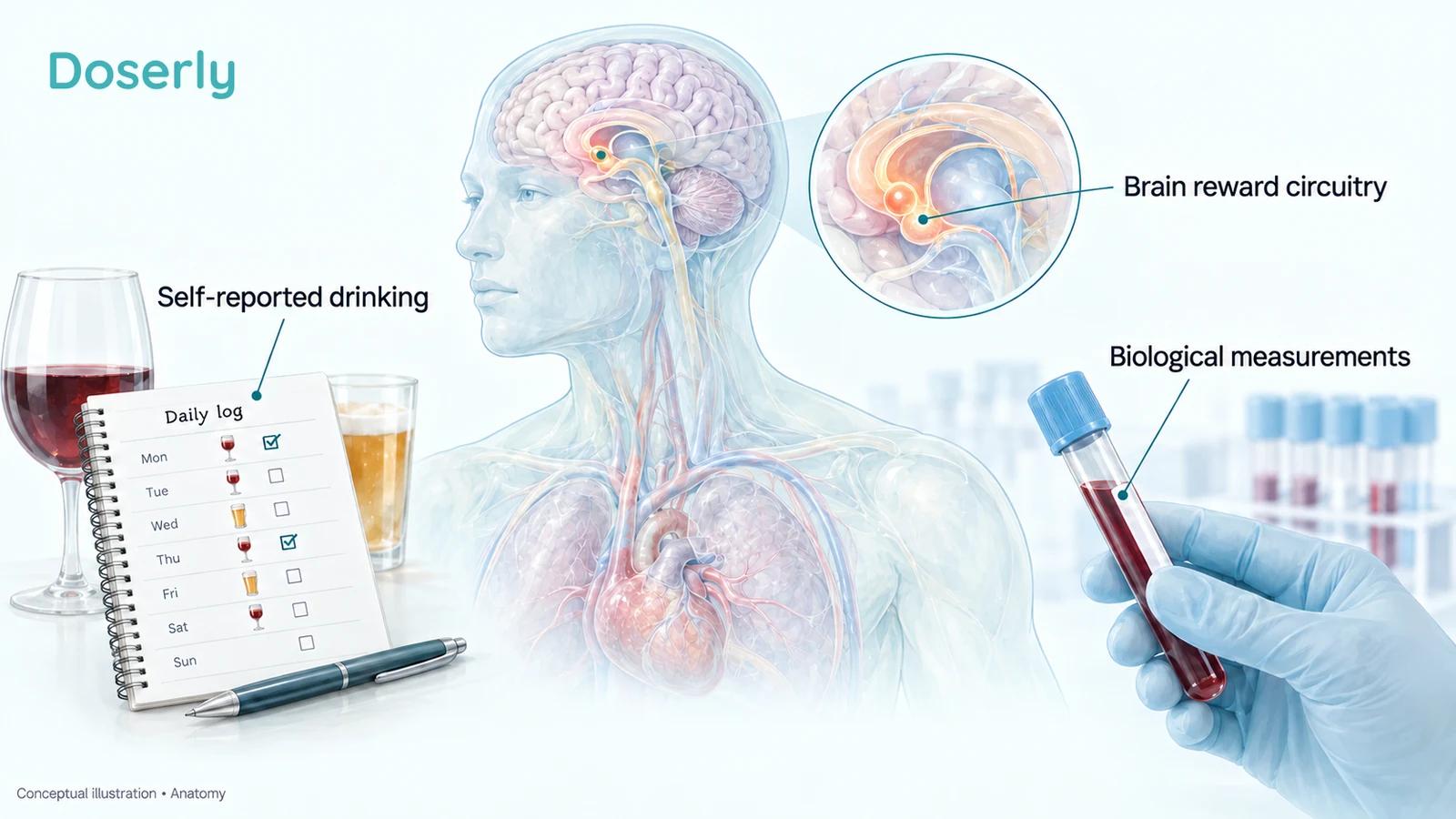
Semaglutide is a GLP-1 receptor medicine best known for diabetes and weight management. Researchers are also studying whether it changes alcohol use. The question is biologically plausible: systems involved in appetite overlap with processes that influence reward and motivation. But being less interested in a drink, drinking less in a laboratory and recovering from alcohol use disorder are different outcomes.
By October 2026, the evidence includes small randomized trials of both injectable and oral semaglutide. Several drinking measures improved. One 2026 trial in people seeking treatment for alcohol use disorder and obesity found fewer heavy-drinking days with semaglutide added to behavioral therapy. Another, testing tablets, did not meet its primary laboratory-craving endpoint. Those findings belong together in an honest explanation of the research. Injection trial and oral trial
For someone worried about drinking, the useful question is what these studies add to available care. They offer reasons for further clinical research, not a reason to postpone established treatment or assume that a weight-loss prescription will manage alcohol withdrawal.
What is alcohol use disorder, and why study GLP-1?
Alcohol use disorder, or AUD, involves difficulty controlling alcohol use despite harmful consequences. It can affect health, relationships and daily functioning. Treatment can involve behavioral approaches, medicines and support that fits a person's needs. NIAAA describes three FDA-approved medicines for AUD: naltrexone, acamprosate and disulfiram. Semaglutide is being investigated for this purpose; it is not among those established AUD approvals. NIAAA treatment overview
The interest in GLP-1 medicines grew from animal research, personal reports and studies of medical records. These provide different kinds of information. Animal experiments can test mechanisms under controlled conditions. Medical records can reveal patterns worth investigating. Randomized human trials can more directly test whether giving the medicine changes drinking compared with a control.
A large 2024 retrospective study associated semaglutide use with fewer recorded new and recurrent AUD diagnoses. The investigators emphasized that the design could not establish causation. People prescribed different medicines may differ in ways that records and statistical matching cannot fully capture, and a recorded diagnosis is not a direct daily measure of drinking. Original electronic-health-record study
That background helps explain why the later trials matter. They moved beyond observing who happened to receive semaglutide and deliberately assigned treatment. Even so, their sample sizes, follow-up periods and endpoints remain important limits.
The 2025 study: a laboratory signal in a small trial
The first trial discussed here randomized 48 adults with AUD to weekly semaglutide or placebo over nine weeks. Participants were not seeking treatment for drinking and were not actively trying to reduce consumption. That makes the study different from an addiction-treatment program. The primary laboratory comparison followed eight weeks of treatment, before the final week's planned dose increase. Hendershot and colleagues, JAMA Psychiatry
Semaglutide reduced alcohol consumed during the laboratory self-administration session and peak breath-alcohol concentration. The reported standardized effect for grams consumed was −0.48, with a confidence interval of −0.85 to −0.11. This is a statistical effect measure, not a 48% reduction in drinking. The paired laboratory analysis involved only 25 participants with complete procedure data, although 48 were randomized.
Weekly reports offered a more mixed picture: drinks per drinking day and craving improved, while drinks per calendar day and the number of drinking days did not show clear treatment effects. There was also evidence of a greater reduction in heavy-drinking days over time. Primary results and figure notes
The study supports an early signal, especially for the amount consumed on occasions when participants drank. It doesn't show that the participants stopped drinking altogether, or that an effect in a controlled session translates into years of recovery. The small number completing the laboratory comparison makes replication particularly important.
Why the drinking measure changes the interpretation
Consider a hypothetical person who drinks on three days in one week. If they consume fewer drinks each time but still drink on three days, their drinks per drinking day falls while their number of drinking days stays the same. If a second person drinks less often but consumes the same amount on each occasion, a different measure changes.
A heavy-drinking-day outcome asks how often consumption crosses a defined threshold. A craving questionnaire asks about an experience, such as an urge to drink. Neither is simply another name for total alcohol consumption. A person can experience less craving without becoming abstinent, and a person can reduce drinking while still finding cravings difficult.
These examples are not trial data. They explain why a study can report a worthwhile improvement in one endpoint and no significant improvement in another without contradicting itself. For treatment planning, it helps to decide what change would be useful and then measure that change directly.
It also matters whether craving is measured during daily life or in response to alcohol cues in a laboratory. The environments differ. A carefully controlled cue task can test one response, while weekly self-reports capture a broader experience with less experimental control.
The 2026 injection trial: treatment seekers with obesity
A Danish single-center trial enrolled 108 adults with moderate to severe AUD and obesity. Participants received semaglutide, targeting 2.4 mg weekly, or placebo for 26 weeks. Both groups also received standard cognitive behavioral therapy. This study therefore examined adding medication to a treatment program, not medication replacing that program. Klausen and colleagues, Lancet
Eighty-eight participants completed the full intervention. The analysis included all randomized participants and used multiple imputation to address missing outcome data. Heavy-drinking days declined in both groups. The reported estimated treatment difference was −13.7 percentage points, with a 95% confidence interval from −22.0 to −5.4, favoring semaglutide. Gastrointestinal adverse effects were more frequent with semaglutide and were generally transient and mild to moderate.
The paper reported within-group changes of −41.1 and −26.4 percentage points. Simply subtracting these gives −14.7, which is not the same as the reported model-estimated difference. The trial's adjusted estimate should be reported as given, rather than silently replaced by subtraction of displayed group summaries. Trial abstract and analysis description
This is more directly relevant to clinical treatment than a brief laboratory experiment, because participants wanted help and received care over six months. It still leaves questions about people without obesity, different care settings, longer treatment and what happens after stopping. Those are reasons to define the population carefully, not reasons to dismiss the improvement observed.
The 2026 oral trial: a missed primary endpoint and useful secondary findings
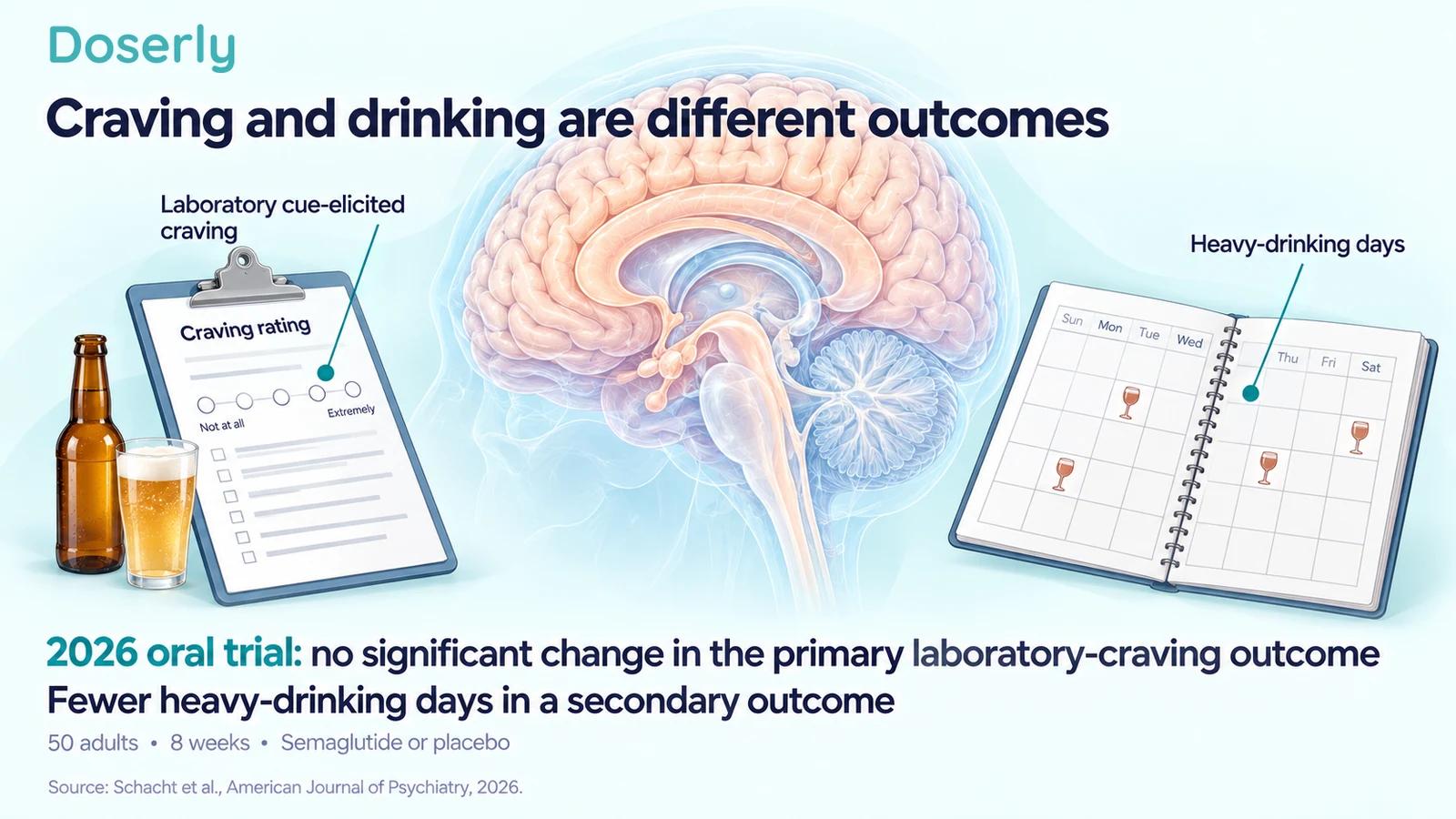
A separate phase 2 trial randomized 50 treatment-seeking adults with moderate to severe AUD to oral semaglutide or placebo for eight weeks. Participants had a BMI of at least 25. The tablet regimen was 3 mg daily for four weeks and 7 mg daily for four weeks. These are study details, not instructions for treating AUD. Schacht and colleagues, American Journal of Psychiatry
The main endpoint was alcohol cue-elicited craving in a laboratory at week six. It did not differ significantly between groups. In the last four treatment weeks, heavy-drinking days improved with semaglutide, but drinks per day did not show a statistically clear difference. Other analyses suggested improvements in drinks per drinking day and naturally occurring craving.
Forty-seven participants completed treatment. Three withdrew, all from the semaglutide group; one had an allergic reaction considered probably related to the study medicine. The short duration and small sample limit what can be concluded about uncommon harms or sustained recovery. Original oral-trial report
A fair summary gives the unsuccessful primary result the same prominence as the encouraging drinking results. Saying the trial “proved semaglutide reduces craving” would conceal that its prespecified laboratory-craving test was negative. Saying it showed no useful signal would conceal the secondary findings. The next studies need to resolve that uncertainty with endpoints and follow-up designed for clinical treatment.
Can the injection and tablet results be compared directly?
They cannot establish which route is better. The studies differed in duration, eligibility, behavioral care and the outcome selected as primary. The injection studies also used different exposure schedules. Their results do not form a dose-response experiment in which everything except dose was held constant.
Oral and injected milligrams are not interchangeable because absorption differs. Our semaglutide guide's formulation section explains why a daily tablet number cannot be converted into a weekly injection number by simple arithmetic. Using those numbers to design an untested AUD regimen would go beyond these studies.
The samples were also selected. A result in adults with obesity and AUD may not apply to someone at a low body weight, with severe malnutrition or with medical conditions that excluded them from participation. These are especially important considerations in alcohol-related care, where nutritional and medical needs can vary substantially.
Does less drinking mean lasting recovery?
Reduced heavy drinking can be meaningful, but the trials do not answer every outcome a person might care about. Sustained recovery could include better functioning, fewer alcohol-related problems, improved health and achieving the person's treatment goals over time. It takes longer observation to learn whether improvements persist after medication changes or discontinuation.
The placebo comparison is also essential. Drinking improved in both arms of the Danish study. Behavioral therapy, contact with a treatment team, expectations and other changes can contribute. The between-group result estimates what the medication added under those study conditions; the entire improvement in the active group cannot be attributed to semaglutide alone.
Likewise, personal reports of reduced interest in alcohol can be real and worth discussing. They do not establish the reason for the change or predict what will happen in another person. A useful clinical record includes drinking patterns, cravings, symptoms and other treatment changes, rather than a single overall impression.
What should someone concerned about drinking do now?
The research is a good topic to raise with an addiction clinician or primary-care professional, particularly if semaglutide is already being considered for another indication. It should be discussed alongside established medication and behavioral options, not treated as the only possible next step. NIAAA's treatment resources explain how to find evidence-based care. Treatment options
If you have been drinking heavily for a prolonged period, stopping suddenly can cause dangerous withdrawal. Get medical advice about a safe plan; these semaglutide trials do not establish a treatment for withdrawal. NIAAA withdrawal guidance
Bring specific questions: Is reducing heavy-drinking days my current goal, or am I aiming for abstinence? Do I need withdrawal management first? Which established treatments fit my history? If semaglutide is prescribed for another condition, how will we monitor nutrition, tolerability and drinking without assuming one change explains another?
The 2025 and 2026 findings make semaglutide a serious research candidate for AUD. They also show why the endpoint matters. The strongest practical reading is that several trials found reductions in some drinking measures, while questions about primary craving outcomes, broader populations and long-term recovery remain open.
Sources
- Hendershot et al., JAMA Psychiatry, 2025: 48-person injection trial, including laboratory and weekly outcomes.
- Klausen et al., Lancet, 2026: 108-person trial with obesity, AUD and background behavioral therapy.
- Schacht et al., American Journal of Psychiatry, 2026: 50-person oral trial with a nonsignificant primary endpoint.
- Wang et al., Nature Communications, 2024: observational medical-record analysis.
- NIAAA: finding treatment: approved medication and behavioral options.
- NIAAA: evidence-based treatment: clinical treatment context.
- NIAAA: treatment and withdrawal questions: safe access to care.