
Peptides
October 16, 2026
Can ipamorelin trial safety be applied to long-term use?
On this page
A study can describe a treatment as well tolerated without establishing that it is safe for months or years. For ipamorelin, this distinction is central because the main published human studies involved brief intravenous exposure, including treatment during recovery from bowel surgery.
Those studies provide information about what happened under their particular conditions. They do not establish the long-term safety of repeated subcutaneous use, a different formulation, or a combination with other peptides. FDA's assessment identifies substantial gaps in those areas. Human pharmacology study; postoperative trial; FDA briefing.
This does not mean every user will experience harm. It means the evidence cannot support a reliable assurance of long-term safety. Understanding what was observed, what remains unknown and what product differences matter makes the discussion more useful than a simple “safe” or “unsafe” label.
What does “well tolerated” usually describe?
Tolerability concerns the unwanted effects experienced during a study and whether participants could continue treatment. It is related to safety, but it is not a lifetime guarantee.
A short study may identify immediate symptoms, laboratory changes or problems severe enough to stop treatment. It may be unable to characterize uncommon events, cumulative effects or outcomes that take longer to appear.
The interpretation also depends on the participants. People recovering from major surgery already face risks related to their illness, operation and other treatments. A favorable overall description in that setting cannot be transferred directly to healthy people seeking improved sleep or body composition.
The most useful reading therefore keeps the phrase attached to its context: this formulation, route, population and period of observation. Removing those details makes the conclusion broader than the study.
What human exposure has been published?
The 1999 pharmacology study administered intravenous ipamorelin to healthy men at five dose levels, with eight men at each level. It characterized drug concentrations and growth hormone release over time. The estimated terminal half-life was approximately two hours. Original study.
That study was informative about acute pharmacology. It did not establish the consequences of recurring exposure over months, nor did it measure every safety outcome relevant to long-term use.
The randomized postoperative study enrolled 117 patients, with 114 in the safety and modified intention-to-treat populations. Participants received intravenous ipamorelin or placebo twice daily, beginning after surgery and continuing until discharge or a maximum treatment period of seven days. Clinical trial.
Even seven days is very different from ongoing use. There is no valid arithmetic that turns a week of observed tolerability into a guaranteed safe number of treatment cycles.
What adverse events occurred in the surgical trial?
The publication reported at least one treatment-emergent adverse event in 87.5% of ipamorelin recipients and 94.8% of placebo recipients. A treatment-emergent event happens after treatment begins; the term does not by itself mean the drug caused it.
Those high percentages are understandable in a postoperative population, where symptoms and complications are common. The lower overall percentage with ipamorelin should not be interpreted as proof that it protects against adverse events.
FDA's detailed review reports that certain individual events were numerically more frequent with ipamorelin. Hypokalemia, or low blood potassium, occurred in 12.5% versus 3.4%; insomnia in 10.7% versus 5.2%; and hyperglycemia at discharge in 14.3% versus 8.6%. These are descriptive study findings, not precise risk estimates for a different population. FDA safety review.
The distinction between the overall count and individual events matters. One aggregate percentage can conceal differences in the type and severity of events. Safety assessment needs the details, not just the most reassuring summary.
How should the serious events and deaths be described?
FDA reports serious adverse events in ten ipamorelin recipients and nine placebo recipients, including infections and postoperative complications. Two participants in the ipamorelin group experienced fatal events following complicated postoperative courses.
FDA explicitly states that it is unclear whether the deaths were related to ipamorelin. That uncertainty should stay next to any mention of them. FDA briefing.
It would be inaccurate to say the study proves that ipamorelin caused the deaths. It would also be inaccurate to say that no serious events occurred because the paper described treatment as well tolerated.
The appropriate account preserves the observed events and the unresolved attribution. Major surgery and underlying disease create competing explanations, while a small study cannot confidently settle uncommon drug-related risks.
This is why the same trial can contain a generally favorable tolerability statement and still leave important safety concerns. They address different levels of certainty.
Does a different injection route solve the problem?
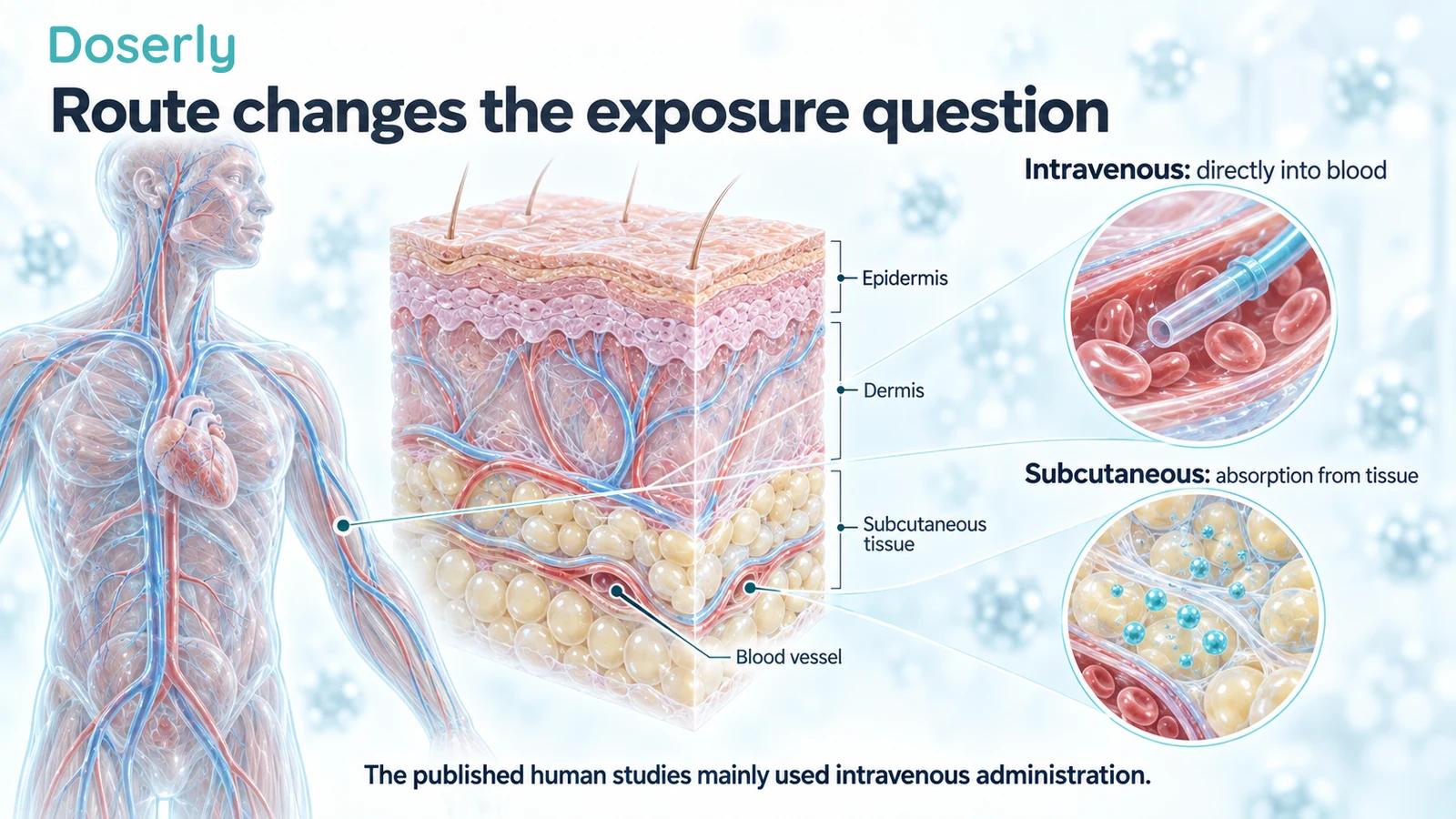
A route change does not automatically make a drug safer. Intravenous administration places it directly into circulation. Subcutaneous administration involves absorption from tissue before systemic exposure. The concentration pattern, local tissue exposure and formulation requirements can differ.
FDA's ipamorelin review found insufficient safety information for the proposed subcutaneous use. That gap cannot be filled simply by assuming that a slower route is gentler or that a smaller-looking injection produces proportionately less risk. FDA assessment.
A published half-life is also route- and study-dependent information. It describes drug disposition under measured conditions, not how long every biological effect lasts or how long someone must wait to avoid risk.
The same principle applies to nasal products or blends. Their names may contain ipamorelin, but that does not make them equivalent to the material administered in a monitored intravenous trial.
Why product quality is a separate safety question
A molecule's intended action and a product's quality are different issues. A formulation can introduce risks through contamination, incorrect concentration or changes in the peptide during preparation and storage.
FDA emphasizes that compounded drugs are not FDA-approved and are not reviewed for safety, effectiveness and quality before marketing in the same way as approved products. This does not mean every compounded medicine is defective; it means that “compounded” is not a synonym for “FDA-approved.” FDA compounding information.
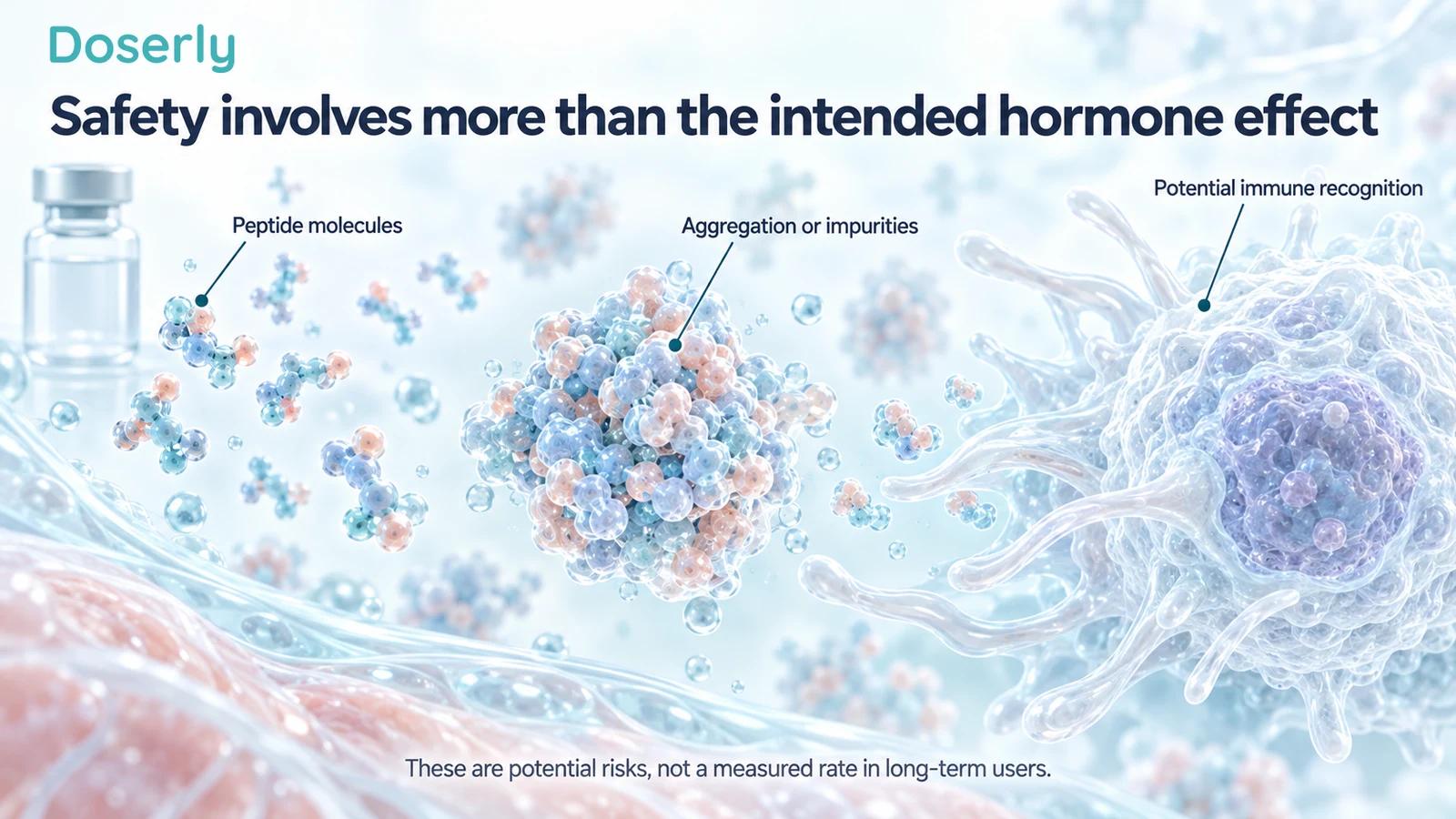
For ipamorelin specifically, FDA discusses aggregation, peptide-related impurities and complexity in characterizing the substance. Aggregation means molecules collecting into larger groupings. Such changes may affect immune recognition. FDA peptide-risk information.
A laboratory certificate or a familiar product name cannot replace clinical evidence for the final formulation and route. Quality controls are important, but they answer a different question from whether long-term exposure improves health with acceptable risk.
What does immunogenicity mean here?
Immunogenicity is the potential to provoke an immune response. For a peptide product, the concern can involve the molecule itself, aggregates or impurities. An immune response may be influenced by how the product is made, stored and administered.
FDA identifies potential immunogenicity concerns for certain ipamorelin routes, but the available evidence does not provide a dependable percentage for long-term users. A conceptual concern should not be reported as a known rate of allergy or antibody formation. FDA risk information.
Conversely, the absence of a noticeable reaction after an early exposure does not establish that future exposures are risk-free. Different safety questions require different observation periods.
This helps explain why a five–amino acid peptide is not automatically harmless because it is small. Molecular size is one characteristic; the clinical product and the immune system's response involve more than that.
Can related GH treatments tell us what to watch for?
Related treatments can identify issues worth studying, but their risk rates cannot be assigned directly to ipamorelin. For example, a longer randomized MK-677 study in older adults found changes in glucose regulation and reported appetite increases, swelling and muscle pain. MK-677 is a different ghrelin mimetic. MK-677 trial.
FDA also notes that insufficient data exist to conclude ipamorelin would avoid safety concerns associated with drugs that stimulate the GH system, including glucose intolerance. That is a statement about uncertainty and biological relevance, not proof that every class-related effect occurs with identical frequency. Ipamorelin briefing.
The balanced approach is to use related evidence to guide questions, while keeping the direct ipamorelin evidence separate. Neither reassurance nor alarm should be imported wholesale from another drug.
Why combinations make long-term assessment harder
If ipamorelin is combined with CJC-1295, another hormone or several peptides, the safety question becomes a question about the combined exposure. Individual studies cannot establish that the effects simply add together or that one compound offsets another's risks.
Combinations also complicate attribution. A change in symptoms or laboratory results may be related to one ingredient, several ingredients, a product-quality issue or an unrelated condition.
A normal monitoring result at one visit cannot validate every aspect of the combination. Monitoring can identify certain changes; it cannot guarantee that unmeasured or delayed risks are absent.
This is another reason to ask for evidence on the actual formulation and treatment context rather than relying only on the presence of a familiar peptide name.
What information is useful in a clinical conversation?
Bring a complete list of medicines, supplements, peptides and hormones, including the exact product and route. Describe the goal of treatment, when exposure began and any changes in symptoms.
A dated record can be useful for identifying patterns. It should include symptoms that seem inconvenient or unrelated, not only the improvements someone hoped to see. Laboratory findings should be interpreted by a clinician in context rather than used to justify escalating exposure.
Ask which risks are established, which are plausible but unquantified, and which have not been adequately studied. These categories are different. A good explanation should be able to acknowledge a gap without replacing it with either a guarantee or a certainty of harm.
Also ask what benefit is expected. When the benefit for the intended use is unproven, even a modest or uncertain risk deserves a different discussion than it would for an established treatment of a serious disease.
What would better long-term evidence require?
Useful studies would need a clearly identified formulation, the intended route, enough participants and sustained follow-up. They would record both common tolerability problems and clinically important outcomes, including after treatment stops.
They would also need to examine the population in which the drug is being proposed. Healthy adults, people with metabolic disease and postoperative patients cannot be assumed to have identical risk profiles.
The present evidence does not provide that complete picture for chronic ipamorelin use. Short monitored studies remain valuable, but their conclusions have boundaries. Our ipamorelin guide explains the broader research context; the most important safety question is whether the evidence matches the product, duration and person being considered.
Explore the research
- Pharmacokinetic-pharmacodynamic modeling of ipamorelin, a growth hormone releasing peptide, in human volunteers (1999): Acute intravenous study; no chronic sleep or muscle efficacy endpoints.
- Prospective, randomized, controlled, proof-of-concept study of the Ghrelin mimetic ipamorelin for the management of postoperative ileus in bowel resection patients (2014): Abstract via Europe PMC freshly reviewed; full safety details cross-checked against FDA; small heterogeneous surgical sample.
- FDA Briefing Document: Ipamorelin-Related Bulk Drug Substances, October 29, 2024 (2024): Advisory briefing, not itself a final legal determination; safety events do not prove causality.
- Certain Bulk Drug Substances for Use in Compounding that May Present Significant Safety Risks (2026): Dynamic regulatory page; not a quantitative individual risk estimate.
- Understanding the Risks of Compounded Drugs (accessed 2026): General compounding guidance; does not establish a defect in a specific product.
- Effects of an oral ghrelin mimetic on body composition and clinical outcomes in healthy older adults: a randomized trial (2008): MK-677, not ipamorelin; functional outcomes underpowered.