
Peptides
October 16, 2026
Can gonadorelin counter testosterone-related fertility suppression?
On this page
Gonadorelin should not be treated as a proven safeguard against fertility suppression during testosterone therapy. It can stimulate pituitary hormone release, and pulsatile treatment can induce sperm production in selected men with deficient GnRH signaling. Neither fact establishes that occasional gonadorelin injections preserve sperm production while a person continues taking testosterone.
The distinction matters because testosterone treatment can improve blood testosterone and symptoms while reducing the hormonal signals needed for sperm production. Feeling better, having a reassuring blood result or noticing a change in testicular size does not establish that fertility has been preserved.
Here we examine the human physiology, the relevant hCG studies and the gap between congenital hormone-deficiency research and ongoing testosterone exposure. The Doserly gonadorelin guide explains the peptide's established research settings and delivery patterns.
Why testosterone can reduce sperm production
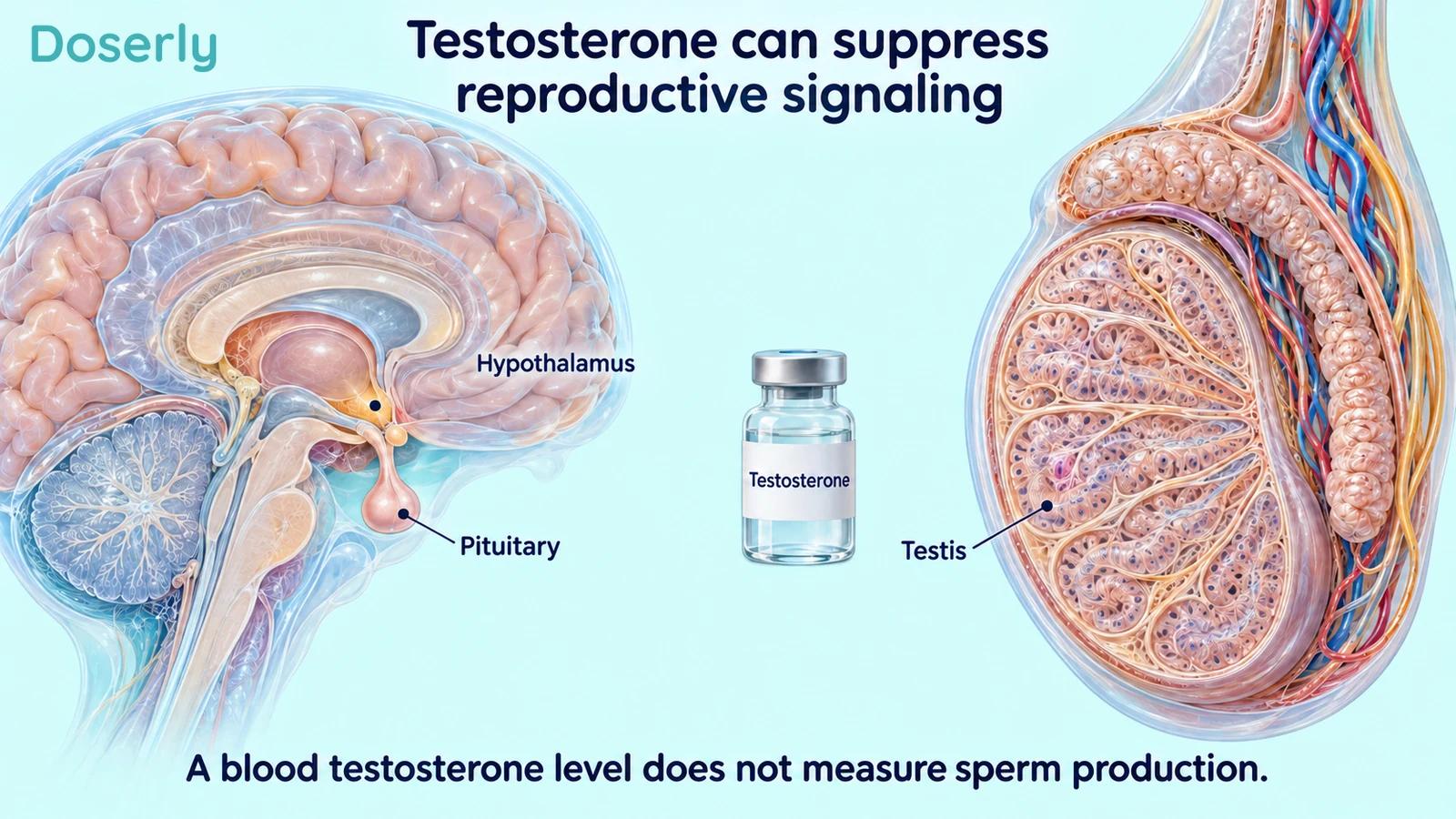
The reproductive hormone system uses feedback. The hypothalamus releases gonadotropin-releasing hormone, or GnRH, which stimulates the pituitary to release luteinizing hormone (LH) and follicle-stimulating hormone (FSH). These signals support different aspects of testicular function. Testosterone and related sex-steroid signals feed information back to the brain and pituitary.
Administered testosterone can suppress gonadotropin signaling. A controlled physiological study in 29 men demonstrated marked suppression of LH and FSH during testosterone administration. In the testosterone-plus-placebo group, testosterone inside the testes fell substantially even though testosterone was being supplied from outside the body. Coviello and colleagues, 2005.
This explains the apparent paradox. A treatment can raise testosterone in the bloodstream while reducing the local hormonal environment supporting sperm production. Blood testosterone and intratesticular testosterone are different measurements; neither should be casually substituted for a semen analysis.
The Endocrine Society recommends against testosterone therapy in men planning fertility in the near term. That recommendation makes fertility planning part of the treatment decision, rather than a problem to address only after a reassuring testosterone result. Endocrine Society testosterone guideline.
Adding GnRH does not erase every feedback effect
Gonadorelin provides a GnRH signal to the pituitary. It is tempting to reason that adding the missing signal must simply switch the reproductive system back on. Human physiology is less straightforward.
A 1991 experiment studied six men with complete GnRH deficiency whose pituitary–gonadal function had been normalized using long-term pulsatile GnRH, alongside six men with normal reproductive function. During a short testosterone infusion, LH and FSH fell even in the GnRH-deficient group receiving controlled GnRH stimulation. The finding supported a pituitary suppressive effect of testosterone and/or its metabolites, in addition to hypothalamic feedback. Finkelstein and colleagues, 1991.
The study also found that suppression depended on the GnRH challenge conditions. It was a small, short physiological experiment, not a trial of fertility preservation during contemporary testosterone treatment. It does not prove that every possible gonadorelin regimen must fail. It does show why replacing an upstream signal is not enough, by itself, to establish protection from ongoing feedback.
A large response to a pharmacological challenge can therefore coexist with uncertainty about everyday hormone output. The size of a brief LH peak does not answer whether stimulation remains adequate between administrations or whether sperm production is maintained over months.
What pulsatile gonadorelin fertility studies actually tested
The strongest clinical rationale for pulsatile GnRH is replacement of deficient hypothalamic signaling in appropriately selected patients. That is not the same condition as deliberate ongoing exposure to exogenous testosterone.
In a small nonrandomized comparison, 28 men with congenital hypogonadotropic hypogonadism and azoospermia received either a gonadorelin pump or cyclical hCG plus human menopausal gonadotropin. Sperm appeared earlier in the pump group under the study conditions. The intervention was a repeated pulsatile treatment program for congenital deficiency, not occasional gonadorelin added to ongoing testosterone therapy. Zhang and colleagues, 2019.
Previous testosterone treatment in a participant's history does not change that distinction. A paper can include men who previously received testosterone without testing concurrent testosterone and gonadorelin as a fertility-preservation combination. The timing of exposure is part of the research question.
Similarly, an older comparison favored pulsatile pump delivery over twice-daily injections in selected men with idiopathic hypogonadotropic hypogonadism. That finding cautions against transferring pump outcomes to less frequent administration. It does not supply direct evidence for a testosterone add-on regimen. Shargil, 1987.
The primary-source search for this article did not identify a controlled human study establishing that occasional gonadorelin injections preserve semen parameters or pregnancy outcomes during ongoing testosterone treatment. That is a statement about the evidence located, not proof that no unpublished experience exists or that every conceivable regimen is ineffective.
Why hCG evidence cannot be relabeled as gonadorelin evidence
Human chorionic gonadotropin, or hCG, acts mainly like LH at the gonads. In men, it stimulates Leydig cells directly. Gonadorelin acts one level upstream at the pituitary. The two interventions therefore encounter different parts of the feedback system. PREGNYL prescribing information.
In the 29-man study described above, adding hCG supported intratesticular testosterone in a dose-dependent manner during three weeks of testosterone-induced gonadotropin suppression. This is direct evidence about hCG and a local hormonal endpoint. It is not evidence about gonadorelin, and three weeks is insufficient to establish long-term fertility preservation. Coviello and colleagues, 2005.
A separate retrospective series followed 26 hypogonadal men receiving testosterone plus hCG. None became azoospermic during the reported follow-up, and nine contributed to pregnancies with their partners. The study assessed clinically closer outcomes, but it remained small and uncontrolled. Its findings cannot guarantee protection for every man, and they cannot be transferred to a different molecule. Hsieh and colleagues, 2013.
The distinction is useful when evaluating a clinic's explanation. A citation about hCG may support considering hCG in a specific specialist plan. It does not establish that gonadorelin is an equivalent replacement because both are described as reproductive hormones.
Preserving function and recovering function are different questions
Three situations are often blended together: supporting fertility during ongoing testosterone use, recovering sperm production after testosterone is stopped and treating a pre-existing congenital hormone deficiency. They should be evaluated separately.
A large integrated analysis used individual data from 30 hormonal male-contraception studies, involving 1,549 healthy men. After treatment ended, the median time to recovery to a sperm concentration of 20 million per milliliter was 3.4 months. Recovery varied across participants and regimens. Liu and colleagues, 2006.
These data are useful evidence that suppression can be reversible under the studied conditions. They do not promise the same timetable after years of testosterone treatment, in a man with an underlying infertility disorder or after unrecorded combinations of androgens. The threshold was a semen endpoint, not a guarantee of conception.
Most importantly, recovery after withdrawal does not demonstrate that an add-on prevented suppression while testosterone continued. If several medications are changed at once, an eventual semen improvement cannot be confidently assigned to gonadorelin without an appropriate comparison.
What evidence would answer the add-on question?
A convincing study would need to enroll men receiving a clearly described testosterone regimen and measure semen before and during the proposed gonadorelin add-on. It would need enough follow-up to assess sustained sperm production, an appropriate comparison group and explicit reporting of treatment changes and adherence.
The study should distinguish men with normal baseline semen from those already suppressed or infertile. Preserving an existing sperm count and restoring an absent one are different outcomes. It should also report the actual gonadorelin delivery pattern, because a pump and occasional injections are not interchangeable exposures.
Hormonal measurements would help explain the mechanism, but semen outcomes would be necessary for a fertility-preservation claim. Pregnancy data could add useful information while acknowledging partner factors and the number of couples actually trying to conceive. These are requirements for stronger evidence, not a tested protocol readers should attempt themselves.
What monitoring can and cannot establish
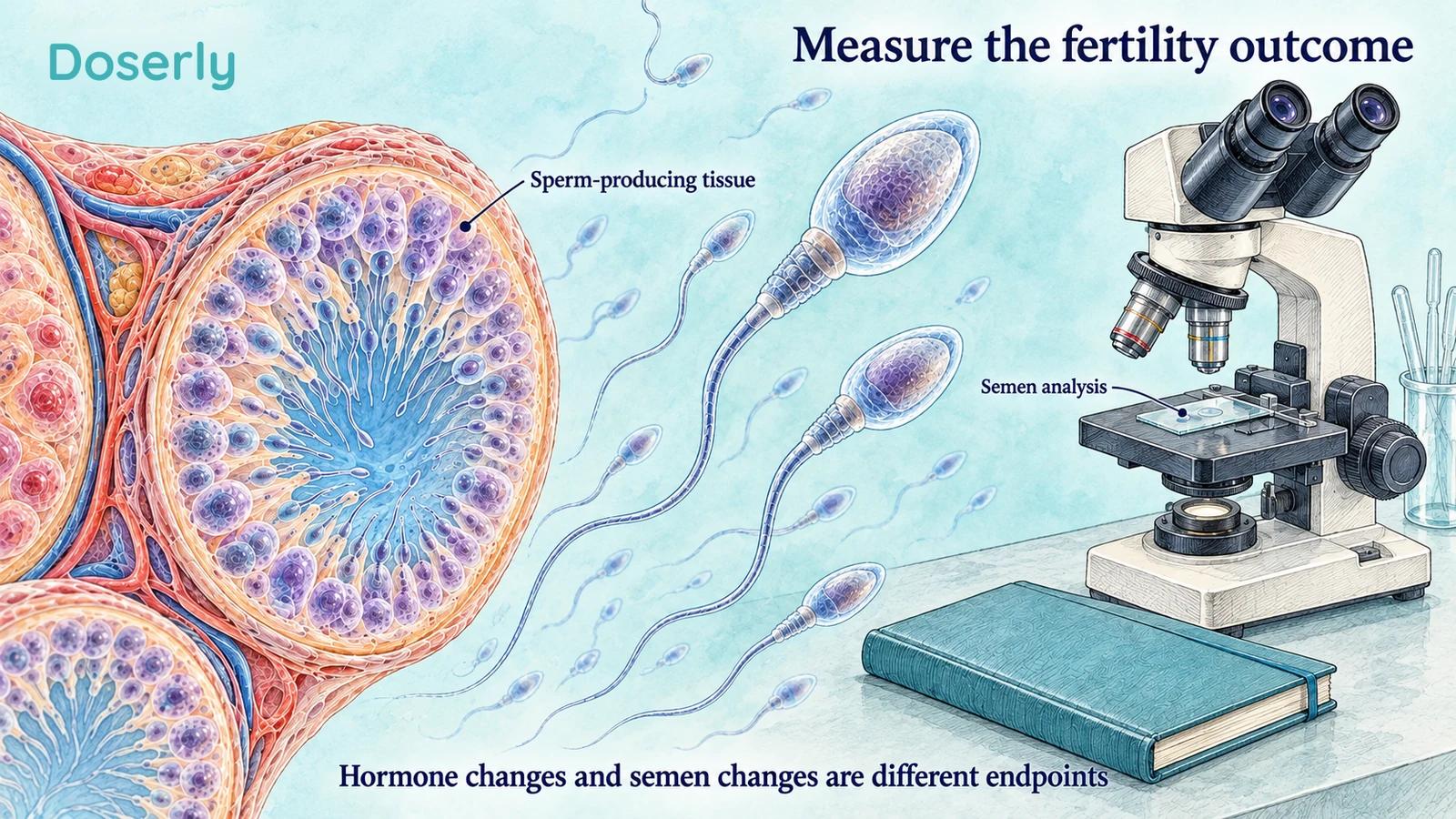
Semen analysis provides information that testosterone, LH and FSH alone cannot supply. Male infertility guidance uses semen assessment together with clinical history, examination and indicated hormonal or other investigations. Evaluation of both partners is relevant when conception is the goal. EAU male infertility guideline.
A semen result still needs interpretation. The collection conditions, laboratory method, prior results and treatment timeline all affect what a change means. One satisfactory sample is not a lifetime guarantee. Conversely, an abnormal sample should prompt assessment rather than an assumption that a particular peptide dose is too low.
Subjective measures are even less specific. Libido, energy, ejaculation volume and perceived testicular size may matter to a patient, but they cannot establish sperm concentration or motility. A treatment plan that claims to preserve fertility should identify how fertility-related function will actually be measured.
It is useful to record the exact products and schedules, when testosterone began, prior semen results and any medication changes. This gives the clinician a usable timeline. It does not turn personal tracking into a controlled trial or establish causation when several things change together.
If fertility matters now or may matter later
The first step is to tell the prescribing clinician about the reproductive goal and its timing. Someone actively trying to conceive has a different decision to make from someone considering children several years from now. Both deserve a discussion before relying on an unproven add-on as insurance.
That conversation may involve a reproductive urologist or endocrinologist, assessment of the original reason for testosterone treatment and discussion of fertility-preservation options. The appropriate plan depends on the diagnosis and available evidence. Abruptly changing prescribed hormones or adding products without that assessment can make both symptoms and laboratory results harder to interpret.
Ask which evidence supports the proposed combination, whether it measured semen during ongoing testosterone exposure and what would trigger a change in plan. A clinic should be able to distinguish direct evidence from a physiological rationale. A plausible mechanism can justify research; it cannot substitute for demonstrated preservation.
The current evidence supports caution about a specific claim: gonadorelin should not be presented as established protection against testosterone-related infertility. Its value in selected pulsatile replacement programs remains a separate, legitimate clinical topic. The gonadorelin evidence overview helps keep those uses distinct while a clinician assesses the individual fertility plan.
Explore the research
- Endocrine Society testosterone guideline
- Testosterone feedback during controlled GnRH stimulation, 1991
- Pulsatile gonadorelin in congenital hypogonadism, 2019
- Pump versus injection delivery, 1987
- PREGNYL prescribing information
- hCG and intratesticular testosterone, 2005
- Testosterone plus hCG semen cohort, 2013
- Spermatogenic recovery after hormonal contraception, 2006
- EAU male infertility guideline