
Peptides
October 16, 2026
Can an IGF-1 blood test tell you what an LR3 product is doing?
On this page
A routine IGF-1 blood result is not automatically a measurement of IGF-1 LR3. It may provide useful clinical information about the body's IGF system, but interpreting it as the concentration, potency or safety of an LR3 product requires evidence about the exact laboratory method.
The opposite claim is too broad as well: LR3 is not inherently impossible to detect. Researchers have developed methods designed to distinguish it from native IGF-I. Those methods illustrate why the assay matters. LR3-specific immunoassay, LC-MS analytical study
The practical answer is therefore conditional. Before interpreting a number, establish what the test was designed and validated to measure. The words “IGF-1” on a report are not enough to answer every question about an analogue.
Start with the question the test is meant to answer
A clinician may request IGF-1 testing to help assess a growth-related or endocrine condition. A person who has used an LR3 product may instead want to know whether the product contains the advertised substance, whether it entered the bloodstream, whether it is affecting tissue or whether another exposure would be safe.
Those are four different questions. They require different kinds of evidence.
A blood assay can measure a defined analyte under validated conditions. It does not automatically authenticate the original vial, quantify every downstream tissue effect or establish a safe range for an unapproved analogue.
Keeping the question explicit prevents a common mistake: asking a clinically useful test to serve as a product-quality certificate and a safety clearance at the same time.
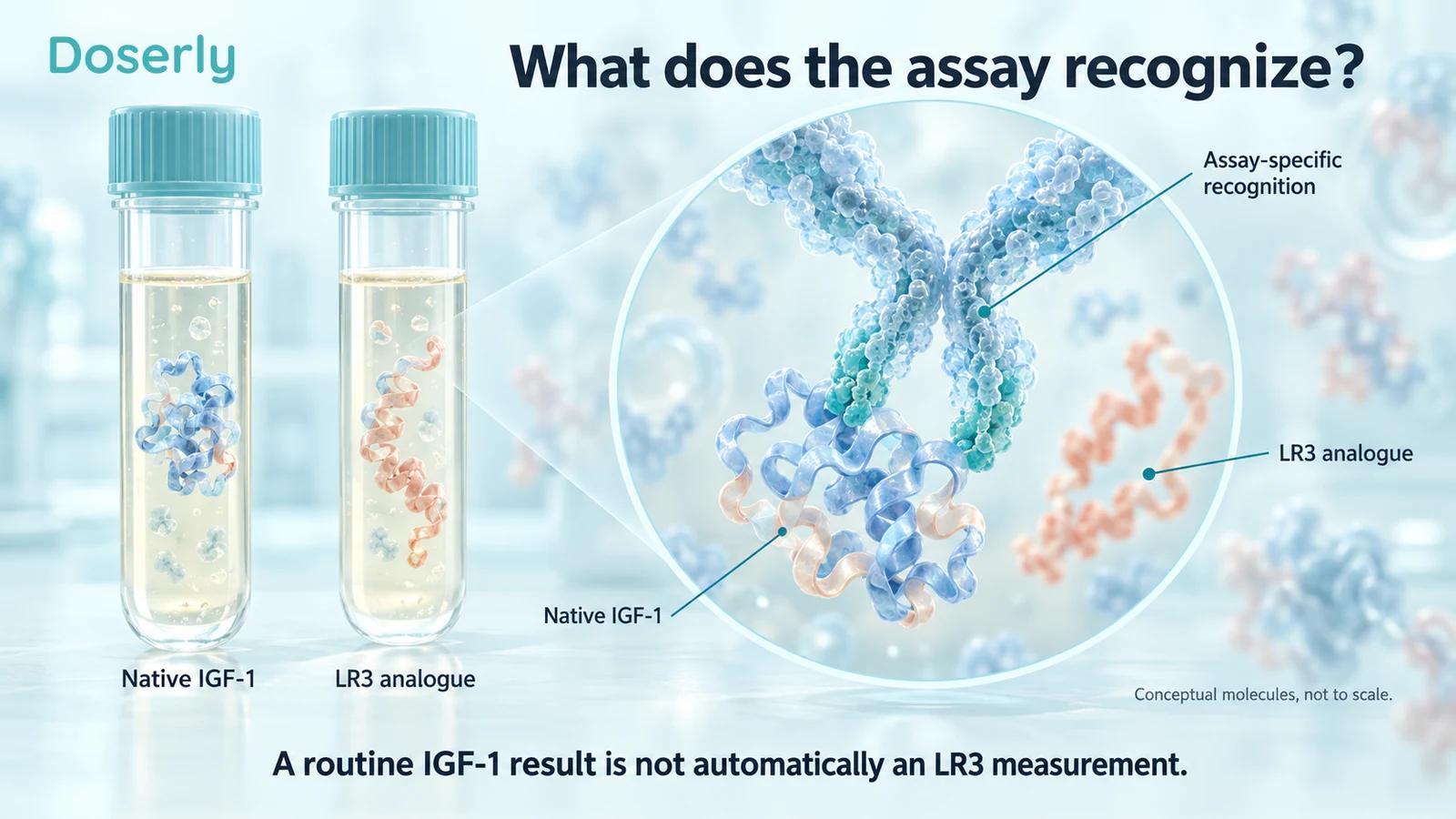
Why an analogue can behave differently in an assay
Long R3 IGF-I differs from native IGF-I through an extension and an amino-acid substitution. Those changes affect interactions with binding proteins and can also matter to analytical recognition. Manufacturer description
Many immunoassays use antibodies to recognize particular features of a molecule. A related protein may be recognized strongly, weakly or differently depending on the antibodies and the method. That response is called cross-reactivity when the assay responds to a substance other than its intended target.
Cross-reactivity is not a universal property of “IGF-1 tests.” It is a property of a particular method under particular conditions. One manufacturer's result cannot be assumed for every other assay.
This is also why a test's name does not settle the issue. An assay can be labelled for human IGF-I while its documentation does not establish how it responds to LR3.
What a routine assay's instructions actually show
The IDS-iSYS IGF-I instructions reviewed for this article describe an assay for quantitative measurement of IGF-I in human serum or plasma, used alongside other clinical and laboratory information in assessing growth disorders. The reviewed document is version 06, dated February 2017. Manufacturer instructions
Its specificity table lists IGF-I, IGF-II, proinsulin and insulin. LR3 is not included in that table.
That absence supports a narrow conclusion: this document does not provide an LR3 cross-reactivity result. It does not prove that the assay has zero response to LR3, nor that it responds exactly like native IGF-I.
A current laboratory may use a different version, platform or locally validated procedure. The appropriate next step is to ask the performing laboratory about the method actually used, rather than treating an older public insert as a complete description of today's test.
An LR3-specific assay was developed for a reason
A 1998 study developed a sandwich ELISA using one antibody that recognized a region containing LR3's substituted arginine and another that recognized a shared region. Native IGF-I and IGF-II showed very little activity in that particular assay. The investigators used it to measure LR3 in plasma from treated cows. Gajanandana and colleagues
The important achievement was discrimination: the method could separate the administered analogue from the endogenous native growth factors under the tested conditions.
It was an animal analytical study, not a validation of every commercial clinical test or a human LR3 monitoring program. Its existence nevertheless refutes the categorical statement that no blood test can detect LR3.
It also shows what a convincing measurement claim looks like. The investigators identified the recognition strategy and tested performance, rather than assuming related molecules would produce an interchangeable signal.
Even kits named for LR3 can have different specificity
Repligen's Long R3 IGF-I ELISA user guide describes a kit developed for cell-culture process applications. It reports approximately 40% reactivity to native IGF-I and no reactivity to insulin. Repligen kit guide
That is not the same specificity profile as the 1998 experimental assay. Similar names do not mean identical antibodies, validation or intended uses.
The direction of the statement matters too. A kit designed for LR3 reacting to native IGF-I does not tell us how strongly an unrelated routine IGF-I assay reacts to LR3. Cross-reactivity cannot simply be reversed.
The user guide also discusses sample handling and adsorption to surfaces. That is a reminder that obtaining a meaningful concentration involves more than detecting a signal. Sample preparation and calibration are part of the measurement.
A research kit is not automatically a clinical solution
The R&D Systems Quantikine human IGF-I kit is explicitly labelled for research use, not diagnostic procedures. Unlike the IDS document discussed above, its specificity section does give an LR3 result: approximately 4.2% cross-reactivity, with interference reported at LR3 concentrations above 10 ng/mL. Kit instructions, specificity section
This is evidence of partial analytical recognition in this particular research kit. It is neither zero recognition nor interchangeable measurement of native IGF-I and LR3. The reported interference concentration describes assay behaviour, not a safe blood concentration for a person.
Nor can the percentage simply be used to calculate an LR3 concentration from a routine clinical result. The method, sample preparation and mixture of endogenous IGF-I and analogue all matter. This kit's finding cannot be assigned to another laboratory platform without its own validation.
A research method can be scientifically useful without being suitable for a particular patient's care. Clinical interpretation also requires the right sample type, validated performance, quality systems and a meaningful relationship between the result and the clinical question.
Buying a kit with a relevant name does not supply those elements. The laboratory and clinician need to determine whether a test is appropriate and what conclusions its result can support.

What mass spectrometry adds
A 2017 analytical study combined antibody-based enrichment with liquid chromatography and high-resolution mass spectrometry to detect IGF analogues in plasma. It specifically addressed LR3 in the presence of much more abundant native human IGF-I. Thomas and colleagues
This approach uses molecular analytical information beyond a routine immunoassay signal. The method was validated for qualitative interpretation, and its metabolism work included laboratory experiments and LR3 administration to rats.
The phrase “human plasma samples” in the title should not be read as proof of a human dosing trial. The abstract identifies rodents for the in-vivo LR3 experiments. It also does not establish a human therapeutic range or a safe concentration.
“Mass spectrometry” is not a guarantee that every laboratory assay will detect every analogue. A method must be designed to identify the molecule or marker of interest, and its validation determines what can be concluded.
A higher result is not proof of product identity
Suppose a person's reported IGF-1 rises after using something labelled LR3. Without method-specific information, several explanations remain possible: a change in endogenous IGF-I, analytical response to a related substance, other biological changes or ordinary measurement variation.
The timing alone does not identify which explanation is correct. Nor does a large rise prove that the vial contained the advertised concentration or was free of contaminants.
Even a method that directly identifies LR3 would answer only part of the question. Detecting the analogue in a sample would not establish the purity or sterility of the original product, and it would not show that the exposure was beneficial.
The interpretation should therefore name what is supported: a reported change in this test, or a detected analyte by this validated method. It should not silently expand into a claim about the whole product.
An unchanged or lower result is not a safety clearance
An unchanged routine IGF-1 result does not prove absence of LR3 exposure. Without validated recognition of the analogue, it may not be the right measurement for that purpose.
A lower endogenous value is also not necessarily evidence of no biological activity. In a pig study, LR3 infusion reduced endogenous IGF-I and altered growth hormone and binding-protein measures. Dunaiski and colleagues
That animal result does not predict a person's response. It demonstrates that the endogenous system can change while an analogue is being administered. The concentration of the body's own IGF-I and the presence of an external analogue need not move together.
Most importantly, a normal IGF-1 result cannot rule out low blood glucose or another acute problem. Those are different clinical questions with their own assessments.
Reference ranges describe a defined comparison
A laboratory reference interval helps place a result in the context of a specified population and method. It is not a universal boundary between safe and unsafe use of an analogue.
A large study of routine IGF-I results across European and US laboratories emphasized the importance of method-specific reference intervals and described differences in measured distributions. All participating laboratories in that analysis used the IDS-iSYS assay. Reference-interval study
For an individual report, the laboratory's age-appropriate interpretation and clinical context matter. Comparing a value with an unrelated internet range can create false reassurance or unnecessary alarm.
Even a perfectly measured native IGF-I value within its reference interval would not establish an LR3 safe-use window. A reference interval and a treatment safety threshold are different concepts.
Questions the laboratory can answer
The most useful questions are concrete:
- Which assay platform and version produced this result?
- Is the assay intended to measure native IGF-I, LR3 or both?
- Has LR3 cross-reactivity or recovery been tested in this sample type?
- Does the method distinguish the analogue from endogenous IGF-I?
- Would a different validated test answer the clinical question more directly?
A laboratory may answer that the relevant validation is unavailable. That is useful information. It means the number should not be used to make a claim the method cannot support.
The clinician can then decide what testing, observation or other assessment is appropriate. The goal is not to find a test that justifies continuing an exposure; it is to understand the person's condition accurately.
Make the record useful without overinterpreting it
Keep the original report with its units, reference interval, collection date and laboratory name. Record the product label, exposure timing, other substances and symptoms separately. If results from different laboratories are compared, preserve the method information when available.
These details help distinguish a real biological change from a change in how it was measured. They also prevent a later conversation from relying on a remembered number without context.
For broader background, see the Doserly IGF-1 LR3 guide. A routine IGF-1 test can be clinically valuable, but its meaning depends on the question and method. It should not be treated as an LR3 concentration, product authentication or safety certificate without the evidence needed for that interpretation.
Sources
- LR3-specific experimental ELISA
- Analogue detection by LC-MS
- IDS-iSYS IGF-I instructions, version 06
- Repligen LR3 ELISA guide
- R&D Systems human IGF-I research kit
- Repligen LR3 molecular description
- Endogenous hormone changes during LR3 infusion in pigs
- IGF-I distributions and reference intervals