
Peptides
October 16, 2026
Can a telomere test show that Epitalon slowed your aging?
On this page
Telomeres are protective structures at chromosome ends. Because their length changes with cell division and is connected with some age-related biology, it is understandable to wonder whether a telomere test can show that an intervention is helping you age more slowly.
For Epitalon, the idea often begins with laboratory studies reporting telomere changes in cultured cells. It then becomes a practical proposal: test before using the peptide, test again afterward, and interpret a longer result as rejuvenation. The difficulty is that this comparison has to answer several different questions. Did the measurement change reliably? Did the intervention cause it? And does that change mean better health?
A before-and-after telomere result cannot, on its own, demonstrate that Epitalon slowed aging. That does not make telomere biology unimportant or every telomere test useless. It means the test's purpose and the evidence connecting a measurement to a clinical benefit matter. Our Epithalon guide explains the compound research behind the interest.
What is actually being measured?
A blood telomere test generally examines DNA from white blood cells, or particular white-cell populations, depending on the method. It does not directly measure the telomeres in your brain, liver, skin and every other tissue. Different methods also summarize the sample differently: some estimate an average across extracted DNA, while others can distinguish selected cell populations.
This distinction matters because a sample contains many cells, each with its own biological history. An average does not describe every chromosome end. It also does not identify which cells contributed most to a difference between samples.
Researchers use techniques such as quantitative polymerase chain reaction, or qPCR, Southern blotting, and flow-FISH, which combines cell analysis with fluorescent probes that recognize telomeric DNA. These methods are valuable, but they are not simply different brand names for the same interchangeable measurement. International laboratory comparison, clinical flow-FISH study.
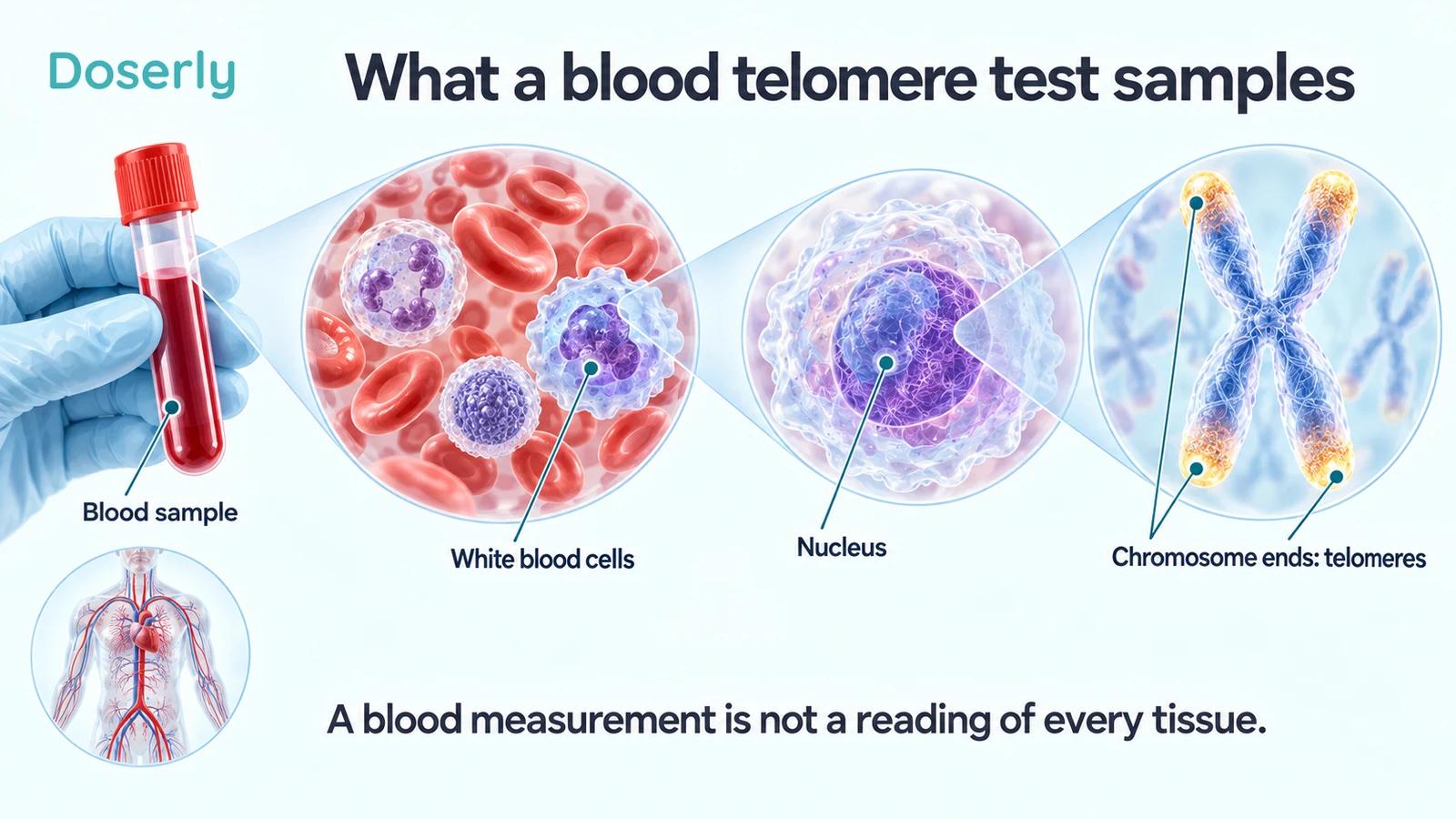
A result reported as a percentile adds another layer. A percentile compares you with a reference population. It is not a percentage of life remaining, and it is not a direct estimate of how quickly all your tissues are aging.
Why two laboratories may give different numbers
An international study asked ten laboratories to measure blinded DNA samples using three techniques. It found that the laboratories often ranked samples similarly, while their absolute values differed enough that results could not be directly pooled or reference ranges freely shared. Martin-Ruiz and colleagues.
That creates an important distinction between agreement about relative ordering and agreement about a precise value. Two methods might both identify one sample as longer than another while producing different numerical estimates for each.
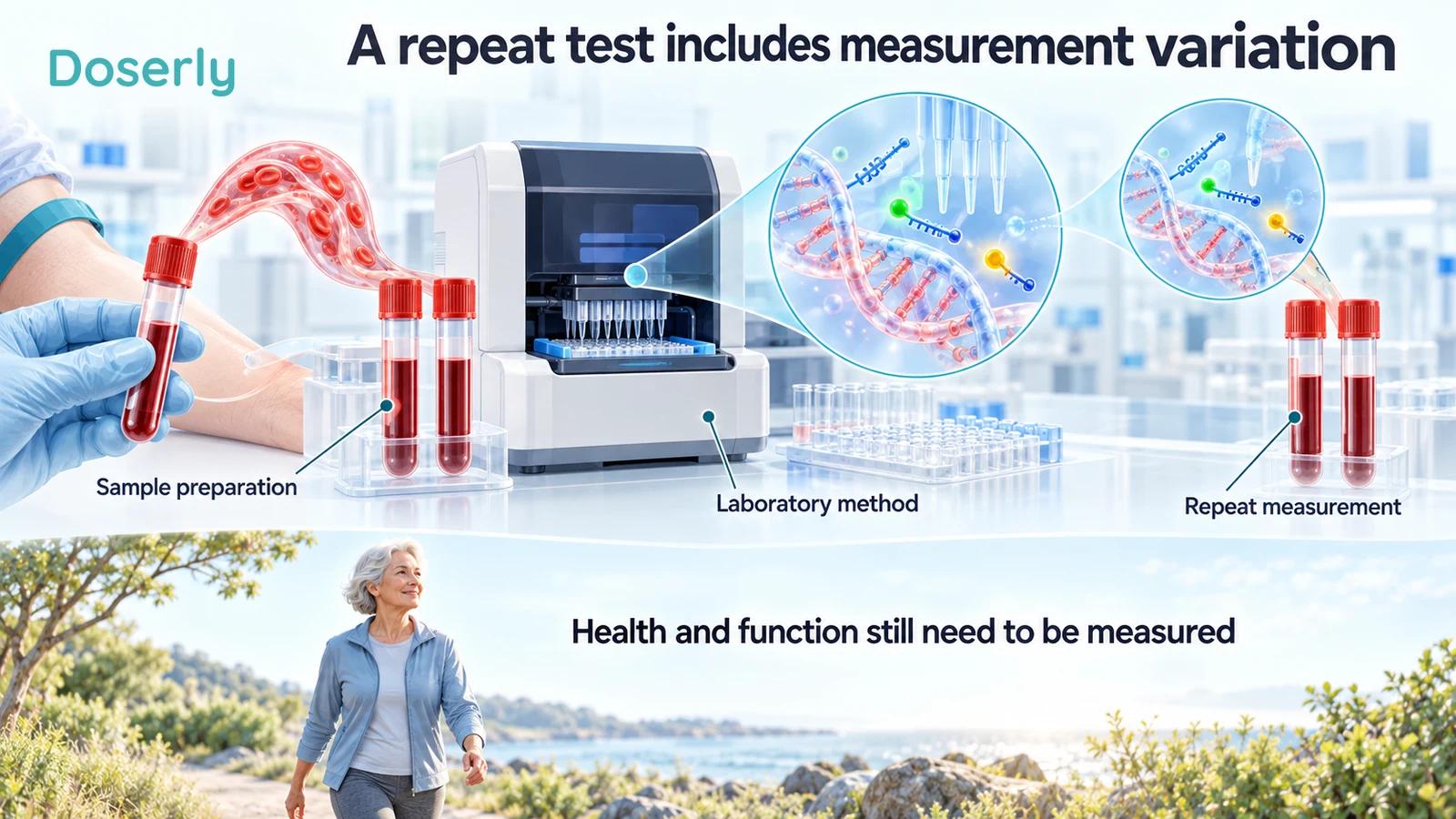
For a before-and-after comparison, changing the laboratory or method can therefore introduce a difference unrelated to the intervention. Using the same laboratory helps control one source of variation, but it does not eliminate every source of error. Sample handling, assay batches, calibration and repeatability still need attention.
This is not an accusation that laboratories are careless. Every measurement has an uncertainty range. The scientific question is whether a reported change is larger and more consistent than the variation expected from the measurement process.
Tracking change is harder than ranking people
A method may distinguish people with very different telomere lengths reasonably well yet be less reliable at measuring a small change in one person. A 2021 analysis demonstrated this using samples from 20 people collected about 6.6 years apart.
The investigators compared qPCR and Southern blot measurements. Their correlations were high when comparing people at either time point—0.90 initially and 0.85 at follow-up—but much lower for the change between time points, at 0.48. The study was small, but it illustrates why a good cross-sectional comparison does not automatically validate longitudinal tracking. Measurement of Telomere Length for Longitudinal Analysis.
In a repeat-test setting, uncertainty enters twice: once at baseline and again at follow-up. If the true biological change is small, those errors can become a large part of the observed difference.
This is particularly relevant when a test is repeated after a short intervention. A precise-looking number does not establish that the method can resolve a small change over that interval. The laboratory needs evidence about repeatability in the intended use, not merely a statement that it measures telomeres.
Could an apparent improvement be regression toward the average?
Imagine that someone chooses to start an intervention because their first result was unusually low. If that first measurement was partly low because of random variation, a second measurement may be closer to their usual value even if nothing effective happened. This statistical pattern is called regression to the mean.
It does not mean every improvement is imaginary. It means that selecting people because of an extreme first result can make later results look better without demonstrating a treatment effect. The longitudinal measurement study describes how assay error can make apparent telomere change depend strongly on the initial result. Assay-precision analysis.
A comparison group helps because people who do not receive the intervention can experience the same pattern. Repeated samples and prespecified analysis can also help researchers distinguish an intervention effect from measurement behavior.
For one person, taking more tests without an interpretation plan may simply produce more numbers to choose from. It is better to know in advance what result would count as a reliable change and how uncertainty will be handled.
What did the Epitalon experiments establish?
The early 2003 Epithalon paper studied human fetal fibroblasts in culture and reported telomerase activation and telomere elongation. It did not test blood samples before and after a course of Epitalon in older adults. Original fibroblast study.
A 2019 experiment used stimulated blood lymphocytes from eleven male donors. The cells were exposed outside the body. Responses varied: some donors' cells showed longer telomeres, some shorter, and others no significant change. These were not eleven people treated with the peptide. Lymphocyte experiment.
The 2025 study examined normal and cancer cell models and reported different telomere-maintenance responses. Its published correction accompanies the original results. Again, the outcome was cellular biology under laboratory exposure, not slowed aging in treated people. Cell study, correction.
These experiments provide reasons to investigate the peptide. They do not validate a commercial test-and-treat package, define an ideal blood telomere target, or establish how often to repeat testing.
A real change would still need a clinical interpretation
Suppose a carefully designed study established that a treatment genuinely changed a telomere measurement. That would answer an important biological question. It would still leave open whether the change improved health.
A biomarker is a measured feature of biology. A surrogate endpoint is a biomarker used in place of a clinical outcome because it has been shown to predict the treatment effect of interest. The fact that a marker is associated with aging does not automatically make it a validated substitute for disability, disease or survival.
The distinction is especially important when trying to increase a marker. A population association between shorter telomeres and some health problems does not establish that making telomeres longer with a particular intervention will prevent those problems. The intervention may have other effects, and the biological meaning may depend on which cells are affected.
Human research involving inherited POT1 variants provides a concrete reason to avoid a universal “longer is better” target: unusually long telomeres in that setting were associated with a syndrome involving clonal cell expansion and tumors. This is not evidence that Epitalon produces that syndrome; it shows why telomere length cannot be interpreted as a simple wellness score. POT1 family study.
Telomere testing can have legitimate medical uses
It would be a mistake to conclude that all telomere testing is meaningless. In a hospital-based study, flow-FISH measurements helped evaluate patients with suspected disorders of telomere maintenance. Results could inform decisions in selected patients with otherwise unexplained bone marrow failure. Alder and colleagues.
That clinical use is different from monitoring a longevity intervention in a generally healthy person. The patient population, reference ranges, diagnostic question and consequences of the result are all more specific.
A test can therefore be useful for one purpose and unvalidated for another. This is common in medicine. Its value depends on the question it is being asked to answer, not merely on whether the underlying laboratory technology is sophisticated.
If a clinician suspects a telomere biology disorder, the result belongs in a specialist assessment that includes symptoms, family history and other investigations. An unexpectedly low consumer result should not be converted into a diagnosis—or a reason to self-treat—without that context.
What to ask before paying for serial testing
Ask what material is sampled, which method is used, and whether follow-up samples will be processed comparably. Request an explanation of the uncertainty around a change, rather than only the percentile or an age-equivalent number.
Then ask what decision the test is intended to change. If a higher reading would lead to continuing an intervention and a lower reading to increasing it, there should be clinical evidence supporting that strategy. Otherwise, the test risks giving an experimental decision a degree of certainty it has not earned.
It is also helpful to ask whether the provider has evidence linking changes produced by this intervention to patient outcomes. Evidence that telomeres differ between age groups is not the same as evidence that an Epitalon-related change predicts improved health.
A dated record of symptoms, sleep, activity, medications and laboratory results can support a useful clinical conversation. It cannot by itself identify the cause of a change, but it can keep the actual experience visible instead of allowing one biomarker to define whether you are doing well.
Before ordering another measurement, ask the provider to explain a realistic example of an ambiguous result. What happens if the follow-up number rises slightly, but the laboratory's expected variation is of similar size? A responsible interpretation should be able to say that the change is uncertain rather than forcing every result into “worked” or “failed.”
A percentile can add confusion here. If the comparison group or reporting method changes between reports, a different percentile need not describe a corresponding change in the underlying sample. Keeping the original measurement, method, reference population, and uncertainty together makes a later clinical review more useful than keeping only an age-equivalent headline.
What would a persuasive Epitalon study look like?
Researchers would first need a characterized product and a clearly defined population. They would compare it with an appropriate control and choose the telomere method, sampling schedule and analysis before examining the results. Blinded processing, repeat measurements and attention to cell populations would help make the biomarker findings interpretable.
They would then need to measure the outcomes that justify using the intervention: for example, function, symptoms or disease events, alongside adverse effects. If telomere change is proposed as the explanation for benefit, the study should examine that relationship rather than assume it.
Until that connection is demonstrated, a better telomere number remains a measurement to interpret, not proof that biological aging has reversed. The Epithalon guide provides a useful starting point for separating the cell findings from the treatment questions that remain unanswered.
Sources
- Martin-Ruiz and colleagues, 2015: blinded international comparison of telomere measurement methods.
- Measurement of Telomere Length for Longitudinal Analysis, 2021: assay precision and before-and-after change.
- Alder and colleagues, 2018: hospital-based diagnostic use of flow-FISH.
- Khavinson and colleagues, 2003: Epithalon in fibroblast culture.
- AEDG lymphocyte study, 2019: cells from eleven donors treated outside the body.
- Al-Dulaimi and colleagues, 2025 and correction: cell-model telomere findings.
- DeBoy and colleagues, 2023: inherited long-telomere syndrome, not an Epitalon trial.