
Peptides
October 16, 2026
Can a TB-500 purity certificate settle what is in the vial?
On this page
A certificate of analysis can answer a useful question about a sample. It cannot answer every question about a product simply because the page displays an impressive purity percentage. With TB-500, even the first question—what molecule was tested—needs more attention than the marketing name usually receives.
The distinction matters when someone sends a laboratory report as the answer to concerns about identity, contamination, or safety. Those concerns overlap, but they require different evidence. A chemically well-characterized sample can still lack human safety data. A genuine laboratory result can also describe a different batch, a raw ingredient rather than the finished vial, or only the substances the chosen method can detect.
The useful way to read a certificate is to work outward from its actual claim. What was submitted, what was measured, how was it measured, and how closely does that sample represent the product being discussed?
Start with a molecular name, not the TB-500 label
In its 2026 TB-500 briefing, FDA evaluated the seven-amino-acid, N-acetylated thymosin beta-4 fragment Ac-LKKTETQ. Full-length thymosin beta-4 is a different molecule. Acetylation of the fragment and the presence of an acetate counterion are also different chemical features. None of these distinctions is resolved by writing “TB-500” at the top of a report.
This makes identity a practical issue rather than a naming technicality. If a certificate's reference standard is full-length thymosin beta-4, that result cannot automatically authenticate a product described as the seven-residue fragment. If the report only gives a trade name, the reader may not know what identity the laboratory was asked to confirm.
The Doserly TB-500 identity guide explains why evidence about these substances is often mixed together. For a certificate, the corresponding question is concrete: does the report specify the intended sequence, chemical modifications, and form, and does the analytical work support that identity?
A 2023 analysis of products sold online found that the composition of products marketed as TB500 and TB1000 differed from earlier descriptions in the literature. That finding establishes a reason to investigate identity. It does not establish a market-wide mislabeling rate, prove that every seller's product is wrong, or authenticate another vial that was never tested.
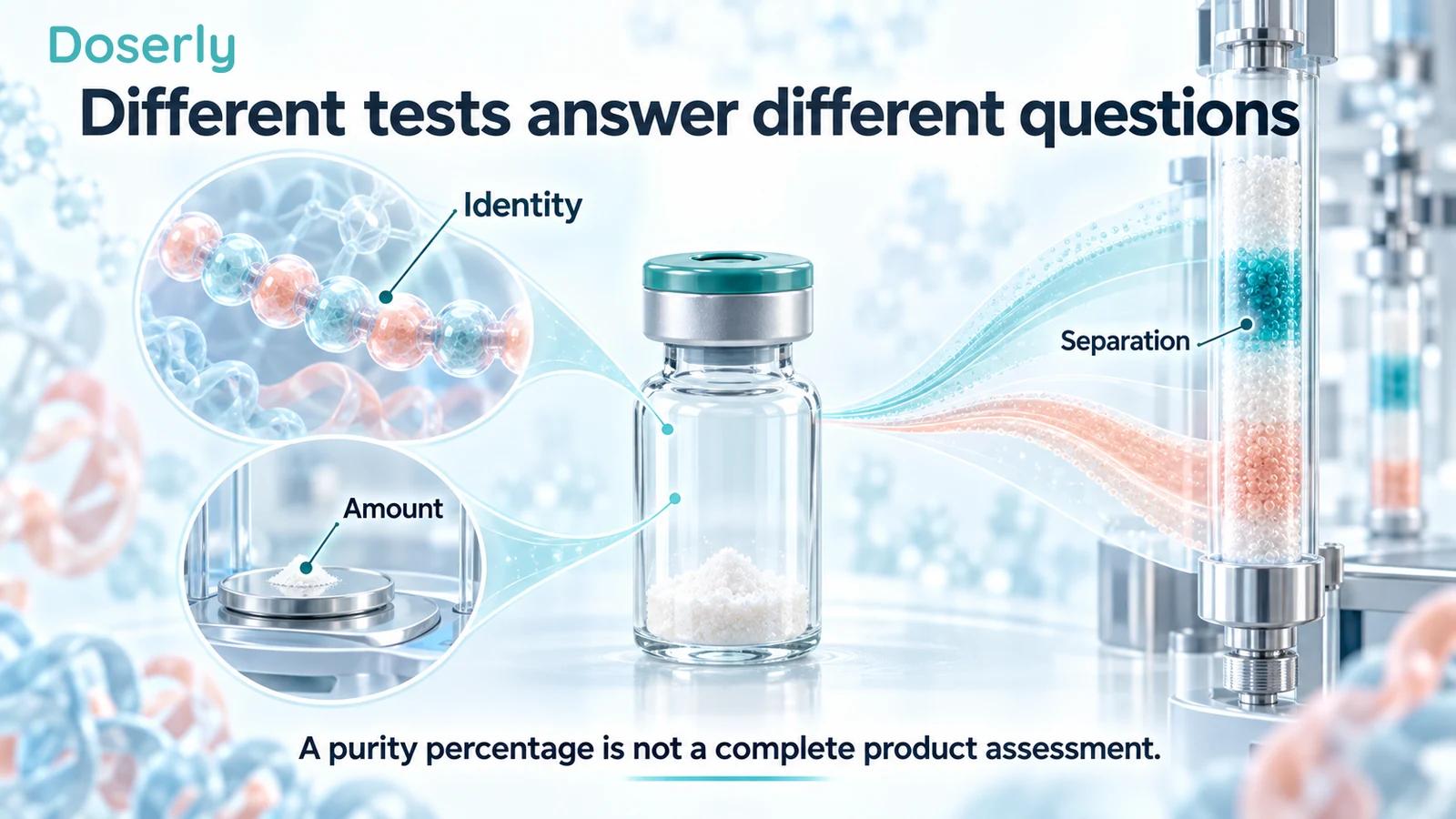
What does a purity percentage actually measure?
“Purity” needs a method and a denominator. One common presentation is chromatographic area purity: the area assigned to a selected peak relative to the areas included in that calculation. That is a statement about measured signals under specified conditions. It should not be silently converted into the percentage of everything inside the vial that is the intended active peptide.
Consider a purely illustrative report that assigns 99% of the integrated signal to its main peak. Before interpreting that result, ask whether the peak has been identified, whether closely related impurities separate from it, and which components produce a measurable response. A large peak is not itself a molecular identification. Two substances that are insufficiently separated can appear together, and components outside the method's detection scope do not become absent merely because they are missing from the displayed trace.
This is why method suitability matters. FDA's analytical validation guidance treats identity, strength, quality, purity, and potency as attributes requiring supporting analytical procedures and validation. The guidance is a framework for drug development and quality documentation, not an endorsement of a commercial TB-500 certificate.
The practical inference is modest: read the result as the result of that test. “99% by this chromatographic method” is a narrower claim than “99% of the vial is correctly identified active peptide,” and much narrower than “safe for injection.” A report should make that boundary easier to see, not hide it behind a badge.
Identity and amount need their own evidence
Mass spectrometry can provide evidence about molecular mass and, with suitable fragmentation analysis, structural identity. Chromatography can help separate components before analysis. These techniques are valuable precisely because they provide information beyond a product name or the visual appearance of a powder.
For example, a 2012 equine analytical study developed methods to identify the Ac-LKKTETQ fragment and investigate its metabolism. That work demonstrates that a specifically defined fragment can be targeted analytically. It was not a clinical safety trial and does not validate every laboratory method marketed under the same acronym.
A certificate should identify which method was actually used, its reference material, and the conclusion it supports. A mass match alone should not be presented as if it were a comprehensive assessment of every impurity. Conversely, a detailed identity analysis should not be dismissed simply because it cannot answer unrelated questions about clinical benefit.
Amount is another distinct question. Knowing that the intended peptide is present does not establish how much is present in a finished vial. A quantitative assay needs a basis for converting the measured response into an amount, including an appropriate standard and treatment of the sample. The mass printed on the label, the mass of all dried material, and the measured quantity of the target peptide should not be assumed interchangeable.
An easy reading check is to replace the word “tested” with a full sentence. “The sample's identity was tested” and “the quantity of the identified peptide was measured” are different sentences. If the report supports only one, the other remains unanswered.
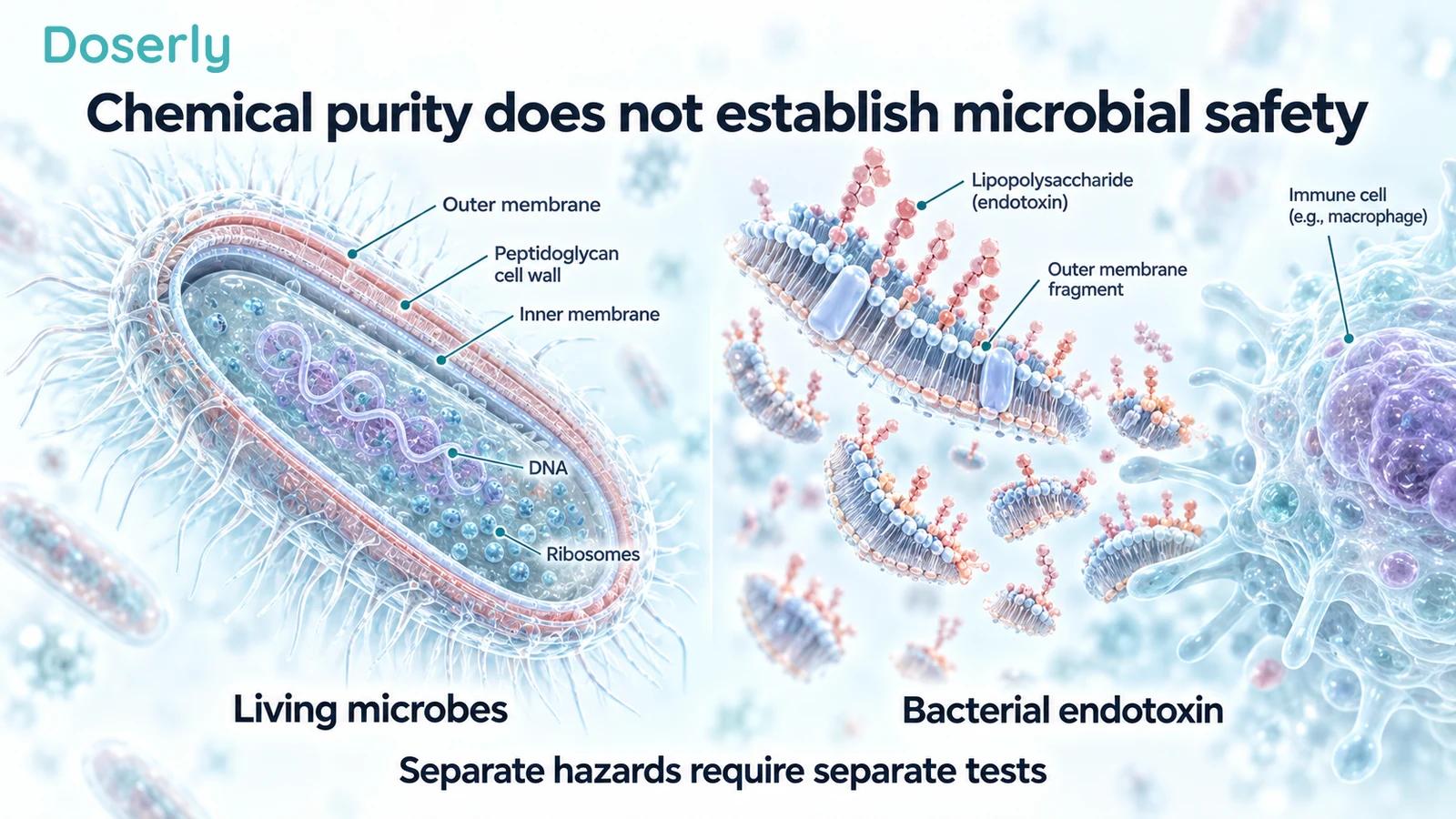
Chemical purity does not establish microbial safety
For a product intended to enter the body by injection, a report about chemical composition leaves microbial quality questions open. Sterility testing concerns viable microorganisms under the test conditions. Bacterial endotoxin testing addresses a different hazard. A chemical chromatogram is not a substitute for either.
FDA's production and process-control guidance explains why sterility assurance depends on a manufacturing control system as well as testing. A sterility test has limits because it examines samples; it cannot inspect every location in every finished container. Appropriate processes, packaging, and controls are part of the evidence, rather than optional extras after an attractive laboratory result.
Endotoxin testing also requires a method suitable for the material being tested. FDA's updated discussion of pyrogen and endotoxin testing emphasizes verification of that suitability, including when recombinant reagents are used. Merely listing an assay name does not show that interference from the product has been addressed.
These distinctions prevent two opposite mistakes. A missing sterility result does not prove that a sample contains microbes. A favorable chemical purity result does not prove that microbial hazards have been excluded. The report's silence is an unanswered question, not a negative result.
The sample has to connect to the vial
Even a technically strong analysis has a sampling boundary. Imagine a laboratory receives a small quantity of raw material from a manufacturer. The result may accurately characterize that submitted material. It does not, without further records, establish what happened during subsequent filling, storage, shipping, or preparation of individual finished containers.
Now imagine that the certificate names a batch different from the one on the vial. The problem is not necessarily that either record is fraudulent. The problem is that the evidence has not been connected. The same applies to an undated screenshot, a cropped report without sample identification, or a report uploaded alongside multiple products with different stated sequences.
Useful traceability therefore includes the sample description, batch or lot identifier, dates, laboratory identity, methods, results, and applicable acceptance criteria. The original report should let a qualified reviewer distinguish a test result from a seller's interpretation. A pass/fail stamp without the underlying scope is less informative than it looks.
Independent testing can reduce dependence on a manufacturer's own assertions, but “third-party” is not a scientific method. Independence does not identify an unknown sequence, establish appropriate sampling, or supply missing microbiological tests. It describes a relationship between organizations; the report still needs to stand on its analytical content.
A result has a time boundary too
A certificate is usually a record of testing at a particular point. Claims about shelf life require evidence that relevant quality attributes remain acceptable over time under the specified conditions. Claims about a prepared solution add another question: whether evidence for the original dry material applies after preparation.
FDA's laboratory-control discussion describes stability-indicating methods as methods that can assess the active ingredient, degradation products, and other relevant components without interference. It also emphasizes the importance of considering the product and its container system. A method that reports the same-looking main peak without resolving meaningful degradation would provide limited reassurance.
For TB-500, this means a general claim such as “stable peptide” cannot supply a product-specific expiry date. Nor does a release certificate establish a storage interval for a differently formulated or prepared product. Those are additional claims requiring additional evidence. This article does not derive storage or preparation instructions from an unrelated certificate.
What a certificate still cannot prove
Suppose all of these questions are answered well: the sample is traceable, identity is established, the amount is measured, relevant impurities and microbial attributes are assessed, and stability is documented. That would be meaningful product-quality evidence. It would still not establish that the substance improves tendon healing, accelerates return to sport, or has an acceptable benefit–risk balance in people.
FDA's TB-500 review identified no human clinical studies of the specific fragment it evaluated and described gaps in the submitted quality information, including impurities, aggregation, and microbial attributes. Those observations are specific to the review and should not become a claim that every available vial has the same defect. They do explain why a purity certificate cannot repair the missing clinical evidence.
The Doserly TB-500 evidence guide separates those clinical questions from the molecular identity question. Keeping both in view helps avoid an unhelpful debate in which a clean analytical result is treated either as worthless or as a complete safety guarantee.
A useful certificate narrows uncertainty about a defined sample and a defined set of attributes. The responsible conclusion goes exactly that far. Everything beyond it—another batch, a later preparation, a different molecule, or a claim about what happens in a person—needs its own supporting evidence.
Explore the research
- FDA Evaluation of TB-500-Related Bulk Drug Substances (TB-500 free base and TB-500 acetate) — regulatory-briefing.
- TB500/TB1000 and SGF1000: A scientific approach for a better understanding of misbranded and adulterated drugs — analytical-product-study.
- Doping control analysis of TB-500, a synthetic version of an active region of thymosin β₄, in equine urine and plasma by liquid chromatography-mass spectrometry — equine-analytical.
- Analytical Procedures and Methods Validation for Drugs and Biologics — FDA guidance.
- FDA CGMP questions: Laboratory Controls — FDA technical guidance.
- FDA CGMP questions: Production and Process Controls — FDA technical guidance.
- FDA clarifies current thinking on pyrogen and endotoxin testing — FDA technical guidance.