
Peptides
October 16, 2026
Can exenatide keep a diabetic cat in remission?
On this page
When a diabetic cat no longer needs insulin injections, the change can transform daily life. Meals, medication and monitoring have often shaped the household routine for months. Remission brings relief, followed by an understandable question: is there a medicine that could help it last?
Exenatide is a glucagon-like peptide-1, or GLP-1, receptor agonist. It acts on a hormone-signalling system involved in glucose regulation. A 2025 veterinary trial tested an extended-release formulation in cats that had already entered remission. It did not demonstrate a longer remission with exenatide than with placebo, although a blood-marker result suggested an effect on glucose exposure. Primary trial
Those findings answer different questions. A laboratory signal may justify more research, but an owner wants to know whether their cat will remain comfortable and avoid needing insulin again. Understanding the distinction starts with what remission does, and doesn't, mean.
Why remission can happen without diabetes being cured
Insulin is produced by beta cells in the pancreas. It helps regulate glucose use and storage throughout the body. In many diabetic cats, tissues respond less effectively to insulin while the pancreas cannot produce enough to compensate. Excess body fat can contribute to that resistance. Persistent high glucose can further impair beta-cell function, making the problem harder to reverse. Cornell's feline diabetes overview
Treatment can bring insulin supply and demand back into a workable balance. A cat may then maintain acceptable glucose without injected insulin even though its underlying capacity to handle glucose remains limited. Remission describes that clinical state; it does not certify that every aspect of metabolism has returned to normal.
The 2025 iCatCare consensus defines remission as at least four weeks without a requirement for external insulin and without clinical signs of diabetes. It emphasizes continuing attention to nutrition, body condition and monitoring. iCatCare guidelines
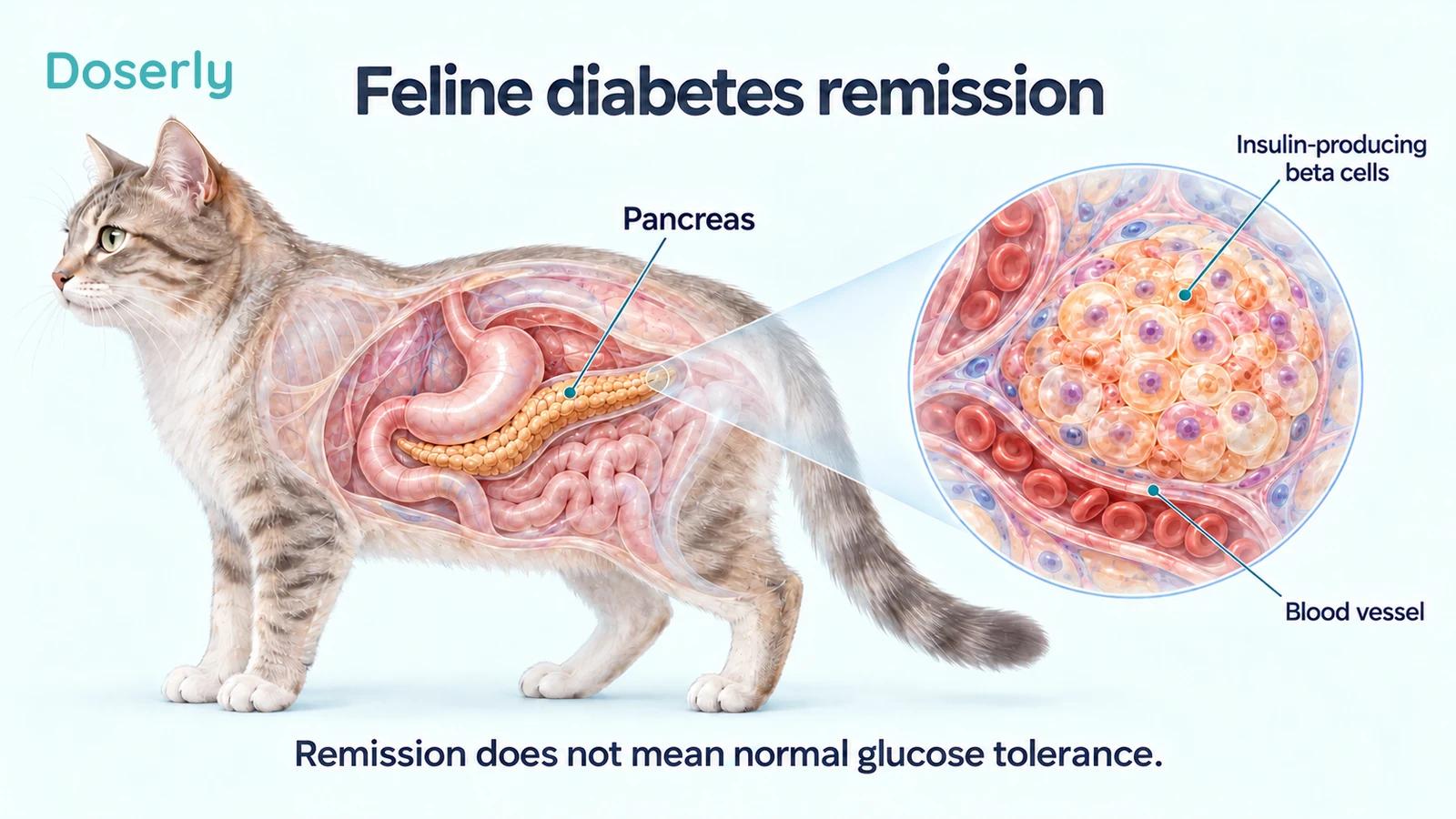
The pancreas and beta-cell inset explain the biology involved in glucose regulation. This is conceptual anatomy, not an image of tissue recovering after exenatide.
Think of two cats whose glucose readings look similar at a routine appointment. One has never had diabetes; the other previously required insulin. The same reading does not necessarily mean they have the same ability to cope with illness, weight gain or a change in food. Their histories remain relevant when the veterinarian interprets the result.
A 2015 study directly examined this issue. Among 21 cats in remission, 16 had impaired glucose tolerance, meaning glucose took longer than expected to clear after a controlled challenge. Six of the 20 cats followed for at least nine months relapsed. This was an observational investigation of risk, not a test of a preventive medicine. Gottlieb and colleagues
What made exenatide worth studying?
GLP-1 medicines have attracted interest because their actions could help a pancreas that still has functioning beta cells. Stimulating glucose-dependent insulin secretion is biologically different from supplying insulin directly. A treatment that depends partly on residual secretion may behave differently in a cat with useful beta-cell function than in one with severe insulin deficiency.
That makes cats in remission an interesting research population: they are already managing without injected insulin, but may remain vulnerable to relapse. The aim is to preserve a favourable state rather than treat a newly diagnosed, unwell cat.
It is also why familiar human drug names can create confusion. Exenatide and semaglutide belong to the same broad class, but they are different molecules and formulations. Our semaglutide guide explains the human medicine and its clinical research. Its human dosing and outcomes should not be transferred to a pet.
The remission trial tested a specific veterinary research question. It did not test a human weight-loss programme in cats, compare every GLP-1 medicine, or establish a class-wide preventive effect. An explanation of the hormone pathway makes the experiment understandable; the clinical comparison determines whether the proposed benefit was observed.
What happened in the 2025 trial?
Researchers enrolled 22 client-owned cats recently in remission. Twelve received extended-release exenatide and ten received saline placebo, with monthly clinic visits over a planned two years. Both groups received dietary and weight-management support. Owners were blinded; treating clinicians were not.
Thirteen cats completed two years without relapse. Three relapsed: two receiving exenatide and one receiving placebo. Six others left early for reasons other than confirmed diabetes relapse. The reported remission-duration comparison was not significant, with P=0.9. Study methods and results
The first practical point is that the control group received considerable care. “Placebo” refers to the comparison injection, not an absence of attention to diabetes. If you imagine the study as medicine versus doing nothing, you miss the question it actually tested: whether the medicine added benefit alongside ongoing management.
The second point is that few relapses occurred. When an outcome happens only three times, each event carries substantial weight in the comparison. The findings do not establish that the treatment caused harm because two relapses occurred in one group and one in the other. They also do not establish a meaningful preventive benefit.
An owner reading only “no difference” might reasonably ask whether that proves the treatments equivalent. It doesn't. Equivalence requires a different design and enough precision to exclude clinically important differences. Here, the appropriate conclusion is that this small study did not demonstrate the proposed benefit.
Why the early exits matter
A cat that leaves a study because of another illness is different from a cat whose diabetes has returned. Both can stop contributing follow-up, but they do not represent the same clinical event.
Imagine two hypothetical cats enrolled on the same day. One is confirmed to be in remission at the two-year visit. The other is still in remission at its last visit but leaves after several months because of an unrelated problem. We know much less about the second cat's subsequent diabetes course. Counting both as having proven two-year remission would overstate the evidence; counting every early departure as diabetes relapse would answer a different question.
This is why duration figures need their methods beside them. The full report includes analyses using study exit and sensitivity analyses around early withdrawals. Readers should not turn the reported medians into a promise that an individual cat will stay off insulin for that many days.
It also explains why a longer calendar study is not automatically a large body of outcome evidence. Two years sounds substantial, and it is valuable follow-up. But the ability to distinguish treatments still depends on how many animals remain observable and how often the event of interest occurs.
What did the blood-marker finding show?
Hemoglobin A1c, often written HbA1c, reflects glucose attaching to hemoglobin in red blood cells. The trial reported a difference in change from baseline, favouring exenatide. HbA1c sampling was not available uniformly, and HbA1c was not the criterion used to decide whether diabetes had relapsed. Primary report
A marker can change before a cat develops obvious clinical signs. That makes it useful to investigate, but it creates a second question: does changing the marker alter the future course of disease?
The study does not resolve that link. To do so convincingly, researchers would need to show that the treatment-associated marker improvement reliably predicts fewer relapses or another meaningful benefit. A result in a blood sample cannot by itself supply the missing clinical outcome.
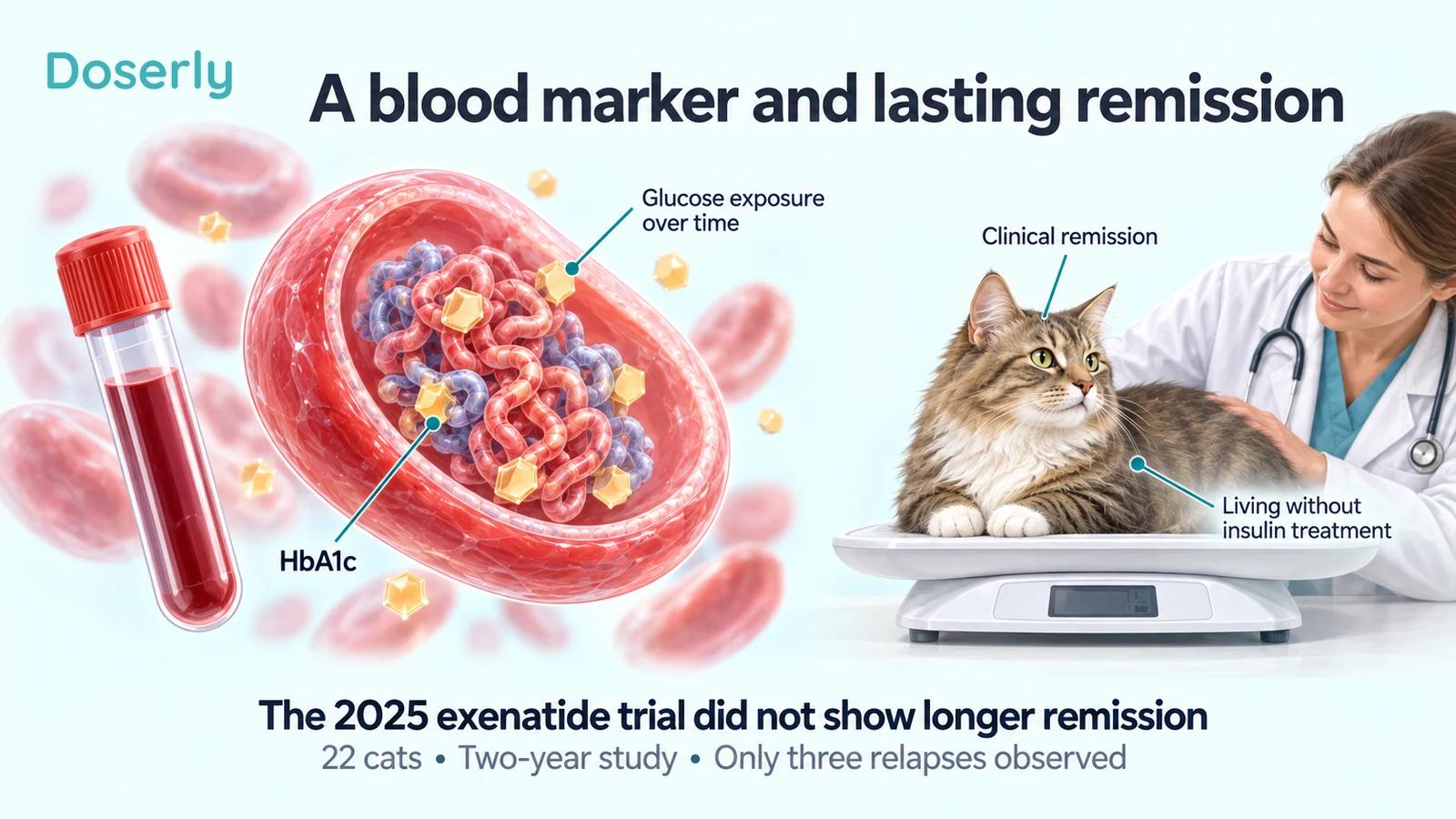
HbA1c and remaining free of insulin treatment describe different aspects of diabetes. The blood-cell artwork is conceptual; it does not reproduce a specimen or suggest that exenatide repaired the pancreas.
Other laboratory work reinforces the distinction between remission and normal metabolism. A 2020 study compared metabolic profiles in 20 cats in remission and 22 controls. It identified differences between groups but did not establish a metabolite that predicted relapse. This was exploratory measurement research, not a validated test for deciding which cat needs preventive medication. Metabolic profiling study
Did the diet and monthly attention explain the long remissions?
They may have helped, but this trial cannot measure their separate effects. Both groups received that support. There was no otherwise comparable group assigned to minimal follow-up or a different diet.
This is an important distinction for owners who want something useful to do now. Supporting nutrition and follow-up is consistent with professional guidance. Claiming that this particular trial proves monthly appointments prevent relapse would go further than its design allows.
A hypothetical comparison shows why. If cats receiving both a medicine and frequent appointments do well, either part of the programme could contribute. Randomizing the medicine while holding appointments similar lets researchers estimate the medicine's added effect. It does not independently estimate the effect of the appointments.
The same reasoning applies to food. Maintaining a consistent, appropriate feeding plan makes changes easier to interpret. It doesn't mean a single food guarantees remission. A cat's appetite, body condition, other illnesses and household circumstances all matter when the veterinary team builds a sustainable plan.
What should owners monitor after remission?
Ask the veterinarian for a plan that distinguishes ordinary follow-up from reasons to call sooner. It should explain what observations to record, which tests are useful for this cat and who will review the results.
A simple dated record can include appetite, noticeable drinking or litter-box changes, weight when practical, and any new medicine or illness. Changes are more informative when their timing is clear. “Drinking more since Tuesday” gives the team something more concrete than “seems different lately.”
Home glucose checks can be helpful when the veterinary team has taught the technique and explained how to interpret it. A single stressful clinic reading may not represent the cat's usual glucose. Conversely, a reassuring observation at home does not replace assessment if the cat becomes unwell. Cornell monitoring advice
It is worth asking in advance what would trigger a repeat examination or confirmation of relapse. This avoids having to improvise when a result is unexpected. It also makes clear that a monitoring plan is not an invitation to restart old insulin doses or use a family member's diabetes medication.
Are newer oral diabetes medicines an alternative?
Some owners encounter Bexacat or Senvelgo while searching for ways to avoid injections. These are SGLT2 inhibitors, a different drug class from exenatide. They increase glucose loss through the kidneys.
The FDA specifies that cats previously treated with insulin should not receive these products because of the risk of diabetic ketoacidosis, including cases with relatively normal glucose. A cat entering remission after insulin treatment does not lose that treatment history. FDA owner guidance
This distinction is particularly relevant to the question in this article. An approved treatment for selected newly diagnosed cats is not automatically suitable for maintaining remission in a previously insulin-treated cat. The stage of illness and eligibility criteria matter as much as whether the product is described as a diabetes medicine.
What is the useful answer for a cat already doing well?
The evidence does not support promising that extended-release exenatide will keep a cat in remission longer. The blood-marker finding is a reason for further investigation, while the small number of relapses limits the certainty of the clinical comparison.
For an owner, the next conversation can stay practical: how has remission been confirmed, what ongoing monitoring is appropriate, what body-condition goal is realistic, and what changes should prompt reassessment? If an additional medicine is proposed, ask what benefit is expected for this particular cat and what evidence supports it.
Remission is a valuable outcome even when its duration is uncertain. Caring for a cat in remission means preserving a manageable routine and remaining attentive to change, with a veterinarian who knows its history. The 2025 trial adds useful information to that conversation; it does not replace it with a preventive drug protocol.
Sources
- Gilor and colleagues, remission-maintenance trial, 2025.
- Gottlieb and colleagues, glucose tolerance and relapse, 2015.
- Gottlieb and colleagues, metabolic profiling during remission, 2020.
- iCatCare diabetes consensus, 2025.
- Cornell Feline Health Center, feline diabetes.
- FDA, Bexacat and Senvelgo owner guidance.