
Supplements
October 16, 2026
Biotin and blood tests: when a supplement changes the result
On this page
Biotin is a B vitamin involved in processing fats, carbohydrates and amino acids. It's also a familiar ingredient in hair, skin and nail supplements. What is less obvious from the front of the bottle is that biotin can interfere with the chemistry used to measure other substances in a blood sample. A result can look abnormal even when the hormone or protein being measured hasn't changed in the way the report suggests.
That creates an unusual supplement problem: you may feel exactly the same, yet a laboratory result can point toward the wrong diagnosis or suggest that a medicine needs adjusting. The practical response is to make biotin use visible to the people ordering and performing the test. It isn't to assume every unexpected result is false. Our biotin guide provides broader nutritional background; here we'll focus on what happens between the sample tube and the reported number.
Why a vitamin appears in laboratory chemistry
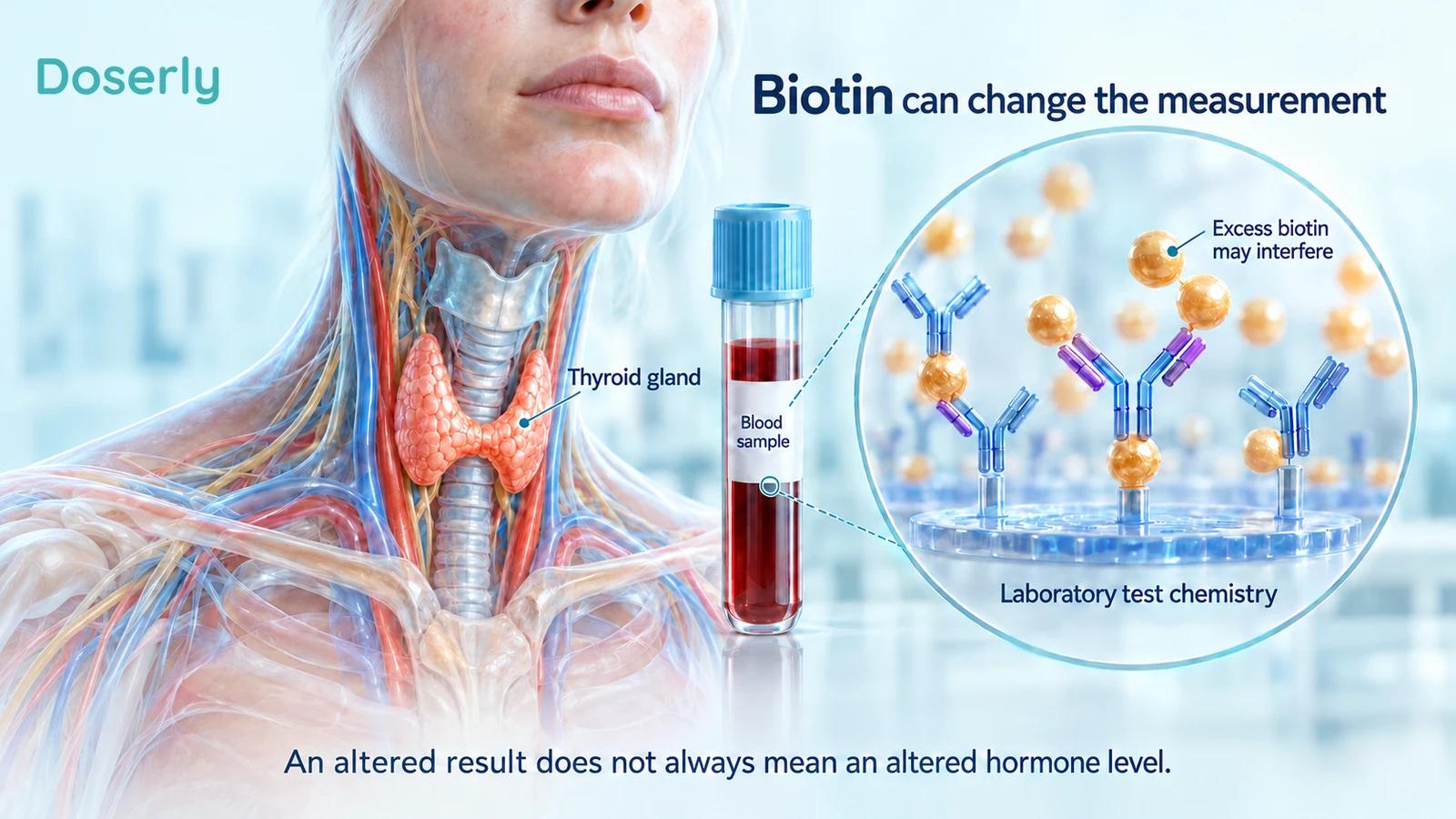
Many tests use antibodies, proteins that recognize a particular target. Laboratory designers can attach biotin to a test component and use another protein, streptavidin, to capture it. Their strong binding is useful for separating the material being measured from everything else in the sample. Biotin is therefore doing two quite different jobs: serving as a nutrient in the body and as a tool inside certain tests.
If a blood sample contains enough free biotin from a supplement, that extra biotin can disrupt the test's intended binding steps. Depending on how the test is assembled, the reported concentration may be falsely high or falsely low. This is analytical interference, a problem with measurement. It does not require biotin to have changed the person's thyroid function. AACC laboratory guidance
The distinction is useful whenever a result changes after starting a supplement. There are at least two possibilities: the body changed, or the measurement changed. Sometimes both deserve consideration. A clinician and laboratory can investigate those possibilities; the appearance of a number on an official report does not resolve them by itself.
The amount on a beauty supplement can be surprisingly large
The adult adequate intake for biotin is 30 micrograms per day. This is a nutritional reference, not a blood-test interference threshold. Supplements may use milligrams: 5 mg equals 5,000 micrograms, and 10 mg equals 10,000 micrograms. The latter is roughly 333 times the adult adequate intake. That arithmetic explains why an ordinary-looking tablet can create exposures very different from everyday nutritional needs. NIH biotin fact sheet
NIH describes limited evidence for improving hair, skin or nails in people without deficiency. The absence of an established upper intake limit also should not be read as a guarantee that any amount is harmless in every context. Laboratory interference is a concrete example of a problem that isn't captured by asking only whether a vitamin directly injures an organ. NIH biotin fact sheet
Read the ingredient panel, not just the product name. A multivitamin, a B-complex and a beauty supplement may all contribute biotin. Write down the amount per serving and how many servings you actually take. If one label uses micrograms and another uses milligrams, converting them to the same unit prevents a thousand-fold misunderstanding. This is a bookkeeping step, not a way to calculate your own safe threshold for a particular laboratory test.
What happened when researchers gave biotin to healthy volunteers?
In a 2017 nonrandomized crossover study, six healthy adults took 10 mg daily for seven days. Researchers examined 37 hormone and nonhormone assays before, during and after supplementation. Some biotin-based assays produced potentially important interference; other assays did not. The study tested measurement performance rather than whether biotin treated a disease. Li and colleagues, JAMA
The small sample limits how precisely it describes variation between people. Its strength is the comparison across laboratory methods in the same volunteers. If the physiological concentration alone had changed, one would expect appropriately functioning methods to agree more closely. The method-specific discrepancies helped identify an analytical explanation.
This does not mean 37 out of 37 tests were unreliable, or that every person taking 10 mg will have a misleading result. Nor does it establish that a lower dose is always safe. It shows why the laboratory's specific method belongs in the discussion alongside the supplement label. “I had a thyroid test” is less informative than it sounds when different laboratories can measure the same hormone using different chemistry.
Why thyroid results attract particular attention
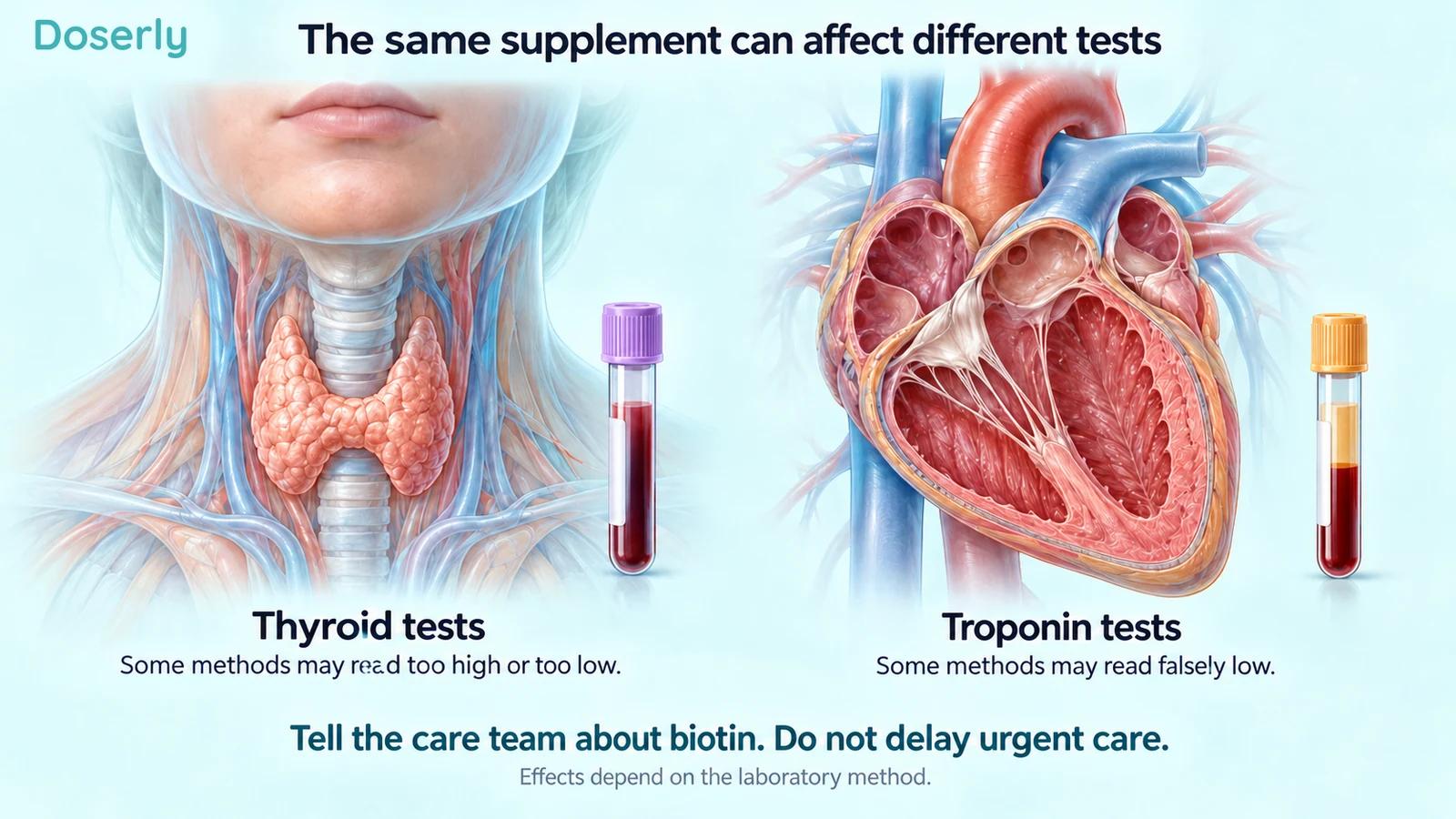
A 2021 prospective study gave 13 adults 10 mg of biotin daily for eight days. Samples were collected at baseline and at two and five hours after ingestion on the first and eighth days. Researchers compared several methods and found interference affecting thyroid-related measurements, including TSH, free T4, total T3 and thyroglobulin on susceptible systems. Ylli and colleagues
TSH is the pituitary signal that helps regulate thyroid hormone production. Free T4 and T3 measurements help clinicians assess the hormone side of that system. If a susceptible method reports TSH too low and thyroid hormone too high, the pattern can resemble an overactive thyroid. Thyroglobulin has a different role, including monitoring selected patients after thyroid cancer treatment; falsely lowering it creates another kind of interpretive problem. The affected pattern depends on the assay, not just on the name of the blood test. Ylli and colleagues
For someone taking thyroid medication, the concern is especially practical. An apparently changed result might lead to a discussion about changing treatment. Tell the prescriber about supplements before interpreting the result or altering medication. A medication dose should not be adjusted by the reader on the assumption that a surprising number must be biotin interference.
A different analyzer can give a different answer
A 2023 investigation examined biotin interference using a Beckman analyzer, combining experiments in supplemented serum with observations in three volunteers who took 10 mg. Biotin-based free T4, free T3 and total T3 assays showed positive interference, while thyroglobulin showed negative interference. The non-biotin-based TSH and total T4 assays studied were not affected. Beckman assay investigation
That finding is a useful correction to an oversimplified rule such as “biotin always lowers TSH.” It may do so on one method while leaving another TSH method unaffected. The same reasoning applies to older research: an analyzer's findings belong to the assay versions and conditions actually studied. They aren't a permanent verdict on every product a manufacturer will make.
FDA's guidance for test manufacturers addresses evaluating biotin interference during device testing. This means assay design and labeling can evolve. A historical paper helps explain the problem, but the testing laboratory is the right place to establish whether today's method is susceptible and what preparation it requires. FDA device-testing guidance
Why troponin interference needs a different response
Troponin testing helps clinicians evaluate injury to heart muscle. FDA has warned that biotin can cause falsely low results with susceptible troponin assays and maintains information about affected tests. A falsely reassuring result can matter when clinicians are evaluating a possible heart attack. This is an issue with particular methods, not a claim that all troponin tests are affected. FDA troponin interference information
If you have symptoms that could require emergency care, do not wait for biotin to clear before seeking help. Tell the emergency team what you take, the dose if known and the last time you took it. They can decide how to investigate symptoms and interpret testing. A routine pre-test pause and an urgent assessment are different situations; instructions meant for a planned blood draw should never become a reason to postpone care.
How long should biotin be paused before a planned test?
There isn't one interval that covers every dose, patient and assay. In a 2020 study, ten healthy adults took 5 mg and 10 mg daily for seven days, and researchers evaluated three testing systems. Interference after 5 mg lasted about eight hours on the susceptible platforms; after 10 mg, it lasted approximately one or two days depending on the system. These are findings under the study's conditions, not a universal preparation schedule. Zhang and colleagues
The AACC guidance discusses a minimum eight-hour wait after 5–10 mg, with longer intervals potentially needed for more sensitive assays. It also notes that impaired kidney function may prolong biotin elimination. This is why the appropriate instruction must come from the ordering clinician or laboratory, especially with prescribed high-dose treatment. AACC guidance
Rather than selecting a number from the internet, ask the laboratory about the actual tests ordered. If it recommends holding a supplement, clarify which product, when the last dose should be and when it can resume. If biotin was prescribed for a medical condition, involve the prescriber before stopping it. Record the instruction with the appointment so a later comparison doesn't rely on memory.
Make the next result easier to interpret
A useful pre-test note can be short: product name, biotin per serving, servings per day, last dose and blood-draw time. A label photograph is helpful when a product contains many ingredients. Include the reason for using it and whether any other supplement changed recently. This gives the care team information they can act on without asking you to remember unfamiliar units during an appointment.
If a result is unexpected, ask whether it fits your symptoms, prior results and medication history. The laboratory may have an alternative measurement method or may recommend a new sample after an appropriate interval. Don't discard the result yourself: real thyroid disease and assay interference are not mutually exclusive, and a repeat needs a plan that addresses the suspected cause.
Keeping a dated supplement record is particularly useful when comparing results from different laboratories. Note where each sample was tested, not only the number it produced. Our biotin guide can help you review why you're taking the supplement; the laboratory and prescriber can connect that history to the tests you actually need.
Sources
- NIH: Biotin, health professional fact sheet: nutritional reference values and the limits of beauty-related evidence.
- Li et al., 2017: six-volunteer comparison of 37 assays.
- Ylli et al., 2021: prospective thyroid-assay study in 13 adults.
- Zhang et al., 2020: dose, platform and washout comparison in ten adults.
- Beckman analyzer investigation, 2023: experimental and volunteer evidence of method-specific effects.
- AACC guidance, 2020: laboratory investigation and preparation considerations.
- FDA: Troponin assays and biotin: diagnostic safety concern.
- FDA: Testing for biotin interference, 2020: recommendations for device manufacturers.